
Cedar Shake vs Asphalt Shingles in Michigan
One is a hand-laid wood roof that turns heads and asks for real upkeep in return. The other is the proven, budget-friendly default on nine out of ten Macomb County homes. Here is the honest ledger, moss, rot, and all.
For nearly every Macomb County home, asphalt at $9,000 to $18,000 is the honest recommendation: proven in our freeze-thaw winters, straightforward to insure, and easy to repair. Cedar shake earns its place only on architecture that calls for it, a long ownership horizon, and an owner willing to treat a wood roof like an ongoing project rather than a one-time purchase.
Cedar shake is the roof people fall for with their eyes first. It has a texture and a patina that asphalt spends real money trying to imitate, and homeowners who want it usually already know they are signing up for something more than a purchase. What most of them do not know going in is exactly how that decision plays out over a Macomb County winter, and what it costs in upkeep, insurance, and attention rather than just a bigger check at closing. Asphalt gets less credit than it deserves in this comparison because it is not romantic. It is proven, it is repairable by any competent local crew, and it is the roof that has already survived thousands of Michigan winters on the houses around yours. This page runs the honest ledger between the two, cedar's real appeal included, without inventing a cedar price we cannot stand behind.
01 /What each roof actually is
Cedar shake is a natural wood roofing product, either hand split for a rougher, more dimensional look or machine sawn for a thinner, more uniform one. Individual shakes are laid in overlapping courses with staggered keyways so water sheds down and off rather than pooling at a seam, and the wood is left to weather to a soft silver gray over its first few years outdoors, or treated to slow that process and resist decay. It is a specialty product installed by crews who know wood roofing specifically, not a line item every roofer stocks.
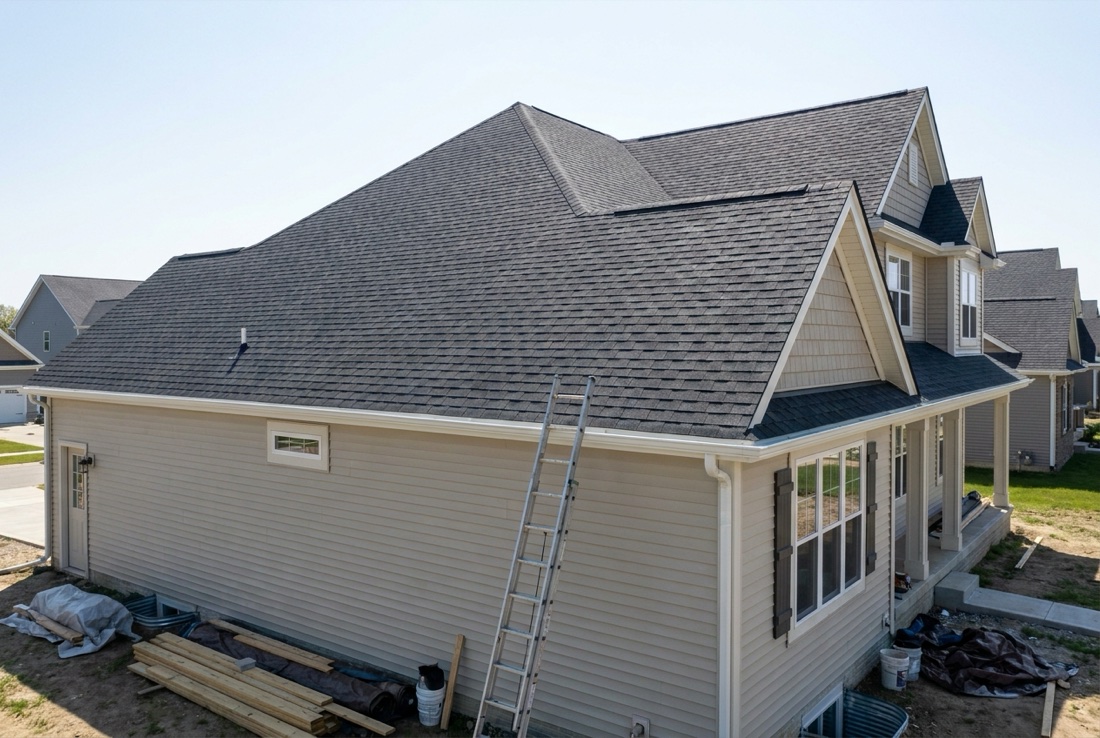
Asphalt shingle, by contrast, is almost always architectural shingle when Macomb County roofers say it: a fiberglass mat saturated in asphalt and surfaced with ceramic granules, laminated into a dimensional profile that replaced the old flat three-tab style because it holds up better to wind and looks heavier on the roof. It installs over underlayment and ice and water shield on a plywood or plank deck, and it is the system on the overwhelming majority of homes from Warren to Romeo, because supply, install crews, and repair parts are all abundant. Worth knowing if the cedar look is the actual draw: several architectural asphalt lines are cut and shadowed specifically to mimic a shake silhouette from the curb, at a fraction of cedar's upkeep and inside the standard $9,000 to $18,000 range. It is not identical up close, but from the street it reads far closer than most homeowners expect.
Neither roof forgives a careless install. Ventilation, flashing, and ice and water shield at the eaves and valleys decide how long any roofing material actually survives a Michigan winter, and that is true whether the surface on top is wood or asphalt. Keep that in mind as you compare quotes for either system; the crew matters as much as the material.
02 /The cost question, honestly
Here are the numbers we can actually stand behind. A typical asphalt shingle replacement in Macomb County runs $9,000 to $18,000, and most homes land between $12,000 and $16,000. That range is our published canon, built from real local installs, and it is the number in every quote we hand a homeower for an asphalt roof. The full breakdown lives on our pricing sheet.
Cedar shake is a different story, and we would rather tell you that plainly than hand you a number invented for a web page. Cedar is not a system in our published canon: it sits above the $9,000 to $18,000 asphalt band and reaches up toward the $20,000 to $36,000 territory we quote for tile and slate, another premium, labor-intensive system. Where it lands inside that range depends on wood grade, hand-split versus machine-sawn stock, the accessory underlayment a wood roof needs, and how cut up your roof is. This Old House's cedar cost guide, showing roughly $7 to $12 per square foot installed nationally, is the kind of citation that belongs here before we publish a firm cedar figure, and until we have it, the honest answer is that a real cedar number comes from an on-site measurement, not a page like this one.
That is what a comparable asphalt roof costs on your house, backed by our published canon. Cedar's real number takes an actual measurement of your roof, its pitch, and its complexity, which is exactly what a free inspection is for.
For context, here is the full range of what roofing systems cost in Macomb County. Cedar is left off this table on purpose, because it is not a system we publish a canon figure for.
| System | Typical Installed Range |
|---|---|
| Asphalt shingle replacement (most homes $12,000 to $16,000) | $9,000 to $18,000 |
| Metal replacement (standing seam, stone-coated steel) | $18,000 to $30,000 |
| Tile and slate replacement | $20,000 to $36,000 |
| Flat and commercial (TPO, EPDM, modified bitumen) | $9,000 to $16,000 |
| Roof repairs (larger or complex repairs can run higher) | $350 to $3,200 |
03 /Cedar's genuine advantages
None of this is a case against cedar. It earns its reputation honestly on the right house. The texture and depth of hand-split shakes read as older and richer than any laminated shingle, which is exactly why cedar shows up so often on Tudors, Cape Cods, and craftsman-style homes where the architecture was designed around that silhouette in the first place. Cedar also ages with a character asphalt cannot replicate, weathering to a silver-gray patina that many owners actively want rather than tolerate.
There is a real functional case too. The gaps and irregular surface between individual shakes let a wood roof breathe in a way a solid shingle mat does not, which can help ventilate the roof deck underneath, and cedar's natural insulating properties are a genuine, if modest, advantage over a purely synthetic surface. None of that changes the upkeep math in the next two sections, but it is a fair account of what cedar is actually buying you before we get to what it costs to keep.
04 /Michigan's liabilities: moss, rot, and freeze-thaw
This is where a Macomb County winter, and not a glossy photo of a cedar roof in a drier climate, changes the comparison. Wood is organic, and organic materials are exactly what moss, algae, and rot are built to exploit. A cedar roof on a shaded, north-facing slope, or under mature trees the way a lot of established Macomb County lots are landscaped, holds moisture longer than an open, sun-exposed roof, and that moisture is what feeds moss growth and, eventually, rot in the wood itself.
Michigan cycles through freezing and thawing dozens of times most winters. Water that gets into cedar's wood grain, through a check, a split, or simple age, expands when it freezes and works the wood apart from the inside over repeated cycles. Asphalt shingles have their own freeze-thaw stresses at the granule and mat level, but they do not absorb water into their structure the way an organic wood shake does.
A well-sited cedar roof on an open, sunny lot with good drainage detailing can go a long time without a moss problem. A shaded cedar roof under a canopy of oaks and maples, common across older Macomb County neighborhoods, is fighting an uphill battle against moisture from the day it goes on. That single sitework variable, shade versus sun, probably matters more to how a cedar roof ages here than any other factor on this page.
05 /Maintenance schedule and fire classification
Cedar is not a set-it-and-forget-it roof. Keeping it healthy typically means periodic cleaning to clear moss and debris from between the shakes, occasional treatment or sealing to slow decay and UV graying, and ongoing attention to nearby tree cover and gutter debris that hold moisture against the wood. Skip that maintenance for long enough and the roof ages faster than its potential lifespan would suggest, which is the trap homeowners fall into when they buy cedar for the look and budget for asphalt's much lighter upkeep.
Fire classification is worth understanding honestly too. Untreated wood shake carries a lower natural fire rating than manufactured asphalt shingle, which is engineered and tested specifically for fire resistance. Cedar can reach a comparable classification with fire-retardant treatment and, on some systems, an added fire-resistant underlayment assembly, but that treatment is an extra cost and step that plain cedar does not include out of the box. Ask any cedar installer directly what rating their specific system carries and how it is achieved before assuming it matches asphalt on this point.
06 /Insurance: why carriers price wood differently
Insurance underwriting looks at a roof's material as a genuine risk factor, not just a cosmetic detail, and cedar's combustibility and maintenance dependency are exactly the kind of thing carriers evaluate. Some insurers price a wood roof more cautiously than an asphalt one, may ask for proof of fire-retardant treatment, or may set different terms around age and upkeep documentation. Michigan-specific carrier guidance (start with DIFS and the Insurance Information Institute) is the citation this page needs before stating specific carrier terms, and the honest guidance in the meantime is to call your own agent and ask directly how a cedar roof changes your policy before you commit to one.
Asphalt does not carry that same friction. It is the material the vast majority of Michigan homeowners insurance policies are underwritten around, which is one more reason it stays the default recommendation for most houses in this county, independent of upfront price.
07 /Asphalt's fair hearing
Asphalt wins this comparison for most Macomb County homes mostly by being unglamorous and reliable. It runs $9,000 to $18,000 installed, most homes landing $12,000 to $16,000, financing is widely available subject to approval, and repairs when they come up run $350 to $3,200, with larger or complex repairs running higher. Any competent local roofer can source materials and match an existing roof, which is not something you can say about every cedar installer in southeast Michigan.
If the actual draw of cedar is the look rather than the wood itself, several architectural asphalt lines are specifically designed with deep shadow lines and irregular tab cuts to echo a shake silhouette from the street. It will not fool someone standing at the eaves, but from curb distance it closes the visual gap considerably, at standard asphalt pricing and standard asphalt upkeep. That is a legitimate middle path worth asking about on any estimate.
08 /When cedar earns its premium, and how to decide
None of this makes cedar the wrong choice everywhere. It is the right choice on a narrower set of houses than the marketing photos suggest, and pretending otherwise would be its own kind of dishonesty.
If most of that ledger fits your house, cedar can be a genuinely rewarding roof. If your lot is shaded, your ownership horizon is short, or the maintenance schedule sounds like a chore rather than a hobby, asphalt at $9,000 to $18,000 is the more honest recommendation, and a cedar-look architectural profile can still deliver most of the curb appeal you actually wanted.
- Asphalt runs $9,000 to $18,000 installed and is proven in Michigan freeze-thaw winters; cedar is not in our published canon and deserves an on-site number, not a web page figure.
- Cedar's real Michigan liability is moisture: shaded, tree-covered lots feed moss and rot far faster than open, sunny ones.
- Cedar needs periodic cleaning and treatment to reach its potential lifespan; skip that schedule and it ages faster than its reputation suggests.
- Insurers can price wood roofs more cautiously than asphalt; ask your own agent before committing to cedar.
- A free inspection gives you an honest number for asphalt on your house and an honest conversation about whether cedar fits it: $0, no obligation.
If cedar's cost and upkeep still make sense for your home, our cedar shake roof cost guide goes deeper on grade, install labor, and the accessory system a wood roof needs. If asphalt is looking like the more honest fit, the roof replacement service page walks through our process, and the cost calculator gives you a size-adjusted number for your own home in under a minute. You can also see how asphalt stacks up against metal on our metal vs asphalt comparison. Or skip the reading: the inspection is free either way, and we will give you a straight answer on both systems before you spend a dollar.
Questions we hear most
Yes. Asphalt runs $9,000 to $18,000 installed, with most homes landing $12,000 to $16,000. Cedar shake is not in our published price canon because it depends heavily on wood grade and install labor, but it sits above the asphalt range and reaches up toward the $20,000 to $36,000 territory we quote for tile and slate. A free inspection gives you a real number for your specific roof.
Yes, more than asphalt. Cedar typically needs periodic cleaning to clear moss and debris, occasional treatment to slow decay and graying, and attention to nearby tree cover that holds moisture against the wood. Shaded, tree-covered lots are more demanding than open, sunny ones. Skipping that schedule tends to shorten a cedar roof's service life well below its potential.
Often, yes. Several architectural asphalt shingle lines are cut and shadowed specifically to mimic a cedar shake silhouette from the street, at standard asphalt pricing of $9,000 to $18,000 and standard asphalt upkeep. It will not match cedar up close, but it closes much of the visual gap at curb distance. Ask about cedar-look profiles on your estimate.