

ON THIS PAGE
Nobody plans to learn how a homeowner insurance claim works. The storm decides for you. If wind or hail has been through Macomb County and your roof took the hit, this page walks through how a typical Michigan homeowner policy treats that damage, what your deductible actually means for your checkbook, why the first insurance check is often smaller than the estimate, and what a clean claim looks like from start to finish. No adjuster-speak, no pressure, just the process on paper.
01 /How Michigan homeowner policies typically treat wind and hail
Most Michigan homeowners carry a policy that covers the house itself on a broad basis, meaning damage to the dwelling is generally covered unless the policy specifically excludes it. Wind and hail are classic covered perils under most standard homeowner forms, which is why a legitimate storm claim usually is not a fight about whether wind damage counts. It is a fight about what the wind actually did, and what was already there before the storm.
That distinction matters more than anything else on this page. Insurance is designed to pay for sudden, accidental damage. It is not designed to pay for wear. A shingle that a windstorm creased last month is typically a covered loss. A shingle that curled over fifteen summers is typically maintenance, and maintenance is your bill, not theirs. Most denied or disputed roof claims in our experience live in that gray zone, where age and storm damage sit on the same roof and someone has to say which is which.
Policies also commonly carve out exclusions worth knowing about before you file. Wear and tear, neglect, and faulty installation are almost universally excluded. Some policies add cosmetic damage exclusions, most often for metal roofing, meaning a dent that does not affect function may not be covered. And nearly every policy imposes a duty to mitigate: once you know about damage, you are expected to take reasonable steps, like emergency tarping, to keep it from getting worse. Damage that spreads because nothing was done can be treated very differently than the original storm damage.
None of this should scare you off a legitimate claim. Macomb County has real storm history, including the severe storms, tornadoes, and flooding of August 24 to 26, 2023 that put the county inside federal disaster declaration DR-4757 alongside eight other Michigan counties. The point is simpler: know what your policy is built to pay for, and document early so the storm's work is on record before time blurs it.
02 /Your deductible is the number that matters most
Before anyone climbs a ladder, find your deductible. It is on your declarations page, and it is the single number that decides whether filing a claim even makes sense. The deductible is your share of a covered loss. If the covered repair costs less than your deductible, a claim gains you nothing and still goes on your claim history.
Deductibles come in two broad flavors. A flat deductible is a fixed dollar amount you chose when you bought the policy. A percentage deductible, which some carriers apply specifically to wind and hail, is calculated as a percentage of your dwelling coverage limit, so it can be a much larger number than homeowners expect. If your policy has a separate wind or hail deductible, that is the one that applies to a storm claim, not the general one.
For repairs outside a claim, our published range is $350 to $3,200, and larger or complex repairs can run higher. See the pricing ledger or run the cost calculator before you decide whether to file.
One warning that belongs in bold: be careful with any contractor who offers to waive, absorb, or "take care of" your deductible. However it is dressed up, hiding who paid the deductible from your carrier can cross into insurance fraud, and the homeowner is the one whose name is on the claim. An honest roofer prices the work, documents the damage, and lets the policy do what it does. If the math does not favor a claim, we would rather tell you that at the free inspection than after the paperwork.
03 /Actual cash value vs replacement cost, in plain English
The second thing to find on your declarations page is how your policy values a loss, because it explains the most confusing moment in most claims: the first check being smaller than the estimate.
A replacement cost policy is designed to pay what it costs to replace the damaged roof with a comparable new one. An actual cash value policy pays replacement cost minus depreciation, meaning the older and more worn your roof was, the less the policy pays, period. Some carriers also apply roofing-specific payment schedules that settle roofs on an actual cash value basis after a certain age even inside an otherwise replacement cost policy, so it is worth asking your agent which rules apply to your roof specifically.
Even with full replacement cost coverage, carriers typically pay in two stages. The first check reflects the depreciated value of the roof. The rest, often called recoverable depreciation, is usually released after the work is complete and the carrier receives the final invoice. That holdback is normal, and it is why the timing of a claim matters as much as the amount.
| QUESTION | ACTUAL CASH VALUE | REPLACEMENT COST |
|---|---|---|
| What the payout targets | Value of the old roof, age and wear subtracted | Cost of a comparable new roof |
| Depreciation | Kept by the carrier | Often recoverable once work is complete |
| First check | Usually the whole settlement, minus deductible | Usually a partial payment, minus deductible |
| After the final invoice | Typically nothing further | Recoverable depreciation may be released |
One more wrinkle: if you have a mortgage, your lender is often named on the claim check and may need to endorse it, sometimes through its own inspection process. It is routine, but it adds days. Plan for it rather than being surprised by it.
04 /The first 48 hours after a storm
What you do in the first two days sets up everything that follows. The order matters.
Stay off the roof. Storm-loosened shingles, wet decking, and hidden soft spots hurt people every year. Photograph what you can see from the ground and from windows: shingles in the yard, dented gutters, hanging flashing, ceiling stains. Wide shots first, then close-ups.
Stop active water. If water is coming in, tarping comes before everything, including the claim. Our emergency tarping runs 24/7, and reasonable steps you take to protect the home from further damage are typically expected by your policy. Keep receipts for anything you spend; mitigation costs are often part of the claim.
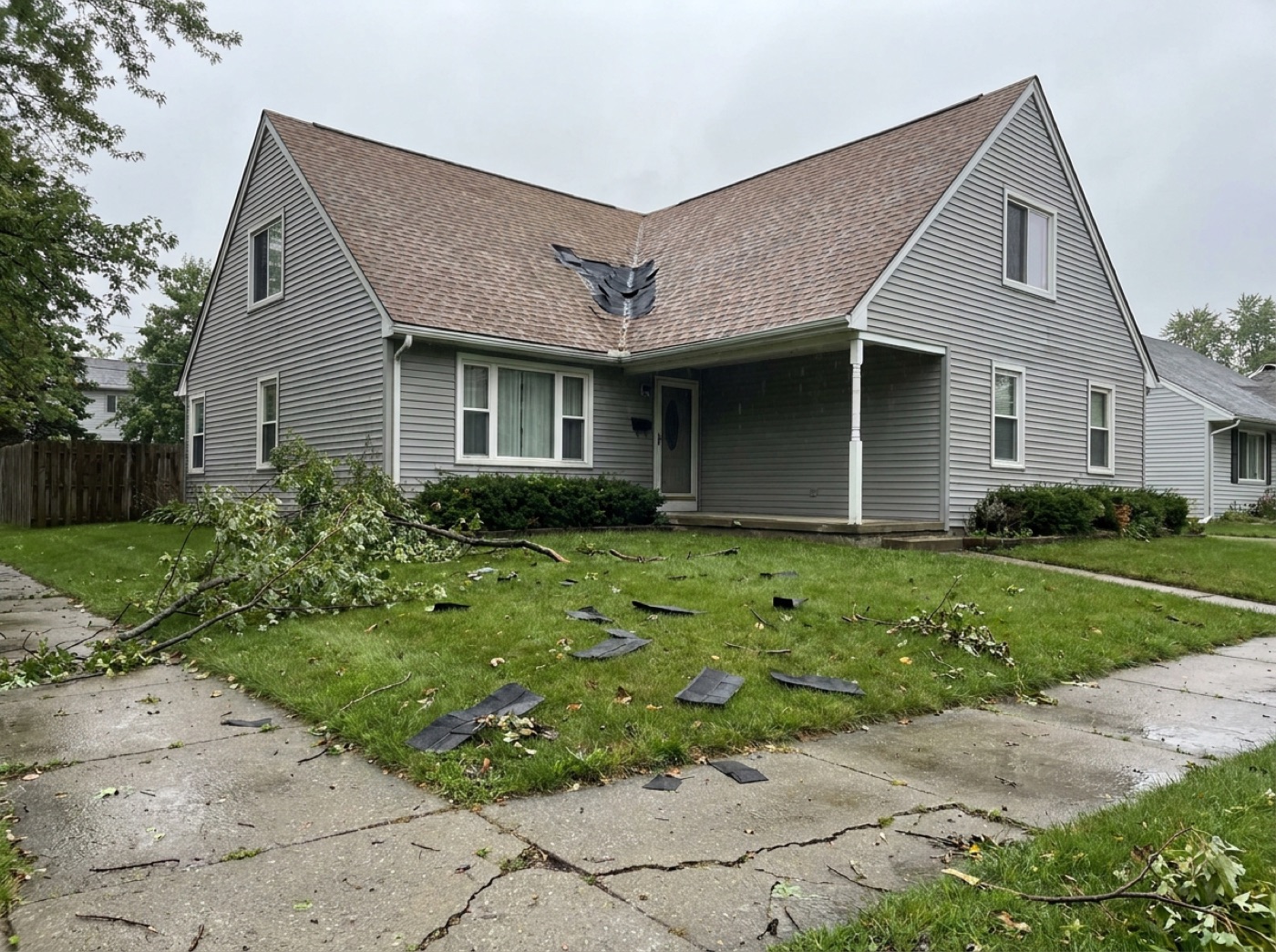
Get it documented before you file. A free professional inspection before you call your carrier tells you what you actually have: real storm damage worth a claim, a small repair that costs less than your deductible, or nothing at all. Filing blind can put a claim on your history for damage that was never going to clear the deductible.
Slow down at the door. After big storms, out-of-town crews canvass Macomb County neighborhoods hard. Some are legitimate. Some are not. Before signing anything, ask for a Michigan license and proof of insurance, and be especially careful with documents that assign your insurance benefits or claim rights to the contractor. Read anything with a signature line twice.
05 /The claim timeline, step by step
The four steps on the plate above are the short version. Here is what each one looks like in practice.
Document. We inspect the whole system, not just the obvious slope: shingles, ridge caps, flashing, vents, gutters, siding, and the attic side of the deck where wind-driven water shows first. Everything gets photographed and dated, and the file is yours whether or not you ever file a claim or hire us.
File. The claim itself is yours to open, by phone or through your carrier's app, and prompt notice matters because most policies require it. You will get a claim number and an adjuster assignment. From there the carrier schedules its own inspection.
Meet your adjuster. This is the step where having your roofer present earns its keep. We can be on site when the adjuster inspects, walk the roof with them, and point to every crease, bruise, and dented vent in our photo file so the scope reflects what is actually up there. The adjuster makes the coverage call, not us, and we never pretend otherwise. Our job is making sure nothing gets missed.
Restore. Once the carrier issues its scope and settlement letter, read it before any work starts. It lists what is covered, what the carrier valued it at, your deductible, and any depreciation holdback. We build to that scope, flag anything the scope missed through a documented supplement request, complete the work to code, and send the final invoice so any recoverable depreciation can be released.
The best claim is a boring claim: documented early, filed promptly, inspected together, and built to code with the paperwork to prove it.
06 /Where claims get complicated
Most claims are straightforward. The ones that are not usually run into one of a handful of known snags, and knowing them in advance takes most of the sting out.
Partial approvals. A carrier may approve one slope and decline the rest, or approve repair when the roofer believes replacement is warranted. Repairing part of an aging roof can be a legitimate call or a poor one depending on the roof, which is why the photo file matters. Documented damage is much harder to leave out of a scope than remembered damage.
Matching. If your shingle color or profile has been discontinued, new shingles on one slope may not match the rest of the house. Whether a carrier must pay to replace undamaged sections for the sake of a uniform appearance depends heavily on your policy language, and practices vary between carriers. If matching matters to you, raise it early and get the carrier's position in writing.
Code upgrades. Michigan code requires items like ice and water barrier along eaves that older roofs may not have. Whether the upgrade cost is covered typically depends on whether your policy includes ordinance or law coverage. It is a checkbox worth finding on your declarations page before the scope is written.
Supplements and reinspections. Hidden damage found mid-job, like rotten decking under storm-torn shingles, gets handled through a supplement to the claim with photos and documentation. And if you believe the first inspection missed real damage, you can request a reinspection, submit further documentation, or invoke the appraisal process if your policy provides one. Michigan homeowners can also contact the state's Department of Insurance and Financial Services with complaints about claim handling. None of those paths guarantees a different answer, but a denial is a decision, not a law of nature.
07 /Where we fit in, and where we stay out
We are roofers, not adjusters, agents, or lawyers, and the line matters. What we do: inspect free, document thoroughly, meet your adjuster on site, price the work honestly against our published ledger, build to code, and handle the completion paperwork that releases recoverable depreciation. What we never do: promise a claim will be approved, inflate a scope, or tell you to file when a $350 to $3,200 repair is the smarter play. No one who is being honest with you can promise what your carrier will decide.
If the damage is real, we help you put it on the record properly. If it is not, you get a free inspection, a photo file, and a straight answer, and that is worth something too. Storm damage sits alongside our storm damage repair service and the rest of the work on the replacement side of the house.
- Inspections and claim documentation are free, with no obligation.
- We can be on site when your adjuster inspects, so nothing gets missed.
- For covered damage, out of pocket may be just your deductible.
- We never promise claim approval. Nobody honest can.
- Emergency tarping runs 24/7 while the paperwork moves.