
Insurance Claim or Out of Pocket: Which Actually Pays Off?
Filing is not always the smart move, and paying cash is not always the safe one. Here is the honest math on when your insurance company should get the call, and when your own checkbook should.
Small, isolated damage rarely clears a wind or hail deductible, so paying $350 to $3,200 out of pocket usually keeps more money in your pocket than opening a claim. Widespread storm damage that pushes a roof toward full replacement at $9,000 to $18,000, the scale Macomb County saw after the August 2023 wind event behind FEMA disaster declaration DR-4757, usually justifies filing, since the payout can clear even a large deductible several times over.
A hailstorm cracks a dozen shingles. A wind gust peels back a corner of the roof. The damage is real, and so is the decision that follows it: call your insurance company, or call a roofer and pay for the fix yourself. Both paths can end with a dry roof, but they do not cost the same, and they do not carry the same risk. This page is not a guide to the mechanics of filing, that lives in our storm and insurance section. It is the decision that comes before all of that: should you file at all?
01 /What actually decides this
Every version of this question collapses to three variables: how much the fix actually costs, how much of that cost your policy covers once the deductible is subtracted, and what filing might cost you later in premium or claim history. Get honest numbers for those three variables, the same way we do on every roofing project in Macomb County, and the decision usually makes itself.
The variable homeowners underestimate most is the deductible itself. Many Michigan homeowners policies apply a separate wind and hail deductible, calculated as a percentage of your dwelling coverage rather than a flat dollar figure (see Michigan DIFS consumer insurance guidance), and that number can run well past the $500 or $1,000 all-perils deductible most people remember from their summary page. Before you decide anything, pull your declarations page and find the actual wind and hail deductible in dollars, not a guess.
That single number changes everything downstream. A flat $500 deductible barely factors into a decision on a $9,000 to $18,000 replacement. A percentage deductible on a well insured home can run into the thousands, and at that size it starts to matter on repairs too, not just replacements. Treat the declarations page as step one, before you call anyone.
02 /The real numbers: repairs, replacement, and your deductible
Here is the cost side of the ledger, the same ranges we use on every estimate in Macomb County. Roof repairs run $350 to $3,200, with larger or more complex repairs running higher. A full asphalt shingle replacement runs $9,000 to $18,000, and most homes land between $12,000 and $16,000. Metal, tile, and flat systems carry their own higher ranges, but asphalt is what most local homes are working with when this question comes up.
| Scenario | Typical Cost |
|---|---|
| Minor repair, one or two spots | $350 to $3,200 |
| Larger or more complex repair | Toward the top of that range |
| Full asphalt shingle replacement | $9,000 to $18,000 |
| Where most local homes land | $12,000 to $16,000 |
Run the arithmetic on a representative example, illustration only, not a promise about any specific policy. A home insured for $300,000 carrying a hypothetical 2 percent wind and hail provision has roughly a $6,000 deductible in dollars. A repair scoped at $2,200 does not clear that deductible at all, so you would owe the full $2,200 yourself whether you file or not, and filing would gain you nothing except an entry on your claim history. A replacement scoped at $14,000 clears that same $6,000 deductible with room to spare, which is the kind of gap that usually makes filing worth it.
Set your deductible next to those numbers before you decide. A small repair at the low end of $350 to $3,200 often sits close to or under a percentage-based wind and hail deductible on an average Macomb County home. A full replacement at $9,000 to $18,000 is a different story: even a large deductible is usually a small fraction of that total.
03 /What filing costs beyond the deductible
The deductible is not the only cost of filing. Insurers track claim history, and a documented pattern of claims, even small ones, may influence your premium or your standing with that carrier at renewal. Michigan does not let carriers cancel most homeowners policies over a single legitimate weather claim, but repeated claims filed close together are a different conversation with your specific insurer, and how much any one claim costs you long term varies by company and by your overall history.
A claim that pays out only slightly more than your deductible can still sit on your claim history for years. If the numbers are close, ask whether a small net payout is worth that entry on the record. A free inspection gives you a written repair number before you decide either way.
04 /Sudden damage vs gradual wear: the line insurers draw
Homeowners policies are built around sudden and accidental loss. A windstorm that peels shingles off on a specific date, a hailstorm that dents a roof in one afternoon, these are exactly the events insurance is designed to answer. Gradual deterioration is treated differently on most policies, sometimes as an outright exclusion, because it is a maintenance issue that developed over years rather than a single loss event.
The trouble is that the two can look similar from the ground. Granule loss that started as normal aging can accelerate after a hailstorm, and an adjuster inspecting the roof has to separate what the storm did from what was already there. This is exactly why documentation before the storm, or as close to the event as possible, matters so much: dated photos and a written condition assessment make the difference between a clean sudden-loss claim and a denied one built on ambiguity.
05 /When paying out of pocket is the smarter move
Out of pocket usually wins when the damage is small, localized, and clearly near or under your deductible. A handful of wind lifted shingles, a cracked pipe boot, a section of flashing, these are exactly the repairs our roof repair crews price toward the lower half of the $350 to $3,200 range, and paying for them directly keeps your claim history clean for the year a bigger storm actually needs it.
It also tends to be the right call when the cause is ordinary wear rather than a sudden event. A roof shedding granules at year twenty two or a soffit rotted from years of poor attic ventilation is a maintenance problem, not an insurance one, and most policies are written that way on purpose. Filing on a claim like that risks a denial on the record without ever getting a payout to show for it.
06 /When filing the claim is the smarter move
Filing tends to win when the damage is widespread, tied to a specific storm date, and large enough that the deductible becomes a small slice of the total rather than most of it. That describes what a lot of Macomb County homeowners faced after the severe wind event of August 2023, which triggered federal disaster declaration DR-4757 across the county. We still find that scale of damage walking roofs in Sterling Heights and Macomb Township years later. Damage across multiple slopes, torn ridge caps, and decking exposed in more than one spot is squarely full replacement territory at $9,000 to $18,000, and a payout at that scale is usually worth the entry on your claim history.
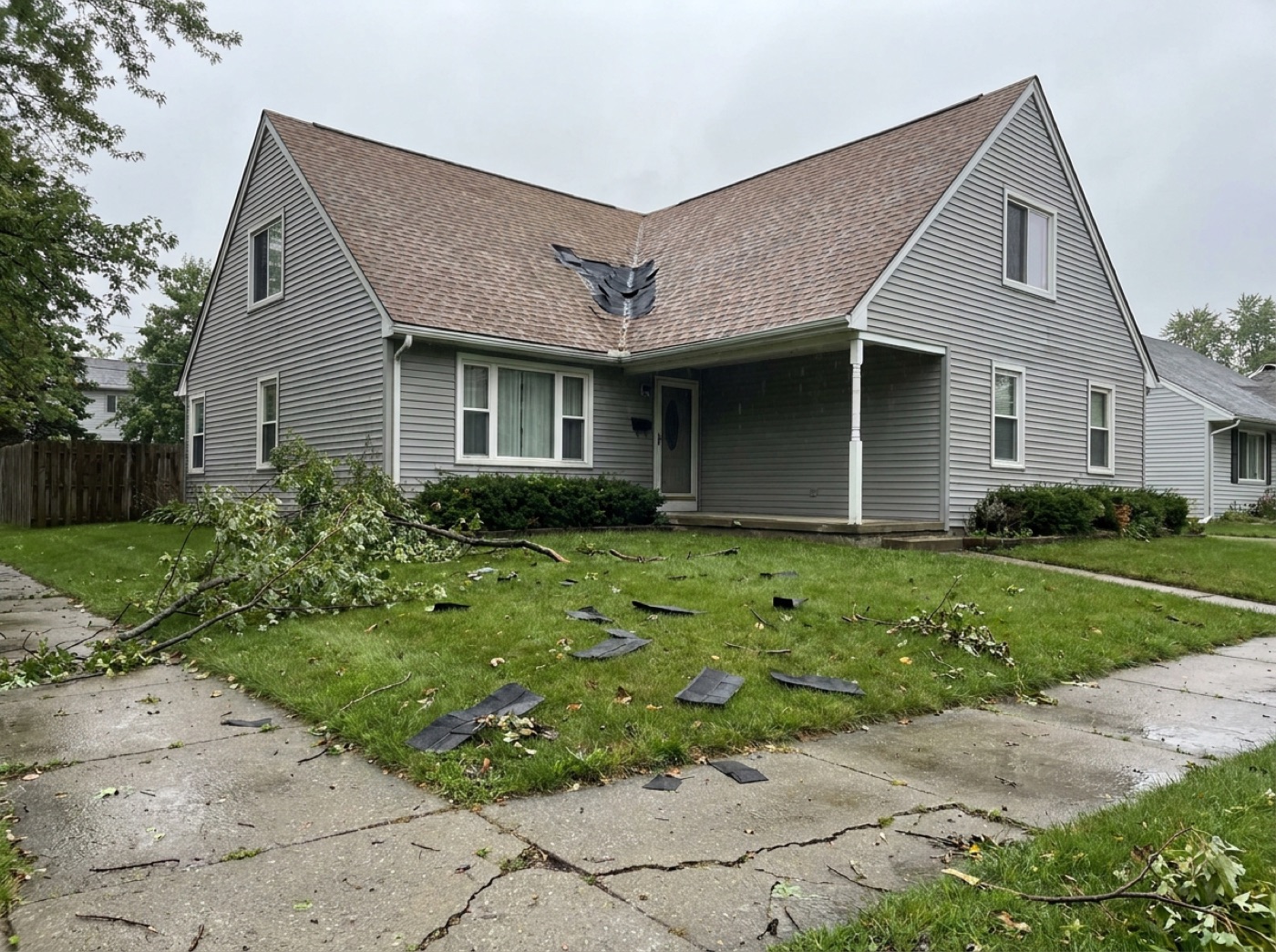
The other marker is documentation quality. If you can point to a specific date, a specific storm, and photograph the damage before anyone touches the roof, you have the strongest possible claim file. We document damage on every free inspection and can meet your adjuster on site to walk the same evidence together, which tends to move a legitimate claim along faster than photos alone.
07 /The holdback that catches smaller claims
Most homeowners policies pay actual cash value first and the remaining replacement cost later, or they pay full replacement cost only after the work is done and invoiced. On a large replacement claim that gap is annoying but manageable, since the numbers are big enough to plan around. On a smaller claim, the depreciation holdback on an older roof can eat a meaningful share of the payout, sometimes enough that the net check barely clears what a straightforward out of pocket repair would have cost.
Picture a $2,200 repair claim on a roof already fifteen years into its service life. Depreciation on an older roof can hold back a real share of that number until the work is finished and invoiced, and on a claim that size the holdback can leave you carrying most of the cost anyway while a claim still sits on file. Ask your agent, in writing if you can, what your policy actually pays on a roof of your roof's age before you decide. The answer changes this comparison more than almost anything else on this page.
08 /A documentation checklist that helps either way
Whichever way you lean, the same handful of steps protect you. None of them commit you to filing, and all of them make either path easier if you change your mind later.
- Photograph the roof from the ground and, if it is safe, from a ladder, dated and from multiple angles.
- Note the date and type of the event: a specific windstorm, a hailstorm, or gradual wear you first noticed.
- Get a written, itemized repair or replacement number from a free inspection before you call your insurer.
- Keep any prior roof inspection or maintenance records that show the roof's condition before the event.
- Ask your agent for your wind and hail deductible in dollars, in writing, before you decide.
09 /How a free inspection helps either way
You do not have to guess at any of this. A free inspection gives you a written repair number and a written replacement number for your actual roof, not a national average, before you decide whether to call your insurer at all. If the number lands near your deductible, you have your answer. If it lands well above it, you have a documented file ready for your adjuster.
There is no cost or obligation either way, and booking an inspection does not commit you to filing a claim, paying out of pocket, or doing anything at all with the number once you have it.
10 /How to decide
Strip the decision down to three questions. What does a written, itemized repair number actually say, not a guess? What is your specific wind and hail deductible, in dollars? And can you tie the damage to a documented storm date, or is it gradual wear? Answer those three honestly and the right path is usually obvious.
- Small, isolated damage near your deductible: pay out of pocket at $350 to $3,200 and keep your claim history clean.
- Widespread storm damage toward full replacement at $9,000 to $18,000: filing usually clears far more than your deductible.
- Gradual wear is a maintenance repair on most policies, not a claim.
- A free inspection gives you both numbers before you decide anything.
If you want the mechanics of actually filing, from documenting damage to meeting your adjuster, our storm and insurance hub walks through the process. If you are weighing materials as part of a larger reroof decision, the metal vs asphalt comparison and our cost calculator price out both systems for your specific roof. Either way, the inspection that gets you real numbers is free: book yours or call us directly.
Questions we hear most
It depends on the size of the damage and your specific deductible. Small, isolated damage near or under your wind and hail deductible often costs about the same whether you file or not, so paying $350 to $3,200 out of pocket can keep your claim history clean. Widespread storm damage that pushes toward a $9,000 to $18,000 replacement usually clears the deductible several times over and is generally worth filing. A free inspection gives you the actual repair number before you decide.
It can. Insurers track claim history, and a pattern of claims, even small ones, may influence your premium or standing with that carrier at renewal. How much any single claim affects your policy varies by insurer and your overall history, so a quick call to your agent before filing is worth it on a borderline claim.
DR-4757 is the federal disaster declaration covering Macomb County after the severe wind event of August 2023. Damage tied to a documented, dated storm like that one is exactly the kind of sudden, accidental loss that insurance is built to cover, which is why widespread wind damage from that event was a strong filing case for many local homeowners.
Yes. Most policies expect prompt notice of a loss, and a long delay can complicate a claim even when the underlying damage is legitimate. If you are undecided, document the damage immediately with photos and a written repair estimate, then decide. That keeps both options open without committing you to file the moment the storm passes.