
JUMP TO A SECTION
When water is coming through the ceiling at night, the phone becomes a fire hose of options. You type 24 hour emergency roof repair near me, and a map fills with pins and a page fills with numbers, all of them promising to be there fast and fix it now. The problem is that the search engine cannot tell you which of those numbers belongs to a licensed local roofer and which belongs to a lead broker or an out-of-town crew that will be three counties away by the weekend. That sorting is on you, at the worst possible hour to be doing it. This guide is built to make that sorting fast. It explains what a 24 hour promise can honestly deliver overnight, the short list of things to verify before you let anyone onto your roof or your paperwork, and the handful of red flags that should end the call. We write it the same plain way we write every figure on our honest pricing sheet: no fear, no upsell, just the plan for getting through the night without getting taken.
A real 24 hour roofer stops the water tonight with an emergency tarp, then scopes and prices the permanent repair in daylight. If someone offers to do a full repair in the dark for a cash price paid on the spot, that is the tell, not the deal.
01 / THE SHORT ANSWERWhat a 24 hour roofer can actually do at night
Here is the honest short answer, so you can act on it before you read the rest. At night, in the rain, on a compromised roof, the correct and only real job is stabilization: a professionally anchored emergency tarp that closes the opening to the weather and stops the water from spreading into your insulation, drywall, and framing. The permanent repair, the part where shingles, flashing, and any damaged decking are actually replaced, happens in daylight when a crew can see the roof, work it safely, and give you a written price. Any roofer who tells you they can do the whole repair tonight is either going to do it badly or is not planning to do it at all.
That is not a limitation of one company. It is the physics of the trade. You cannot safely stand on a wet, steep, possibly punctured roof during lightning or high wind, you cannot color-match and seat shingles that need dry conditions to bond, and you cannot assess decking you cannot see in the dark. So when a listing says 24 hour, the reasonable thing it can mean is that someone answers, triages, and stabilizes around the clock, then repairs on a real schedule. Understanding that up front is your best defense, because it immediately separates the roofers describing reality from the ones describing whatever they think you want to hear at midnight.
Everything below unpacks those rows. If you are mid-emergency as you read this, the fastest move is a phone call to a number you can verify belongs to a local roofer; if you are reading ahead of trouble so you are ready, the sections that follow give you the whole checklist to keep by the door.
02 / THE PROMISEWhat 24 hour service honestly means
The phrase 24 hour gets stamped on roofing ads so freely that it has almost stopped meaning anything, so it is worth being precise about what an honest version of it looks like. Around-the-clock in this trade should describe two things: a real human who answers or calls back at night, and a crew who can deploy an emergency tarp when a roof is genuinely open to the weather. It should not be read as a promise that shingles get installed at 2 a.m. Those are different jobs on different clocks, and the honest operator keeps them separate.
That distinction is exactly how our own service is structured, and we say so plainly because it is the truthful version of the promise. Our phones for scheduling, free inspections, and written estimates are staffed Monday through Saturday, 7 to 7. The one thing we run around the clock is 24/7 emergency tarping, because a roof that is actively open cannot wait for morning without the water winning. If your roof is exposed and water is coming in right now, that is what the after-hours line is for. If the roof is stable and the problem is a stain or a slow drip, that is a same-week inspection, not a midnight truck roll, and a straight roofer will tell you so rather than bill you for panic. Our what to expect when you call an emergency roofer walks that first phone call step by step, and the tarp itself is explained in full in emergency roof tarping explained.
So when you read a 24/7 claim on a listing, translate it in your head into the honest version and then ask the roofer to confirm it out loud: can you stabilize my roof tonight, and will the permanent repair be scoped and priced in daylight? A roofer who answers that cleanly is describing the real trade. A roofer who insists the whole thing can be finished tonight is describing a sales pitch, and the gap between those two answers is most of what you need to know before you decide who to trust.
03 / THE CHECKLISTHow to vet a roofer at 11 p.m.
You do not have time at midnight for a full contractor background check, but you do have time for four quick verifications, and any legitimate emergency roofer will pass all four without hesitation. If someone balks at a single one of these while your ceiling drips, that is your answer.
1. A license you can actually check
In Michigan, residential roofing on a home of this kind is builder-licensed work, and the state's Department of Licensing and Regulatory Affairs (LARA) keeps a public license lookup you can search by name or license number. Ask for the exact name the license is held under and the number, then confirm it yourself. This takes two minutes on a phone. A roofer who gives you a number that checks out has already separated themselves from most of the storm-chasing pack, and one who cannot produce a name and number that match a real license has told you everything you need to know.
2. Proof of insurance, not a promise of it
You want a roofer who carries both liability insurance and workers' compensation, because if an uninsured worker is hurt on your roof or your home is damaged during the work, an unprotected homeowner can end up exposed. Ask for a certificate of insurance and the carrier's name. A legitimate contractor can send or show one quickly; the certificate names the insurer and the coverage dates, and you can call the carrier to confirm it is current. Insurance you are merely assured exists is not insurance you can count on.
3. A local address you can drive to
This is the single fastest filter after a storm. Ask where the business is physically located, and be wary of an answer that is only a cell phone and a magnetic door sign. A roofer with a real local address is one you can find again in six months when a warranty question comes up, and one who is accountable to the same community your house sits in. Out-of-area operators who follow storms rarely have that anchor, which is exactly why the door-to-door roofers after a storm playbook treats a verifiable local address as non-negotiable.
4. A straight answer about tonight
The last check is the one from the previous section, asked directly: what can you actually do tonight, and what waits for daylight? The honest answer is stabilize now, repair later, in writing. That answer is not a downsell; it is the sound of someone who has done this before and is not going to pretend the weather and the darkness are not real. A roofer who promises a complete overnight repair is failing this check even if they pass the first three.
04 / TONIGHTWhat is actually possible before sunrise
Once you have a roofer who checks out, it helps to know what a good overnight response actually looks like, so you can tell competent work from a mess. The goal at night is narrow and important: get a waterproof cover over the opening, protect the inside of the house, and set up the daylight repair. Here is the honest sequence.
- A triage call. Before anyone drives out, a good dispatcher asks whether water is actively coming in, whether it is reaching a ceiling or any wiring, how the roof can be accessed, and whether it is safe to be on. That is not stalling; it is deciding whether you need a truck tonight or an inspection this week. The full script is in what to expect when you call an emergency roofer.
- Interior protection. Whether or not the roof can be worked immediately, the first move inside is to contain the water: move belongings, catch the drip, and relieve a bulging ceiling if it is safe to do so. This limits the damage while the roof waits for a safe weather window.
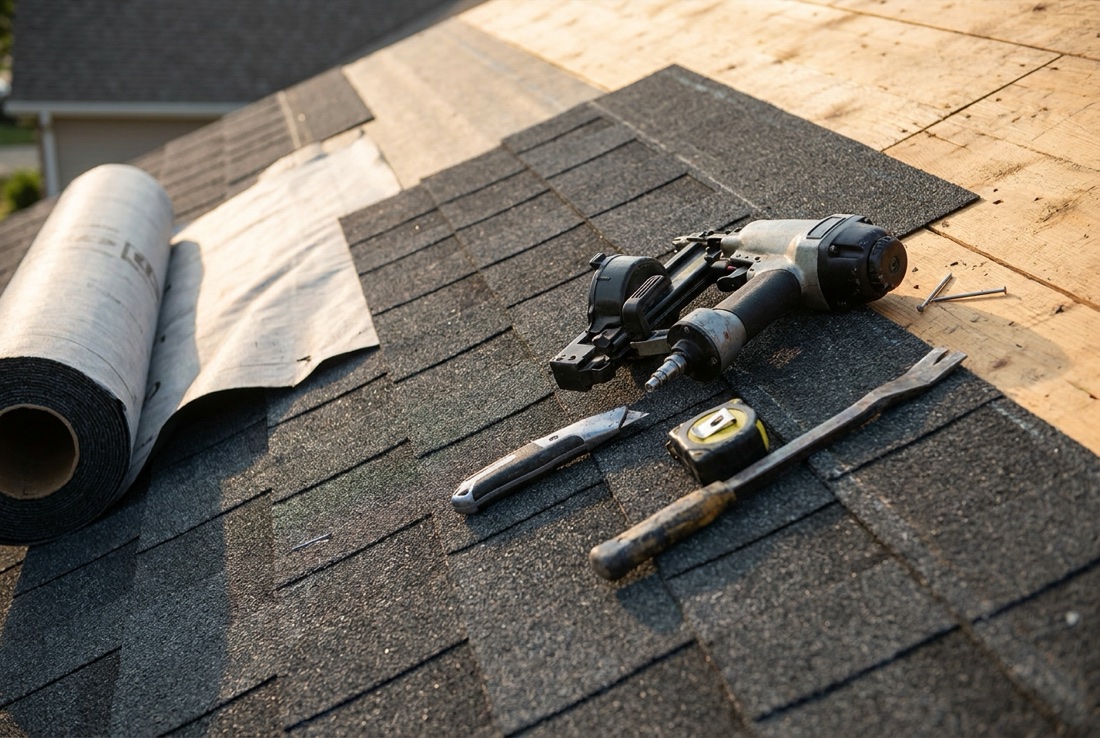
- The tarp, when conditions allow. When it is safe to be on the roof, the crew installs a professional tarp that overlaps the ridge and is anchored to battens rather than nailed through good shingles, so it survives a windy night without adding holes to a roof you are about to repair. During active lightning or high wind, the responsible move is to stage everything and deploy in the first safe break, not to send someone up into the storm.
- A plan for daylight. Before the crew leaves, you should know what happens next: a daylight inspection, a written scope, and a repair date. The tarp is the bridge to that plan, not the end of it.
What you should not expect overnight is a finished roof or a firm repair price pulled out of the dark. The true extent of the damage, whether it is a patch of shingles or decking that has to come off in sheets, only becomes clear in daylight from the top of the roof and the attic side. That is why the permanent number comes after the inspection, and why the tarp buys the time to get that number right. Repairs in Macomb County run $350 to $3,200, with larger or complex work higher, and you can get a ballpark on the permanent fix in about a minute with the cost calculator or start a written quote from the repair estimator once the sun is up.
05 / THE TELLSRed flags that should end the call
The uncomfortable truth about late-night roofing searches, especially in the days after a widespread storm, is that trouble advertises just as loudly as help. The operators you want to avoid are not always obvious, but they tend to share a handful of tells. Any one of these should slow you down; two of them together should end the call.
- Cash tonight, paid on the spot. A demand for a large cash payment before any work is documented, or a price that is only good if you decide right now, is the oldest tell there is. Legitimate emergency work is stabilized first and priced in writing after; it does not hinge on a wad of cash changing hands in the dark.
- No paperwork, no contract. If a roofer will not put the scope and the price in writing, there is nothing to hold them to and nothing protecting you. A written estimate before the permanent work is not bureaucracy; it is the whole basis of the deal.
- Unverifiable names and numbers. A license number that does not match the name, a business you cannot find at any local address, or a caller who dodges the question of who and where they are should be disqualifying. You are letting this person onto your roof and possibly into an insurance claim; anonymity is not acceptable.
- Pressure to sign over the insurance claim. Be very careful with anyone who wants you to sign a document handing them control of your claim before an adjuster has seen the roof, especially on a first-night visit. What we can and cannot honestly promise about the claim process is laid out on our storm and insurance claims page, and the wider pattern is detailed in door-to-door roofers after a storm.
- A full repair promised in the dark. Circle back to the physics one more time. Nobody seats and seals a permanent roof repair correctly at night in the rain. A promise to do so is not ambition; it is a sign the work will be a patch job or a no-show.
An honest emergency roofer stops your water tonight and earns the repair in daylight. If the whole deal has to close in the dark for cash, the emergency being solved is theirs, not yours.
None of this is about assuming the worst of everyone who knocks. It is about running four quick verifications and watching for a short list of tells, so that the roofer you hand your roof to at midnight is one you would still be glad to have chosen at noon. Southeast Michigan has real reason for the caution: after the severe storms of August 2023, Macomb County was included in federal disaster declaration DR-4757, the kind of widespread event that opens roofs across whole neighborhoods and draws out-of-town crews to local doors overnight. When demand spikes like that, the checklist is worth more, not less.
06 / OUR SERVICEHow our emergency service actually works
Because this whole guide is a checklist for vetting a roofer, it is only fair to hold our own service to it in plain terms. We are a local Macomb County roofer, licensed and insured, and we run the honest version of the 24 hour promise rather than the marketing one. That means around-the-clock 24/7 emergency tarping to stop the water when a roof is open to the weather, and phones staffed Monday through Saturday, 7 to 7 for scheduling, free inspections, and written estimates. When you call, you get triage first, stabilization when it is genuinely needed, and a daylight plan for the permanent repair, priced in writing before anyone starts.
The permanent work is where the real numbers live, and we keep them the same on the worst night as on a calm afternoon. Repairs run $350 to $3,200 in Macomb County, larger or complex work higher, with a full replacement priced by its own free inspection. Emergency circumstances do not change our price canon; they only change the order of operations, stabilize now, repair right, in daylight. The full emergency arc, from the first tarp through the scheduled fix, is covered on our emergency roof repair page, and when a leak turns out to be a routine fix rather than a storm event, our roof repair service covers that path. You can browse the rest of the emergency library any time in our roofing services hub.
The point of all of it is simple. A night with water coming in is stressful enough without wondering whether the person on your roof is the real thing. Run the four checks, watch for the tells, and let the honest sequence, stabilize tonight and repair in daylight, be the standard you hold every 24 hour roofer to, ours included.
- At night the only real job is stabilization: a professional emergency tarp that stops the water. The permanent repair happens in daylight, in writing.
- Honest around-the-clock service means 24/7 emergency tarping plus a human who answers, not shingles installed at 2 a.m.
- Before you hire at midnight, verify four things: a license you can check with LARA, proof of insurance, a local address, and a straight answer about tonight.
- Red flags that should end the call: cash-tonight pricing, no written contract, unverifiable names, pressure to sign over a claim, and a full repair promised in the dark.
- Permanent repairs run $350 to $3,200, larger or complex work higher, and our one around-the-clock line is 24/7 emergency tarping with phones Mon to Sat, 7 to 7.
Questions we hear most
Not the permanent repair, no. At night, in the rain, on a compromised roof, the correct job is stabilization: a professionally anchored emergency tarp that stops the water until daylight. The actual repair, replacing shingles, flashing, and any damaged decking, needs dry conditions, daylight, and a safe roof, so it is scoped and priced after an inspection. Anyone promising a complete overnight repair is describing a patch job or a sales pitch, not real roofing.
Run four quick checks before you hire, even at midnight. Ask for a license you can verify through Michigan's LARA lookup, proof of both liability and workers' compensation insurance, a local address you can drive to, and a straight answer about what is possible tonight versus in daylight. A legitimate local roofer passes all four without hesitation. If someone balks at even one while your ceiling drips, that is your answer.
The overnight stabilization is a tarp, priced by the area covered, the pitch and access, and the conditions, so it is quoted per situation rather than as one flat number. The permanent repair that follows runs $350 to $3,200 in Macomb County, with larger or complex work higher and a full replacement priced by its own free inspection. Our price canon does not change because it is an emergency; only the order of operations does, stabilize first, repair right in daylight.
- FEMA, disaster declaration DR-4757-MI, Michigan severe storms of August 2023 (Macomb County designated). fema.gov/disaster/4757
- Michigan Department of Licensing and Regulatory Affairs (LARA), residential builder licensing and the public Verify a License lookup. michigan.gov/lara
- Insurance Information Institute, consumer explainers on homeowners policy coverage, deductibles, and the claims process. iii.org