
JUMP TO A SECTION
Drive from a house three streets back from the water to one that actually fronts Lake St. Clair, and the roofs look the same from the curb. They are not doing the same job. A shoreline lot in St. Clair Shores, Harrison Township, or the Chesterfield waterfront usually has fewer windbreaks, more open fetch for wind to build across the water, and roof surfaces that stay damp longer after a storm than a similar house tucked into a subdivision. None of that changes what a metal roof is. It changes how it should be specified, fastened, and detailed. This guide is about that spec, not a pitch for one brand over another, and it complements rather than replaces our general steel vs aluminum comparison and wind rating guide for anyone weighing a metal roof anywhere in Macomb County.
01 / THE SHORT ANSWERWhat actually changes for a waterfront metal roof
For most Macomb County homes, a metal roof runs $18,000 to $30,000 installed, the same canon range whether the house sits on the water or a mile from it. What moves inside that range on a waterfront lot is the spec: panel material leaning toward aluminum or a premium-coated steel rather than the base-tier option, edge metal built for higher wind exposure, and a fastening and clip schedule tightened for a site with less shelter than a typical inland lot. None of that is exotic. It is the same system, built to the exposure category the site actually has instead of the exposure category a standard quote assumes by default.
is the canon range for a metal roof anywhere in Macomb County, waterfront or not. On a shoreline lot, more of that budget tends to go toward panel material, edge metal, and fastening detail, and less toward decorative extras. Get a ballpark for your own roof with the instant estimator.
Two houses with the same square footage, one on the water and one three streets back, can produce two honest quotes that look different in their line items even though both land in the same canon range. That is not a sign either quote is wrong. It is a sign the shoreline house is being priced for the exposure it actually has.
02 / THE ENVIRONMENTWhy the shoreline corridor is a different job
Lake St. Clair is freshwater, not the ocean, so the corrosion story here is not the salt-air script you hear about on a coastline. What waterfront lots along this shoreline corridor do share with any large open-water setting is longer, more consistent wind exposure and roof surfaces that stay wet longer after weather moves through. Three things follow from that.
More consistent wind loading
A house set back in a subdivision has other rooflines, mature trees, and neighboring structures breaking up wind before it reaches the roof. A house that fronts open water on the lake side often does not have that buffer on at least one exposure, which means the roof surface, and especially the edges and corners where uplift concentrates, can see more consistent wind loading over the life of the roof than an equivalent inland home. Our wind rating guide covers how uplift testing and clip spacing work in more depth; this guide focuses on what that means specifically for open-water exposure.
Sustained humid air and slower drying
Roof surfaces near open water tend to stay damp longer after rain, fog, and wind-driven spray than roofs further inland, simply because the air carries more moisture and evaporation has less help from sun and wind pattern. That does not damage a properly coated metal panel on its own. It does mean that any break in a coating, a scratch, a fastener that backs out, a cut edge left unsealed, has a more persistent moisture source working on it than the same nick would on an inland roof.
Freeze-thaw on a wetter surface
Michigan winters put every roof through freeze-thaw cycling, but a roof surface that dries out more slowly between events spends more of the season at the wet, vulnerable stage of that cycle. This is less about the metal panel itself, which sheds water well by design, and more about the fasteners, sealant joints, and any exposed cut edges where water can sit rather than run off.
None of this argues for a different roofing material on the water. It argues for treating the details, coating, fastening, edge metal, as the parts of the job that deserve the tighter spec, because the environment gives them less margin for error.
03 / MATERIAL SELECTIONAluminum vs premium-coated steel for a shoreline lot
Steel and aluminum are both legitimate metal roofing choices in Macomb County, and our general steel vs aluminum guide walks the tradeoff for a typical home. On a waterfront lot with sustained humid exposure, the calculus tilts slightly, for one specific reason: aluminum's corrosion resistance comes from the metal itself forming a stable oxide layer, while steel's corrosion resistance depends on an applied coating, galvanized or Galvalume, staying intact for the life of the roof. A scratch through aluminum's surface does not start a corrosion clock the way a scratch through a steel panel's coating can.
That is not a reason to rule out steel on the water. A premium-coated steel system with a full-thickness coating package and careful field practice, no cut edges left bare, fasteners driven correctly rather than overdriven, is a sound choice for a shoreline home and it is what a large share of Macomb County waterfront reroofs actually use, often for reasons of appearance, panel profile, or budget rather than durability alone. The honest framing is this: aluminum removes one variable from the equation on a site with less margin for coating damage, while premium-coated steel closes most of that gap if the coating spec and installation practice are both right. Either can be the right answer for a specific house; neither is automatically wrong for waterfront exposure.
| MATERIAL | WATERFRONT CONSIDERATION | WHERE IT FITS |
|---|---|---|
| Aluminum standing seam | Corrosion resistance is inherent to the metal, not dependent on an intact coating | Open, unsheltered lots directly on the water where coating damage risk is highest |
| Premium-coated steel | Corrosion resistance depends on the coating package and paint system staying intact | Waterfront homes where panel profile, cost, or appearance favor steel and installation practice is disciplined |
| Standard-tier steel | Thinner coating packages leave less margin for scratches or cut edges | Better suited to sheltered, inland lots than open shoreline exposure |
Coating thickness and paint system matter as much as the base metal choice, on either material. A thin, minimum-spec coating on steel gives up most of the advantage steel otherwise has; a well-specified coating on a mid-weight steel panel can outperform a poorly detailed aluminum installation. Material is one lever, not the whole answer.
04 / THE DETAILSEdge metal and clip spacing for open exposure
Wind does not fail a metal roof in the field of the panel nearly as often as it fails the edges: the rake, the eave, and the ridge, where uplift forces concentrate and where the fastening or clip schedule matters most. Manufacturers publish tighter clip spacing and heavier-gauge edge trim for higher exposure categories, and a shoreline lot with an open fetch across the water is a textbook case for using that tighter spec rather than the standard-exposure default a quote might assume without a site visit.
Concealed-fastener standing seam systems use floating clips that let the panel move with thermal expansion while the clip itself carries the wind load; the spacing between those clips is exactly the kind of line item that should shrink on an exposed waterfront lot compared to a sheltered inland one. Exposed-fastener panels rely more directly on the screws holding the panel down, which makes fastener quality, pattern, and torque even more important on a site with sustained wind loading. Either system can be built to a higher exposure spec; the point is that it needs to be asked for, not assumed.
The right roof for a house that faces open water is not a different roof. It is the same roof spec, with the edge metal, the clip schedule, and the coating package all turned up one notch to match what the site actually sees.
05 / A DETAIL WORTH KNOWINGAvoiding corrosion where two metals meet
One detail that deserves specific attention on any metal roof, waterfront or not, is what happens where the roofing metal contacts a different metal directly: a steel fastener driven into an aluminum panel without a compatible coating, or aluminum flashing set against a copper or steel gutter system without a separating layer. Direct contact between dissimilar metals in the presence of moisture can drive galvanic corrosion at the contact point, and a shoreline roof's longer damp periods give that reaction more time to work each season than a roof that dries out quickly.
If your waterfront home is getting new gutters, flashing, or trim in a different metal than the roof panel itself, ask how the two are being isolated from direct contact. It is a small line item on a quote and an easy one to skip, but it is exactly the kind of detail that matters more on a lot with sustained humid exposure than it does three streets inland.
This is a detail-level fix, not a reason to avoid mixing metals altogether. Manufacturers publish compatible fastener and flashing combinations for their panel systems specifically because this is a known and solvable issue, and it is a fair question to put to any contractor bidding a waterfront reroof.
06 / THE CORRIDORWhat this means along the Lake St. Clair shoreline
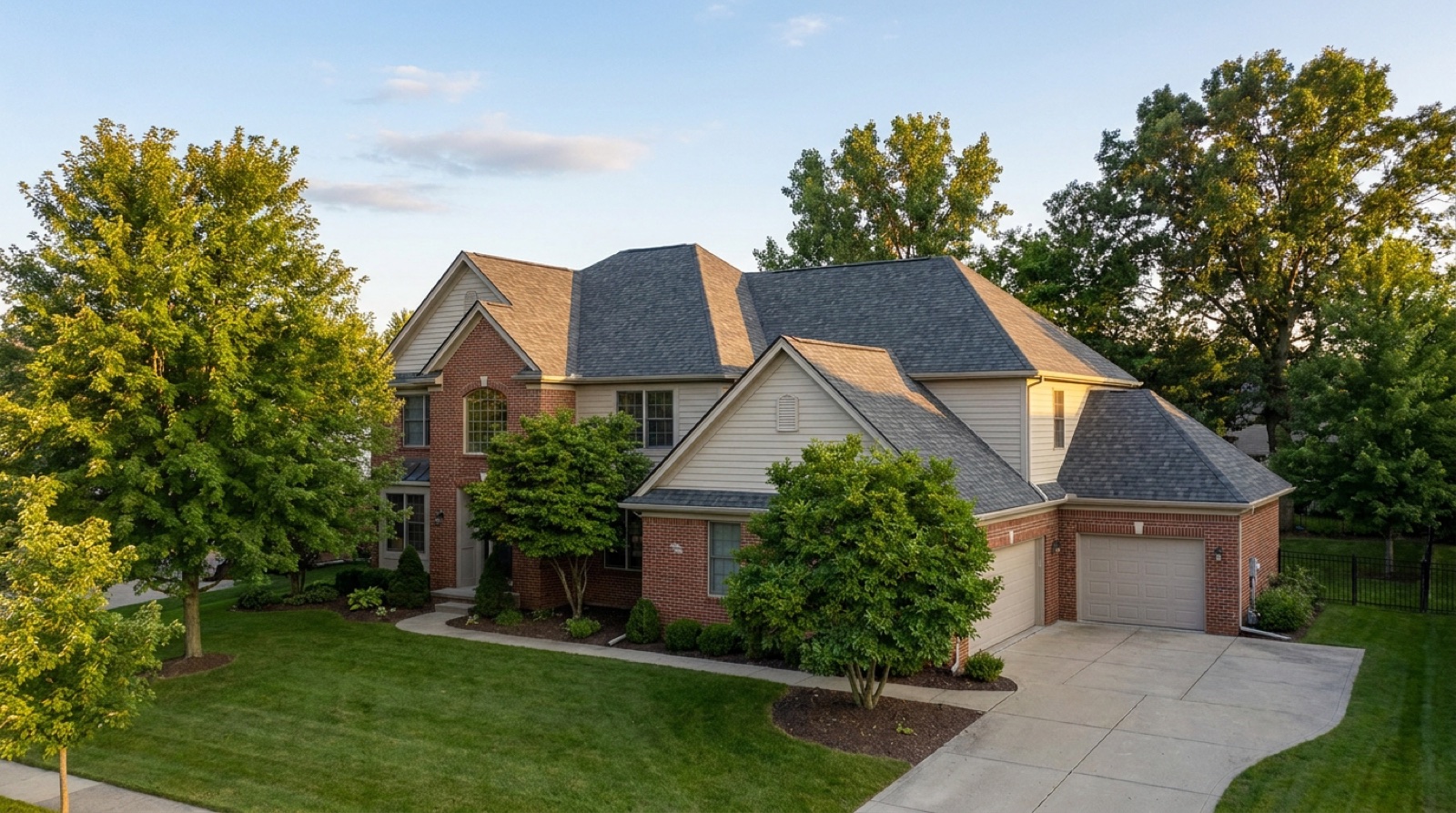
St. Clair Shores, Harrison Township, and the Chesterfield waterfront cover a range of lot conditions, from tightly packed canal-front streets with real shelter from neighboring homes to open lake-front parcels with a long, unbroken wind fetch across the water. The exposure conversation in this guide applies most directly to that second category: homes with a genuinely open sightline to the lake and little else breaking the wind before it reaches the roof. A canal-front home a few lots back with mature landscaping and neighboring rooflines on either side is closer to a standard inland exposure case, even though it is still technically waterfront property.
The practical takeaway is that waterfront is not one exposure category. It is a range, and the right metal roof spec for a given house depends on where on that range the specific lot actually sits, not on its zip code or its proximity to water on a map. That is exactly the kind of judgment call that needs eyes on the actual site rather than a generic waterfront pricing page.
07 / THE REAL SPECGetting the right spec for your specific lot, free
Everything above narrows the decision. The only way to get a spec matched to your actual lot, its wind exposure, its shelter or lack of it, its history with prior roofs, is a free, no-obligation inspection. We look at the site the same way we look at material and clip schedule: what does this specific house actually face, not what a generic waterfront checklist assumes. If a standard-exposure spec is genuinely enough for your lot, that is what we will recommend; if the site calls for the tighter edge metal and clip spacing described above, you will know why before you sign anything.
Financing follows the same canon math as any other Macomb County reroof: as an illustration only, a $13,500 project financed over a 10 year term at 9.9% APR works out to about $178 per month, subject to approval and not an offer of credit. Metal systems on the higher end of the $18,000 to $30,000 range scale up from there, and we will run your real numbers at the inspection. If you are still deciding between metal and asphalt for a waterfront home, our metal vs asphalt comparison is a useful next stop, and the cost calculator runs these same ranges against your roof size in about a minute.
- Waterfront exposure does not change the canon metal roof range, $18,000 to $30,000; it changes how that budget is allocated within the spec.
- Aluminum's corrosion resistance is inherent to the metal; premium-coated steel can perform just as well if the coating package and installation practice are both disciplined.
- Edge metal and clip spacing matter more on an open, unsheltered lot than on a sheltered inland one, and the tighter spec needs to be asked for rather than assumed.
- Where dissimilar metals meet, fasteners, flashing, gutters, isolating them from direct contact prevents galvanic corrosion that a longer damp season would otherwise accelerate.
- Not every waterfront lot has the same exposure; a canal-front home with shelter is a different case than an open lake-front parcel, and a free inspection tells you which one your house actually is.
Questions we hear most
There is no single best material for every waterfront lot. Aluminum standing seam removes coating damage as a variable and suits the most open, exposed sites well. Premium-coated steel with a full-thickness coating package and disciplined installation performs just as well on many waterfront homes. The bigger factors are edge metal, clip spacing, and fastener detail matched to your specific site's exposure, which a free inspection can assess.
No. The canon metal roof range in Macomb County, $18,000 to $30,000, applies whether a home sits on the water or well inland. What changes on a genuinely exposed waterfront lot is the spec within that range: material selection, edge metal, and clip spacing tightened to match the exposure, not a different category of roof altogether.
Metal roofs in Macomb County, including waterfront homes, run $18,000 to $30,000 installed. Where a given house lands in that range depends on size, panel profile, coating package, and how much the edge and fastening detail need to be upgraded for the site's specific wind exposure. A free inspection gives you an exact number.
- FEMA, disaster declaration DR-4757-MI, Michigan severe storms of August 2023 (Macomb County designated). fema.gov/disaster/4757
- Metal Construction Association, technical resources for metal roof systems. metalconstruction.org