
JUMP TO A SECTION
A flat roof is the least glamorous line on any building's capital plan and one of the easiest to price badly. Owners call us with a number in their head that came from a neighbor's shingle job, a big-box estimate, or a per-square-foot figure they found online, and almost none of those translate to a low-slope membrane roof. The honest range for a flat or commercial roof replacement in Macomb County is $9,000 to $16,000 installed, and the rest of this guide is about why the same building can land at either end of that spread. It is the same price canon we publish on our honest pricing sheet, unpacked line by line.
01 / THE SHORT ANSWERWhat a flat roof replacement costs here
For a small to mid-size commercial building, a detached garage or addition with a low-slope roof, or a strip of attached units in Macomb County, a full flat roof replacement runs $9,000 to $16,000 installed. That figure is the complete job: removal or preparation of the existing roof, the insulation package, the membrane and its attachment, all the flashings and edge metal, the details at drains and penetrations, and labor. It is not a materials-only teaser, and it is not a coating touch-up priced to look cheap next to a real reroof.
is where most Macomb County flat and commercial membrane replacements land, installed and complete. Where your building sits inside that range depends on the factors in the sections below. Get a ballpark on your own roof in about 60 seconds with the instant estimator.
For context, here is the standing price canon across the systems we install, so you can see where flat sits relative to the rest:
Every figure here is an installed price for the complete job. The flat range is wide on purpose, because a flat roof is an assembly of layers and details rather than a single product, and two buildings of the same footprint can carry very different scopes. Larger, unusual, or heavily cut-up roofs can run beyond the range, and the only way to price yours is to get on it. Published per-square-foot benchmarks exist in the trade press and cost-estimating references, but they swing so widely by system and region that we quote the whole installed job instead.
02 / THE LOGICWhy flat roofs are not priced like shingle roofs
The instinct most owners bring to a flat roof is the shingle instinct: measure the area, pick a color, get a per-square number. That works reasonably well on a sloped asphalt roof, where the big cost levers are how many squares there are, how steep and walkable the pitch is, and how many old layers have to come off. Pitch barely exists on a flat roof, and the product on top is a thin membrane rather than the thing carrying most of the cost. So the pricing logic moves somewhere else entirely.
On a low-slope roof, you are buying an assembly, not a covering. From the deck up, that assembly is usually a vapor consideration, one or more layers of insulation that also establish the slope, a cover board, the membrane itself, and then the details: how it is fastened, how it turns up every wall and curb, how it wraps every pipe and drain, and how the perimeter edge metal is built. The membrane sheet is often one of the cheaper ingredients. The insulation package and the linear feet of flashing and detail work frequently cost more than the field of the roof.
That is why a flat quote cannot be read like a shingle quote. A cheap flat bid is almost never cheap because someone found a bargain on membrane; it is cheap because it quietly thinned the insulation, skipped a cover board, reused failing edge metal, or planned to leave a wet layer in place. Those omissions do not show from the parking lot, and they are exactly what our bid-comparison guide teaches owners to catch. Understanding the assembly is the whole game, because it tells you which line on a bid is real value and which one is a future leak.
This also changes what getting three bids actually means. On a shingle roof, three quotes for the same house are usually pricing the same scope, so the spread is mostly labor rate and margin. On a flat roof, three quotes can be pricing three different roofs: one recover, one tear-off, one with code-current insulation and one without, one that corrects the ponding and one that ignores it. The cheapest number may simply be the smallest scope, and comparing them apples to apples means reading the assembly on each bid, not the bottom line. An owner who knows what layers belong in the assembly can tell a value bid from a future callback in about five minutes.
On a shingle roof you are mostly paying for pitch, squares, and tear-off layers. On a flat roof you are paying for the assembly and the details. Price them the same way and you will pick the wrong bid.
03 / THE DRIVERSSix things that set your price inside the range
When we walk a flat roof to build a number, these are the levers we are actually measuring. Any two of them can move a project from the bottom of the range toward the top, and the first three below are the ones owners almost never have on their radar when they picture a price.
1. Membrane choice
The membrane is the visible product and the first decision most owners think about: a heat-welded thermoplastic like TPO, a rubber sheet like EPDM, or a multi-ply modified bitumen system. The sheet cost differences between them are real but usually smaller than owners expect, and the bigger cost story is the labor and detailing each system demands. Our TPO vs EPDM comparison walks the tradeoff for a Michigan building, and mil thickness matters too: a thicker, longer-warranty membrane costs more up front than a thin builder-grade sheet.
2. The insulation package
This is the line owners never see coming and the one that moves flat pricing the most. A commercial reroof often triggers current energy-code insulation minimums, which can mean more inches of polyiso, a cover board, and tapered layers to build positive slope toward the drains. More insulation is more material, more fasteners or adhesive, and more labor. It also quietly grows the edge and flashing heights, because a thicker assembly changes every termination. A bid that keeps you at the old, thinner R-value may simply be ignoring the code your project has to meet.
3. Tear-off versus recover
Whether the old roof comes off or a new system goes over it is a major fork, and it has cost, schedule, and warranty consequences. A recover skips demolition and disposal and can be meaningfully less disruptive; a full tear-off means labor, dumpsters, and tons of old material leaving the building. Which path is even allowed depends on what is already up there, and we give it its own section below and a dedicated recover vs tear-off guide.
4. Deck condition
Under the old roof is the structural deck, and no one can see all of it until the roof is opened or a moisture survey is done. Sound deck adds nothing; wet, rotted, or corroded sections have to be replaced before the new assembly goes down, priced by the area repaired. On a roof that has leaked for years, deck and saturated-insulation replacement is the single most common reason a mid-range project climbs toward the top of the range. A good contractor states a unit price for deck repair up front so there are no mid-job surprises.
5. Drainage corrections
If water has been standing on the roof, replacing the membrane without fixing why it ponds just resets the clock on the same failure. Real drainage corrections, adding or relocating drains and scuppers, building crickets and saddles, or tapering the insulation to move water where it belongs, cost more than a flat re-cover but are often the difference between a roof that lasts its warranty and one that ages in ice all winter. In a freeze-thaw climate, standing water becomes an ice lens that works at every seam.
6. Roof area, penetrations, and edge
Finally, the obvious ones. More square footage means more of everything. But on a flat roof the detail count matters as much as the field: every rooftop unit, curb, skylight, pipe, and drain is hand-flashed, and a roof cluttered with mechanical equipment carries far more labor per square than an open field. Long or complex perimeters, parapet walls, and custom edge metal all add up. A simple open warehouse roof and a small office roof crowded with HVAC units can be the same size and price very differently.
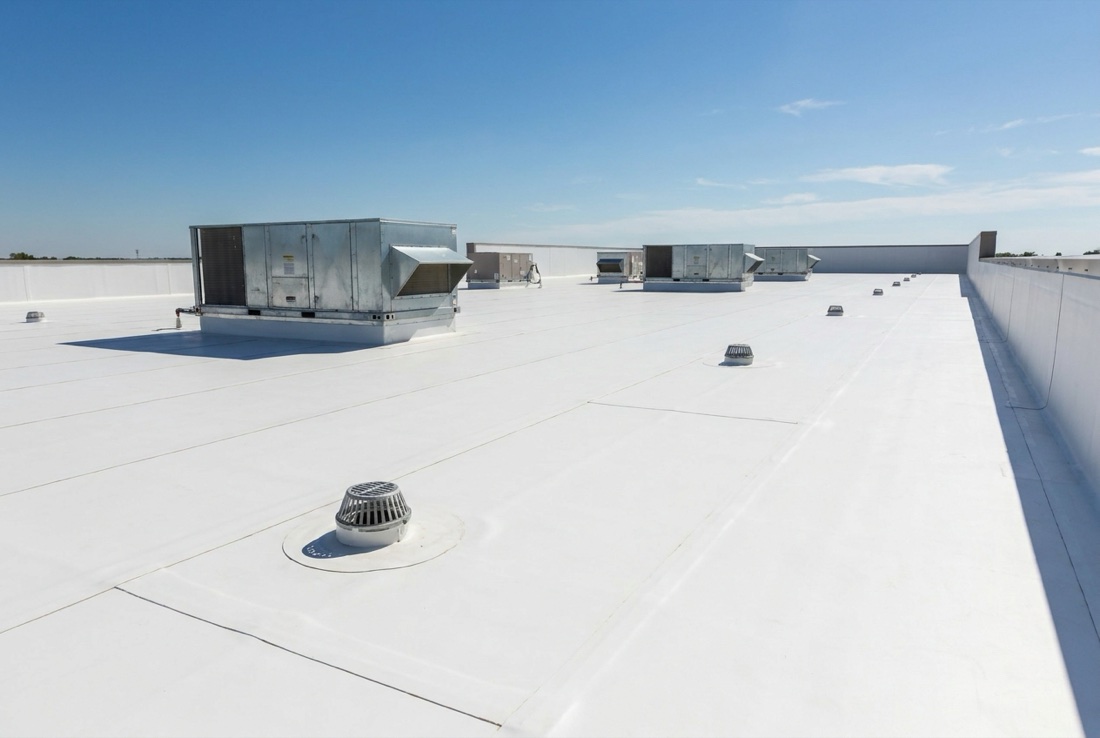
04 / BY MEMBRANECost by membrane system, in plain terms
Owners always want a per-system price list, but on flat roofs that list would be misleading, because the same membrane can land anywhere in the range depending on the insulation, drainage, and detail work under and around it. What we can give you honestly is how each system tends to position within the $9,000 to $16,000 range and why.
| SYSTEM | COST POSITION | WHY |
|---|---|---|
| EPDM (rubber) | Often lower to mid | Long cold-climate track record; seams are the watch item |
| TPO (thermoplastic) | Mid | Heat-welded seams; white surface; weld quality drives labor |
| Modified bitumen | Mid to higher | Multi-ply redundancy; more labor on install |
| Coating restoration | Below a replacement | Only for a dry, sound roof; not a replacement substitute |
The Michigan climate quietly shades every row of that table. Freeze-thaw cycling is hard on seams no matter the membrane, cold makes some sheets stiffer and less forgiving to install in late season, and a white reflective surface that saves cooling energy in a Sun Belt strip mall does less for a building that spends five months under snow. None of that reorders the price range on its own, but it is why the right membrane for your building is a question of drainage, foot traffic, and exposure rather than a single winner, and it is worth reading a real comparison before you let a salesman pick for you.
Two cautions on that table. First, coating is not a cheaper replacement; it restores a roof that is still structurally dry and sound, and it disqualifies itself the moment the insulation is saturated. Second, the cost order above flips easily once the assembly is factored in: a bargain membrane over a full code-compliant insulation package and new drainage will cost more than a premium membrane laid over a dry existing roof in a simple recover. Membrane is the label on the box, not the price of the box. For the head-to-head on the two most common choices, the TPO vs EPDM guide goes deeper than a cost line can.
05 / THE FORKRecover or tear off, and what it does to the price
The single biggest swing between two otherwise similar flat quotes is usually the tear-off decision. A recover installs a new roof system over the existing one, which saves the demolition labor, the disposal, and much of the disruption to the business below. It is genuinely less expensive when it is allowed. A tear-off removes everything down to the deck, which costs more in labor and dumpster fees but is the only honest option when the roof underneath is compromised.
Whether a recover is even permitted is a code question, not a preference, and it hinges on what is already on the building and whether the existing roof and insulation are dry and intact. A roof with saturated insulation cannot be recovered; sealing wet material inside a new assembly traps the moisture and rots the deck from within. This is exactly why an infrared moisture survey or core cut before you buy a roof is worth the small cost, and why a bid that promises a recover without ever checking for wet insulation should make you nervous. The full decision, with the code conditions, is laid out in our recover versus tear-off guide.
If your roof is only leaking in one or two spots and the assembly under it is dry, you may not be looking at a replacement at all. Flat roof repairs run $350 to $3,200, and larger or complex repairs can run higher; our flat roof repair cost guide maps common fixes to that range. The honest way to know which conversation you are in, repair, recover, or full tear-off, is to have someone look, which is what the free inspection is for.
06 / THE REAL NUMBERGetting a real number, and financing it
Everything above narrows the range. Only one thing produces your actual number: someone on your roof, looking at the membrane, the seams, the drains, the edge, and the moisture in the insulation, and pulling the interior story together with it. Our inspection is $0 with no obligation, and if the roof turns out to need a repair instead of a replacement, that is what we will tell you. You can start from the estimator or the cost calculator, both of which run the same published ranges on this page.
For owners spreading the cost, financing is available subject to approval. As an illustration only, a $13,500 project financed over a 10 year term at 9.9% APR works out to about $178 per month. That example is not an offer of credit; your rate, term, and approval depend on the lender and your credit profile. The useful way to frame it: a flat roof rarely fails all at once. It fails a seam and a drain at a time, through wet insulation, stained ceilings, and repairs that stop holding, so the choice is often a monthly line item now against a running repair bill later. Larger commercial projects, unusual buildings, or full portfolios are better handled with an on-site scope than a range, and our commercial roof replacement cost guide covers how those bigger jobs get structured.
A word on timing. Membrane work and its adhesives and sealants have installation temperature windows, and southeast Michigan closes those windows early. An owner who schedules an inspection in late summer is choosing their week; one who calls after the first hard freeze with an active leak is taking what is left, and in the meantime is relying on 24/7 emergency tarping to keep water out until a real repair can be made. The price canon on this page does not change with the season. Your leverage on scheduling does. When you are ready, browse the rest of our guides library or head back to the roofing services hub to see how flat work fits the full lineup.
- Flat and commercial roof replacements in Macomb County run $9,000 to $16,000 installed, the whole assembly and all details included.
- Flat roofs are priced as an assembly, not a covering; the insulation package and flashing detail often cost more than the membrane sheet.
- Membrane choice, insulation, tear-off vs recover, deck condition, drainage corrections, and detail count are the six levers inside the range.
- A recover is cheaper when it is allowed, but saturated insulation forces a full tear-off; check for wet insulation before you believe a recover bid.
- Repairs run $350 to $3,200; financing example is a $13,500 roof at about $178 per month over 10 years at 9.9% APR, subject to approval, illustration only.
Questions we hear most
A full flat or commercial roof replacement in Macomb County runs $9,000 to $16,000 installed, covering the insulation package, membrane, flashings, and all detail work. Larger or unusually complex buildings can run higher. Because a flat roof is an assembly of layers rather than a single covering, the only way to get an exact number is an on-site inspection, which we provide free with no obligation.
A shingle roof is priced mostly by area, pitch, and how many old layers must come off. A flat roof has almost no pitch, so the cost lives in the assembly instead: the insulation package, the attachment method, and the linear feet of flashing and detail work at every wall, curb, drain, and penetration. On many flat roofs the membrane sheet is one of the cheaper ingredients, which is why a cheap flat bid usually means a thinner assembly, not a better deal.
Yes, financing is available subject to approval. As an illustration only, a $13,500 project financed over a 10 year term at 9.9% APR works out to about $178 per month. That example is not an offer of credit; your actual rate, term, and approval depend on the lender and your credit profile. Ask about financing when you get your free inspection and we will run your real figures.
- FEMA, disaster declaration DR-4757-MI, Michigan severe storms of August 2023 (Macomb County designated). fema.gov/disaster/4757
- Michigan Uniform Energy Code (state adoption of the International Energy Conservation Code), LARA Bureau of Construction Codes. michigan.gov/lara: code books
- Michigan Building Code 2015, chapter 15 Roof Assemblies and Rooftop Structures: commercial reroofing, recover, and replacement conditions. up.codes: MBC chapter 15