
JUMP TO A SECTION
Somewhere in the fine print of a good roofing quote is a line for ice and water shield, the self-adhering rubberized membrane that goes down before the shingles at the most vulnerable edges of your roof. It is not glamorous, it is not something you will ever see once the roof is on, and it is one of the cheapest components on the job. It is also, in a Michigan winter, one of the few things standing between an ice dam at your eaves and a stain spreading across your bedroom ceiling. This guide is about what that membrane costs, where the code and good practice say it has to go, and why the bargain quote that leaves it thin is charging you less today to hand you a much bigger bill later.
01 / THE SHORT ANSWERWhat ice and water shield costs on a real roof
Ice and water shield is not a project you buy on its own. It is a line item inside your roof replacement, priced by how much area it has to cover, and on a normal Macomb County house it is a modest part of the total. A full asphalt shingle replacement here runs $9,000 to $18,000 installed, with most homes landing $12,000 to $16,000, and the code-required ice barrier at the eaves is already baked into an honest number in that band. It is not an upgrade you add. It is part of what a complete roof is supposed to include in the first place.
is where most Macomb County asphalt replacements land, within a full range of $9,000 to $18,000, and a proper eave-and-valley ice barrier lives inside that band on an honest bid. Membrane-only patch work at a leaking penetration or eave is a repair, and repairs run $350 to $3,200. Get your own ballpark in about 60 seconds with the instant estimator.
The reason we are not printing a hard per-square-foot price for the membrane on this page is the same reason we do not print one for decking: material pricing moves, and a figure quoted this season is stale the next. What does not move is the logic. The cost of ice and water shield on your roof is driven almost entirely by how many square feet of it the roof needs, which comes down to how long your eaves are, how many valleys you have, and how many penetrations poke through the deck. The rest of this guide walks that math so you can read your own quote and tell a complete number from a hollow one. For how the whole job breaks into parts, our roof replacement cost guide lays out every line the membrane sits beside.
02 / THE COMPONENTWhat ice and water shield actually is
Ice and water shield, sometimes called ice barrier or by a brand name your roofer happens to stock, is a self-adhering waterproof membrane. Peel the backing and it sticks directly to the roof deck, and its rubberized asphalt compound seals around every nail driven through it. That last part is the whole point. Ordinary underlayment sheds water that runs down its surface, but it does nothing at the thousands of holes the shingle nails punch through it. The membrane, by contrast, grips each nail shank so tightly that water backing up under the shingles cannot find a way in. It is the difference between a raincoat and a wetsuit.
It is worth being clear about what the membrane is not, because roofers use these words loosely and homeowners get them tangled. Ice and water shield is not the same as felt or synthetic underlayment, the broad sheet material that covers the main field of the roof. The two do different jobs and get installed together: the membrane armors the edges and details where water pools and backs up, and the underlayment covers everything else. Our roofing underlayment cost guide covers that field layer, and reading the two together is the fastest way to understand why a real bid has both lines and a cheap one sometimes blurs them into one.
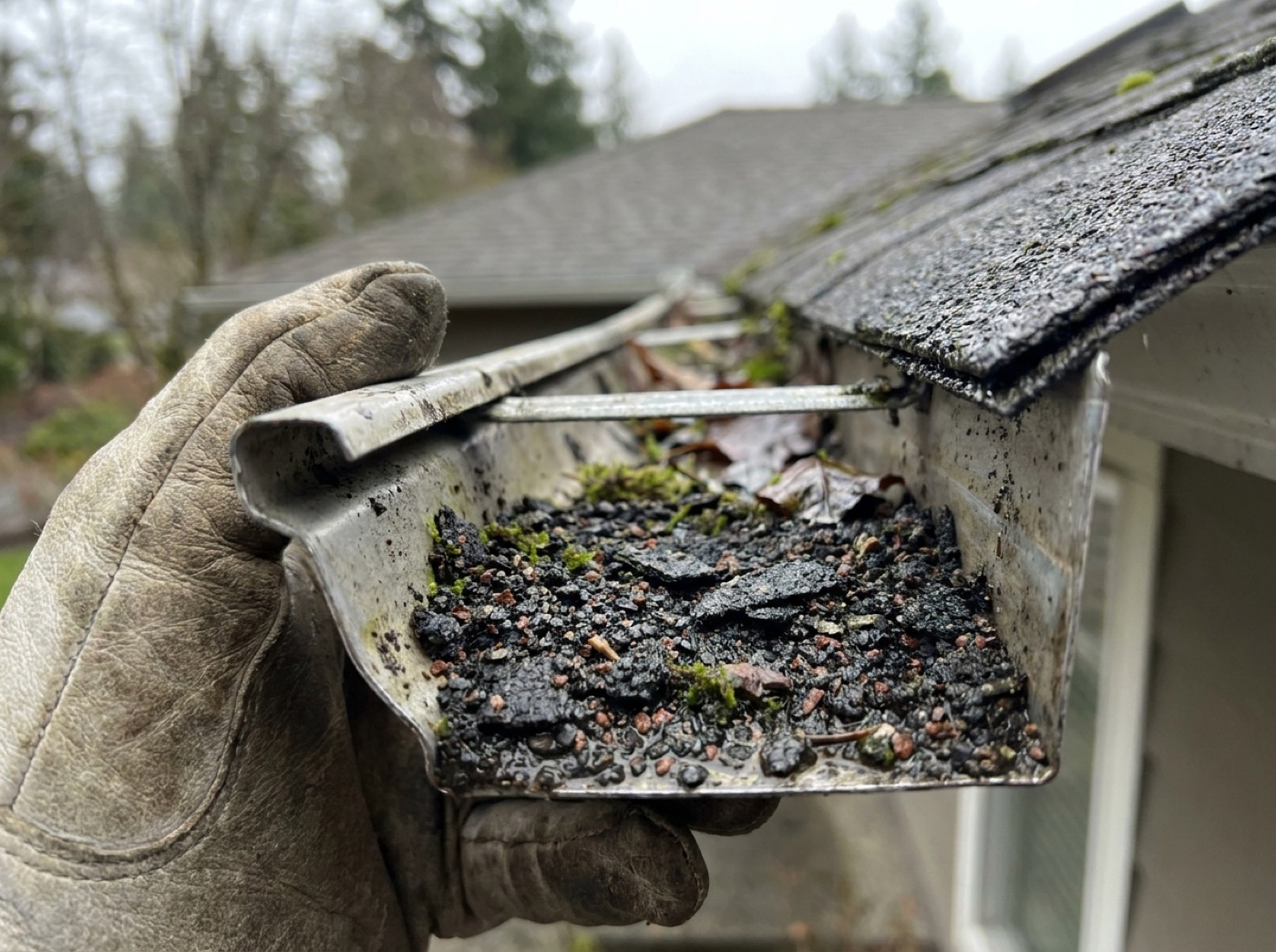
The membrane earns its keep specifically against the failure mode Michigan roofs face every winter. When attic heat melts the snow on the upper roof and the runoff refreezes at the cold overhang, it builds a ridge of ice, and the meltwater behind that ridge has nowhere to go but sideways and up, under the shingles. Shingles are built to shed water flowing down, not to hold back water pushing up from below, so without a sealed membrane at the eaves that backed-up water reaches the deck and the wall. The full ice-dam story, and how ventilation prevents the dam in the first place, belongs to our winter roofing guides. What matters here is that the membrane is the last line of defense when the dam forms anyway.
03 / THE CODEWhere code and good practice put the membrane
In a climate like ours, ice and water shield at the eaves is not optional or a premium touch. It is required by the Michigan Residential Code, which calls for an ice barrier in regions with a history of ice forming along the eaves. That is the legal floor, and any roofer pulling a permit in Macomb County is building to it. The code text and its exact measurements are cited in the records at the bottom of this page; the practical version is what follows.
At the eaves, extending inside the wall
The core requirement is a continuous band of membrane along the eaves, the lower roof edges, running from the very edge up the slope to a point that reaches past the inside of the exterior wall. The idea is that the sealed zone has to end somewhere warm, inside the heated envelope of the house, not out over the cold overhang where the ice dam sits. Per general code practice that band extends a set distance inside the exterior wall line, and on a low-slope or wide-overhang roof it can mean two courses of membrane rather than one to satisfy the measurement. This is the single largest chunk of ice barrier on most homes, because it follows the entire perimeter of the lower roof.
In the valleys
Wherever two roof planes meet, they form a valley, and a valley is a river during every rain and thaw. Good practice, and often code, is to run ice and water shield up the full length of each valley before any metal or shingle work goes over it, because that is where the greatest volume of water concentrates and where ice loves to bridge. A cut-up roof with several valleys needs meaningfully more membrane than a simple gable, which is one of the ways roof complexity quietly drives this line item up. Our Michigan roof permit guide covers how the local building department inspection ties these details to the permit.
Around penetrations and other details
The third place the membrane belongs is around penetrations, the plumbing vents, chimneys, skylights, and anywhere the deck is cut open, because those are the points where water most reliably finds its way in. Good crews also carry it up walls and around dormers where flashing does the sealing but a backup layer earns its place. None of this is exotic. It is the standard anatomy of a roof built for a Michigan winter, and the membrane at these details is small in area but large in consequence, since a penetration is exactly where a leak becomes a rotted deck. It rides right alongside the metal covered in our drip edge installation guide, another edge detail the cheap bids like to skip.
04 / THE MATHHow coverage area drives the cost
Since ice and water shield is priced by area, the cost on your roof is really a question of how much of it the roof calls for, and that comes down to a few measurements a roofer takes without thinking twice. Understanding them lets you see why two houses of the same square footage can carry very different membrane lines.
Eave length is the biggest driver
The eave band follows the entire lower perimeter of the roof, so a house with a long, spread-out footprint has more linear feet of eave to cover than a compact one, even at the same total roof area. A rambling ranch with a big attached garage has a lot of eave. A tall, narrow two-story has less. The membrane width up the slope is set by the code measurement, so once you know the total length of eave, the eave portion of the cost is close to fixed. This is why the ranch shape so common in Macomb County tends to carry a healthy ice barrier line even though the roof is simple.
Valleys and complexity add up
Every valley adds a full run of membrane up its length, and every hip, dormer, and penetration adds its own smaller patches. A plain gable roof with two eaves and no valleys uses the least. A complex roof with multiple valleys, several dormers, and a cluster of vents and a chimney uses considerably more, and that is before the extra flashing and slow detail labor those same features demand. The membrane cost tracks roof complexity closely, which is one more reason a cut-up roof prices above a simple one across every line, not just this one.
Full-deck coverage is a real option
Some homeowners, and some roofers by default, choose to run ice and water shield across the entire deck rather than only the code-required zones, wrapping the whole roof in the sealed membrane instead of felt or synthetic in the field. It is the most protective option and the most expensive, since it multiplies the membrane area several times over. Whether it is worth the premium depends on the roof and your appetite for belt-and-suspenders protection; on many homes the code-required eave-and-valley coverage plus a quality field underlayment is a sound, weather-tight system. A roofer should be able to price both and explain the tradeoff rather than deciding it silently for you. You can compare full replacement scenarios through the estimator or the published ranges on our honest pricing sheet.
05 / THE FALSE ECONOMYWhy shorting the membrane costs more than it saves
Here is the uncomfortable truth about ice and water shield: because it is invisible once the roof is done, it is one of the easiest lines for a bargain contractor to trim, and one of the hardest for a homeowner to catch. A crew can run a single narrow strip at the eaves instead of the full code band, skip the valleys, and leave the penetrations to caulk, and the roof will look identical from the driveway the day it is finished. The corner they cut does not show up until the first hard freeze-and-thaw drives water where the membrane should have been and was not.
The math on that trade is lopsided. The membrane is a small fraction of a $9,000 to $18,000 roof, so shorting it saves a bargain outfit very little, while the damage it prevents, water into the deck, the insulation, the drywall, and the framing, runs into repairs that dwarf the savings. An ice-dam leak rarely announces itself at the roof edge; it shows up as a stain feet away and inside a wall, and by the time it does the wood it soaked has been wet for a while. Our guide on the cost to replace roof decking follows exactly this chain, from a shorted edge to rotted sheathing you pay to tear out later.
Ice and water shield is the classic line to lowball, because you will never see whether it was installed to code once the shingles are down. The defense is to get the coverage in writing before the job: where the membrane goes (eaves, valleys, penetrations) and how far up the slope, and to be wary of any quote that comes in well under the others without naming it. A roof that skips the ice barrier is not cheaper. It is a Michigan winter with the wrong side of the bet placed on your deck.
The membrane you cannot see is the one an ice dam finds first. Skipping it does not make the roof cheaper; it just moves the cost to the ceiling below and adds a demolition bill on top.
06 / THE BIDHow to read the membrane on a quote
When you compare roofing quotes, the ice barrier is one of the fastest tells of a complete bid versus a hollow one, and it takes only a minute to check. Look for the membrane called out by name, with its locations spelled out, the same way you would look for the tear-off line or the decking line. A thorough estimate names it; a lowball estimate leaves it vague or leaves it out.
A few specific things to ask when the language is thin. Does the quote cover the eaves to the code distance inside the wall, or just a token strip at the edge? Are the valleys membraned their full length? Are penetrations sealed with membrane, not only caulk? Is the field of the roof getting quality underlayment, and is anyone offering full-deck coverage as a priced option? You do not need to become a roofer to ask these; you just need to make the invisible line visible before you sign. A contractor who welcomes the questions is a contractor who did the work; one who waves them off is telling you something.
This is the same read we recommend on every hidden line of a roofing bid: the honest number is the one that accounts for what your roof actually needs, and the suspiciously cheap outlier is usually the one that quietly assumed it could skip something you will pay for later. If a storm may be involved and you are heading into a claim, the edge and valley detailing also matters to what an adjuster documents, and our storm and insurance claims page explains what we can and cannot promise there. You can also browse the full library in our guides index or price a complete job with the cost calculator.
07 / THE REAL NUMBERGetting your actual price, free
Everything above narrows the range. Only one thing produces your real number: someone on your roof measuring the eaves, counting the valleys and penetrations, and reading how your particular house sheds and freezes. Our inspection is $0 with no obligation, and it covers the shingles, the flashing, the ventilation, and the attic side of the deck, with photos, then puts a complete replacement quote in writing with the ice barrier spelled out where it belongs rather than buried or blank. If the roof only needs a repair, that is what we tell you, and repair-scale membrane work at a leaking eave or penetration falls in the $350 to $3,200 repair range.
The larger point is that the ice barrier is not the place to save money on a Michigan roof, and the good news is that on an honest bid you are not asked to. It is already inside the $9,000 to $18,000 a complete replacement costs, doing quiet work at the edges every winter for decades. The way to make sure yours is really there, at full coverage, is to get a real inspection and a real quote and read the membrane line the way this guide taught you. You can start from the roof replacement service or go straight to the estimator.
- Ice and water shield is a line item inside your roof replacement, not a standalone project; a full asphalt roof runs $9,000 to $18,000 and an honest bid already includes the code-required ice barrier.
- The Michigan Residential Code requires the membrane at the eaves, running from the edge to a point inside the exterior wall; good practice adds valleys and penetrations.
- Cost tracks coverage area: eave length is the biggest driver, and valleys, dormers, and penetrations add more, so a complex roof carries a larger membrane line than a simple one.
- Because it is invisible once shingled, the membrane is easy to lowball; shorting it saves little and risks decking, insulation, and drywall damage that costs far more.
- Read the membrane on a quote the way you read the tear-off line, and get your exact number from a free inspection, which is $0 with no obligation.
Questions we hear most
It is priced by coverage area and included as a line item in your roof replacement rather than sold on its own. A full asphalt replacement in Macomb County runs $9,000 to $18,000, and the code-required ice barrier at the eaves is already part of an honest number in that band. Membrane-only patch work at a leaking eave or penetration is a repair, which runs $350 to $3,200. The exact figure comes from a free inspection.
Yes. The Michigan Residential Code requires an ice barrier membrane at the eaves in regions with a history of ice forming along the roof edge, which includes Macomb County. The membrane must run from the eave edge to a point inside the exterior wall line. Good practice adds it in the valleys and around penetrations as well, and any roofer pulling a permit is building to that standard.
They can, and because the membrane is invisible once the shingles are on, a shorted or skipped ice barrier is hard to catch after the fact. It is a poor trade: the membrane is a small fraction of the total, while the ice-dam damage it prevents can run into far larger repairs to the deck, insulation, and drywall. Get the coverage spelled out in writing before you sign, and be wary of a quote that omits it.
- Macomb Roofing Pros 2026 price canon, installed ranges by system: asphalt $9,000 to $18,000 (most homes $12,000 to $16,000), repairs $350 to $3,200 (larger or complex can run higher).
- Michigan Residential Code 2015, section R905.1.2 Ice Barriers: membrane required from the eave edge to not less than 24 inches inside the exterior wall line. up.codes: MRC chapter 9
- FEMA, disaster declaration DR-4757-MI, Michigan severe storms of August 2023 (Macomb County designated). fema.gov/disaster/4757