
JUMP TO A SECTION
People think about a new roof in metro terms, not county terms. You do not search "new roof cost in my census tract," you search "new roof cost metro Detroit," because the metro is the unit that feels real: the same weather, the same labor pool, the same lumber yards and landfills feeding every crew from Livonia to New Baltimore. That instinct is mostly right. A roof in Sterling Heights and a roof in Royal Oak are priced out of the same regional cost structure. But the number on your driveway is set by your house, not the metro, and the honest way to read any regional range is as a starting point you then adjust up or down for the specifics of your roof. Below are the installed ranges we actually work from, followed by the four things that move your quote inside them.
01 / THE SHORT ANSWERWhat a new roof costs across metro Detroit
For a typical single family home in the Detroit metro, a full asphalt shingle roof replacement runs $9,000 to $18,000 installed, and most homes land $12,000 to $16,000. That figure is the complete job, not a materials teaser: tear-off of the old shingles, disposal, underlayment, ice and water barrier at the eaves, flashing, ventilation, the new shingles, and labor. Premium systems cost more because both the material and the labor to install it cost more. Here is the full ledger at a glance.
is where most metro Detroit asphalt replacements land, inside a full range of $9,000 to $18,000. You can get a ballpark for your own roof in about 60 seconds with the instant estimator, or dig into the full breakdown in our roof replacement cost guide.
These are the same ranges published on our honest pricing sheet, and they do not move by which suburb you live in. What moves is where inside the range your specific roof lands, and by how much. A metro is a wide place: it holds 1950s brick ranches with simple gable roofs and it holds cut-up two-story colonials with three dormers and a turret, and no single figure can be fair to both. So treat the range as the frame and the rest of this page as the way to find your spot in it.
Every figure here is an installed price for the complete job on a typical home. Larger or complex repairs can run higher than the repair range shown, and metal, tile, and slate carry their own bands. Ranges are wide on purpose, because your exact number depends on the drivers in the next four sections, and no honest roofer can name a firm price without seeing the roof.
02 / THE REGIONAL LOGICWhy two metro Detroit quotes come back thousands apart
The most common frustration we hear is that a homeowner collected three quotes for the same roof and got three very different numbers, sometimes $5,000 apart, with no explanation of why. That gap is real, and only part of it is honest. Some of the spread is legitimate: contractors carry different overhead, run different crew sizes, and include or exclude different line items. But a large share of a suspiciously low metro quote is a roof that was scoped thinner than the one next to it, with a corner cut you will pay for later. We take that frustration apart directly in why roofing quotes come back so different, which ends with the short list you can send back to every contractor so the three numbers finally describe the same job.
Across the metro, four things account for almost all of the legitimate variation in a residential asphalt quote: the age and style of the housing stock your home belongs to, the complexity and pitch of your particular roof, how the crew has to access and stage the job, and how many layers of old roofing have to come off and where they go. The rest of this guide walks each one. None of them is Detroit-specific magic; they are the same levers everywhere. What is regional is the cost of the inputs behind them, and that is where a metro like Detroit does have its own signature, which we cover in depth in Michigan roof prices versus national averages.
The short version of the regional story: metro Detroit roofs carry climate-driven spec that milder markets skip, the installation season is compressed by winter, and metro labor and disposal economics are their own thing. Michigan code requires an ice barrier membrane at the eaves, a real roof includes balanced ventilation to fight ice dams, and both of those cost money that a Sun Belt quote never has to include. That is why lifting a national average off the internet and expecting it to match a Warren driveway is a setup for disappointment. The regional band above already bakes that spec in.
A regional range tells you the neighborhood the price lives in. It cannot tell you which house on the street is yours. Only someone on the roof can do that.
03 / THE HOUSING STOCKHousing stock and era: where your home sits in the range
The single biggest reason metro Detroit quotes vary is that the metro's housing stock varies enormously, and different eras of house tend to carry different roofs. The metro's inner-ring communities are dense with modest post-war single-story homes, many built in the 1950s and 1960s with simple gable rooflines and small footprints. Those roofs are usually the cheapest shape to shingle: a crew can move fast, there is little flashing detail, and the square count is low. Homes like that tend to land in the lower and middle part of the asphalt band.
The metro's outer-ring and newer subdivision communities skew larger and more complex. Two-story colonials, cut-up rooflines with hips and valleys, attached garages, and steeper pitches all add square footage and hand-flashing work for the same floor plan. A home like that can sit in the upper part of the range, or push past it into premium-material territory if the owner upgrades. The point is not that one suburb is expensive and another is cheap; it is that the era and style of your home, which correlates loosely with where in the metro it was built, is a strong predictor of where your quote lands.
There is also an age dimension that has nothing to do with style. Older metro homes are more likely to hide a second layer of shingles from a budget reroof decades ago, and more likely to have decking, fascia, or flashing that has quietly aged out and needs attention during the job. Newer subdivision homes are more likely to be on their first tear-off with sound decking underneath. Both facts move the number, and neither shows from the street. For a statewide view of how era and climate shape the average, our average roof cost in Michigan guide runs the same logic across the whole state.
It is worth being blunt about what this means for the way you read a metro-wide number. A regional average quietly assumes a roof that may look nothing like yours: a certain size, a certain pitch, a certain number of penetrations, one layer of shingles over sound wood. The further your home sits from that invisible baseline, the less the average is worth to you. A compact one-story with a clean gable roof and a first tear-off can genuinely land near the bottom of the asphalt band; a big two-story with steep, cut-up geometry and a hidden second layer can just as genuinely sit near the top, and both are fair prices for the same regional cost structure. The range is not lying to you. It is simply describing a crowd, and you are one specific house in it.
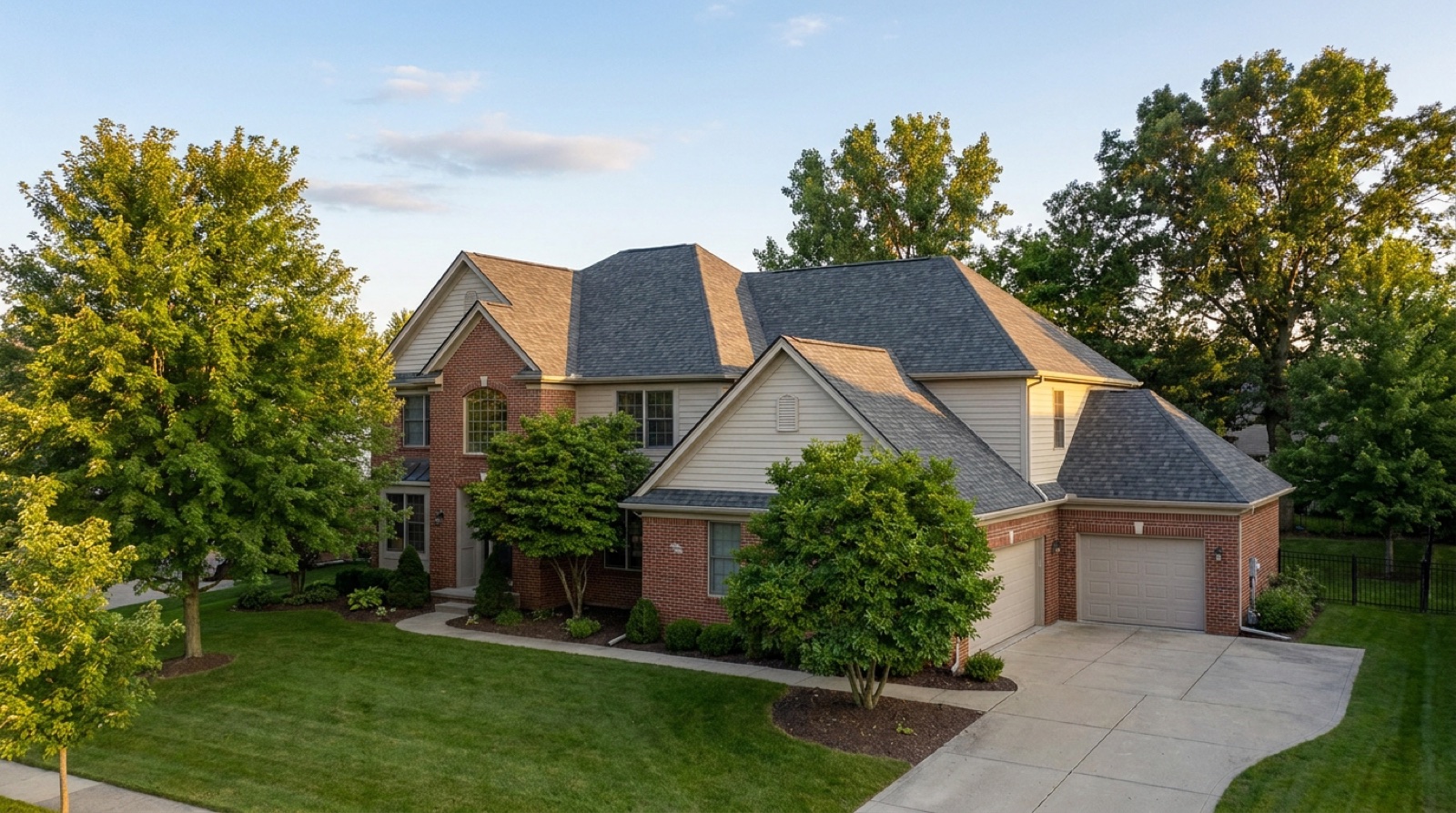
04 / THE ROOF ITSELFComplexity, pitch, and access: the site multipliers
Two houses with the same floor plan can carry very different roofs, and the estimator standing in your driveway is measuring the differences you cannot see from a listing photo. Three of them dominate.
Roof size, measured in squares
Roofers price by the square, which is 100 square feet of roof surface, and roof area is always larger than the home's footprint because the roof is sloped and overhangs the walls. A modest ranch might carry 20 to 24 squares; a large two-story with a complex roofline can carry more than double that. More squares means proportionally more shingles, underlayment, and labor hours, which is the first and largest multiplier on any metro quote.
Pitch and walkability
A shallow roof a crew can walk upright gets shingled quickly. A steep roof needs harnesses, roof jacks, and staging, and every movement is slower, so the same square footage takes more hours. Steeper pitch also means more actual surface area for the same footprint, so it compounds: you are paying for more material and more time at once. Many of the metro's larger homes carry steeper, more complex roofs, which is a real reason their quotes run higher than the ranch down the road.
Access and staging
The site around the house matters more than people expect. A crew that can back a dump trailer up to the eaves and stage materials on a wide driveway works faster and cheaper than one squeezing equipment down a narrow lot line, protecting a pool or landscaping, or reaching a third story over a fenced yard. None of this changes the shingle, but all of it changes the labor hours, and labor is a large share of any metro Detroit bid. Complexity items like valleys, chimneys, skylights, and dormers each add hand-flashing work too, which is exactly where cut-rate quotes quietly under-scope.
If you are weighing a material upgrade on top of all this, the tradeoff between asphalt and a longer-lived system is its own decision. Our metal versus asphalt comparison walks the lifecycle math, and the cost calculator runs the canon ranges against your roof size so you can see the material choice in dollars.
05 / THE HIDDEN LINESTear-off layers and disposal: the metro's quiet cost
Two line items separate an honest metro quote from a cheap one, and both live below the shingles. The first is tear-off. A roof that already carries two layers of shingles is twice the weight to strip and twice the volume to haul, and metro Detroit's older communities are full of homes that were reroofed on a budget decades ago by overlaying rather than tearing off. When a quote reflects a genuine two-layer tear-off and a suspiciously cheaper one does not, the cheaper one is often planning a third overlay, which traps heat and moisture and shortens the life of the roof you just paid for. We tear off to the deck, every time.
The second is disposal. Torn-off shingles are heavy, and hauling several tons of them to a landfill is priced by container and by weight. That is a fixed regional cost every honest metro crew pays and passes through, and it is precisely the line a lowball quote leaves off the page. Add the decking that only reveals itself after tear-off, which must be replaced per sheet when it is soft or rotted, and you have the two most common sources of a legitimate mid-job cost change. A good contractor states a per-sheet decking price up front and shows you photos of anything replaced, so the surprise is priced before it happens rather than after.
The same discipline applies to the parts of the system nobody sees from the ground. Michigan's climate makes an ice barrier membrane at the eaves a code requirement, not an upgrade, and proper attic ventilation is what keeps the deck cold and even so ice dams do not form in the first place. Both cost money, and both are quietly missing from the cheapest metro quotes because leaving them off is the easiest way to shave a number without the homeowner noticing on the spot. A roof installed over a starved, poorly vented attic ages faster from below than it ever does from the weather above, which is why the true cost of a roof is not the sticker on day one but the number of winters it survives. The published ranges on this page assume the full, code-correct system, which is the only kind we install.
When one metro Detroit quote comes in thousands under the others, walk the line items before you celebrate. The gap is usually a missing tear-off layer, no stated decking allowance, thinner underlayment, skipped ice barrier, or ventilation quietly left out. Each of those is a real cost that does not disappear because it was omitted from the paper; you just pay it later, with interest, in leaks and premature failure.
There is one scenario where the cost question changes shape entirely: storm damage. Metro Detroit has recent history here. After the severe storms of August 2023, Macomb County was included in federal disaster declaration DR-4757. Homeowners insurance policies generally cover sudden damage from wind and hail rather than gradual wear, and every policy is different, so your declarations page and your adjuster have the final word. Our role is documentation and craft: we photograph the damage, write up what we find, and can meet your adjuster on site, but no contractor can promise a claim outcome. The full playbook is in our storm and insurance claims guide.
06 / YOUR NUMBERFrom a metro range to your actual price
Everything above narrows the range. Only one thing produces your actual number: someone on your roof. The metro range tells you a full asphalt replacement runs $9,000 to $18,000 and most homes land $12,000 to $16,000, and the four drivers tell you which direction your house pushes from there. What they cannot do is measure your squares, count your layers, test your decking, and price your flashing details. A free inspection does exactly that, and ours is $0 with no obligation: shingles, flashing, ventilation, gutters, and the attic side of the deck, with photos of everything we find. If the roof only needs a repair, that is what we will tell you.
A word on why a Macomb County inspection is the accurate next step even for a metro-wide search. A regional average is built by blending thousands of different houses together, which makes it useless for budgeting any one of them; it is the roofing equivalent of the average temperature of a hospital. The moment a licensed local roofer stands on your specific roof, the metro range collapses into a single written price. That is the number you can actually plan around, and it is the only number worth signing.
If you are comparing quotes you already hold, the driver list on this page is a fair checklist. Any two honest metro Detroit quotes should each account for size, pitch, layers, decking allowance, material tier, complexity, access, and disposal. A quote that is thousands cheaper is almost always missing one of those lines. And if financing is part of the plan, a $13,500 roof amortized over a 10 year term at 9.9% APR works out to about $178 per month as an illustration only, not an offer of credit; your real rate, term, and approval depend on the lender and your credit profile.
- Across metro Detroit, a full asphalt replacement runs $9,000 to $18,000, and most homes land $12,000 to $16,000.
- The metro range is a frame, not a quote; your house sets your number, and four drivers move you inside the band.
- Housing era and style, roof complexity and access, and tear-off layers and disposal explain most legitimate variation.
- A suspiciously low metro quote is usually a missing line: a tear-off layer, decking allowance, ice barrier, or ventilation.
- The exact number requires an inspection, and our Macomb County inspection is $0 with no obligation.
Questions we hear most
For a typical single family home across the Detroit metro, a full asphalt shingle replacement runs $9,000 to $18,000 installed, and most homes land $12,000 to $16,000. Metal runs $18,000 to $30,000 and tile and slate run $20,000 to $36,000. The regional range is a starting point; the only way to get your exact number is an on-site inspection, which we provide free with no obligation.
Some of the spread is legitimate, because contractors carry different overhead and include different line items, but a large share of a suspiciously low quote is a roof scoped thinner than the ones next to it. The common omissions are a second tear-off layer, a stated decking allowance, ice barrier membrane, or ventilation. Walk the line items on each quote before you decide, and the cheapest number often turns out to be missing real work.
The published ranges do not change by suburb; the same regional cost structure feeds every crew in the metro. What changes is your house. Older inner-ring homes with simple roofs often land lower in the range, while larger, steeper, more cut-up homes in newer areas land higher. Your era, roof complexity, and layers matter far more than your zip code, which is why a free inspection beats any regional average.
- FEMA, disaster declaration DR-4757-MI, Michigan severe storms of August 2023 (Macomb County designated). fema.gov/disaster/4757
- Michigan Residential Code 2015, section R905.1.2 Ice Barriers: membrane required from the eave edge to not less than 24 inches inside the exterior wall line. up.codes: MRC chapter 9
- Manufacturer technical and warranty literature for the major asphalt shingle lines: GAF (gaf.com), Owens Corning (owenscorning.com), and CertainTeed (certainteed.com).
- Your city or township building department: reroofing permit requirements and fee schedules are set locally in Macomb County; see the county directory of communities. macombgov.org