
JUMP TO A SECTION
Open the settlement letter on a roof claim and the number that jumps out is usually smaller than any roofing quote you have seen. That is not necessarily a dispute, a denial, or a mistake. It is usually depreciation: the insurer's estimate of how much value your roof had already used up before the storm arrived. The carrier starts from what a new roof would cost, subtracts value for age and condition, and pays the remainder first. In Macomb County, where a full asphalt replacement runs $9,000 to $18,000 installed, that subtraction routinely moves four figures from the first check into a holdback column, and whether you ever see that money again depends on a single word in your policy. This guide is the concept page for that math. It shows the generic structure insurers use, walks a worked hypothetical from replacement cost down to the first check, and explains the recoverable versus non-recoverable distinction that decides what happens next. One standing caveat before any of it: every carrier, policy form, and adjuster is different, depreciation methods vary, and nothing on this page is insurance or legal advice. Your policy language and your adjuster have the final word on your claim.
01 / THE CONCEPTWhat roof depreciation actually is
Insurance depreciation is the same idea as depreciation on a car: an asset loses value as it ages and wears, even if it still works. A roof is a wasting asset with a rated service life. The day it is installed it is worth its full replacement cost; the day before it fails it is worth close to nothing, at least on paper. When an adjuster settles a roof loss, they typically calculate two numbers. The first is replacement cost value, or RCV: what it would cost to put a new roof of like kind and quality on your house today. The second is actual cash value, or ACV: that same replacement cost minus depreciation for the age and condition of the roof that was actually up there. The full comparison between those two settlement types lives in our ACV versus RCV guide for Michigan, but the one-line version is that ACV is what your roof was worth, and RCV is what a new one costs.
Depreciation matters because it is usually the engine behind the first check. On a common replacement-cost policy, the carrier often pays the claim in two stages: an ACV payment up front, then the depreciation released later, after the work is done and documented. On an ACV-only policy or endorsement, the depreciated figure is not the first stage. It is the settlement. Either way, the size of the depreciation deduction, sometimes called the holdback, is the single biggest variable in how much money arrives before your roof gets built. The two settlement bases behind that sentence, and how to tell from your own declarations page which one you are standing on, are taken up in what ACV and RCV mean on a roof.
Depreciation is the value your roof had already used up before the loss. The adjuster subtracts it from today's replacement cost to produce the ACV figure, and that figure, less your deductible, typically drives the first check on the claim.
02 / THE SCHEDULEThe expected-lifespan math insurers lean on
Carriers do not guess at depreciation one shingle at a time. Adjusters commonly work from expected-lifespan schedules, tables that assign each roofing material a service life and depreciate it against its age, most often in a roughly straight line. The estimating software used across the industry ships with life-expectancy tables by material, and many carriers publish or maintain their own. The structure is simple division: a roof's age over its expected life gives a percentage of value consumed, and that percentage of the replacement cost is the depreciation.
The generic formula
Written out, the common straight-line structure looks like this: depreciation percentage equals roof age divided by expected lifespan. Depreciation dollars equal replacement cost times that percentage. ACV equals replacement cost minus depreciation dollars. A 10 year old roof on a 20 year schedule is 50 percent depreciated. A 15 year old roof on the same schedule is 75 percent depreciated. The math is not exotic; what varies is the inputs, and the inputs are where claims are won and lost.
Where the inputs come from
Expected lifespan comes from the schedule for your material: architectural asphalt is commonly carried at a longer life than three-tab, and metal, tile, and slate are carried longer still. Roof age comes from permits, the home sale file, aerial imagery history, or the adjuster's reading of the shingles themselves. And condition can adjust the line: many methods let an adjuster depreciate a well-maintained roof more gently, or a neglected one more steeply, than straight age would suggest. None of this is standardized across carriers, which is why two adjusters can look at the same roof and produce holdbacks that differ by real money. The percentage on your estimate is a judgment expressed as arithmetic, not a law of nature.
One roof, many line items
A detail worth knowing before you read your own estimate: adjusters usually do not depreciate the roof as one lump. The estimate is built line by line, and each line can carry its own schedule. The shingle field is depreciated against the shingle lifespan, but the metal flashing, the vents, the underlayment, and the drip edge may each be aged on their own lines, and some line items, like the dumpster or the permit fee, are often not depreciated at all because they are not wasting assets. That is why the depreciation percentage at the bottom of a real estimate rarely matches the clean age-over-lifespan fraction exactly. It is a weighted blend of many small calculations, and it is also why reading the line items, not just the totals, is how you catch an input that is wrong.
03 / THE WORKED EXAMPLEFrom $14,000 down to the first check
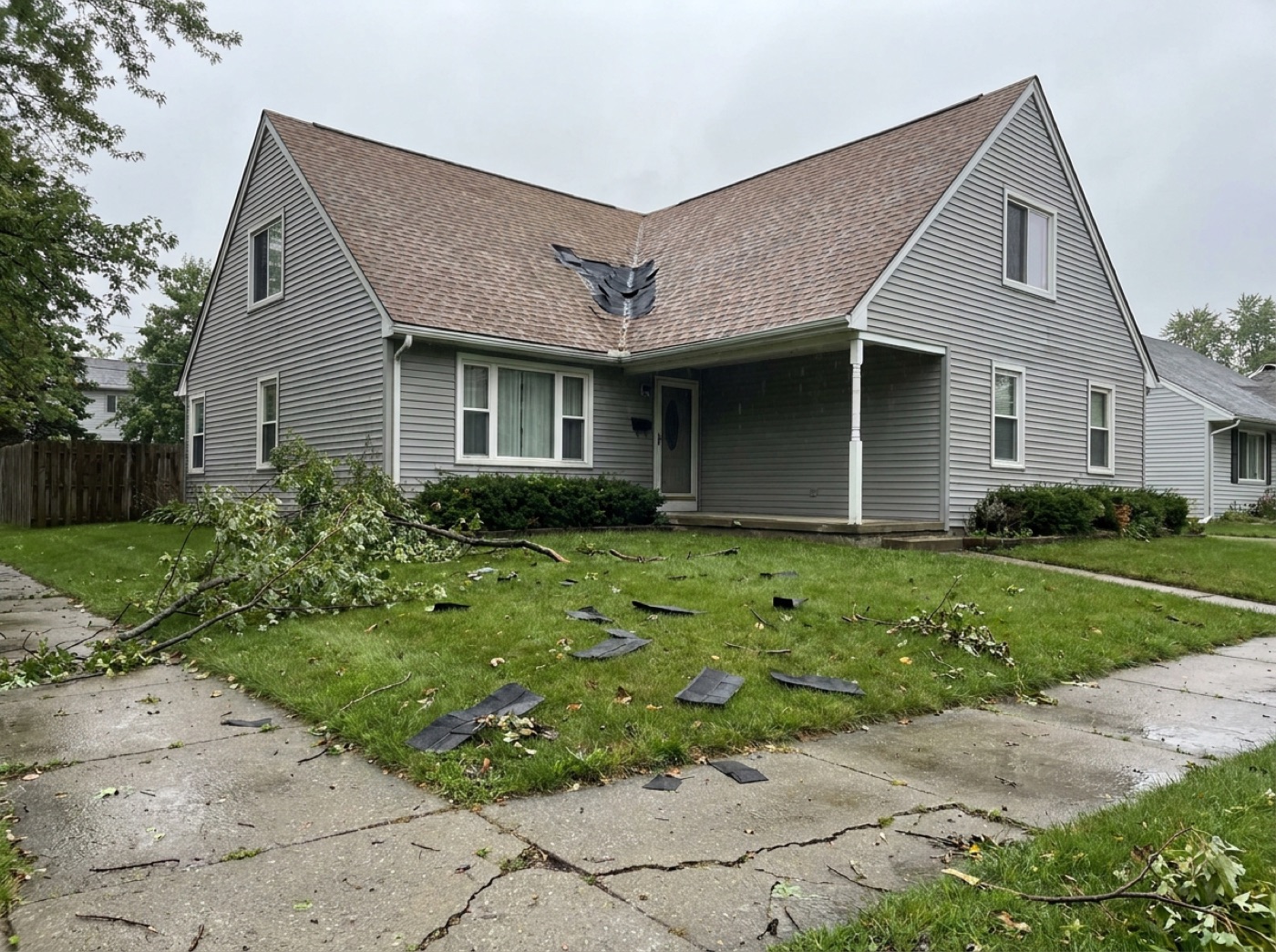
Numbers make the structure concrete, so here is a hypothetical inside our local price canon. Say a wind claim on a Macomb County colonial prices out at $14,000 to replace with like kind and quality, squarely inside the $12,000 to $16,000 band where most homes here land. The shingles are architectural asphalt, carried on the adjuster's schedule at a 20 year expected life, and the permit record says the roof is 12 years old. Straight-line math says the roof is 60 percent depreciated. Sixty percent of $14,000 is $8,400 of depreciation, which leaves an actual cash value of $5,600. The policy carries a $1,000 deductible, which comes out of the ACV payment. The first check is $4,600.
Read that ledger twice, because it explains most of the shock in most settlement letters. The roof still costs $14,000 to build. The first check is $4,600. The $8,400 in the middle is the holdback, and the age of the roof, not the severity of the storm, is what set its size. Run the same loss on a 5 year old roof and the picture changes completely: 25 percent depreciation is $3,500, ACV is $10,500, and the first check after the same deductible is $9,500. Same house, same wind, same replacement cost; the schedule did all the work. If you want to sanity-check the replacement figure itself, our roof replacement cost guide breaks down the full local ranges, and the 60-second cost calculator will put a ballpark on your own roof before any adjuster does.
One deductible note before moving on, because it stacks with everything above. Some Michigan policies carry a separate wind and hail deductible calculated as a percentage of the dwelling coverage rather than a flat figure, and on a well-insured house that percentage can be a much larger number than the $1,000 in our example. Depreciation and the deductible are independent subtractions that land on the same check: the schedule takes its share first, then the deductible takes its share of what remains. On an older roof with a percentage deductible, the two together can shrink a first check toward zero even on a claim the carrier fully accepts, which is exactly the scenario worth discovering while you are reading a renewal packet instead of a settlement letter.
04 / THE FORKRecoverable versus non-recoverable depreciation
Everything above describes how the holdback is calculated. What happens to it afterward depends on which of two kinds of depreciation your policy applies, and this is the distinction worth finding in your paperwork before a storm rather than after.
| DEPRECIATION TYPE | WHAT IT TENDS TO MEAN FOR THE HOLDBACK |
|---|---|
| Recoverable | The holdback can be released after the roof is actually replaced and the completed work is documented, typically up to the policy limit and within stated deadlines. |
| Non-recoverable | The holdback is not paid at any stage. The ACV figure, less the deductible, is generally the settlement, and the gap to a new roof is yours. |
Recoverable depreciation is the design of a standard replacement-cost policy. The carrier pays ACV first, you complete the replacement, you submit the final invoice and completion documentation, and the carrier can then release the depreciation as a second payment. In the worked example above, that second check would be the $8,400, bringing the claim to replacement cost less the deductible. The release is usually conditional: policies commonly require that the work actually be completed, often within a stated window, and paperwork gaps are a common reason homeowners leave the second check unclaimed. The step-by-step process, deadlines included, is the subject of our companion guide on how to recover depreciation on a roof claim.
Non-recoverable depreciation is what an ACV-only policy or a roof ACV endorsement produces. The depreciated figure is the settlement, full stop, and no invoice unlocks the rest. One more wrinkle belongs on the map: carriers differ on whether labor can be depreciated at all, or only materials, and in some states that question has regulatory and legal texture. It can move a Michigan holdback by a meaningful amount, which is why we gave it its own page on labor depreciation in Michigan claims.
The costliest mistake in this corner of roofing is assuming the first check is the whole claim. On a replacement-cost policy with recoverable depreciation, cashing the ACV check and never completing or documenting the replacement can forfeit the entire holdback. Read the settlement letter for the word recoverable, and ask the adjuster directly which kind you have.
05 / THE VARIABLESWhat moves your depreciation number
Because the formula is simple, every dollar of movement comes from its inputs. These are the levers that most often change the holdback on an otherwise identical loss.
- Roof age, as documented. The single biggest input. A permit or dated invoice that proves the roof is younger than the adjuster's estimate directly shrinks the depreciation percentage.
- The lifespan the schedule assigns. A roof carried at a 30 year expected life depreciates more slowly per year than one carried at 20. Material and shingle grade drive which line of the table you are on.
- Condition evidence. Many methods allow condition to adjust straight-line age. Dated photos and a documented maintenance history may support a gentler line; visible neglect can support a steeper one.
- Materials versus labor. Whether the labor share of the estimate is depreciated alongside materials varies by carrier and is worth checking on any Michigan claim.
- The policy form itself. Endorsements can convert the roof to ACV-only settlement or attach a payment schedule, which changes not just the number but whether the holdback is recoverable at all.
Notice what is not on that list: the size of the storm. Depreciation is about the roof, not the wind. That is also why the same documentation habits that serve you at renewal serve you in a claim. A photo-documented inspection with the age and condition of your roof on record is evidence you can put in front of an adjuster on the day it matters, and ours is $0 with no obligation from the estimator any day of the week.
Keep depreciation separate from a different lever entirely: scope. Depreciation is a percentage applied to the replacement cost; scope is whether the replacement cost itself captured everything the storm actually damaged. If the estimate missed a slope, the ice barrier the code requires, or the detail work around a chimney, correcting the scope through a documented supplement raises the RCV, and every downstream number, ACV included, moves with it. Homeowners sometimes argue the depreciation percentage when the real problem is a scope that priced half a roof. An itemized contractor scope, written against published local pricing, is the tool that separates the two conversations, and it is part of what our free inspection produces.
06 / THE LOCAL ANGLEGetting the holdback back in Macomb County
This math is not hypothetical here. After the severe storms of August 2023, Macomb County was included in federal disaster declaration DR-4757, and the housing stock this math lands on skews toward roofs deep into their schedules: postwar ranches and colonials in Warren, Sterling Heights, and Clinton Township carrying shingle fields 10, 15, and 20 years old. On roofs like those, straight-line schedules routinely place half or more of the replacement cost into the holdback column, which makes the recoverable-versus-non-recoverable question worth answering before the next wind event, not after.
The storm decides whether you have a claim. The schedule decides the first check. The paperwork decides whether you ever see the rest.
Our role in that sequence is documentation and craft, not adjusting. We photograph the damage, write a scope against the same published ranges you can check on our pricing page, and can meet your adjuster on site to walk the roof together. If the claim is approved, we complete the covered work and hand you the completion paperwork that a recoverable-depreciation release typically requires. What no contractor can honestly promise is the outcome: not approval, not the depreciation percentage, not the release of the holdback. Policies differ, adjusters differ, and anyone guaranteeing a number before the carrier has spoken is selling something. The full claim sequence, from first photos to final invoice, lives in our storm and insurance claims playbook, and the deep dives on each stage of the money are in the guides library. If the numbers above have you wondering where your own roof sits on the schedule, start with the free inspection and know before the weather makes it urgent.
- Depreciation is the value your roof had already used up: replacement cost minus depreciation equals actual cash value, and ACV less the deductible typically drives the first check.
- Insurers commonly depreciate against expected-lifespan schedules, roughly straight-line: a 12 year old roof on a 20 year schedule is 60 percent depreciated.
- Worked hypothetical: a $14,000 Macomb County replacement at 60 percent depreciation yields $5,600 ACV, and a $4,600 first check after a $1,000 deductible.
- Recoverable depreciation can be released after the replacement is completed and documented; non-recoverable depreciation never comes back, and endorsements decide which you have.
- Documented age and condition are the inputs you can influence: permits, invoices, and a photo-documented inspection, free from us, are the evidence an adjuster can weigh.
Questions we hear most
Depreciation is the value the insurer says your roof had already used up before the loss, based on its age and condition against an expected lifespan. The carrier subtracts it from the cost of a new roof to produce the actual cash value, and that ACV figure, less your deductible, typically drives the first check. Methods vary by carrier and adjuster, and your policy language controls.
Most commonly against expected-lifespan schedules, roughly straight-line: roof age divided by expected life gives a depreciation percentage, which is applied to the replacement cost. A 12 year old roof on a 20 year schedule is 60 percent depreciated, so a $14,000 replacement would carry $8,400 of depreciation and a $5,600 actual cash value. Condition evidence and the material's assigned lifespan can move the line.
It depends on your policy. Recoverable depreciation can be released after you actually replace the roof and submit completion documentation, often within stated deadlines. Non-recoverable depreciation, common under ACV-only policies and roof endorsements, is not paid at any stage. Check your settlement letter and policy for the word recoverable, and ask your adjuster directly which kind applies.
- FEMA, disaster declaration DR-4757-MI, Michigan severe storms of August 2023 (Macomb County designated). fema.gov/disaster/4757
- Verisk (Xactware), Xactimate estimating platform: regional price lists and line-item structure used by carriers. verisk.com
- Michigan Department of Insurance and Financial Services (DIFS), consumer insurance resources and complaint process. michigan.gov/difs
- Insurance Information Institute, consumer explainers on homeowners policy coverage, deductibles, and the claims process. iii.org