
JUMP TO A SECTION
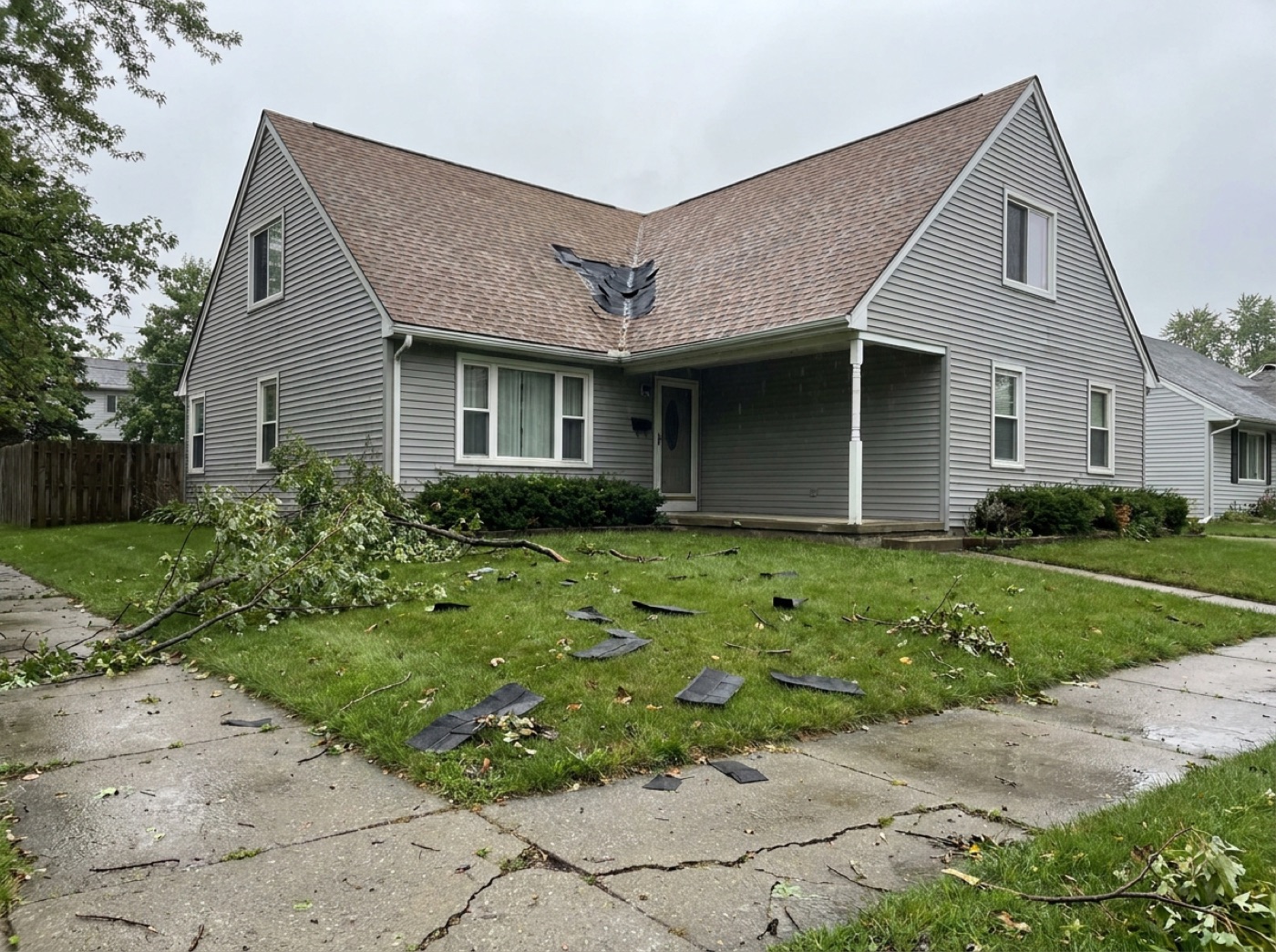
You just closed on a home in Macomb County, and somewhere in the first weeks, whether it is a fall inspection, a contractor pointing at the shingles, or your own walk through the attic after a rainstorm, you find roof damage that looks like it came from wind or hail, not from age. The natural question is who pays to fix it. The frustrating answer is that it often is not your homeowners insurance, and it is rarely a fast yes. Insurance claims are built around a specific storm, on a specific date, filed under whoever's policy was in force that day. If the damage happened before you owned the house, the claim generally belongs to the seller's old policy, not yours, even though you are the one looking at the shingles now. Below is why that is, what you can still do about it, and how to protect yourself the next time a roof surprises you.
01 / THE SHORT ANSWERWho the claim usually belongs to
In most cases, storm damage that happened before your closing date is the previous owner's insurance claim, not yours, because a homeowners policy is written to a specific date of loss and a specific policy that was in force on that date. Your new policy generally covers damage that occurs after its effective date, which is typically your closing date, not damage that already existed when you bought the house. That does not mean you have no options. It means the fix rarely starts with your insurer. It starts with the timeline: when the damage actually happened, what the seller knew and disclosed, and what your purchase paperwork says about the condition of the roof at closing.
Insurance claims attach to a date of loss and the policy that was in force on that date. A policy that starts at your closing does not reach backward to cover damage that predates it, no matter how recently you personally discovered it.
02 / THE PRINCIPLEWhy the date of loss decides everything
Every property insurance claim is tied to a date of loss, the day the covered event (a windstorm, a hail cell, a falling limb) actually damaged the roof. Adjusters do not just take a homeowner's word for when damage occurred; they look for physical evidence that dates it, because the wrong date means the wrong policy is paying.
How adjusters try to date roof damage
Fresh hail bruising and wind-torn shingle tabs expose granules and mat that have not yet weathered, and they look noticeably different in color and texture from the surrounding, sun-aged shingle field. Damage that is weeks or months old has already started to oxidize and blend in. Adjusters and roofing inspectors compare what they see on the roof against dated weather records for the area, and if there is a prior inspection report or listing photo on file, they compare against that too. None of this is exact, but it is enough to separate damage from last month's storm from damage that has clearly been there since before a home changed hands.
Why not knowing does not move the date
It is common, and understandable, to feel that discovering the damage should count for something. It does not change the underlying fact pattern. The date of loss is when the wind or hail actually hit the roof, not when a new owner happened to notice it. That is uncomfortable, but it is also the reason documentation matters so much in the sections below: if you cannot show when damage happened, an insurer has little reason to assume it happened on your watch.
03 / THE COVERAGE GAPWhy your new homeowners policy usually will not pay
Your new policy typically starts on the day you closed, and most policies are written to cover losses that occur while the policy is in force, not losses that predate it. If an adjuster's inspection points to damage that is clearly older than your policy, a claim filed under your name is likely to be denied as a pre-existing condition rather than a covered loss. Filing anyway, without disclosing what you know about the timeline, can also raise questions about the application itself, since most policies ask whether the insured is aware of any existing damage at the time coverage begins.
It is also worth being clear about what you cannot do: you cannot file a claim on the seller's old policy. You were never the insured party on that policy, so the carrier has no relationship with you and no obligation to speak with you about it. Only the policyholder, meaning the seller, can file or continue a claim under a policy that was theirs. If that claim was already open when the sale happened, our companion guide on selling a house with an open roof claim walks through how proceeds and repairs are supposed to be handled between a seller and a buyer, and why they rarely transfer automatically with the deed.
Calling the previous owner's insurance company yourself rarely produces a payout. You are not the policyholder, and privacy rules generally keep the carrier from discussing someone else's policy with you at all. Any resolution has to run through the seller, your purchase agreement, or your own policy, not a cold call to their old carrier.
Does title insurance help here
It is a fair question, since title insurance is the other policy every buyer walks away from closing with. Generally, no. Title insurance protects against defects in ownership, such as liens, boundary disputes, or a break in the chain of title, not against the physical condition of the roof. A storm-damaged shingle field is a property-condition issue, and property condition is exactly what a standard home inspection and the seller's disclosure are supposed to surface before closing, not something a title policy is designed to catch or pay for afterward.
04 / BEFORE CLOSINGDocumenting the roof before you close
The cheapest way to avoid this entire problem is catching it before you own the house. A roof-specific inspection during your due diligence or inspection contingency period, separate from a general home inspector's walk of the shingles from the ground, gives you dated, written evidence of the roof's condition on a specific day, before closing. If damage exists, that inspection becomes the anchor point for every conversation that follows: with the seller, with your agent, and with your own insurer if you decide to buy the house anyway with a credit or repair commitment negotiated up front.
Ask directly whether the seller has filed or discussed any storm or roof-related insurance claims on the property, and get the seller's disclosure statement in writing rather than relying on a verbal answer during a walkthrough. If a claim was ever filed, ask when, for what, and whether it was resolved. None of this guarantees a clean answer, but a documented question on the record matters later if it turns out the answer was not accurate.
A rough ballpark on repair or replacement cost is also useful leverage at the negotiating table, even before an inspector has been on the roof. Our cost calculator runs the same published ranges used across this site against your roof's rough size, so you can walk into a credit negotiation with a realistic number instead of a guess, and ask for a repair credit or a price reduction that actually matches what the fix is likely to cost.
05 / AFTER CLOSINGWhat you can still do after closing
If you already own the house and the damage surfaced after the fact, you still have a few hedged paths worth pursuing, none of them guaranteed, all of them stronger with documentation.
Follow up on the seller's disclosure
Michigan sellers generally complete a disclosure statement about known defects, and roof condition and known damage are commonly part of that form. If evidence suggests the seller knew about storm damage and did not disclose it, that is a real estate and legal question, not an insurance one, and it belongs with a real estate attorney rather than a roofer. Our guide on selling a house with an open insurance claim covers the seller-side obligations in more depth.
Get a second opinion that establishes the damage clearly
An independent roof inspection with dated photographs, taken as soon as you notice the problem, does two things at once. It tells you honestly whether you are looking at a repair or a full replacement, and it creates your own timeline evidence, which matters if the question of who knew what and when ever gets revisited. If your own insurer denies a claim on the grounds that the damage predates your policy, our guide on a preexisting-damage claim denial walks through what that denial typically means and the limited paths that remain.
Build the timeline while it is still fresh
Photograph the damage the day you find it, note the date in writing, and save any communication with your agent, inspector, or the seller about the roof. If a specific storm event is suspected, matching your discovery against public weather records for that date strengthens the case either way. Our guide on how to prove when storm damage happened goes through the evidence adjusters and attorneys actually look at.
The roof does not know who owns the house. The paperwork is what decides whose policy answers for it, which is exactly why the paperwork is where this gets solved.
Whatever the outcome on coverage, the roof itself still needs an honest answer. If the damage turns out to need a repair, most repairs in Macomb County run $350 to $3,200. If it has gone further and a full replacement is the right call, most asphalt replacements run $9,000 to $18,000, with most homes landing $12,000 to $16,000. A free inspection tells you which one you are actually facing, independent of how the coverage question resolves, and you can start that conversation any time from our storm damage estimator.
06 / LOCAL CONTEXTMacomb County's recent storm history
Timing questions like this are not hypothetical here. Macomb County was included in federal disaster declaration DR-4757 after the severe wind storms of August 2023, and that kind of widespread event is exactly the sort of thing forensic dating looks for: a documented storm, on a known date, that can be matched against roof damage discovered later. If you bought a home in the county after that event and are now finding damage that could plausibly trace back to it, the seller's ownership timeline relative to August 2023 is one of the first things worth establishing, alongside your own inspection evidence.
None of this is legal or insurance advice, and every policy and every sale is different. A real estate attorney can speak to your specific purchase agreement and disclosure obligations, and your insurer's adjuster has the final word on your own policy. What we can do is document the roof itself honestly, with photos, and give you a straight answer on repair versus replacement so that piece of the decision is not a mystery while the rest gets sorted out.
- Storm damage that predates your closing is generally the previous owner's claim, tied to the policy in force on the actual date of loss.
- Adjusters date damage using shingle color, granule condition, and matching against known storm events, not just what a homeowner reports.
- You cannot file a claim on the seller's old policy; you were never the insured party on it.
- A pre-closing roof inspection and a documented disclosure conversation are the cheapest protection against this problem.
- After closing, a dated independent inspection plus the seller's disclosure record are your strongest evidence, and a free inspection tells you the repair or replacement number either way.
Questions we hear most
Usually not, if the damage happened before your policy's effective date, which is typically your closing date. Insurers generally cover losses that occur while the policy is in force, and adjusters can often tell from the condition of the shingles whether damage is older than that. It is still worth an independent inspection to document exactly what you are looking at before you decide how to proceed.
Then you may be looking at an open or unresolved claim situation rather than a new one. Claim proceeds generally do not transfer automatically with the deed, and you cannot file or continue a claim under a policy that was never yours. Our guide on selling a house with an open roof claim covers how that situation is typically supposed to be handled between buyer and seller.
Dated photographs taken as soon as you notice the damage, a written independent inspection report, and any pre-closing inspection records all help establish a timeline. Matching the damage against known local storm events, such as the August 2023 windstorms covered by FEMA disaster declaration DR-4757, can also support or undercut a claimed date of loss. None of this guarantees a specific outcome, since every policy and every claim is different.
- FEMA, disaster declaration DR-4757-MI, Michigan severe storms of August 2023 (Macomb County designated). fema.gov/disaster/4757
- Insurance Information Institute, consumer explainers on homeowners policy coverage, deductibles, and the claims process. iii.org
- Haag, engineering-based damage assessment methodology for hail and wind effects on roofing. haagglobal.com