
JUMP TO A SECTION
A tree limb landing on a roof is an impact event, the same physics as hail, just concentrated in one spot instead of spread across the whole field. That single point of force can crack decking, snap a rafter, or punch a slow leak that will not show up for weeks, and none of that is obvious from the driveway. Macomb County has plenty of mature trees close to rooflines, and after any high wind, ice, or storm, a limb strike is one of the most common calls we get. This guide is a safe, ground-level and attic-level way to read what happened before anyone gets near the roof itself, along with a plain line between when it is an emergency and when it can wait for a scheduled look.
01 / THE SHORT ANSWERWhat to do in the first few minutes
First, stay out from under the limb and away from the area of roof it is resting on. A branch that looks settled can shift, and a compromised deck underneath it can give way without warning. Second, look for the two things that actually matter: is water actively getting into the house right now, and does the roof or the framing underneath look structurally different than it did yesterday. Everything else, cleanup, removal, exact repair scope, comes after those two questions are answered.
- Stand off from directly under the limb and the section of roof it landed on
- Check for active water inside the house, ceilings, walls, light fixtures
- Look for sag in the roofline from a safe distance across the yard or street
- Check the attic underneath the impact point for daylight, cracks, or fresh moisture
- Photograph what you can see before anything is moved, for your own record
This guide covers assessment only: how to tell what a limb strike did to the roof and the structure underneath it. It does not cover tree removal cost, which is a tree service's trade, or how to file an insurance claim, which our storm and insurance claims guide walks through separately.
02 / SAFETY FIRSTStay clear before you assess anything
The instinct after a limb comes down is to get close and see what happened, and that instinct is exactly backward. A limb that punched through the roof surface may be the only thing currently holding a cracked section of decking in place. Moving it, or even walking underneath it to get a better look, can turn a contained problem into a bigger one, and it puts a person under a load that has already proven it can fail.
What a safe assessment looks like
A safe assessment happens from a standoff distance: across the yard, from a neighboring window, from the street. It does not involve climbing on the limb, climbing a ladder to the roofline, or going into an attic space directly beneath the impact until you know the framing above it is sound. If any part of the roof deck looks like it has dropped, bowed, or opened up around the limb, treat that area as off limits and call for an inspection rather than testing it yourself.
Large limbs and whole trees
A large limb, or a tree that has come down partially onto the roof and is still rooted or leaning against another structure, is a different category entirely. That combination of unstable weight and roof damage is a job for a tree removal crew working alongside a roofer, not a homeowner with a ladder. Keep the area clear, keep kids and pets away from it, and let the professionals sort out the sequence of removal and roof stabilization together.
There is a sequencing question that matters here too: which comes first, removing the limb or stabilizing the roof. In most cases the tree crew removes the load safely, cutting it down in sections rather than pulling the whole thing off at once, and the roofer follows to assess and, if needed, tarp the exposed area. Trying to shortcut that order, for example dragging a limb off a roof yourself to see what is underneath, risks turning a contained hole into a larger one, or dropping additional weight through a section the limb was still partly supporting.
03 / FROM THE GROUNDReading the roof from a safe distance
Before anyone gets close to the impact point, a lot can be learned by standing back and looking at the whole roofline. This is the same ground-level read we recommend after any storm, and it applies just as much to a single falling branch as it does to a wind event across the whole roof.
Look along the ridge and the slope for any section that appears to dip, wave, or sit lower than the roof around it. A healthy roof deck is flat and straight from eave to ridge; a section that has cracked or partially given way under an impact often shows as a subtle dish or dent in that line, sometimes only visible in certain light. Also look for obvious surface damage right at the impact point: torn or missing shingles, exposed underlayment, or a hole where the limb made contact. None of that requires climbing anything, just a careful look with the naked eye or a pair of binoculars from the yard.
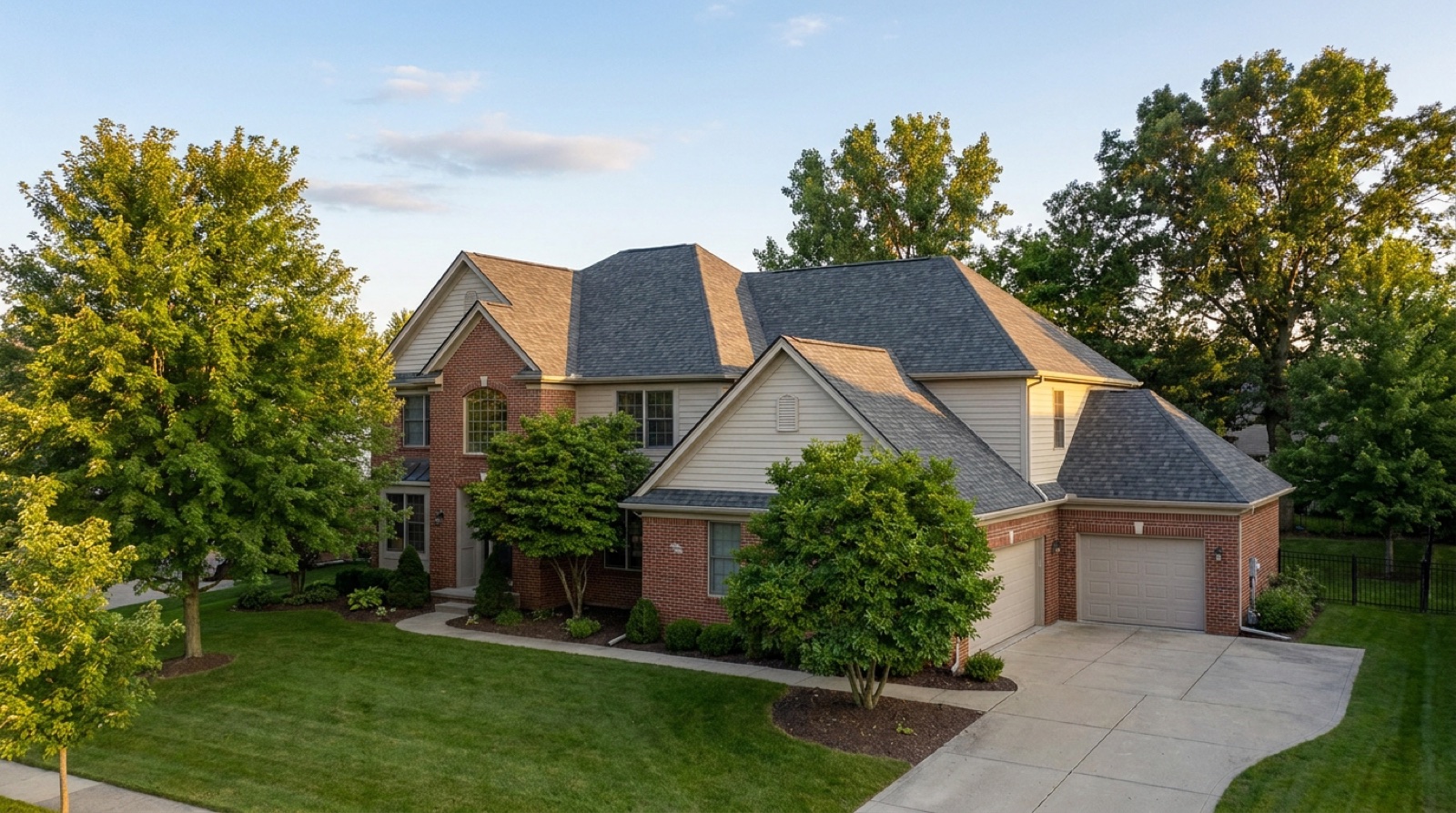
Debris tells its own story too. A branch large enough to leave a dent in the lawn or crack pavers on impact was carrying real force when it hit the roof, even if the visible shingle damage looks minor. Note the size and apparent weight of what fell, and where exactly on the roof it landed, both details worth mentioning if an inspector or an adjuster ends up looking at the roof later.
Gutters, downspouts, and the ground below
The gutters and downspouts nearest the impact are worth a quick look too, since a falling limb often clips them on the way down or pulls them loose where it finally came to rest. A dented, bent, or separated gutter section near the strike point is a strong sign of how much force traveled through that part of the roofline, and it also tells you where water will misbehave the next time it rains until the gutter is fixed. Photograph any granules or shingle fragments you see collected in the gutter or on the ground beneath the impact area as well; scattered granules from the point of contact are a sign the shingle mat itself absorbed a real hit, not just a graze.
04 / THE ATTIC CHECKWhat the attic tells you that the roof will not
The attic, checked from underneath rather than the roof from above, is often the safest and most informative place to assess a limb strike. If the framing above the impact point is intact, the attic access is usually safe to use normally. If you can see that the roofline outside has visibly sagged or opened at the impact point, skip the attic entirely and call for an inspection instead of testing the space underneath a compromised deck.
What to look for with a flashlight
Standing on solid attic flooring or joists, well clear of the section directly under the impact, look for daylight coming through the deck where none should be, which usually means the limb punched through the sheathing itself. Look at the rafters and the underside of the deck for fresh cracks, splintered wood, or a rafter that appears to have shifted out of line with the ones next to it, all different from old, weathered wood grain. Fresh moisture, whether it is a wet spot on insulation, water beaded on a nail tip, or a damp patch on the underside of the deck, tells you water is already getting in, even if nothing is dripping into the living space yet.
Why a modest branch can still crack a rafter
A rafter fails from concentrated force in one spot, not from total weight distributed evenly, so a branch that does not look especially large or heavy from the yard can still deliver enough point-load impact to crack a rafter or split decking, particularly if it fell any distance before landing. Framing damage does not always announce itself with a visible dip in the roofline right away either; sometimes the first sign is a crack visible only from inside the attic. That mismatch, between how a branch looks from the ground and what it may have done structurally, is exactly why the attic check matters even when the roof from outside looks like it got off easy.
05 / SIZE ISN'T THE STORYSmall branch, real damage: why size can mislead
It is tempting to judge urgency by the size of what fell, and that instinct fails often enough to be worth correcting directly. A small branch that fell from high in a mature tree can carry enough velocity to crack a shingle mat or split a section of decking on impact, the same way a small hailstone moving fast enough bruises a shingle that a slower, larger one would not. A larger limb that fell a short distance from a low branch may do more cosmetic damage and less structural harm. Neither size nor the amount of visible mess in the yard is a reliable stand-in for what actually happened where the wood met the roof.
This is also why a puncture from storm debris deserves its own careful look rather than a quick glance, because the entry point of a slow leak is frequently smaller and less dramatic than the branch that caused it. Our storm debris puncture guide goes further into how these small openings behave and why they can take weeks to show up as a stain inside the house. Whatever the branch looked like coming down, the honest read comes from checking the roof deck and the attic together, not from eyeballing the limb.
The angle of impact matters as much as the size of the branch. A limb that falls nearly flat spreads its force across a wider patch of shingles and is more likely to leave scuffed or torn shingle surfaces than a true puncture. A limb, or worse a broken-off stub end, that comes down point first concentrates that same force into a much smaller area, which is exactly the shape of impact most likely to punch through both the shingle layer and the decking beneath it. If you can see how the branch landed, whether it is lying flat or wedged in at an angle, that detail helps an inspector know where to look first.
A puncture from a falling limb does not always leak on the first rain. Water can travel along the underside of the deck and down a rafter for weeks before it ever reaches a ceiling, so a dry house today does not rule out a real opening from the impact. If you noticed the branch fall but have not had the roof checked, that gap is worth closing sooner rather than later.
06 / THE URGENCY LINEWhen this is an emergency, and when it is not
The line is simple, and it is worth keeping in mind before adrenaline or a messy yard makes everything feel urgent. An active opening, meaning you can see daylight through the deck, water is actively dripping inside, or a hole is open to the weather, is an emergency. That gets 24/7 emergency tarping to stop the water while the permanent repair is scheduled. Tarping is the emergency response; it is not the fix itself.
Everything short of an active opening, meaning the limb has been cleared or is stable, there is no daylight through the deck, and no water is currently entering, is not an emergency in the middle-of-the-night sense. It is still worth documenting with photos and getting a proper inspection scheduled, because a cracked rafter or hairline puncture that is not leaking yet can absolutely leak with the next rain. The urgency there is getting it checked soon, not getting someone on a roof at 2 a.m.
Either way, the same free inspection covers it, the same one described on our storm damage service page. We check the impact point on the roof surface, the decking underneath, and the attic side of the framing, and we tell you plainly whether it is a straightforward repair, something bigger, or nothing at all. If the roof came through clean, that is exactly what we will say. For the wider self-check after any storm, not just a limb strike, our attic check after a storm guide and our first 72 hours guide walk through the fuller routine.
If the inspection turns up a repair, the standard repair canon of $350 to $3,200 applies, the same ranges published on our pricing page. You can start the process any time from the storm damage estimator on our homepage, or by calling directly.
- Stay clear of the limb and the section of roof it landed on until someone qualified has looked at it.
- A ground-level read of the roofline plus a careful attic check, both done safely, tell you more than climbing the roof would.
- Fresh cracks, shifted rafters, or daylight through the deck seen from the attic mean real structural impact, even if the roof looked fine from outside.
- Branch size does not reliably predict damage; a small limb falling far can crack decking, and a large limb falling a short distance may not.
- Active daylight or dripping water is an emergency and gets 24/7 tarping; everything else gets documented and a free inspection.
Questions we hear most
Only if there is an active opening, meaning daylight through the deck, water actively entering, or a visible hole. That gets 24/7 emergency tarping. If the limb has been cleared and no water is entering, it is not a middle-of-the-night emergency, but it is still worth a free inspection soon, since a crack or small puncture can start leaking with the next rain.
Yes. A modest branch falling from height can deliver enough concentrated force at the point of impact to crack decking or a rafter, similar to how a small, fast-moving hailstone can bruise a shingle a slower, larger one would not. Branch size and mess in the yard are not a reliable measure of what happened to the structure underneath.
No. Stay off the limb and off the roof, since a compromised deck can give way without warning. A safe assessment is done from the ground at a distance, from inside the attic if the framing above it looks intact, and then confirmed by a professional inspection rather than a homeowner on a ladder.
- FEMA, disaster declaration DR-4757-MI, Michigan severe storms of August 2023 (Macomb County designated). fema.gov/disaster/4757
- Michigan Residential Code, 2015 edition, adopted with Michigan amendments by the LARA Bureau of Construction Codes, in effect since February 8, 2016. michigan.gov/lara: code books
- National Roofing Contractors Association, technical guidance for steep-slope roof systems. nrca.net