
JUMP TO A SECTION
Most homeowners have never heard the word cricket used to describe part of a roof, and most never need to, right up until a chimney starts leaking in a spot no one can explain. A cricket, also called a saddle, is a small triangular ridge built into the roof deck directly behind a chimney, on the uphill side where water and snow would otherwise have nowhere to go but straight into the brick. It is not decorative. It is a diverter, and on the wrong chimney its absence is the entire reason a roof leaks.
This guide covers what a cricket is built from, the width threshold that decides whether code requires one, how a missing or failed cricket actually shows up on the ceiling and in the attic, and what it takes to get one added, whether that happens as a standalone repair or as part of a full roof replacement.
01 / THE SHORT ANSWERWhat a chimney cricket actually does
Picture water running down a roof slope and hitting a wide, flat obstruction sitting square in its path, which is exactly what a chimney is from the water's point of view. Without help, that water pools against the chimney's uphill face, and in winter, snow does the same thing on a larger scale, drifting and packing against the brick instead of sliding past it. A cricket splits that flow before it ever reaches the chimney, sending water and snow around both sides instead of letting either one dead-end against the masonry.
Roofers use the two words interchangeably. Either way, it is the small peaked structure built into the deck immediately behind a chimney, sloped away from the brick on both sides so water and snow are redirected around it rather than stopped by it.
The chimneys most likely to need one are the wide ones, because a narrow chimney simply does not present enough of an obstruction to matter. A slim single-flue chimney lets water slip past its sides easily enough on its own. A wide chimney, common on Macomb County colonials and older brick-front homes, blocks a much larger share of the roof's water path, and that is exactly the case a cricket is built to solve.
Snow raises the stakes on this in a way that rain alone does not. A Michigan winter can pile drifting snow against the up-slope side of a wide chimney for weeks at a time, and each melt-and-refreeze cycle sends water into the same joint over and over rather than one hard rain that drains and stops. A cricket that only barely handles a summer downpour can still fall short once real snow load and repeated freeze-thaw cycles get added to the picture, which is one reason a Macomb County chimney sized right at the margin deserves a second look rather than an assumption that it has never leaked yet settles the question.
02 / THE ANATOMYWhat a cricket is made of
The framing underneath
A cricket starts as carpentry, not roofing. A short ridge of framing lumber is built directly behind the chimney, high point against the brick, sloping down and outward on both sides to meet the existing roof deck. The result is a small two-faced peak, similar in shape to a miniature roof of its own, tucked into the larger roof at exactly the point where the chimney would otherwise create a flat catch basin for water and snow.
The flashing that actually keeps it dry
Framing alone does not stop water. The cricket has to be sheathed and then flashed into the same watertight system that wraps the rest of the chimney, tied into the step flashing running up each side and the counterflashing set into the mortar joints above it. Our chimney flashing guide covers how that step and counter system works on the rest of the chimney perimeter; a cricket is simply an added surface that same system has to wrap correctly. A cricket built with good carpentry but sloppy flashing at the tie-in points is not actually solving the water problem, it is just moving where the leak starts.
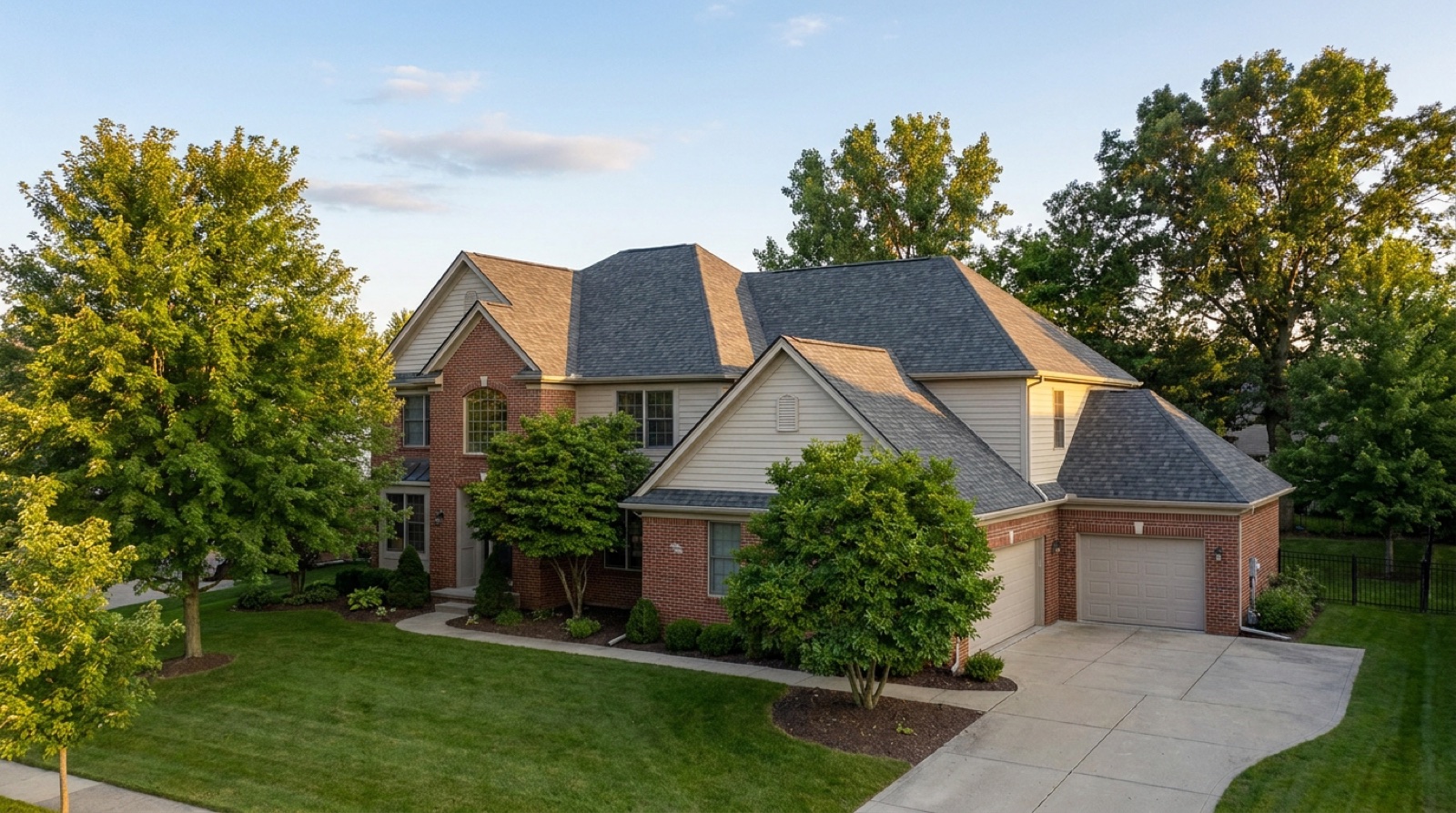
The size of the cricket itself scales with the chimney. A modest saddle a few inches tall is enough behind a narrower chimney with a gentle roof pitch. A wide chimney on a steep roof, where snow load and water volume both increase, calls for a taller, more pronounced cricket to actually clear the water and snow rather than just slow it down.
The metal itself matters too. Cricket flashing is usually formed from the same material as the rest of the chimney's step and counterflashing, most often aluminum or galvanized steel on a typical Macomb County home, sometimes copper on older or higher-end construction. Mixing incompatible metals directly against each other at the tie-in points can accelerate corrosion over time, which is one more reason a cricket retrofit is best planned alongside the existing flashing rather than patched in with whatever material happens to be on the truck that day.
03 / THE THRESHOLDWhen code requires a cricket, and when it is optional
Residential building code does not leave this entirely to a contractor's judgment. There is a width threshold, measured parallel to the ridge line, above which a cricket or saddle is required rather than a nice-to-have. The commonly cited trigger point is a chimney (or any similarly wide roof penetration) wider than about 30 inches across; below that width, code generally treats flashing alone as sufficient, and a cricket becomes a judgment call based on pitch and exposure rather than a strict requirement. The exact section and current adopted language are worth verifying against Michigan's currently adopted residential code edition, noted in the sources below, since local jurisdictions and code cycles can shift the specifics.
A house built decades before its current code edition can have a wide chimney with no cricket and never have been in violation at the time. That does not mean the physics changed. A wide chimney without a cricket collects water and snow the same way whether or not it was required when the house was built, which is exactly why so many older Macomb County homes develop this exact leak.
This is also a detail that is easy to miss from the ground. A cricket sits low behind the chimney and is often no taller than a few inches, so it can be hard to tell from a driveway whether one is there at all, let alone whether it is correctly flashed. Tear-off is the moment this gets confirmed with certainty, because the old roofing has to come off the deck before new material goes down, and at that point a contractor can measure the chimney width directly and tell you plainly whether code calls for a cricket on your specific chimney.
04 / THE LEAK SIGNATUREHow a missing or failed cricket actually shows up
A cricket problem has a specific and fairly recognizable signature, once you know to look for it. Staining concentrates at the chimney's uphill shoulder, the side facing up-slope where water and snow are arriving and have nowhere to go without a cricket to split the flow. That is different from a leak at the sides or the downhill face of the same chimney, which usually points to step flashing or counterflashing instead, a distinction worth naming out loud to whoever is diagnosing it, because the two problems are fixed differently.
From inside the house, the tell is a ceiling or wall stain that shows up specifically on the up-slope side of a chimney chase, sometimes worsening after heavy rain or a fast snowmelt rather than appearing gradually. In the attic, the same pattern reads as staining or damp decking concentrated directly behind the chimney rather than spread evenly around its perimeter, which is a useful clue even before anyone gets on the roof.
Timing is a clue as well. A leak that only shows up during a hard, wind-driven rain often points somewhere else on the chimney, the counterflashing or the step flashing on the sides. A leak that follows a big snowmelt, especially after a stretch of drifting snow visibly built up behind the chimney, points much more strongly at a cricket that either is not there or is not shedding water the way it should. Neither symptom is proof on its own, which is exactly why a physical look at the chimney settles it faster than guessing from the pattern of stains alone.
A leak at the sides of a chimney is usually a flashing problem. A leak concentrated at the uphill shoulder, with a wide chimney above it, is usually a missing or failed cricket.
It is worth comparing this to two other small-part leaks that get confused with chimney trouble. A cracked pipe boot, covered in our plumbing vent boot leak guide, produces a stain that tracks to a specific plumbing stack rather than a chimney. A failed skylight, covered in our skylight leak guide, produces staining traced to the skylight opening itself. All three are small components doing an outsized amount of water management work, and all three get misdiagnosed when someone assumes the nearest big flat leak source, usually the shingles themselves, before checking the actual detail work.
05 / NEXT STEPSGetting a cricket added or repaired
Adding a cricket to an existing chimney that never had one, or rebuilding a cricket whose flashing has failed, is carpentry and flashing work concentrated in one small area of the roof, and it typically falls within our general repair range of $350 to $3,200, with the exact number depending on chimney width, roof pitch, and how much of the surrounding flashing needs to come apart to tie the new work in correctly. Larger or more complex work, such as a wide chimney on a steep roof with deteriorated flashing on all sides, can run higher, which is exactly why a firm number waits for someone to actually measure it.
The more common path, though, is a cricket getting added or corrected during a full roof replacement, since tear-off already exposes the deck and the chimney flashing at the same time. Folding cricket work into that project avoids a second mobilization and a second set of flashing tie-ins, and it means the new cricket is flashed into brand new step and counterflashing rather than woven into an aging system elsewhere on the roof. Our roof replacement cost guide covers the full range and the seven factors that set your price on that larger project.
Either way, the honest starting point is the same: someone needs to actually look at the chimney, measure it, and check the existing flashing before any number means anything. Our inspection is $0 with no obligation, and it covers the chimney, the cricket if one exists, and the rest of the roof's flashing details at the same time. If you already know a reroof is on your horizon, the instant estimator gives you a ballpark in about 60 seconds using the same ranges published on our honest pricing page, and the cost calculator runs those same ranges against your specific roof size.
- A chimney cricket, also called a saddle, is a small framed peak built behind a chimney that splits water and snow around it instead of letting either pool against the brick.
- Building code sets a width threshold, commonly cited at about 30 inches measured parallel to the ridge, above which a cricket is required rather than optional; verify the exact section for your current code edition.
- A missing or failed cricket shows a specific signature: staining concentrated at the chimney's uphill shoulder, distinct from side-flashing leaks.
- Adding or rebuilding a cricket typically runs $350 to $3,200 as a standalone repair, and larger or complex work can run higher.
- Tear-off during a full roof replacement is the easiest moment to confirm whether your chimney needs one and build it into new flashing correctly the first time.
Questions we hear most
A chimney cricket, also called a saddle, is a small triangular ridge of framing built into the roof deck directly behind a chimney. It slopes away from the chimney on both sides, splitting water and snow around the brick instead of letting either pool against its uphill face.
No. Building code generally requires one only once a chimney exceeds a certain width, commonly cited at around 30 inches measured parallel to the ridge line. Narrower chimneys usually shed water past their sides without one, though a steep roof or heavy snow exposure can still make a cricket worth adding.
Look for staining concentrated at the chimney's uphill shoulder, on the ceiling below or on the attic decking directly behind the chimney, rather than spread evenly around its perimeter. That pattern is different from a side-flashing leak, and a free inspection can confirm which one you actually have.
- Michigan Residential Code, 2015 edition, adopted with Michigan amendments by the LARA Bureau of Construction Codes, in effect since February 8, 2016. michigan.gov/lara: code books
- National Roofing Contractors Association, technical guidance for steep-slope roof systems. nrca.net
- InterNACHI Standards of Practice for home inspections (scope of a generalist roof inspection). nachi.org/sop