
The Quiet Death of Felt Paper: An Underlayment Market Note
Underlayment never shows up in a driveway photo of a finished roof. It sits under every shingle on every roof we tear off, and over the last decade or so the black paper rolls that used to cover it have largely given way to a synthetic sheet. This note is about why that switch happened and what it means when it shows up as a line on your quote.
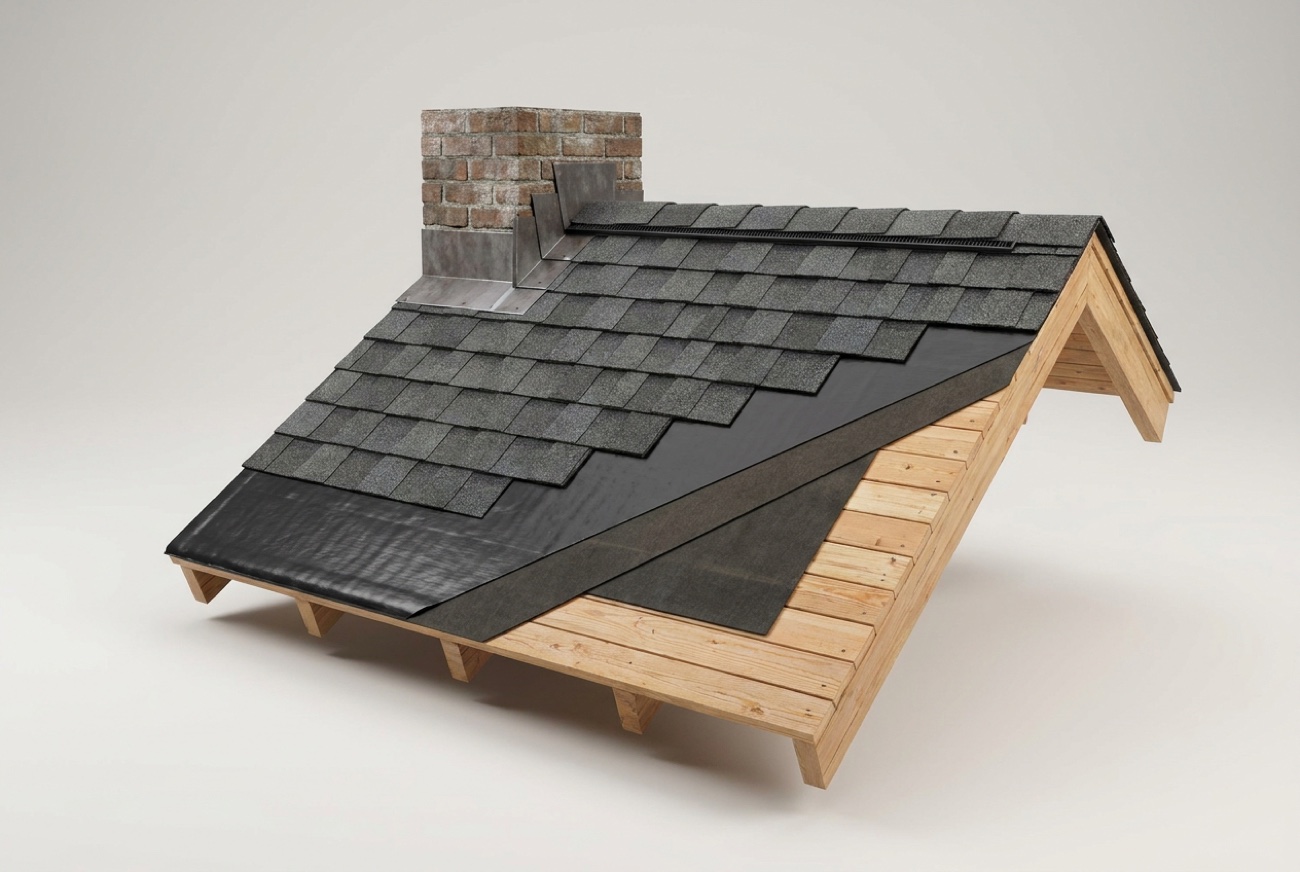
Underlayment is the layer nobody sees and everybody depends on. It rolls out over bare decking before a single shingle goes down, and its only job is to keep water out if wind, ice, or a failed shingle ever lets water past the surface layer. For most of the twentieth century that layer was asphalt-saturated felt, the black paper rolls still called tar paper by habit. On a growing share of the reroofs we do in Macomb County today, it is a synthetic sheet instead. This is a record of that shift, not a head-to-head spec sheet, because the honest story is more about how a trade changes its habits than about any one product being declared the winner.
01 /What felt paper was, and why it was the default
Traditional felt underlayment is an organic or fiberglass mat saturated with asphalt, sold by the roll in either a lighter 15 pound weight or a heavier 30 pound weight, the numbers referring to the historical weight of a roll at a standard size. It was cheap, it was familiar to every crew, and it did the job for generations of roofs. It also had known weaknesses that any experienced roofer could recite: it absorbs water and can wrinkle or tear if it gets wet and dries out before shingles cover it, it degrades faster in direct sun if a job gets delayed, and the rolls themselves are heavier and more awkward to carry up a ladder than what replaced them.
02 /Why synthetic underlayment took over
Synthetic underlayment is a woven or spun polypropylene or polyethylene sheet, engineered rather than saturated, and manufacturers began pushing it into the market in the 1990s and 2000s as an alternative to felt. Trade publications and manufacturer literature have tracked a steady swing toward synthetic on new construction and reroofs since. The reasons crews give for preferring it are practical rather than marketing driven. A roll of synthetic covers more square footage per roll than felt at a similar weight, which means fewer trips up the ladder and fewer seams on a given roof. It does not absorb water the way felt does, so a surprise rain shower mid-tearoff is far less likely to ruin a partially covered deck. It resists tearing underfoot, which matters on a job site where a crew is walking the same underlayment all day while nailing shingles. And it tends to hold its printed layout lines more clearly, which helps crews keep straight, consistent courses.
None of that means felt disappeared overnight, and none of it means felt is now unacceptable. Many manufacturer shingle warranties still list felt as an approved underlayment alongside synthetic, and some jobs, especially certain low-slope or code-driven applications, still call for a felt or self-adhered membrane specifically. What changed is the default habit on the truck: crews who once stocked felt because that is what the supply house carried now more often stock synthetic because that is what the supply house carries.
03 /What the switch means on a Macomb County reroof
On most quotes we write today, synthetic underlayment is simply what is included, not an upgrade line item, because it has become the standard stock material rather than a premium option. If a homeowner specifically wants felt for a particular reason, that is a conversation worth having before tearoff, not a surprise afterward. The material choice sits inside the same canon numbers regardless: a full asphalt replacement in Macomb County runs $9,000 to $18,000, with most homes landing $12,000 to $16,000, and underlayment is one input in that range rather than a separate charge that swings the total on its own.
If you want to know which underlayment a contractor plans to use, ask before the shingles go down, not after. A written quote that names the underlayment product, not just "felt" or "synthetic" as a generic term, is a sign the crew is being specific about what is going on your roof rather than reciting a habit.
Michigan's freeze-thaw winters make the underlayment layer matter more here than in milder climates, because it is the backup plan every time ice or wind-driven rain gets past a shingle course. Ice and water shield membranes at eaves and valleys are a related but separate product from field underlayment, and both are addressed in our broader roof replacement coverage. If you want to see how underlayment choice fits into a full quote before anyone climbs a ladder, the 60 second cost calculator walks the same inputs we use, and the full pricing breakdown covers every canon range on this site.
We inspect roofs across Macomb County for free, at no cost or obligation, and if we find a roof with brittle, torn, or water-damaged underlayment during a tearoff, we photograph it and explain what we are replacing it with before we close the deck back up. Materials keep evolving; what does not change is that we tell you what is actually under your shingles, in writing.
- Manufacturer technical and warranty literature for the major asphalt shingle lines: GAF (gaf.com), Owens Corning (owenscorning.com), and CertainTeed (certainteed.com).