
Field Notes: Sterling Heights Colonials and Their Roofs
Sterling Heights grew up in waves, and the roofs from each wave fail in their own particular way. This note is what we keep finding on the colonials and split-levels that make up so much of the city: bigger planes, more valleys, and attics that were never given enough air to breathe.
Sterling Heights is the largest city in Macomb County, and it did not get that way in one building boom. The city grew explosively from the 1960s through the 1980s, when its population jumped from about 15,000 to over 117,000, with newer construction filling in through the 1990s and the oldest homes, classic 1940s to 1950s ranches, concentrated on the south end. What that history leaves on our inspection ladder is a lot of colonials and split-levels, two-story massing with steep, tall roof planes and, on many of the split-levels, a stepped roofline that creates valleys where a simpler ranch would have none. This note is what those roof shapes tend to show us in 2026, apart from any single service page.
01 /The shapes we keep seeing
A colonial's roof is usually a straightforward gable, but a big one: two full stories under a steep pitch means more total roof area and a longer run for water to travel before it reaches a gutter. A split-level does something different. It staggers roof planes at different heights to match the staggered floor levels inside, and every place two planes meet at an angle is a valley. A ranch might have one or two; a split-level can have several, plus the dormers some Sterling Heights colonials picked up in later additions, and every dormer adds its own small valley and its own step-flashing detail that has to be done correctly or not at all.
None of that makes either style a worse-built house. It means more places for water to concentrate and more area exposed to weather, so ordinary wear tends to show up sooner and in more places at once. Our breakdown of what drives replacement cost, including how complexity changes labor, lives on the roof replacement service page.
02 /Why the valleys go first
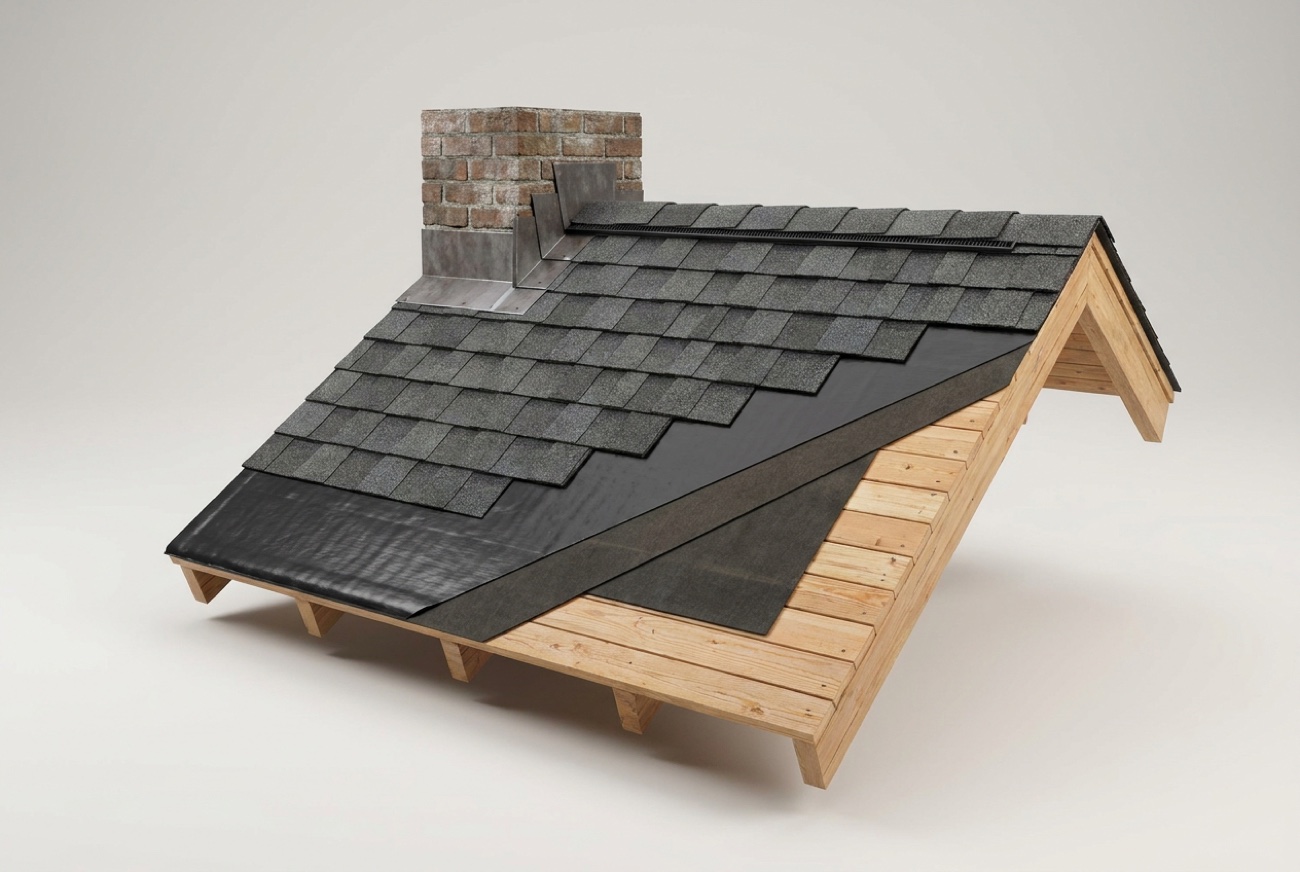
A valley is the lowest point of two converging roof planes, so it is where the most water funnels together before reaching an eave. That makes the valley liner and the shingles overlapping it the hardest working material on the whole roof. Two things typically wear a valley out ahead of the rest of the field: aging valley flashing that has corroded or cracked, and granule loss on the shingles that line it, which happens faster there because more water crosses that spot than anywhere else on the slope. A stepped split-level roofline can also shed sliding snow from an upper plane onto a lower one, so the lower valley takes a mechanical beating a single-plane ranch never sees.
On an inspection, the valley is one of the first places we look, and usually the first place we find granule loss, a cracked seal, or a lifting flashing edge. Caught early, that is repair-scale work in the $350 to $3,200 range (larger or more complex repairs can run higher). Left alone through another Michigan winter, a failed valley is how a small leak becomes a stained ceiling in a room nobody uses in summer, often where the leak is noticed last.
03 /The ventilation shortfall we still find
The second pattern is less visible from the ground and more common in the era of colonials that make up a large share of Sterling Heights. A two-story colonial has a large attic volume relative to its ventilation openings if the original builder used a couple of gable vents and modest soffit intake, common building practice decades ago and often insufficient by the balanced intake-and-exhaust standard the industry uses today.
Undersized ventilation does not announce itself the way a leak does. It shows up as a hotter summer attic that quietly bakes the underside of the shingles from below, shortening their service life years before their rated age, and as trapped winter moisture that condenses on the deck and can feed rot or mold nobody sees until a reroof pulls the old material off. Because the effect is slow, it rarely surfaces until an inspection, or until a homeowner notices the attic feels unusually hot or musty in humid weather.
A shingle warranty assumes the attic behind it is ventilated the way the manufacturer's install specs expect. A colonial with two gable vents and light soffit intake may be quietly voiding some of that warranty math every summer, independent of anything wrong with the shingles themselves. It is worth asking directly during any inspection or estimate whether the attic's intake and exhaust are balanced, not just whether vents are present.
04 /What we look for on these roofs
On a Sterling Heights colonial or split-level, our free inspection checks every valley for granule loss, flashing condition, and shingle wear, and checks the attic for signs the original ventilation is undersized: heat buildup, staining on the underside of the deck, or insulation drifted over soffit vents. The inspection is $0, no cost or obligation, and we photograph what we find so the file speaks for itself either way. If it needs a valley repaired or the ventilation brought to a balanced system, we price that plainly, and if you are looking at full replacement, the 60 second cost calculator gives an honest range, with asphalt running $9,000 to $18,000 on most homes.
This note is specific to what we see on Sterling Heights colonials and split-levels, not a substitute for the full picture. Our Sterling Heights roofing hub covers the city's services end to end, and if you want the ranch-heavy comparison case, our field notes from Warren's ranches show how differently a simpler roof profile ages next door. If the shape of your roof includes stepped planes and multiple valleys, we can meet your adjuster on site if a storm claim is involved, and we answer 24/7 for emergency tarping if water is actively coming in.
- Macomb Roofing Pros, Roof Replacement Service Page