
Class 3 vs Class 4 Shingles: Are Impact Ratings Worth It?
A steel-ball drop test, a modest upcharge, and an insurance catch most homeowners never hear about.
If you plan to stay in your home long term and your part of Macomb County sees real hail exposure, Class 4 is usually worth the modest upcharge, provided your carrier confirms any discount and its exclusions in writing. If you are budget constrained, selling soon, or your insurer's discount comes bundled with a cosmetic-damage exclusion that guts the benefit, Class 3 remains an honest, code-compliant choice.
The impact rating printed on a shingle wrapper is not marketing filler. It refers to a real laboratory test, and the result changes how a shingle holds up when hail hits a Macomb County roof. Every supplier will tell you Class 4 is the upgrade worth having. What they often leave out is the modest cost gap, the fact that not every insurer rewards the upgrade the same way, and the fine print some carriers attach to any discount they do offer. This page runs the honest comparison: what the test actually measures, what Class 4 costs on top of a standard asphalt job, and what to verify with your own carrier before you pay extra for a rating you may not get credit for.
01 /What "impact rated" actually means
Class 3 and Class 4 are not marketing tiers invented by a single manufacturer. They come from UL 2218, the Underwriters Laboratories standard for impact resistance of prepared roof covering materials, and the test itself is direct: a steel ball is dropped from a set height onto a shingle sample, and inspectors check the underside of the shingle and its mat for cracking or splitting after two strikes to the same spot. UL 2218, the Standard for Impact Resistance of Prepared Roof Covering Materials covers the exact ball weights, drop heights, and pass and fail criteria for each class. In practical terms, Class 4 is rated to survive the hardest, highest drop the standard tests, which is the closest a laboratory can get to simulating a serious hailstone hitting your roof at speed.
A shingle earns its class rating from the mat and coating underneath, not just the granules on top. Most Class 4 shingles use a heavier fiberglass mat, a rubberized or polymer modified asphalt layer, sometimes called SBS modified, or both, which lets the shingle flex and absorb an impact instead of cracking. Class 3 shingles use a more conventional asphalt formulation that costs less to manufacture but has less give when something hard strikes it. Neither rating has anything to do with wind performance, which is tested and rated separately; a shingle can carry a strong wind rating and only a Class 3 impact rating, or the reverse.
02 /Class 3 vs Class 4: what actually changes on your roof
Side by side on a shelf, a Class 3 and a Class 4 shingle from the same product line often look identical: same color blend, same dimensional profile, same install method and nailing pattern. The difference lives inside the shingle, and it shows up after a hailstorm rather than before one. Cosmetic granule loss and mat bruising can happen to both classes in a serious hailstorm; what Class 4 is built for is stopping that bruising from turning into a crack that lets water in over the following seasons.
Warranty terms sometimes move with the impact rating too, since a manufacturer confident enough to sell a Class 4 line typically backs it with coverage at least equal to the comparable Class 3 product. Confirm the specific warranty language for the shingle you are quoted rather than assume; the exact terms vary by manufacturer and product line, and we would rather you read the real document than take a generic promise from any roofer, including us.
03 /The cost gap in Macomb County
Here is the number homeowners actually want first. A typical asphalt shingle replacement in Macomb County runs $9,000 to $18,000, and most homes land between $12,000 and $16,000, whether the shingle chosen carries a Class 3 or a Class 4 rating. Upgrading to a Class 4 line adds a real but modest amount to the material cost of the job. On most roofs that upcharge does not push the project into a different pricing category; it simply moves you toward the upper half of the same range you would already expect to pay for architectural asphalt in this county.
Class 4 shingles typically add a modest amount to material cost on top of a standard architectural asphalt job. On most Macomb County homes, that upgrade keeps the project inside the same $9,000 to $18,000 asphalt range rather than creating a new price tier. Your written quote will show the Class 3 and Class 4 line item side by side so you can see exactly what the upgrade costs on your own roof.
For context, here is the full canon of what roofs cost in Macomb County across systems:
| System | Typical Installed Range |
|---|---|
| Asphalt shingle replacementMost homes $12,000 to $16,000; Class 3 or Class 4 | $9,000 to $18,000 |
| Metal replacement (standing seam, stone-coated steel) | $18,000 to $30,000 |
| Tile and slate replacement | $20,000 to $36,000 |
| Flat and commercial (TPO, EPDM, modified bitumen) | $9,000 to $16,000 |
| Roof repairsLarger or complex repairs can run higher | $350 to $3,200 |
04 /Hail exposure in Macomb County and southeast Michigan
Macomb County sits inside the same severe thunderstorm belt as the rest of southeast Michigan, with the active season typically running spring through late summer, and hail is one of the more common causes of the shingle damage claims we document during storm and insurance inspections. Not every year brings a significant hail event, and not every property in the county takes a direct hit even in a rough storm season, which is exactly why this decision is conditional rather than universal. A home on a shaded interior street with mature tree cover is not carrying the same practical hail exposure as a home on an open lot with a wide, unobstructed roof.
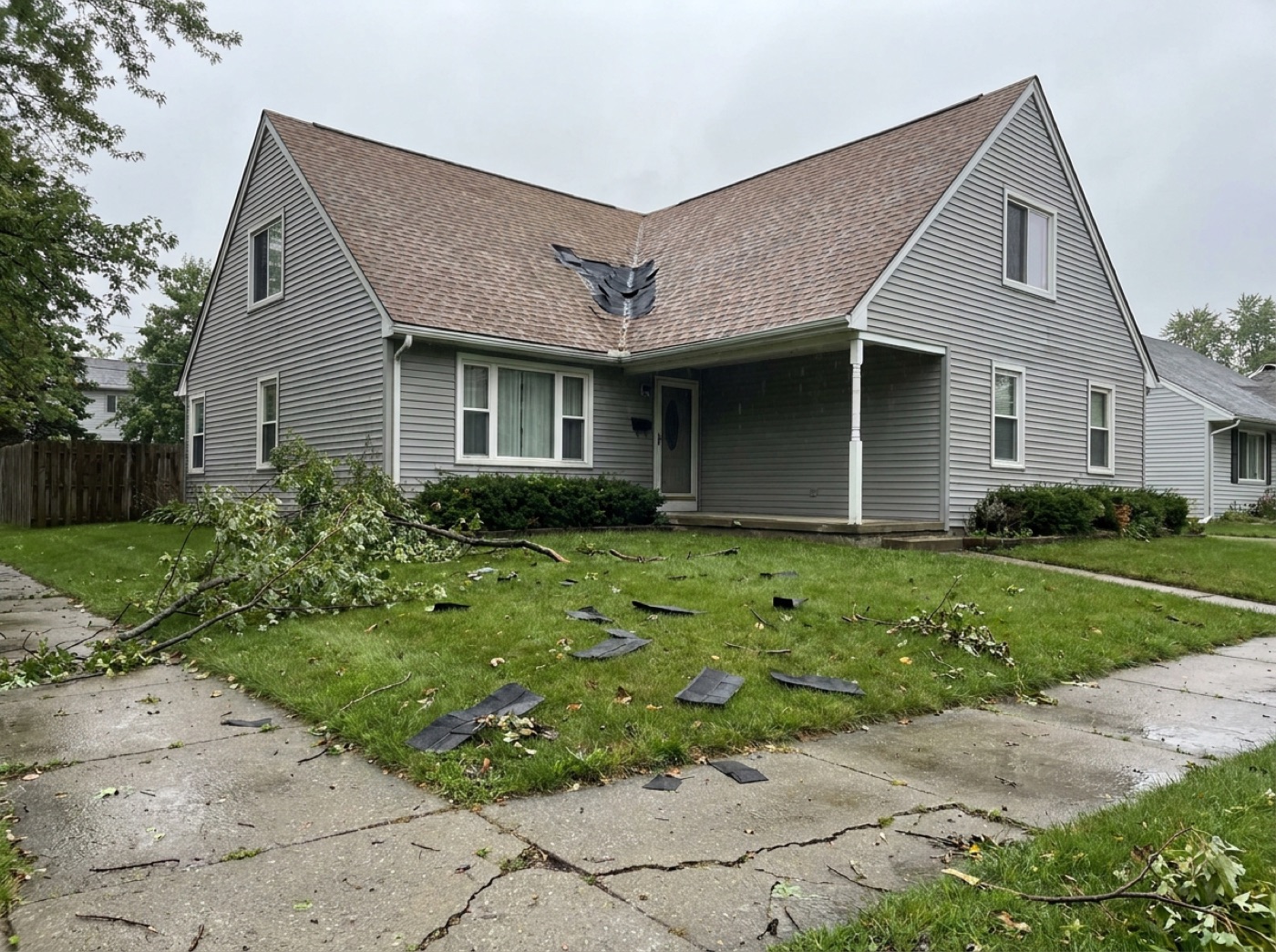
Macomb County was also part of the federal disaster declaration DR-4757 after the August 2023 wind event, a reminder that severe weather here is not hypothetical. That declaration was tied to wind rather than hail specifically, but the underlying point holds for both perils: a roof built to a higher impact standard has more margin whenever a serious storm actually arrives, whatever form it takes.
05 /The insurance discount question, and the catch
Ask any roofer about Class 4 shingles and the conversation drifts to insurance within the first minute, because some carriers have offered a premium discount for impact-resistant roofing in hail-prone states. Whether that discount is currently available, from which specific carriers serving Michigan, and at what size, is not something we will guess at: Whether a discount is offered, by which Michigan carriers, and with what cosmetic-damage exclusions attached should be checked against your own policy and carrier before you factor a discount into the upgrade math at all.
Some carriers that offer an impact-resistant shingle discount pair it with a cosmetic-damage exclusion, language that can limit or waive coverage for damage that affects appearance but not function, which is close to the exact kind of hail bruising a Class 4 shingle is designed to shrug off without cracking. In practice, that can mean a homeowner earns a small ongoing discount while giving up a future claim for cosmetic hail damage. Discount availability and exclusion language vary by carrier and change over time, so ask your agent to show you the exact policy language in writing before you count on either one.
None of this makes Class 4 a bad idea. It means the insurance angle is a bonus to verify in writing, not the reason to buy the upgrade on its own. The roof itself, not the discount, is what actually protects your house through the next hailstorm.
06 /Manufacturers and product lines
Most major shingle manufacturers now sell at least one Class 4 line alongside their standard Class 3 architectural product, and the two are usually installed the same way by the same crews, so choosing Class 4 rarely changes your contractor options or your install timeline. Brand-specific performance differences, not just impact class, are a big part of why we wrote a separate GAF vs Owens Corning comparison for homeowners weighing manufacturers alongside shingle class.
Whichever manufacturer you choose, ask specifically whether the exact product you are quoted carries a Class 4 rating under UL 2218, since not every line from a given manufacturer does, even within the same general shingle family and color offering.
07 /Financing the choice
Because the Class 4 upcharge is modest relative to the full project cost, it rarely changes the monthly payment in any meaningful way once the whole roof is financed rather than paid in a single sum.
A $13,500 roof financed on a 10 year term at 9.9% APR runs about $178 per month. Subject to approval; illustration only, and your rate, term, and the exact cost of a Class 4 upgrade may differ.
Financing is available on both impact class options, subject to approval, and your written quote will put the Class 3 and Class 4 numbers side by side so the monthly difference, not just the sticker difference, is part of the decision. See the full picture, including size adjustments for your own home, on our cost calculator.
08 /How to decide
Strip away the marketing and the decision comes down to three honest questions. How long do you plan to own this house, since a longer horizon gives the upgrade more storms to pay off? How exposed is your specific property to hail, given shade, orientation, and the general storm pattern for your part of the county? And what does your own insurance carrier put in writing about a discount and any exclusion attached to it, since a verbal mention from an agent is not the same as policy language you can hold them to?
- Class 3 and Class 4 both meet code; Class 4 simply survives more of the same UL 2218 hail test.
- The upcharge is modest and typically stays inside the $9,000 to $18,000 asphalt range.
- Insurance discounts and cosmetic exclusions vary by carrier: ask for the exact language in writing.
- A long ownership horizon and higher hail exposure both push the math toward Class 4.
If you want the fuller picture on the base shingle decision before layering an impact class on top of it, our architectural vs 3-tab comparison and the roof replacement service page cover the rest of the ground. See a size-adjusted number for your own home on the pricing sheet. Or skip the reading: the inspection is free either way, and we will show you Class 3 and Class 4 pricing for your actual roof before you decide anything.
Questions we hear most
It depends on how long you plan to stay and how exposed your roof is to hail. The upcharge is modest and typically keeps the project inside the same $9,000 to $18,000 asphalt range, so for a longer-term homeowner in a hail-exposed part of the county it is often worth it. For a shorter horizon or a lower-exposure property, Class 3 remains a reasonable, code-compliant choice.
Not automatically, and not everywhere. Some carriers offer a discount for impact-resistant roofing, and some of those discounts come with a cosmetic-damage exclusion that can limit future hail claims. Discount availability and any attached exclusions vary by carrier and change over time, so confirm the exact terms with your own agent in writing before counting on a discount as part of your decision.
UL 2218 is the Underwriters Laboratories standard that drops a steel ball from a set height onto a shingle sample and checks the underside of the shingle for cracking after repeated strikes to the same spot. Class 4 shingles pass at the toughest height the standard tests, which is the closest a lab test gets to simulating a serious hailstone impact.