
JUMP TO A SECTION
Every flat-roof product carries a service-life number, and every one of those numbers is a best case measured on a well-drained roof that somebody actually looks after. In a Michigan freeze-thaw climate, the gap between that best case and what a neglected roof actually delivers can be a decade or more. So the honest answer to how long your flat roof will last is not a single figure off a spec sheet; it is a range set by the membrane, then widened or narrowed by drainage, install quality, foot traffic, and maintenance. This guide gives you the general industry ranges for each system, then spends most of its time on the factors that decide where inside that range your roof actually lands. Every flat and commercial roof we work on in Macomb County falls inside the same published range on our honest pricing sheet, and knowing where your current roof sits on its own timeline is the first step to spending that money at the right moment instead of a panicked one.
01 / THE RANGESHow long each flat roof system lasts
Here are the honest service-life ranges for the low-slope systems we see on Macomb County buildings, presented as general industry ranges rather than promises. Treat the low end as what a poorly drained, unmaintained roof delivers and the high end as what a well-built, well-kept roof reaches. Most real roofs live somewhere in the middle.
| SYSTEM | TYPICAL SERVICE LIFE | WHAT PUSHES IT TO THE TOP |
|---|---|---|
| TPO (thermoplastic) | About 15 to 30 years | Thicker mil, sound welds, good drainage |
| EPDM (rubber) | About 20 to 30 years | Taped seams, adhered attachment, low traffic |
| Modified bitumen | About 15 to 25 years | Two-ply install, granulated cap, maintenance |
| Coating restoration | Adds roughly 10 to 20 years | Applied to a dry, sound roof; recoated on cycle |
Two things stand out from that table. First, the ranges overlap heavily, which is exactly why arguing about which membrane lasts longest in the abstract is a waste of time; a well-installed, well-drained roof of any of these systems will outlast a cheap, ponding one of any other. Second, a coating is not a fourth membrane with its own lifespan. It is a way to extend the roof you already have, and its added years depend entirely on the condition of the assembly underneath it, a point we come back to in section five. If you are still choosing between systems for a new roof rather than aging an existing one, our Michigan flat roof winter guide covers how each behaves through the freeze-thaw season that sets these numbers.
A membrane rated for 30 years is rated for 30 years on a roof that drains, was installed by a skilled crew, and gets inspected twice a year. Put the same sheet over standing water, a starved insulation package, or a rushed install, and it can fail in half that time. The number on the spec sheet is a ceiling, not a floor.
02 / THE VARIABLESThe five factors that swing the number
If the membrane sets the range, these five factors decide where in the range your roof lands. Every one of them matters more in Michigan than it would in a mild climate, because our winters test a roof harder than our summers do.
1. Drainage
Drainage is the single biggest lever on flat-roof lifespan, and it is the one most owners never think about until it is too late. A roof that sheds water cleanly can wear its membrane for the full service life. A roof that ponds punishes every system: standing water accelerates membrane aging, and in a freeze-thaw climate that water does not just sit there, it freezes into ice lenses that expand and grind at seams and flashings through the whole winter, then thaws and refreezes and does it again. Standing water is also the fastest way to void a membrane warranty, so a ponding roof loses years and coverage at the same time. Fixing drainage is not optional maintenance; it is the difference between a roof that reaches its rated life and one that quietly loses a decade.
2. Install quality
The seam is where a membrane roof lives or dies, and the seam is only as good as the crew that made it. A TPO weld set at the wrong temperature or run too fast looks fine on day one and opens up three winters later. An EPDM seam glued instead of taped is on the clock from the start. Modified bitumen laps that were not fully adhered fishmouth and let water track underneath. None of this is visible from the parking lot, which is why the cheapest bid so often becomes the shortest-lived roof. Install quality is not a factor you can inspect after the fact; it is bought at the time of installation, and it is the main reason a warranty backed by a real workmanship guarantee is worth paying for.
3. Attachment method and insulation
How the membrane is fastened to the building, fully adhered, mechanically attached, or ballasted, changes how it handles wind uplift and thermal movement, both of which are constant stresses in Michigan. The insulation package underneath matters just as much: a roof insulated to current code sheds heat evenly and manages the condensation that a freeze-thaw climate drives up into the assembly, while a thin or wet insulation layer cooks the membrane from below and rots the deck. When wet insulation is the real problem, no membrane on top of it will reach its rated life, which is why a commercial reroof is really a decision about the whole assembly, not just the sheet.
4. Foot traffic
A roof that nobody walks on except for a yearly inspection ages very differently from one with technicians servicing rooftop units every week. Foot traffic and dropped tools are how single-ply membranes get punctured, and every puncture is a leak waiting for the next rain. High-traffic roofs argue for the redundancy of a two-ply modified bitumen system, a thicker single-ply mil, or protective walkway pads along the service routes to the equipment. Matching the roof's toughness to how much it actually gets walked on is one of the cheapest ways to protect its lifespan.
5. Maintenance
This is the factor entirely within your control, and it is the one that most reliably adds years. A roof that is inspected twice a year and after major storms, with drains cleared and small seam problems caught while they are still small, routinely reaches the top of its range. A run-to-fail roof that nobody touches until the ceiling stains reaches the bottom. The difference is not luck; it is a maintenance file. Our flat roof maintenance checklist lays out the seasonal walkthrough that keeps a roof on the long end of its lifespan.
The membrane sets the ceiling; drainage, install quality, and maintenance decide how close you ever get to it. A neglected premium roof loses to a maintained ordinary one every time.
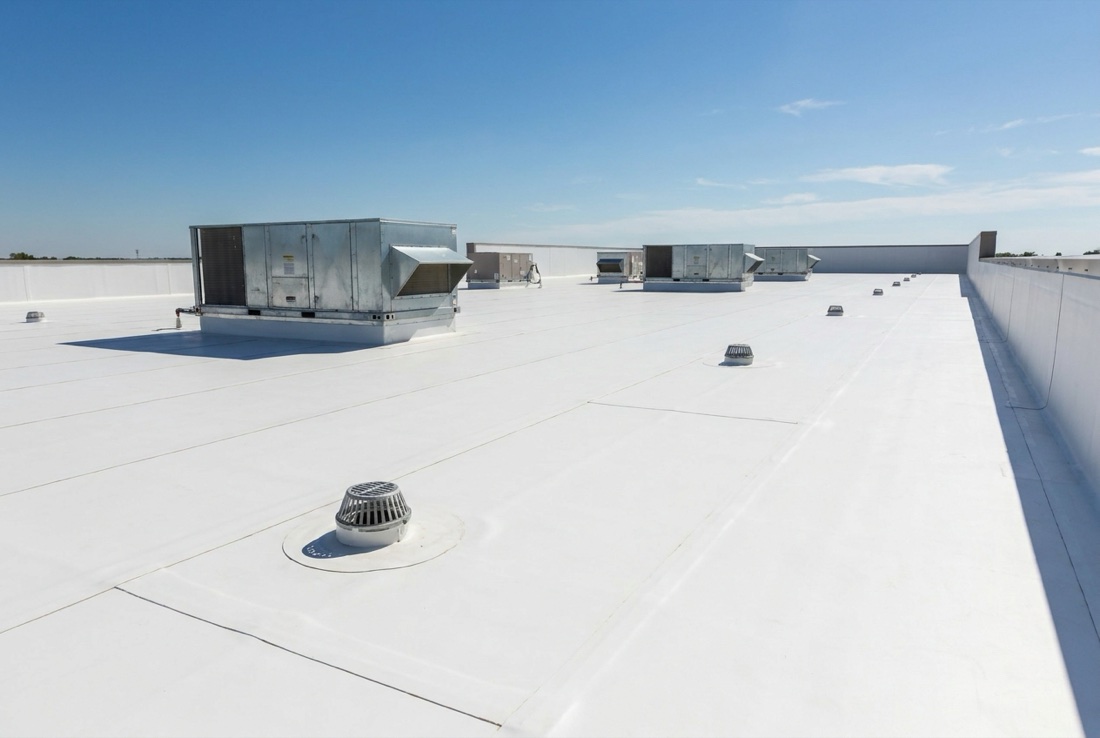
03 / END OF LIFESigns your flat roof is near the end
A flat roof rarely fails all at once. It tells you it is nearing the end for a year or two first, if you know what to read. These are the signals that a roof is closing in on the bottom of its range, roughly in the order they tend to show up.
- Seams opening or lifting. The first thing to go on any membrane roof. TPO welds that peel at the edge, EPDM seams that bridge or pull apart, mod-bit laps that fishmouth. When several seams are failing at once rather than one isolated spot, the roof is aging out, not just injured.
- Widespread surface aging. On EPDM, a chalky, cracked, or alligatored surface. On TPO, crazing and a surface that has gone brittle. On mod-bit, granule loss down to the asphalt. Isolated is a repair; everywhere is a signal.
- Ponding that never fully dries. Water that still stands more than a day or two after rain means the drainage has given up, and standing water at end of life accelerates everything else.
- Blisters, ridges, and soft spots. Blisters where the membrane has delaminated, ridging where insulation boards have shifted, and soft, spongy areas underfoot that signal saturated insulation below.
- Repairs that no longer hold. When a patch fails right next to last year's patch, you are no longer fixing a roof, you are subsidizing one. That is the clearest financial signal that replacement money is now the better spend.
- Interior evidence. Fresh stains, drips, or musty smells appearing in more than one place, especially after the roof has passed its rated age, usually mean the assembly is wet rather than the leak being local.
One caution specific to flat roofs: the leak you see inside is almost never directly below the breach. Water enters at a seam or penetration, runs along the deck or insulation, and surfaces rooms away. So a single interior stain does not tell you how much of the roof is failing; only getting on the roof does. If the symptoms above are showing up and the roof is anywhere near its rated age, an inspection is how you learn whether you are looking at a targeted repair or a countdown to replacement.
04 / THE STRETCHThe maintenance that adds years
Because maintenance is the factor most within your control, it is worth being concrete about what actually stretches a flat roof's life. None of this is exotic; it is the difference between a roof that reaches the top of its range and one that quits early.
Keep the water moving
Clear drains, scuppers, and gutters every fall and after big storms, before winter turns a clogged drain into a sheet of ice. More flat roofs are lost to blocked drainage than to any membrane defect, because standing water is what turns a Michigan winter into a seam-destroying machine. If the roof ponds even with clear drains, the fix is drainage correction, crickets, added drains, or tapered insulation, not another season of hoping.
Inspect twice a year, and after storms
A spring and fall walkthrough, plus a look after any major wind or hail event, catches the small seam separation or lifted flashing while it is a fifteen-minute repair instead of a wet-insulation replacement. Photograph a baseline so you can see what is changing year over year. This twice-yearly plus after-storms rhythm is standard industry practice for a reason: it is the cheapest years a roof ever buys.
Fix the small things while they are small
A failing pitch pocket, a lifted flashing, a single open seam, a cracked pipe boot: each is cheap and fast on the day you find it, and each becomes an assembly-soaking, deck-rotting problem if it waits a winter. Reseal sealant joints before they fully dry out, re-secure loose flashing, and reweld or patch seams as they appear. Small, timely repairs are what keep a roof off the replacement schedule.
Protect the traffic lanes and consider a coating on time
If people walk the roof to service equipment, add walkway pads so foot traffic is not slowly wearing the membrane thin. And on a roof that is still structurally dry but aging on the surface, a coating applied at the right moment, before the membrane fails rather than after, can add a decade for a fraction of a tear-off. The timing is everything, which is the whole subject of our coating versus replacement guide.
05 / THE DECISIONRepair, restore, or replace: what it costs
Knowing where your roof sits on its lifespan points to one of three moves, and they cost very different amounts. If the roof is mid-life and the problem is local, you are in repair territory. Flat roof repairs run $350 to $3,200, and larger or complex repairs can run higher; a reweld or a flashing rebuild lands in that band and buys back years on an otherwise sound roof. The honest first question is always whether you are even in a replacement conversation, because a roof with plenty of life left does not need a new membrane.
If the roof is aging on the surface but the assembly under it is still dry, restoration is the middle path: a coating that adds a decade or so without a tear-off, but only on a roof that passes a moisture check first. Seal wet insulation inside the assembly and you just rot the deck faster, so this move lives or dies on the condition underneath. If the insulation is saturated, the seams are failing across the whole roof, or the deck itself is going, restoration is off the table and full replacement is the honest answer.
is where most Macomb County flat roof replacements land when the roof has reached the end of its life, whichever membrane comes next. Larger or unusual roofs can run higher, and the only way to price yours is to get on it. Run a ballpark in about 60 seconds with the instant estimator or the cost calculator.
For owners spreading the cost of a replacement, financing is available subject to approval. As an illustration only, a $13,500 project financed over a 10 year term at 9.9% APR works out to about $178 per month. That example is not an offer of credit; your rate, term, and approval depend on the lender and your credit profile. The useful way to frame it: a roof at the end of its life does not fail on your schedule, and putting the decision on a monthly line item now is often cheaper than the interior damage, wet insulation, and emergency calls that come from waiting for it to fail on its own.
There is only one way to know where your flat roof actually sits on its timeline, and it is not this chart or any online estimate. It is someone on the roof, checking how it drains, whether the insulation is dry, how the seams are holding, and how many years the assembly has left. Our inspection is $0 with no obligation, and if the roof has years of life in it and only needs a repair or a coating, that is exactly what we will tell you. Browse the rest of the guides library or head back to the roofing services hub to see how flat work fits the full lineup, and if you have an active leak in the meantime, 24/7 emergency tarping holds it off until a real repair can be scheduled.
- Flat roof service life is a range, not a number: TPO about 15 to 30 years, EPDM about 20 to 30, modified bitumen about 15 to 25, with coatings adding roughly 10 to 20 to a sound roof.
- Drainage, install quality, attachment and insulation, foot traffic, and maintenance decide where in that range your roof actually lands.
- Standing water is the fastest way to lose years and void a warranty in a freeze-thaw climate.
- End-of-life signals cluster: failing seams across the roof, widespread surface aging, ponding, soft spots, and repairs that stop holding.
- Repairs run $350 to $3,200 and full flat replacements $9,000 to $16,000; a free inspection is the honest way to tell which conversation you are in.
Questions we hear most
It depends on the membrane and, more than that, on how the roof drains and how it is maintained. As general industry ranges, TPO lasts about 15 to 30 years, EPDM about 20 to 30 years, and modified bitumen about 15 to 25 years, with a coating adding roughly 10 to 20 years to a roof that is still dry and sound. A ponding or unmaintained roof lands at the low end; a well-built, well-kept one reaches the top. A free inspection is the only way to know where yours sits.
Standing water is the biggest culprit, especially in a freeze-thaw climate where ponded water freezes into ice that grinds at seams all winter and voids most warranties. Poor install quality, thin or wet insulation, heavy foot traffic, and skipped maintenance also pull years off the number. Most of these are avoidable, which is why a maintained roof so reliably outlasts a neglected one of the same material.
Repair while the roof is mid-life and the problem is local; flat roof repairs run $350 to $3,200. Replace once the seams are failing across the whole roof, the insulation is saturated, ponding no longer clears, or repairs stop holding, which usually coincides with the roof reaching its rated age. Full flat and commercial replacements in Macomb County run $9,000 to $16,000 installed, and a free inspection is the honest way to decide between the two.
- FEMA, disaster declaration DR-4757-MI, Michigan severe storms of August 2023 (Macomb County designated). fema.gov/disaster/4757
- SPRI, single-ply and low-slope roofing industry standards. spri.org
- Michigan Uniform Energy Code (state adoption of the International Energy Conservation Code), LARA Bureau of Construction Codes. michigan.gov/lara: code books