
JUMP TO A SECTION
Cut a continuous slot along the peak of a roof, cap it with a low profile vent, and shingle over it, and you have built the single most common exhaust point on a Michigan house. A ridge vent has no fan, no moving parts, and no power draw. It works entirely off two forces the roof itself generates: warm attic air rising toward the highest point in the structure, and wind moving across the ridge line creating a zone of lower pressure right where the slot sits. Get the hardware and the matching intake right and it is close to maintenance-free for decades. Get either one wrong and the same vent that should be drying out your attic can sit there doing almost nothing.
01 / THE SHORT ANSWERWhat a ridge vent actually does
A ridge vent is a continuous exhaust opening running the length of the roof's highest ridge line, shielded by a low cap and internal baffles so it sheds rain and blowing snow while still passing air. It is the exhaust half of a two-part system. Air has to enter somewhere low, almost always at the soffit under the eaves, travel up the underside of the roof deck, and exit at the ridge. Remove either half and the other one is just a hole in the roof. The ridge vent does not pull air on its own; it gives the air already moving through the attic a place to leave once it gets there.
A ridge vent is the exit for a soffit-to-ridge airflow loop. It only performs as well as the intake feeding it, the slot's actual open area, and the shape of the roof it is cut into.
02 / THE PHYSICSThe pressure differential a ridge vent rides
Two forces put air in motion through an attic, and a ridge vent is built to use both. The first is the stack effect: warm air is less dense than cold air, so heat that leaks up from the living space into the attic rises and collects at the highest point of the roof, building slightly higher pressure there relative to the cooler air at the eaves. The second is wind. Air moving across a ridge line accelerates over the peak the way it does over a curved surface, and that acceleration creates a zone of lower pressure right at the ridge, similar in principle to how air moves faster over the top of an airfoil. Lower pressure at the ridge and higher pressure at the soffit is exactly the gradient that pulls air up through the attic and out the slot, with or without wind, though wind noticeably speeds it up.
Neither force needs to be dramatic to work. Even on a still, sunny day the stack effect alone keeps a slow wash of air moving from soffit to ridge, because attic air is almost always warmer than outside air, summer or winter. Wind adds to that baseline draw whenever it blows across the roof, which is most of the time in southeast Michigan. The system is passive, self-adjusting, and asks nothing of the homeowner, which is exactly why it became the default exhaust choice over powered attic fans on most reroofs.
A powered attic fan, by contrast, has to be sized, wired, and eventually replaced, and it can create its own problems if it is oversized for the intake feeding it, pulling conditioned air out of the living space through ceiling gaps rather than just attic air from the soffit. A ridge vent sidesteps all of that by design. It moves less air per minute than a fan running at full speed, but it runs every hour of every day for the life of the roof without a switch, a motor, or an electric bill, which is a large part of why most reroofs in Macomb County default to it over a powered alternative unless the roof shape rules it out entirely.
03 / THE MATHNet free area: the number that actually matters
Not every inch of ridge vent is an inch of usable opening. The figure that matters is net free area, the actual unobstructed area air can pass through once you subtract the baffles, external mesh, and structural ribs built into the vent to keep out rain, insects, and wind-driven snow. Manufacturers publish this figure per linear foot of vent, and it varies by product line and profile height, which is why two ridge vents that look similar on a shelf can perform differently once installed.
This is also the number building code cares about. Michigan's residential ventilation requirement sizes the total net free ventilating area against the attic floor area, split between intake and exhaust, rather than just specifying a length of ridge vent. A short ridge on a big, complicated attic can be well within code on paper for total vent product installed and still be short on the net free area that ratio actually demands, which is one reason a competent estimator measures the whole roof rather than eyeballing the ridge.
04 / THE PARTNER SYSTEMWhy a ridge vent starves without matching soffit intake
A ridge vent cannot draw air from nowhere. If the soffit is blocked, painted shut, packed with blown-in insulation, or simply undersized relative to the ridge exhaust it is supposed to feed, the vent has almost no source to pull from. The pressure differential at the ridge still exists, but with little intake air available to move, the net result is far less airflow than the vent's rated capacity suggests. In the worst cases a starved ridge vent can even begin pulling air backward through itself in gusty conditions, briefly reversing the intended flow, because there is no steady upward column of soffit air to hold the pattern in place.
Ventilation guidance generally treats intake and exhaust as needing to be roughly balanced, not exhaust-heavy, and a ridge vent installed with no real look at the soffit underneath it is the single most common way that balance goes wrong on an otherwise good-looking reroof. Sizing the intake side correctly against the ridge vent's own net free area is exactly the kind of arithmetic our how many roof vents guide walks through in full.
A ridge vent with no soffit intake behind it is not a smaller vent. It is a hole with almost nothing to pull through it.
05 / ROOF SHAPEThe roof shapes that defeat a ridge vent
A ridge vent is only as good as the ridge it is cut into, and not every roof offers one worth the effort. A few shapes routinely undercut its performance even when the hardware and the soffit are both done right.
All-hip roofs with little to no ridge
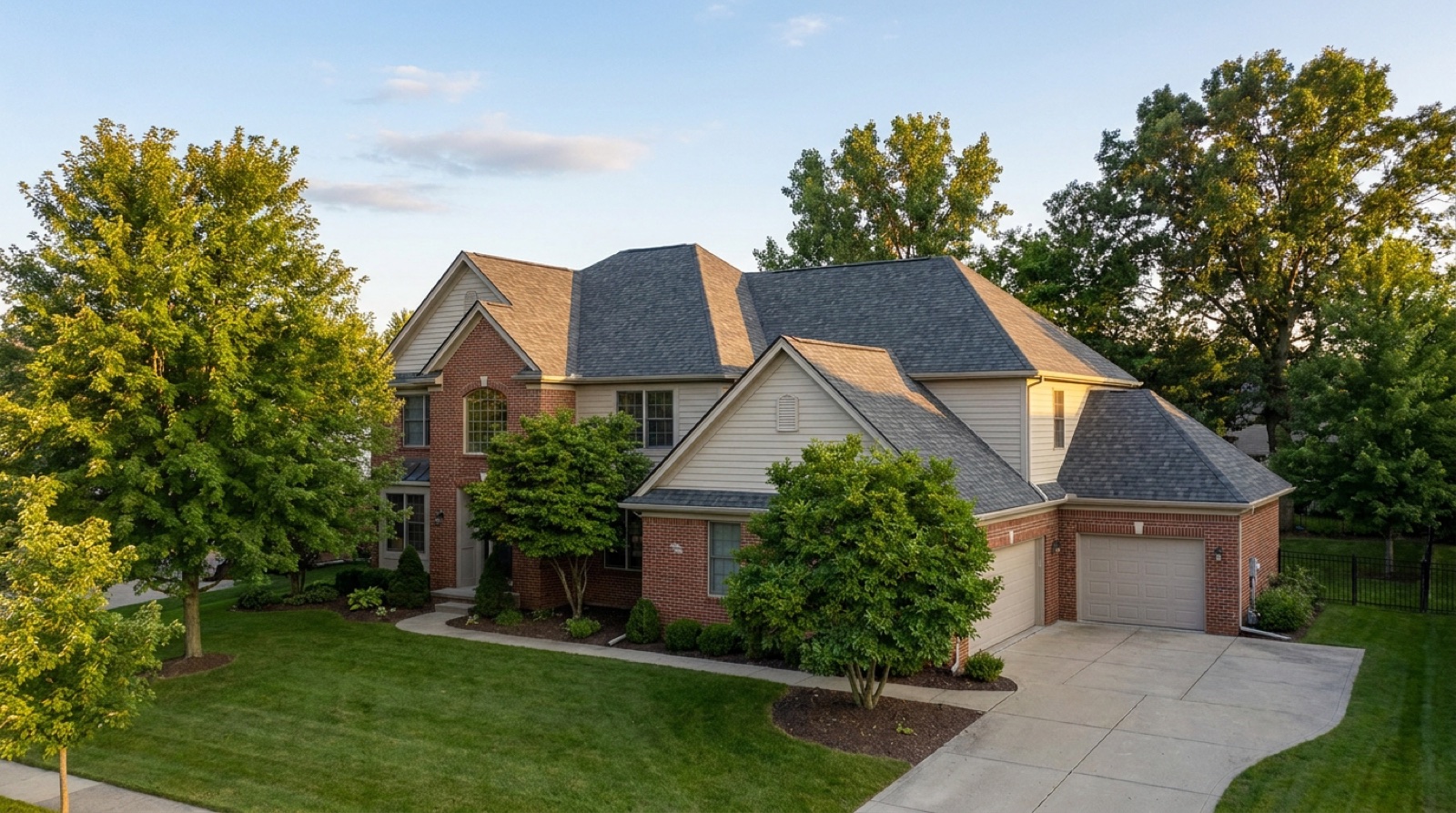
A true hip roof, where all four sides slope up to meet near a point or a very short peak, simply does not offer enough linear ridge to install a meaningful length of vent. Some hip roofs have almost no straight ridge at all. On these shapes, exhaust ventilation usually has to come from another source entirely, box vents or a different exhaust strategy sized to the attic's actual net free area needs, rather than forcing a token ridge vent onto a few feet of peak.
Short or broken ridgelines
A roof chopped up by dormers, cross gables, and intersecting rooflines often ends up with several short ridge segments instead of one long run. Each segment vents only the section of attic directly beneath it, and segments separated by a valley or a hip do not share airflow the way one continuous ridge does. A homeowner can end up with ridge vent installed and still have dead zones in the attic that the short segments never reach.
Ridges that run into a wall or a dead end
Where a ridge terminates into a vertical wall, a chimney, or a T-intersection with another roof plane, the vent has to stop and get capped well short of that point for the flashing and end details to seal properly. On an already short ridge, those necessary stop points eat into the little usable length there was to begin with.
None of this makes a hip roof or a cut-up roofline a bad roof. It means the exhaust strategy has to be chosen for the shape in front of the estimator, not defaulted to whatever went on the last job. Our gable vents versus ridge vents guide walks through the shape-driven decision in more depth, and the head-to-head against box vents, the usual fallback when a ridge cannot carry the load, belongs to a comparison of its own rather than this explainer.
06 / THE HARDWAREInstallation details that make or break performance
Two ridge vents cut from the same roll of material can perform very differently depending on how the crew installs them. A handful of details separate a vent that quietly does its job for decades from one that leaks, whistles, or barely moves air.
- Slot width. The gap cut into the deck along the ridge has to match the vent manufacturer's specification. Cut too narrow and the vent is starved before it even starts; cut too wide and structural sheathing strength at the ridge and weather resistance both suffer.
- End plugs and terminations. Every ridge vent run needs proper end caps where it stops short of a hip, wall, or gable, sealing the cut slot so wind-driven rain and snow cannot enter at the exposed ends, which are the most common spot for a ridge vent to leak.
- Baffled internal design. The internal chambers and external filter mesh built into a quality ridge vent are what let it pass air while blocking wind-driven rain and fine snow. A flatter, unbaffled profile can look similar from the ground but perform very differently in a sideways winter storm.
- Cap shingle nailing. The shingles installed over the vent have to be fastened with nails long enough to reach solid wood on either side of the cut slot rather than just biting into the vent material itself, or the cap shingles can work loose over time.
- Continuous coverage. Gaps left in the vent run for a plumbing stack, a satellite mount, or a skylight curb reduce the net free area actually delivered along that ridge, even though the roof still looks fully vented from the driveway.
Because most of these details are invisible once the cap shingles go down, a ridge vent is one of the easier parts of a reroof to get wrong without anyone noticing until a leak or a stubborn ice dam shows up years later. It is also one of the line items covered in the ventilation discussion of our roof replacement cost guide, since a thorough quote accounts for slot cutting, end details, and matching intake, and a bargain quote often quietly skips them.
is the standard installed range for a full asphalt shingle replacement in Macomb County, and a properly cut and capped ridge vent with matching soffit intake typically folds into that range rather than billing as a large separate add-on, because the deck is already exposed. See where your own roof likely lands with the 60-second cost calculator or the instant estimator.
The full published ledger behind that number, by material and by repair, is also on our honest pricing page, and a free inspection confirms exactly where your own roof and its ventilation stand against it.
- A ridge vent is passive exhaust, powered by the stack effect and wind acceleration over the peak, not by any moving parts.
- Net free area per linear foot, not ridge length alone, is the number that determines how much air a given vent product can actually pass.
- A ridge vent with blocked, undersized, or missing soffit intake underneath it will underperform its rated capacity no matter how well it is installed.
- All-hip roofs, short segmented ridgelines, and ridges that dead-end into walls all limit how much a ridge vent alone can do for that attic.
- Slot width, end plugs, baffled design, and correct cap shingle nailing are the installation details that separate a ridge vent that lasts from one that leaks or underperforms.
- A properly cut and capped ridge vent typically folds into the standard $9,000 to $18,000 asphalt replacement range rather than pricing as a large separate line item.
Questions we hear most
Yes. A ridge vent is entirely passive. It relies on warm attic air rising toward the ridge and on wind accelerating over the peak to create lower pressure at the vent slot, which together pull air up from the soffit and out through the ridge without any fan or motor.
The most common cause is blocked, undersized, or missing soffit intake feeding it. A ridge vent can only exhaust air that has somewhere to enter first, so if the soffit path is closed off, the ridge vent has very little to pull through it no matter how well it was installed. A free inspection can trace whether your intake and exhaust are actually balanced.
No. Roofs with little to no straight ridge, such as many all-hip designs, or ridgelines chopped into short segments by dormers and cross gables, often cannot carry enough continuous vent length to matter. Those roofs typically need a different exhaust strategy, such as box vents, sized to the attic's actual ventilation needs.
- Michigan Residential Code 2015, section R806 Roof Ventilation: minimum net free ventilating area of 1/150 of the vented space, reduced to 1/300 where listed conditions are met. up.codes: MRC chapter 8
- Manufacturer technical and warranty literature for the major asphalt shingle lines: GAF (gaf.com), Owens Corning (owenscorning.com), and CertainTeed (certainteed.com).
- Macomb Roofing Pros 2026 price canon, installed ranges by system: asphalt $9,000 to $18,000 (most homes $12,000 to $16,000), repairs $350 to $3,200 (larger or complex can run higher).