
JUMP TO A SECTION
Almost every roofing price question starts with the same missing number: how big is the roof? You cannot ballpark a cost, sanity-check a quote, or even use an online calculator honestly until you have a rough size, and most homeowners have no idea what theirs is. The good news is that you can get within striking distance from your own driveway with a tape measure, a phone, and one multiplication. The method roofers use comes down to two numbers, footprint and pitch, and this guide walks both, then turns the result into a Macomb County dollar range using our published price canon. It also does the honest thing the calculators skip: it tells you exactly where a ground-level estimate stops being reliable, and why the three most expensive variables on a roof are the ones you can never see from the driveway.
01 / THE SHORT ANSWERRoof size is two numbers: footprint and pitch
Roofers price by the square, which is 100 square feet of roof surface. A 2,000 square foot roof is 20 squares. Everything on a replacement, shingles, underlayment, ice barrier, and labor hours, scales roughly with that number, so it is the first thing anyone measuring your roof is really after. Once you have a measured area, the shingle quantity calculator lets you check field bundles against the coverage stated for the proposed product.
Here is the part that trips people up: your roof is bigger than your house. The floor plan tells you the building's footprint, but the roof sits on a slope and hangs past the walls, so its actual surface area is always larger than the square footage you live in. That is why you cannot just read your roof size off a tax record. You start with the footprint, then you multiply by a factor for the slope. Two numbers, one multiplication.
Footprint area (including overhangs) times a pitch factor equals your roof area. Divide by 100 to get squares. Everything below is just how to find each of those two numbers safely from the ground, and how far to trust the answer once you have it.
If you would rather skip the arithmetic entirely, our cost calculator runs the same published ranges against a roof size you enter, and the instant estimator gets you a ballpark in about a minute. But understanding where the size number comes from is what lets you tell a fair quote from a fantasy, so the walkthrough is worth ten minutes.
02 / THE FOOTPRINTMeasure your footprint from the ground
The footprint is the outline of everything the roof covers, seen from above, and you can measure it without ever leaving the ground. Walk the perimeter of the house with a tape measure or a measuring wheel and record the length and width of the main rectangle. For a simple ranch, that might be all you need: a house that measures 50 feet by 30 feet has a 1,500 square foot footprint.
Most homes are not one clean rectangle, so break yours into pieces. Measure the main body, then any wings, the attached garage, and any bump-outs as separate rectangles, and add them together. An attached garage is roof too, and it is one of the most commonly forgotten pieces when a homeowner guesses. Do not forget the overhangs: the roof extends past the exterior walls by a foot or more on most homes, so add roughly a foot to each edge of your measured footprint to account for the eaves. On a modest house that overhang alone can add a square or two.
Every measurement in this guide is taken from the ground, on purpose. There is no reason to climb a ladder to ballpark a roof, and a fall is a far more expensive outcome than a slightly rough estimate. Falls are the single largest hazard in roofing, which is exactly why the trade prices real labor and safety into every honest quote. Measure the footprint from the yard, count the slopes from the sidewalk, and leave the walking to the inspection.
If measuring by hand is impractical, a satellite view can get you close. Zoom in on your address in a mapping app and use its measure tool to trace the roof outline. This is the same starting point the online calculators use, and it is genuinely useful for the footprint. Its limits show up the moment slope enters the picture, which is the next number and the harder one.
One more habit sharpens a hand measurement: sketch the house as you go. A quick outline on paper with each rectangle labeled and its dimensions written in keeps you from double-counting a wing or forgetting the porch roof, and it gives you a record to check your math against later. Homeowners who skip the sketch and try to hold four measurements in their head are the ones who end up a whole square or two off, always in the direction of guessing low.
03 / THE PITCH FACTORMultiply the footprint by the slope
Footprint is the flat shadow of the roof. The actual surface is longer because it climbs at an angle, and the steeper the slope, the more surface there is over the same footprint. To convert one into the other, roofers multiply the footprint by a pitch factor that corresponds to the slope.
Roof slope is written as rise over run: how many inches the roof climbs for every 12 inches it travels horizontally. A 4/12 roof rises 4 inches per foot, a common and walkable Michigan slope. A 6/12 is noticeably steeper, and anything past 8/12 is steep enough that a crew needs staging and harnesses to work it. You can estimate your own pitch from the ground by standing back and comparing the roofline to a level line, or by holding a small level against a rafter in the attic and measuring the rise over 12 inches.
Each slope carries a multiplier. As a working guide, a low 4/12 roof multiplies the footprint by roughly 1.05, a 6/12 by roughly 1.12, and a steep 8/12 by roughly 1.2, with the factor climbing from there. So that 1,500 square foot ranch footprint at a 6/12 pitch works out to about 1,680 square feet of roof, call it 17 squares once you round and add for overhangs and waste. The exact multipliers are published in roofing tables, and the honest way to treat them is as approximations, since a home with several different slopes needs each section factored on its own.
This is precisely where satellite measurement gets shaky. An overhead image sees your footprint clearly but has to guess at slope, and a wrong pitch factor throws the whole number off. Guess a roof is 4/12 when it is really 8/12 and you can understate the true surface by more than ten percent, which is a square or two of shingles and a meaningful chunk of the price. Our guide on whether online roof cost calculators are accurate for Michigan digs into how those tools handle, and mishandle, slope and the other local variables. Slope is only the first of the three parts a real measurement carries, and all three are walked through in how we measure a roof without guessing, including the materials sold by the linear foot that never show up in a square count at all.
04 / THE BALLPARKTurn your squares into a price range
Once you have a square count you can place it against the price canon. For a typical single family home in Macomb County, a full asphalt shingle roof replacement runs $9,000 to $18,000 installed, and most homes land $12,000 to $16,000. That figure is the whole job: tear-off, disposal, underlayment, ice and water barrier, flashing, ventilation, the shingles, and labor. A smaller ranch of 18 to 20 squares tends toward the lower half of that range, and a large or cut-up two-story pushes toward the top.
is where most Macomb County asphalt replacements land, within a full range of $9,000 to $18,000. Your square count tells you roughly where inside that range your own roof sits. Run it against your size in the cost calculator, or the same ranges live on our honest pricing page.
Material tier moves the ballpark from there. The ranges above are for asphalt, the system most Macomb homes choose. If you are weighing an upgrade, metal runs $18,000 to $30,000 and tile and slate run $20,000 to $36,000, because both the material and the labor to install them cost more per square. Flat and commercial membrane roofs run $9,000 to $16,000. Because roofers quote by the square, knowing your size is what lets you translate any of these ranges into a number for your specific roof rather than a generic band.
For a deeper look at how the per-square math actually works, our guide on the roofing square explained breaks down what one square of installed roof includes, and roof cost per square foot in Michigan converts the same canon into the per-foot terms homeowners often search for. Between the two, you can pressure-test any ballpark you build here against the way a real quote is priced.
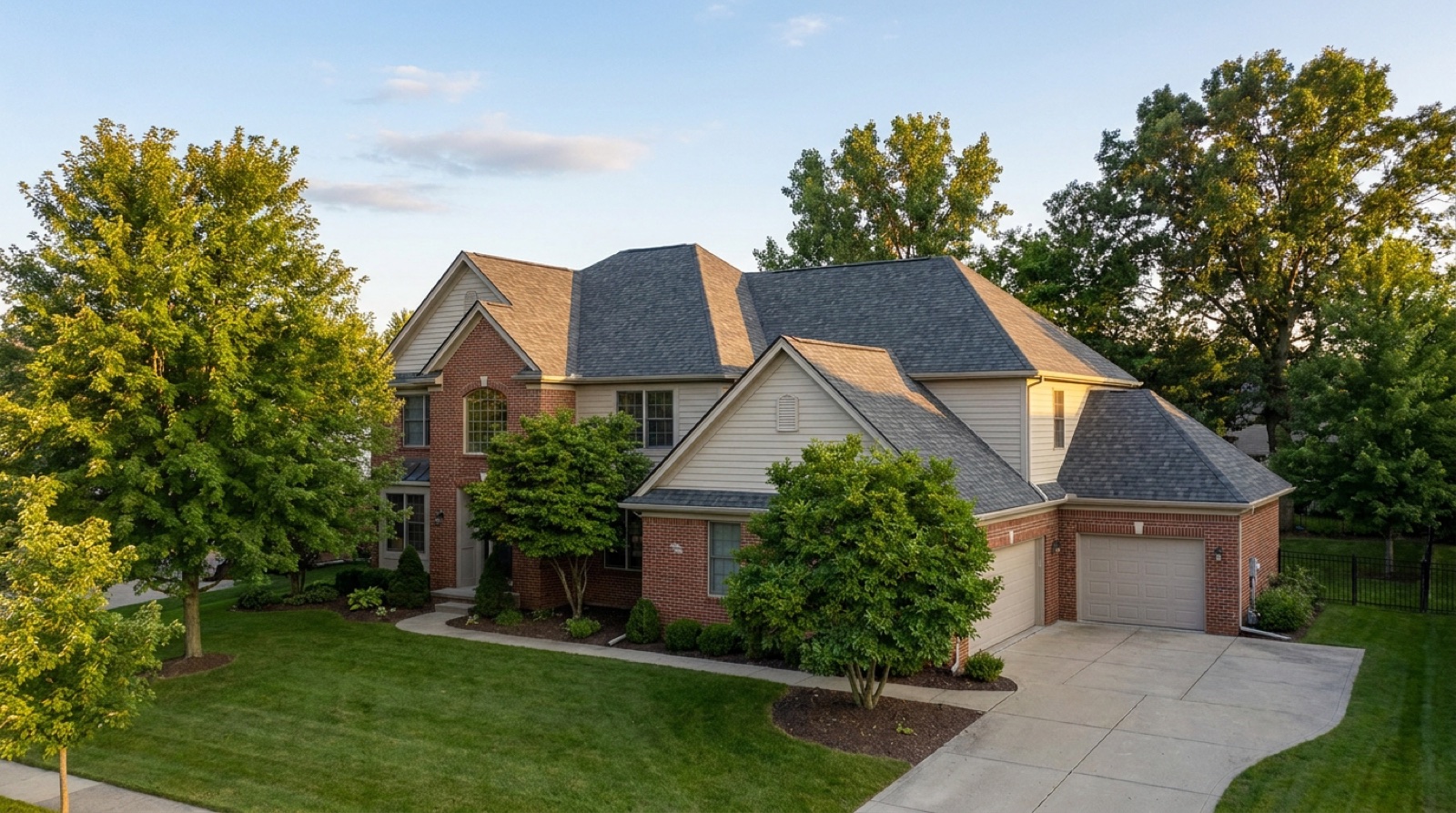
05 / THE BLIND SPOTSThe three things the driveway cannot see
A ground-level size estimate is a genuinely useful starting point, and it is also, by design, incomplete. Size is only one of the levers that set a roof price, and three of the biggest are invisible from the yard no matter how carefully you measure. This is not a sales caveat. It is the honest reason a firm number requires someone on the roof and in the attic.
Layers you cannot count from below
If your roof already carries two layers of shingles, everything has to come off before new shingles go down, and the tear-off crew is handling twice the weight and twice the disposal. Many Macomb County homes reroofed on a budget decades ago quietly carry a second layer, and there is no way to know from the driveway. That single fact can move a quote by a real amount, and it never shows up in a square count.
Decking condition under the shingles
Under the shingles is the wood deck the whole roof nails to, and nobody can see all of it until tear-off. Soft, delaminated, or rotted sheets have to be replaced, priced per sheet, and a thorough estimate names that per-sheet allowance up front. Your footprint measurement says nothing about what condition that wood is in. A leak you have been ignoring can turn a clean square count into a much larger job, which our guide on the cost of ignoring a roof leak traces in detail.
Complexity: valleys, chimneys, and cut-up roofs
Two roofs of identical square footage can price differently because of shape. Every valley, chimney, skylight, dormer, and wall intersection is a place that needs flashing work done by hand, and a cut-up roof with hips and valleys takes more time and material than a simple gable of the same size. From the ground you can count some of these, but you cannot judge the flashing condition or the detail work each one will need. Repairs alone, when that is all a roof requires, run $350 to $3,200, and larger or complex work can run higher, which is a reminder that the details, not just the size, carry cost.
- Roof size is footprint area times a pitch factor, divided by 100 to get squares, all measurable from the ground.
- Add for overhangs and do not forget the attached garage; a typical Macomb ranch runs about 20 to 24 squares.
- Satellite views measure footprint well but guess at slope, which is where their size estimates drift.
- Placed against the canon, most Macomb asphalt replacements run $9,000 to $18,000, with most homes at $12,000 to $16,000.
- Layers, decking condition, and complexity are invisible from the driveway, which is exactly what a free inspection resolves.
So use the method: measure your footprint, factor for slope, count your squares, and place them against the ranges. You will walk into any conversation with a roofer knowing roughly what your roof should cost, which is the whole point. Then let the inspection close the gap between a smart ballpark and an exact number. Ours is free and no obligation, it covers the layers, the deck, the flashing, and the ventilation the driveway cannot, and it produces a written price you can check against everything you just estimated. You can start from the instant estimator, browse the rest of our pricing work in the guides library, or see the full menu of what we do on the roofing services page.
Questions we hear most
Measure your home's footprint from the ground, including the attached garage and about a foot of overhang on each edge, then multiply by a pitch factor for the slope, roughly 1.05 for a low 4/12 roof up to about 1.2 for a steep 8/12. Divide the result by 100 to get squares. A typical Macomb County ranch works out to about 20 to 24 squares, which is the number roofers price from.
A roofing square is 100 square feet of roof surface, and it is the unit roofers use to price a job. A 2,000 square foot roof is 20 squares. Shingles, underlayment, ice barrier, and labor all scale roughly with the square count, so it is the first number anyone measuring your roof is after. Remember the roof surface is always larger than your home's floor area because of the slope and overhangs.
Satellite and aerial tools measure your footprint well, but they have to guess at the roof's slope, and a wrong pitch factor can throw the square count off by more than ten percent. They also cannot see how many shingle layers you have, the condition of the deck underneath, or the flashing detail work a cut-up roof needs. They are a fine starting ballpark and no substitute for an on-site inspection.
For a typical Macomb County home, a full asphalt shingle replacement runs $9,000 to $18,000 installed, and most homes land $12,000 to $16,000. Metal runs $18,000 to $30,000 and tile and slate run $20,000 to $36,000. Your square count tells you where inside the asphalt range your own roof likely sits, but layers, decking, and complexity set the final number, which is why the inspection is free.
- FEMA, disaster declaration DR-4757-MI, Michigan severe storms of August 2023 (Macomb County designated). fema.gov/disaster/4757
- National Roofing Contractors Association, technical guidance for steep-slope roof systems. nrca.net
- Manufacturer technical and warranty literature for the major asphalt shingle lines: GAF (gaf.com), Owens Corning (owenscorning.com), and CertainTeed (certainteed.com).
- U.S. Occupational Safety and Health Administration, fall protection requirements for roofing work. osha.gov