
JUMP TO A SECTION
"Is my roof too old" is a question people usually ask with a specific number already in their head, and twenty years is the most common one. It is old enough to remember installing, old enough that the shingles do not look new in photos, and old enough that a home inspector or an insurance renewal notice has started asking about it. The honest answer is that twenty years is not a wall a roof hits and fails. It is a threshold where the range of possible conditions gets very wide. Some twenty-year-old roofs in Macomb County have five or more good years left. Others are already leaking somewhere the owner has not found yet. This guide is the reality check: what the number actually means by shingle tier, why two roofs the same age can be in opposite shape, the checklist that tells you which side of the line yours is on, and what changes if you are buying or selling a house with a roof this age.
01 / THE SHORT ANSWERSo is twenty years too old, or not
For most asphalt shingle roofs, twenty years is inside the normal replacement window, not past it. It is not automatically "too old" in the sense of being unsafe or certain to fail this year. It is old enough that the odds of needing a full replacement soon are meaningfully higher than they were at year ten, and it is the age where a homeowner should be actively watching the roof rather than assuming it is fine because nothing has leaked yet. What twenty years means for your specific roof depends heavily on what kind of shingle is up there and how it has been treated, which is exactly what the next two sections unpack.
is where most full asphalt shingle replacements land in Macomb County, inside a full range of $9,000 to $18,000. That number only applies if a replacement is actually the right call. Confirm it with a free inspection before assuming, and get a ballpark in about 60 seconds with the instant estimator.
It also matters what kind of twenty is in play. A roof that has weathered twenty Michigan winters with good attic ventilation, a single layer of shingles, and no history of ice dam trouble is a very different roof than one that was reroofed over an existing layer, sits on a starved attic, or has already had two or three patch repairs. Age is one input. Condition is the one that actually decides the answer, and condition is only visible up close, which is the whole reason a free inspection exists as an option rather than a guess from the driveway.
02 / BY SHINGLE TIERWhat 20 years means by shingle tier
Not all asphalt shingles are the same product, and the tier installed twenty years ago changes what that age means today. Older Macomb County homes, especially anything built or last reroofed before the late 1990s and early 2000s, are more likely to be wearing a flat, single-layer three-tab shingle. Homes reroofed more recently, or ones where a previous owner upgraded, are more likely wearing a laminated architectural shingle, the two- or three-layer, dimensional-look product that became the market default as it improved on wind performance and durability.
Three-tab shingles carry the shortest service expectation of the common asphalt tiers, and twenty years is closer to the end of that window than the middle of it. Architectural shingles are built with more material and a better seal, and twenty years is more often the middle of their useful life than the end of it, assuming the rest of the system, decking, underlayment, and ventilation, held up its end. That is a real difference, and it is the single biggest reason two twenty-year-old roofs on the same street can be in such different condition. Our asphalt shingle lifespan guide goes deeper on the mechanisms that shorten or extend that window in this climate, if you want the full picture.
One more wrinkle: age alone does not tell you which tier is on your roof. If you were not the one who had it installed, the shingle tier is something a roofer can identify on sight, and it is one of the first things we note on a free inspection, right alongside the condition items in section 04. Homeowners are sometimes surprised to learn their roof was upgraded to architectural at some point by a previous owner, or conversely that a fast, budget reroof decades ago left a three-tab shingle in place longer than anyone in the house realized.
03 / THE VARIABLEWhy identical-age roofs age so differently
Two houses built the same year, reroofed the same summer, with the same shingle bundle off the same delivery truck, can be in noticeably different shape twenty years later. Age sets the clock running, but several other factors decide how hard those twenty years actually were on the shingles.
Sun and wind exposure
A south- or west-facing slope with full sun bakes harder over the decades than a shaded north slope under mature trees, and shingles on the exposed side often show curling and granule loss first. Open, lakeward exposure in parts of Macomb County also means more direct wind loading over the years, which stresses seal strips and fastener lines.
Attic ventilation
A starved attic runs hotter in summer and traps more moisture in winter, and both conditions age the shingles and the deck beneath them from below faster than weather alone ages them from above. Two roofs with identical shingles can wear at very different rates purely because one attic breathes properly and the other does not.
Layers and prior repairs
A roof installed as a clean tear-off tends to lie flatter and shed water more evenly than one installed over an existing layer, which telegraphs the old shingle lines through the new ones over time. A roof with a history of patch repairs is also a roof with more seams, more places where a hidden problem could be developing quietly under a fix that solved yesterday's leak but not tomorrow's.
Maintenance and gutters
Clogged gutters back water up under the shingle edge, and debris held against a roof surface holds moisture longer than a clean roof does. None of this shows up as a single dramatic event. It accumulates, which is exactly why age and condition can drift apart over twenty years.
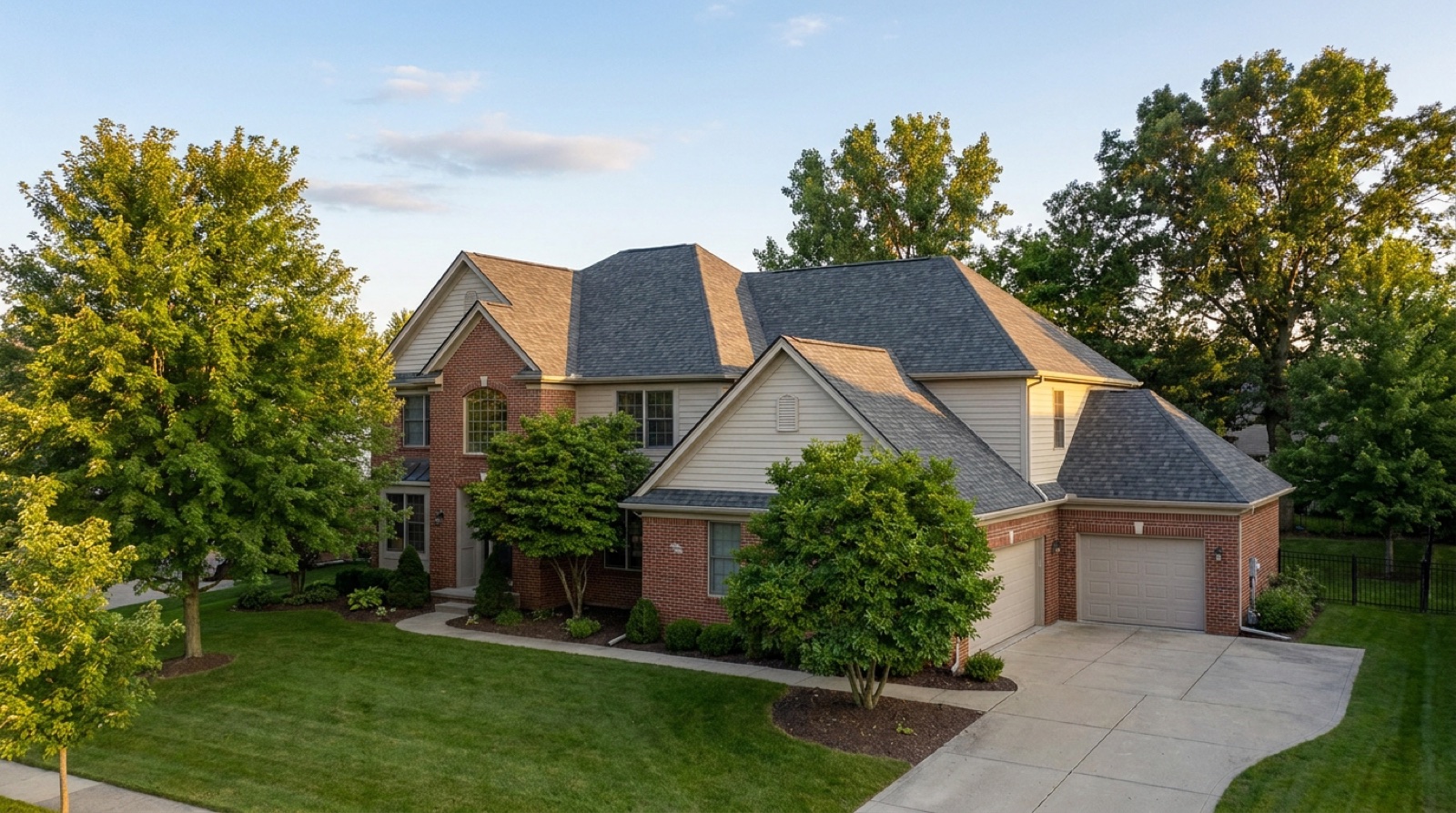
04 / THE CHECKLISTKeep watching, or start planning
Since age alone will not settle the question, here is the checklist we actually use to sort a twenty-year-old roof into one of two buckets: keep watching it, or start planning a replacement now, on your schedule rather than a leak's schedule.
- Granule loss. A little granule wear in the gutters is normal. Bald patches where you can see the black asphalt mat underneath, especially on more than one slope, is a start-planning sign.
- Curling or cupping edges. A few curled tabs here and there is watchable. Widespread curling across a slope means the shingles have lost the flexibility that keeps them sealed against wind.
- Cracking. Shingles that crack when a corner is lifted, rather than flexing, have lost their oils and are near the end regardless of the calendar age.
- Repeated leak spots. One leak, once, traced and fixed, is a repair. The same area leaking again, or leaks appearing in more than one place, is a system-level sign, not a one-off.
- Daylight or staining in the attic. Light coming through the deck, or dark staining and damp insulation on the underside, means water has already found a way in, even if no ceiling stain has shown up yet.
- Moss or dark streaking in shaded valleys. Not urgent by itself, but it flags areas that hold moisture longer and are worth a closer look during an inspection.
One or two of the watchable items, on their own, usually mean exactly what they say: keep an eye on it and revisit next year. Several of them together, or any of the start-planning items, are the pattern that tends to precede an active leak rather than follow one. If you want the fuller version of this list with more detail on each sign, our ten signs a roof needs replacing guide walks through it front to back.
A twenty-year-old roof is not a verdict. It is a prompt to go look, closely, at the actual roof instead of the number on the permit.
05 / BUYING OR SELLINGBuying or selling a house with a 20 year old roof
A roof this age comes up constantly in real estate transactions, on both sides of the deal. If you are buying, a home inspector will typically note the roof's approximate age and visible condition, and that note can become a negotiating point or an inspection contingency item. If the roof's actual age is unclear from the seller's disclosure, our how old is my roof guide walks through the practical ways to pin down a real number before you rely on a guess.
Insurance is the part buyers and sellers ask about most, and it is also where we have to be careful about what we can honestly say. Some insurers may ask about roof age at renewal or a new policy application, and some may adjust terms, such as how a roof claim is settled, based on age or condition. That varies by carrier and by policy, and it is not something a roofer can speak to with certainty on your behalf. If age or condition questions come up with your insurer, that is a conversation for your agent or carrier directly, using their actual underwriting rules rather than a general assumption.
We cannot tell you what your specific insurer will decide about a twenty-year-old roof, and no roofer honestly can. What we can do is document exact, current condition with photos, which is the same evidence an insurer, an inspector, or a buyer's agent would want to see.
For sellers, the practical move is usually the same regardless of what an insurer might ask: know the real condition before it becomes a line item in someone else's negotiation. A free inspection ahead of listing gives you the same photos and findings a buyer's inspector will eventually surface, on your timeline instead of theirs, and with time to decide whether a repair, a full replacement, or simply disclosing honest condition is the right move for your sale.
06 / THE REAL ANSWERGetting the real answer for your roof
Everything above narrows the odds. It cannot tell you, with certainty, what your roof looks like today, because that requires eyes on the actual shingles, the actual attic, and the actual flashing. Our inspection is $0 with no obligation, and it covers the shingle tier and condition, the ventilation, the gutters, and the attic side of the deck, with photos of everything we find. If the roof still has real life left, we will tell you that. If it does not, you get a straight answer and a written price, not a scare-tactic pitch built around a round number like twenty.
If a replacement turns out to be the right call, the same honest pricing canon applies as everywhere else on this site: most Macomb County asphalt replacements run $9,000 to $18,000, with most homes landing $12,000 to $16,000, and financing is available subject to approval, illustrated as roughly $178 a month on a $13,500 project over 10 years at 9.9% APR. That example is not an offer of credit. If the roof is instead a repair situation, repairs run $350 to $3,200, and larger or complex repairs can run higher. You can start either path, or just get a ballpark first, from the cost calculator or the full roof replacement service page.
- Twenty years is inside the normal replacement window for asphalt shingles, not automatically past it.
- Shingle tier matters more than the calendar: three-tab is closer to end of life at twenty years, architectural is often closer to mid-life.
- Sun exposure, attic ventilation, layers, and maintenance history are why identical-age roofs can be in opposite condition.
- A handful of watchable signs mean keep an eye on it; several together, or any start-planning sign, mean act on your own schedule.
- Insurance rules on roof age vary by carrier and are a question for your agent, not a general promise any roofer can make.
- The only way to know for certain is a free, no-obligation inspection with photos.
Questions we hear most
Not automatically. Twenty years is inside the normal replacement window for asphalt shingles rather than past it, and whether your specific roof still has life left depends more on shingle tier and visible condition than on the calendar alone. A free inspection is the only way to get a real answer for your roof.
Often, yes, in practice. A home inspector will usually note the roof's approximate age and visible condition, which can factor into negotiations. Insurance questions about roof age vary by carrier, so that is best confirmed directly with your agent or insurer rather than assumed.
If a full replacement is the right call, most Macomb County asphalt shingle replacements run $9,000 to $18,000 installed, with most homes landing $12,000 to $16,000. Repairs, if the roof only needs one, run $350 to $3,200. A free inspection tells you which one you actually need before any price is quoted.
- FEMA, disaster declaration DR-4757-MI, Michigan severe storms of August 2023 (Macomb County designated). fema.gov/disaster/4757
- Insurance Information Institute, consumer explainers on homeowners policy coverage, deductibles, and the claims process. iii.org
- Manufacturer technical and warranty literature for the major asphalt shingle lines: GAF (gaf.com), Owens Corning (owenscorning.com), and CertainTeed (certainteed.com).
- InterNACHI Standards of Practice for home inspections (scope of a generalist roof inspection). nachi.org/sop