
JUMP TO A SECTION
Moss on a roof reads as a cosmetic problem from the driveway, a green patch on the north slope that has been there a couple of summers. Up close, it is a plant that has rooted into the shingle surface, and every month it stays is a month it holds water against a material that is built to shed water, not hold it. This guide covers why moss finds a home on Macomb County roofs in the first place, what it is actually doing to the shingles underneath it, the removal method that will not strip a roof of years it has left, and the prevention steps that hold up to an honest look rather than a marketing claim.
01 / THE SHORT ANSWERWhat to do about roof moss, in one line
Moss on a roof should be removed with a dry, downward brushing technique or a low-pressure soft wash, never a pressure washer, and the removal itself is not the whole job. Moss holds moisture against the shingle surface for weeks at a time, and depending on how long it has been established, the shingles underneath it may have already lost granules or lifted at the tab edge. Treat moss removal as step one and a shingle check as step two, on the same visit if possible.
is the typical range for a Macomb County roof repair, and larger or complex repairs can run higher. Most roofs with moss need cleaning and a maintenance step, not a repair, but a free inspection tells you which situation you are actually in before anyone touches a ladder.
The rest of this guide walks the why, the how, and the prevention math. If you would rather start with a look at your own roof, the repair estimator gets you a starting range in about a minute, and a free inspection gets you the real answer.
02 / THE CLIMATEWhy moss grows on Michigan roofs
Moss needs three things to establish on a roof: shade, moisture, and time. Southeast Michigan supplies all three more generously than most climates. Mature tree cover is common on older Macomb County lots, winters and shoulder seasons keep humidity high for long stretches, and a roof left uncleaned for years gives moss the time it needs to move from spores to a visible mat.
North-facing slopes are almost always the first to show it, and the reason is simple physics rather than bad luck. A south-facing slope gets direct sun for most of the day, which dries the shingle surface between rain events. A north-facing slope in the shadow of the house itself, a neighboring tree line, or a chimney can stay damp for days after the same rain, especially in fall and spring when the sun sits lower in the sky. Valleys and the shaded side of dormers behave the same way, holding moisture in the shingle's granule layer long enough for airborne moss spores to take root.
It is worth being precise about what moss is, because it gets lumped in with algae and lichen constantly and the three are not the same organism, do not damage a roof the same way, and are not removed the same way. Moss is a true plant with small rootlike structures. The dark streaking that shows up on sunnier slopes is usually algae, covered in our black streaks on roof guide, and the crusty, tightly bonded growth that looks almost fused to the shingle is typically lichen, which behaves differently enough that it has its own guide and its own removal caution. If what is growing on your roof does not look like a soft green cushion you could dent with a fingernail, it may be one of those instead, and the removal approach below is written specifically for moss.
How moss actually arrives on a roof is worth a sentence, because it explains why treating one house rarely solves the problem for good. Moss reproduces through airborne spores, carried on the wind from established colonies on nearby trees, fences, and neighboring roofs, and it can also hitch a ride in the debris birds and squirrels track across a roofline. A single shaded, damp slope in a tree-heavy Macomb County neighborhood is rarely isolated from that spore supply, which is why prevention below leans on making the roof surface inhospitable rather than trying to seal off the source.
03 / THE MECHANISMHow moss actually damages a shingle roof
A thin moss cushion sitting on top of a shingle is a cosmetic problem. Moss with any thickness to it becomes a structural one, for two related reasons.
Rhizoids work into the shingle surface
Moss anchors itself with small rootlike structures called rhizoids, which are not true roots but behave similarly at a small scale. They work into the granule layer and the seams at a shingle's tab edge, and as the moss cushion grows, that anchoring can gradually pry the edge of a shingle up from the course below it. A shingle that no longer lies flat is a shingle that wind can get under, which is how a patch of moss quietly becomes a patch of lifted, wind-vulnerable shingles.
Moisture held through freeze-thaw
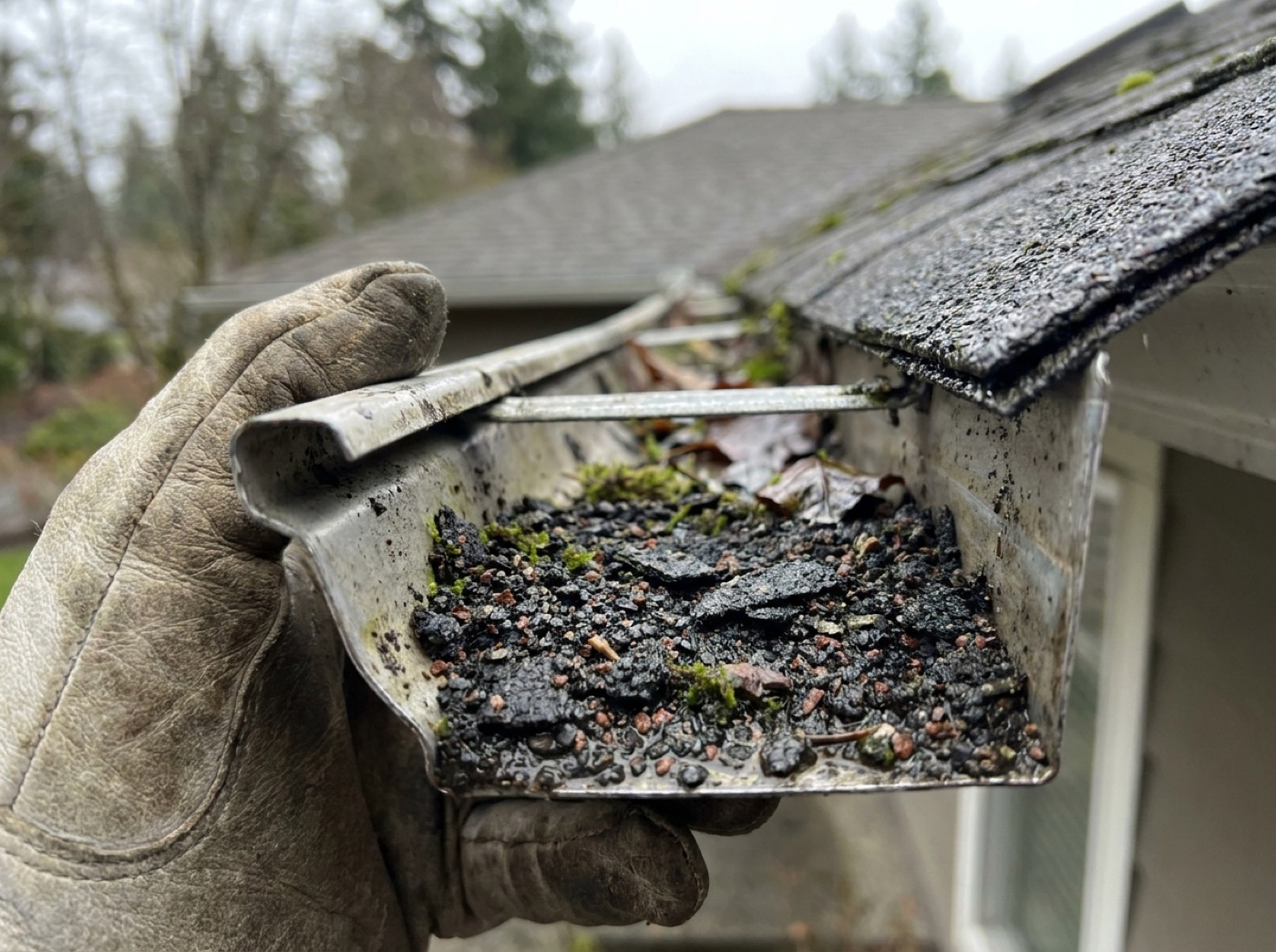
The bigger issue is what the moss cushion does to water. A healthy shingle surface sheds rain within hours. A moss mat behaves like a sponge, holding water against the shingle granules for days after a storm has passed. In a Michigan winter, that trapped moisture freezes and thaws repeatedly along with the rest of the roof, and each cycle works on the shingle the same way it works on a sidewalk crack: expanding, contracting, and gradually breaking down the material it sits against. Granule loss accelerates under an established moss patch faster than on bare shingle nearby, and once granules thin out, the asphalt beneath loses UV protection and ages faster still.
None of this happens on a fast timeline. A first-year moss patch is mostly cosmetic. A moss patch that has been ignored for three or four seasons is a different conversation, and it is common for us to find lifted shingles and thinned granules under a mat that thick when we pull it back during an inspection.
There is a secondary path worth naming as well: moss growing thick against a soffit vent or ridge vent can partially block airflow at exactly the spots a roof relies on to stay ventilated. A vent choked with moss and debris is not moving as much air as its rating assumes, and in winter that can compound the ice-damming conditions that already stress Michigan eaves. It is a smaller effect than the direct shingle damage above, but it is one more reason a moss patch near a vent line deserves a closer look rather than a shrug.
04 / THE REMOVALSafe removal, step by step
The single most important rule in this entire guide is also the one most often broken: never use a pressure washer on a shingle roof, moss or no moss. A pressure washer's stream strips granules straight off the shingle, drives water up under the laps where it is never supposed to go, and can void a shingle manufacturer's warranty outright. Our full explanation of why is in the pressure washing guide, but the short version for moss specifically is that the same water pressure that blasts moss loose also blasts away the granule layer the moss was sitting on.
- Work from the top down, dry first. Using a soft-bristle brush, not a stiff wire brush, lift and pull moss cushions downward, in the direction the shingles overlap, rather than scraping upward against the grain. Downward strokes clear moss without catching and lifting the tab edge underneath it.
- Clear the loose debris before wetting anything. Bag up what you brush free rather than hosing it toward the gutters, where it can compact and clog the downspouts on its way off the roof.
- Apply an approved low-pressure cleaning solution to what remains. A garden-hose-pressure application of a cleaner formulated for asphalt shingles, left to dwell per the product's instructions, loosens what the brush could not reach without any pressure-washer force involved.
- Rinse at hose pressure only, working downhill. Let gravity and low pressure carry the residue off the roof in the direction water already drains, rather than spraying across or against the shingle courses.
- Expect gradual results, not an instant clean. Soft washing dissolves and loosens growth chemically as much as it rinses it away, and full results on stubborn patches can take one to two weeks of rain cycles to finish clearing, similar to the timeline covered in our algae removal guide.
A ground-level, single-story, shallow-pitch roof is within reach of a careful homeowner following that sequence. A steep roof, a multi-story roof, or a moss patch that has already lifted shingle edges is not a good DIY candidate, both for fall-risk reasons and because pulling at a shingle that is already loose can turn a cleaning job into a repair job with one wrong tug. When in doubt, a professional soft-wash and inspection in the same visit answers the safety question and the damage question at once.
05 / PREVENTIONPrevention that actually works, and what does not
Prevention for roof moss is honest, not magic, and it is worth being direct about what each option really does before you spend money on it.
Trim back shade
Because moss needs shade and lingering moisture to establish, the single highest-leverage prevention step is reducing both. Trimming overhanging branches back from the roofline lets more sun and airflow reach slopes that currently stay damp longest, and it also reduces the leaf and needle litter that helps hold moisture against the shingle surface in the first place. This is the one prevention step with no real downside or limitation.
Zinc and copper strips, honestly evaluated
Zinc and copper strips installed near the ridge work by leaching metal ions into rainwater as it runs downslope, and those ions suppress new moss and algae growth in the water's path. It is a real mechanism with real, if limited, effectiveness. The honest caveats: strips do not remove moss that is already established, protection only reaches a certain distance downslope from where the strip is installed, and the effect fades over years as the metal wears. Whether strips are worth installing on your roof, and how far their protection actually reaches, is covered in full in our zinc strips for roof moss guide.
Algae- and moss-resistant shingles
Many shingle lines now include copper-infused granules specifically to resist algae and moss growth, and choosing that option at replacement time is a reasonable long-term prevention step for a slope that has struggled with growth before. It is a decision best made at replacement, not retrofitted onto an existing roof, and it works on the same principle as metal strips at a whole-shingle scale.
A maintenance cadence, not a one-time fix
The most reliable prevention is simply not letting moss get established for years at a stretch. A twice-yearly look at the roof, spring and fall, catches new growth while it is still a thin cushion that a soft brush clears in minutes, rather than a mat that has already worked into the shingle edge. Pairing that look with gutter cleaning on the same visit is efficient, since clogged gutters and lingering moisture tend to show up together on the same shaded slopes.
Gutters and debris, the quiet accomplice
Leaves, pine needles, and other organic debris that collect in a valley or against a clogged gutter line do two things at once: they hold moisture directly against the shingle surface, and they decompose into a thin organic layer that gives moss spores something to root into more easily than bare granules alone. A roof that gets its gutters and valleys cleared each fall, before the wet season sets in, is measurably less hospitable to new moss growth than one where debris sits through the winter. This is inexpensive, mechanical prevention rather than a chemical or metallic one, and it pairs naturally with the twice-yearly inspection above.
06 / THE FORKWhen moss removal turns into a repair
Cleaning and prevention are the right call for the large majority of moss situations, especially when the growth is caught within a season or two. The conversation changes once removal reveals what was underneath it.
Signs that a moss patch has already done real damage: shingle tabs that lift or feel loose to the touch once the moss is cleared, bald patches with heavy granule loss concentrated exactly where the moss was rooted, or a soft or spongy feel underfoot on that section of roof, which can point to moisture that reached the deck itself. Any of those findings moves the job from a cleaning to a repair, and repairs in Macomb County run $350 to $3,200, with larger or complex repairs running higher. A localized moss-damage repair, replacing a handful of compromised shingles and checking the deck underneath, is typically at the lower end of that range.
Moss removal without a shingle check afterward is only half the job. The point of clearing it is to see what it was hiding, not just to make the roof look clean again.
The good news is that a moss-related repair, caught early, is almost always a targeted fix rather than a signal the whole roof is failing. It is a localized problem with a localized fix, and it is exactly the kind of question a repair estimate is built to answer once someone has actually looked at the shingles underneath.
One more honest note on timing: a repair on a moss-damaged section will color-match as closely as available shingles allow, but an exact match to shingles that have weathered for a decade or more is rarely possible, since asphalt fades unevenly and manufacturers periodically change their color blends. That is a cosmetic tradeoff worth knowing before the work starts, not a surprise afterward, and it does not change whether the repair itself holds.
07 / THE REAL NUMBERGetting a real answer for your roof, free
Everything above narrows the question. The only way to know for certain whether your roof needs a cleaning, a small repair, or nothing at all is someone on it. Our inspection is $0 with no obligation, and when moss is the reason for the call, it covers the growth itself, the shingle condition underneath once it is cleared, and the attic side of the deck below that section, with photos of everything we find.
If you want a ballpark on repair costs before anyone visits, the cost calculator runs the same published ranges against your situation, and our full honest pricing sheet lays out every canon range we work from, repairs included. You can also start from our roof repair service page for the broader picture of what a repair visit covers, or keep reading in the guides library on the related growth types covered above.
- Moss establishes on shaded, moisture-holding slopes, most often north-facing sections and valleys, and needs time as much as shade and moisture.
- Rhizoids can pry shingle edges up, and the moss cushion holds moisture against the shingle through freeze-thaw, accelerating granule loss underneath it.
- Safe removal is dry downward brushing plus an approved low-pressure soft wash; a pressure washer strips granules and can void a shingle warranty.
- Real prevention is trimming shade, a twice-yearly maintenance check, and honestly evaluated zinc or copper strips or algae-resistant shingles at replacement time.
- If removal reveals lifted shingles or heavy granule loss, that is a repair, typically $350 to $3,200, and a free inspection tells you which situation you are in.
Questions we hear most
It starts cosmetic but does not stay that way. Moss holds moisture against the shingle surface for days after rain, which accelerates granule loss through Michigan's freeze-thaw cycles, and its small rootlike rhizoids can gradually pry shingle edges up. A thin, recently established patch is mostly cosmetic; a mat that has been there for a few seasons often has real shingle wear underneath it.
No. A pressure washer strips granules off the shingle along with the moss, can drive water under the laps, and can void a shingle manufacturer's warranty. The safe method is dry downward brushing followed by an approved low-pressure soft wash, rinsed at hose pressure only.
They prevent new growth in the water's path downslope from where they are installed, but they do not remove moss that is already established and their protection only reaches so far down the roof. They are one honest tool among several, not a standalone fix for an existing moss patch.
- Asphalt Roofing Manufacturers Association, industry technical bulletins. asphaltroofing.org
- Manufacturer technical and warranty literature for the major asphalt shingle lines: GAF (gaf.com), Owens Corning (owenscorning.com), and CertainTeed (certainteed.com).