
JUMP TO A SECTION
Every roof accumulates black streaks, moss, or a gray film eventually, and a pressure washer is sitting in most garages already, so the logic seems sound: blast it clean in an afternoon. On siding, a driveway, or a deck, that logic mostly holds. On an asphalt shingle roof it does not, and the reason is specific enough that it is worth understanding rather than taking on faith. This guide covers what a pressure washer actually does to a shingle surface, why the professional standard is a completely different technique called soft washing, when a roof should not be cleaned by any method at all, and what to ask before you let anyone near your roof with a wand and a hose.
01 / THE SHORT ANSWERNo, and here is why that matters
Do not pressure wash an asphalt shingle roof. High-pressure water aimed at a shingle surface strips away the protective mineral granules embedded in the top layer, and those granules do not grow back. The roof can look temporarily cleaner and age noticeably faster afterward, because the layer that shields the asphalt mat from UV breakdown is now thinner or gone in the sprayed areas. This is not a minority opinion inside the roofing trade. It is close to unanimous, which is unusual for an industry that disagrees about almost everything else.
If a company offers to pressure wash your shingle roof, or cannot clearly explain what pressure and technique they use, get a second opinion before they start. The accepted method for cleaning asphalt shingles is a low-pressure soft wash, not a high-pressure blast, and the difference is not a matter of degree. It is the difference between a roof that keeps its warranty and one that does not.
The confusion is understandable. Pressure washing genuinely is the right tool for concrete, brick, and many siding materials, where the surface being cleaned is hard and the coating is not load-bearing for the material's service life. A shingle is different. The granules are not decoration. They are the wear layer, and once they are gone from a section of roof, that section is permanently more exposed than the rest of it.
02 / THE MECHANISMWhy granules do the real work, and why blasting them off backfires
An asphalt shingle is built in layers: a fiberglass mat, a layer of asphalt that provides waterproofing, and on top of that, a coating of small mineral granules pressed into the asphalt while it is still soft during manufacturing. Those granules do three jobs at once. They shield the asphalt underneath from direct UV exposure, which otherwise dries and cracks the asphalt over a matter of seasons rather than decades. They give the shingle its fire rating and its color. And they provide the surface texture that keeps a roof walkable and helps rain sheet off cleanly rather than pool.
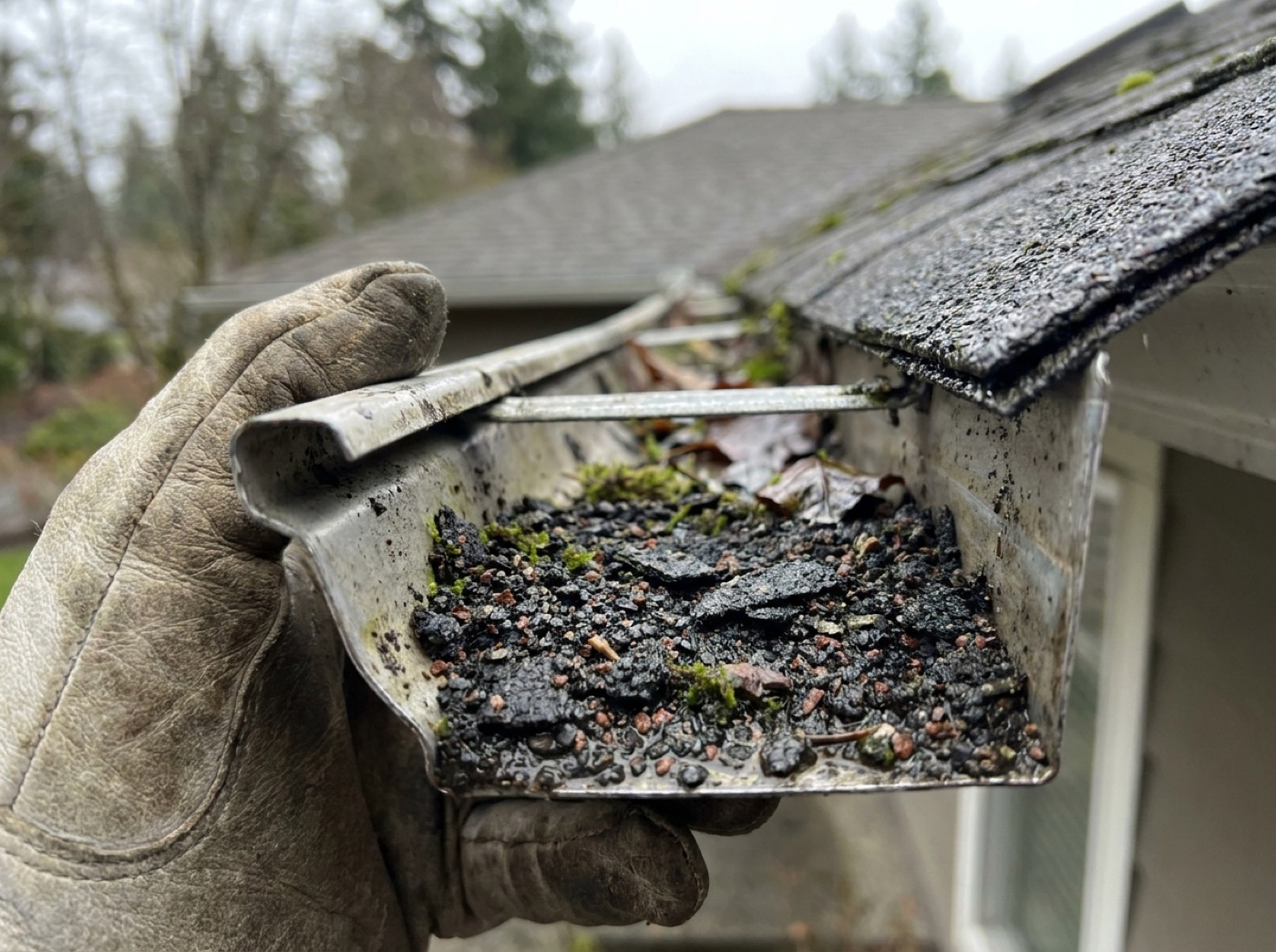
A pressure washer's nozzle concentrates water into a narrow, high-velocity stream specifically because that is effective at removing dirt bonded loosely to a hard surface. Against a shingle, that same velocity does not distinguish between the algae or moss sitting on top of the granules and the granules themselves. The stream dislodges both, and once granules are gone from a patch of shingle, no cleaning afterward restores them. What is left is bare asphalt exposed to UV light, and bare asphalt ages in a fraction of the time a granule-covered shingle does.
There is a second mechanism that is easy to miss from the ground: pressure washing does not only remove granules, it can drive water sideways and upward under the shingle laps, the overlapping edges that are designed to shed water running downhill, not resist water forced uphill by a wand. Enough force at the wrong angle can work water past a seal strip that was never engineered to stop pressurized spray, which is part of why manufacturers who publish cleaning guidance for their products draw a hard line against high-pressure equipment on the shingle field.
Why the damage does not show up on the day it happens
This is the part that lets pressure washing keep getting recommended by well-meaning people who have never followed a roof for the following few years. A freshly pressure-washed roof looks great immediately. The streaks and moss are gone, the color looks more uniform, and the homeowner is satisfied. The cost shows up later, as accelerated granule loss becomes visible in the gutters, as the sprayed sections weather and fade faster than the rest of the roof, and as the shingle's remaining service life turns out to be shorter than it should have been. By the time that connection is obvious, the pressure washing happened months or years earlier and the roof looks like it simply aged, which is exactly what happened, just faster than it needed to.
03 / THE ALTERNATIVEWhat soft washing actually is, and why the results take longer
Soft washing is the industry-standard alternative, and it works on a completely different principle than pressure washing. Instead of using force to physically strip material off the roof, a soft wash applies a diluted cleaning solution, formulated for organic growth on roofing surfaces, at low pressure, typically closer to garden-hose pressure than a pressure washer's output. The solution is left to dwell on the roof for a period of time so it can work on the algae, moss, or lichen at the biological level, and only then is it rinsed, again at low pressure.
Because the cleaning is chemical rather than mechanical, the visible result is not instant. Algae killed by a soft wash typically darkens further before it lightens, and the full effect, as the dead organism weathers and rinses away naturally with subsequent rain, plays out over the following weeks rather than the same afternoon. That delay is normal and expected, and a homeowner who pressure washes because soft washing did not look finished by dinnertime is usually undoing a treatment that was working correctly.
Pressure washing gives you an instant result and a shorter shingle life. Soft washing gives you a slower result and does not cost you granules. For a roof, the slower method is the one that actually protects the investment underneath the cleaning.
The organisms being treated matter for how the wash is approached, too. Black streaking is usually algae feeding on the limestone filler in the shingle, which soft washing handles well and which our black streaks guide covers in more depth. Moss is a different case, because it can root into the shingle surface and hold moisture against it even after the visible growth is killed, and our moss removal guide walks through the extra steps that moss specifically requires beyond a standard soft wash.
04 / THE HARDER QUESTIONWhen a roof is too fragile to clean at all
Soft washing is gentler than pressure washing, but gentler is not the same as harmless to every roof. Some roofs should not be cleaned by any method until an inspection has confirmed the shingle can tolerate it, and the honest answer on any given roof depends on what is actually happening at the shingle surface, not how the roof looks from the driveway.
- Shingles nearing the end of their rated service life can be brittle enough that even foot traffic during a cleaning visit cracks them, regardless of the chemistry used on the surface.
- A roof that already shows significant granule loss, visible as bald or shiny patches where the black asphalt mat shows through, has less protective layer left to risk, and cleaning it is a judgment call rather than a default yes.
- Low-slope sections and valleys can hold cleaning solution longer than a steep pitch sheds it, which changes the dwell time and the rinse approach compared with a straightforward gable roof.
- A roof with existing storm or wind damage, lifted tabs, or exposed fasteners should be inspected and repaired before it is cleaned, since cleaning a compromised roof can push water into openings that were not previously a problem.
This is the piece most cleaning-only companies are not positioned to tell a homeowner, because their business is the cleaning appointment, not the roof's long-term condition. Our roof repair team looking at the same roof is evaluating whether it should be cleaned, repaired, or left alone, which is a different question than how to clean it fastest. If you are not sure which category your roof falls into, a free inspection settles it with photos rather than a guess, and you can start that conversation through the repair estimator and pick repair as the job type, and if the roof needs a repair before or instead of a cleaning, that is what gets recommended.
05 / THE FINE PRINTWarranties, and what a bad wash actually costs to fix
Shingle manufacturers generally publish cleaning guidance for their products, and that guidance commonly restricts or prohibits high-pressure washing precisely because of the granule and seal-strip issues described above. Following that guidance, or failing to, can matter if you ever need to make a warranty claim on the shingles, since a manufacturer reviewing a claim can point to visible pressure-washing damage as a maintenance issue rather than a manufacturing defect. Read the actual warranty document for your shingle line rather than assuming, since specific terms vary by manufacturer and product.
When pressure washing damage is significant enough to need correction, the fix is a repair, not another cleaning. Depending on how much granule loss occurred and whether water was driven under the shingle laps, the scope can range from replacing a handful of damaged shingles to addressing a section where seals were compromised. Repairs in Macomb County run $350 to $3,200, and larger or complex repairs can run higher, so a cleaning shortcut that seemed free can end up costing real money down the line.
If you already had a roof pressure washed and are seeing granule loss in the gutters, fading in the sprayed sections, or a new leak that was not there before, an inspection is the way to find out whether you are looking at a cosmetic issue or something that needs a repair. Our granule loss guide covers how to read that specific warning sign and what it predicts about remaining shingle life. Our full honest pricing sheet shows the repair and replacement ranges side by side, and the cost calculator can run a ballpark against your own roof if a bigger repair turns out to be on the table.
06 / BEFORE YOU HIRE ANYONEQuestions to ask any roof-cleaning vendor
Roof cleaning is a lightly regulated service compared with roofing itself, and plenty of general pressure-washing businesses will take a roof job without necessarily understanding the difference in technique it requires. A short conversation before you hire anyone filters out most of the risk.
- Ask directly what pressure they use on the shingle field and whether their equipment and process is a soft wash, not a pressure wash. A vendor who cannot answer this specifically has not been asked before.
- Ask what cleaning solution they use and whether it is formulated for roofing, since generic surface cleaners are not always appropriate for shingles or for the landscaping and gutters the runoff passes through.
- Ask whether they carry insurance for roof work specifically, since a fall or a damaged shingle during a cleaning visit is a different liability picture than a driveway job.
- Ask how they protect plants, siding, and windows from the cleaning solution's runoff during the dwell and rinse steps.
- Ask whether they will document the roof's condition, ideally with photos, before they start, so any pre-existing damage is on record.
If the answers are vague, or if pressure washing is offered as the standard service without qualification, that is worth treating as a red flag rather than a minor detail. The roof is the largest exterior surface on the house and one of the most expensive to replace early, and a cleaning method chosen for speed instead of the shingle's actual tolerance is a poor trade for a result that mostly matters for curb appeal.
A roof cleaning should leave you with a cleaner roof and the same remaining shingle life you started with. If the method used cannot promise both, it is the wrong method.
- Never pressure wash an asphalt shingle roof. High-pressure water strips protective granules that do not regrow and can shorten the roof's remaining life.
- Soft washing, a low-pressure application of a shingle-safe cleaning solution with a dwell time, is the accepted professional method, and results appear over weeks, not the same afternoon.
- Some roofs, especially older or already granule-thin ones, should not be cleaned by any method until an inspection confirms the shingle can tolerate it.
- Manufacturer cleaning guidance generally restricts high-pressure washing, and visible pressure-washing damage can complicate a shingle warranty claim.
- Repairs from a bad cleaning run $350 to $3,200 in Macomb County, and a free inspection is the way to find out whether your roof needs one before or instead of a cleaning.
Questions we hear most
You should not. High-pressure water strips the protective granules that shield the shingle from UV damage, and those granules never grow back. The roof can look cleaner immediately and age noticeably faster afterward. Low-pressure soft washing is the accepted professional method for cleaning asphalt shingles.
Soft washing works chemically rather than mechanically. The cleaning solution needs dwell time to act on algae, moss, or lichen at the biological level, and the visible result plays out over the following weeks as the treated growth weathers and rinses away with normal rain, rather than disappearing the same day.
It depends on the shingle's condition, not its age alone. Roofs with significant existing granule loss, brittle shingles, or storm damage can be poor candidates for cleaning by any method until a professional inspection confirms what the shingle can tolerate. A free inspection settles the question with photos rather than a guess.
- Asphalt Roofing Manufacturers Association, industry technical bulletins. asphaltroofing.org
- Manufacturer technical and warranty literature for the major asphalt shingle lines: GAF (gaf.com), Owens Corning (owenscorning.com), and CertainTeed (certainteed.com).