
JUMP TO A SECTION
The letter arrives and the number is smaller than you expected, and when you read the estimate you see why: the carrier approved two slopes, not four. The adjuster found hail bruising on the west plane and wind-creased shingles on the south plane, decided the north and east planes were undamaged, and wrote the claim for a partial roof replacement. This is not a mistake and it is not unusual. Insurance policies generally cover direct physical damage, and adjusters scope a roof plane by plane, so a carrier may pay to replace only the sections where the damage actually sits. Whether that partial approval is fair, workable, or worth contesting is a harder question, because a new slope stitched into a decade-old field raises matching, weathering, and workmanship issues the one-page estimate never mentions. This guide walks through how slope-by-slope scoping works, how to read a partial approval, and the arguments that sometimes, though never always, extend the scope to the full roof.
01 / THE SHORT ANSWERYes, carriers can approve half a roof
A homeowner policy typically owes for the damage the storm caused, not for a new roof. If a hailstorm bruised the west and south planes and left the others clean, many carriers will scope the claim as a replacement of the damaged planes plus repairs to any scattered hits elsewhere. On paper that is a defensible reading of the policy. On a real roof it can produce an odd result: a house wearing two ages of shingle, a tie-in seam across the field, and a color that does not quite line up from the street.
Neither extreme reaction serves you. A partial approval is not automatically a lowball, and it is not automatically final either. Some partial approvals are reasonable and worth accepting. Others understate the damage, ignore how shingle systems actually fail, or leave you with a mismatch problem the policy language may address. The difference lives in the details of your roof, your policy, and the estimate itself, which is why the first step is always to read the scope line by line, ideally with a roofer on the roof who can meet your adjuster and walk the same planes together. It also helps to separate the money question from the permission question early, since whether an insurer can force a repair over a replacement is really a question about who pays for the slopes beyond the approved scope rather than about what you are permitted to do with your own roof.
02 / THE SCOPING LOGICHow adjusters decide which slopes get paid
Adjusters generally work a roof one plane at a time. On each slope they look for qualifying storm damage: hail bruises that fracture the mat, wind creases along the shingle line, torn or missing tabs, and impact marks on soft metals like vents and flashing that corroborate the storm. Many carriers use a test-square convention, counting hits inside a marked area on each slope, and a slope that clears the threshold may be written for replacement while a slope below it may be written for spot repairs or nothing at all.
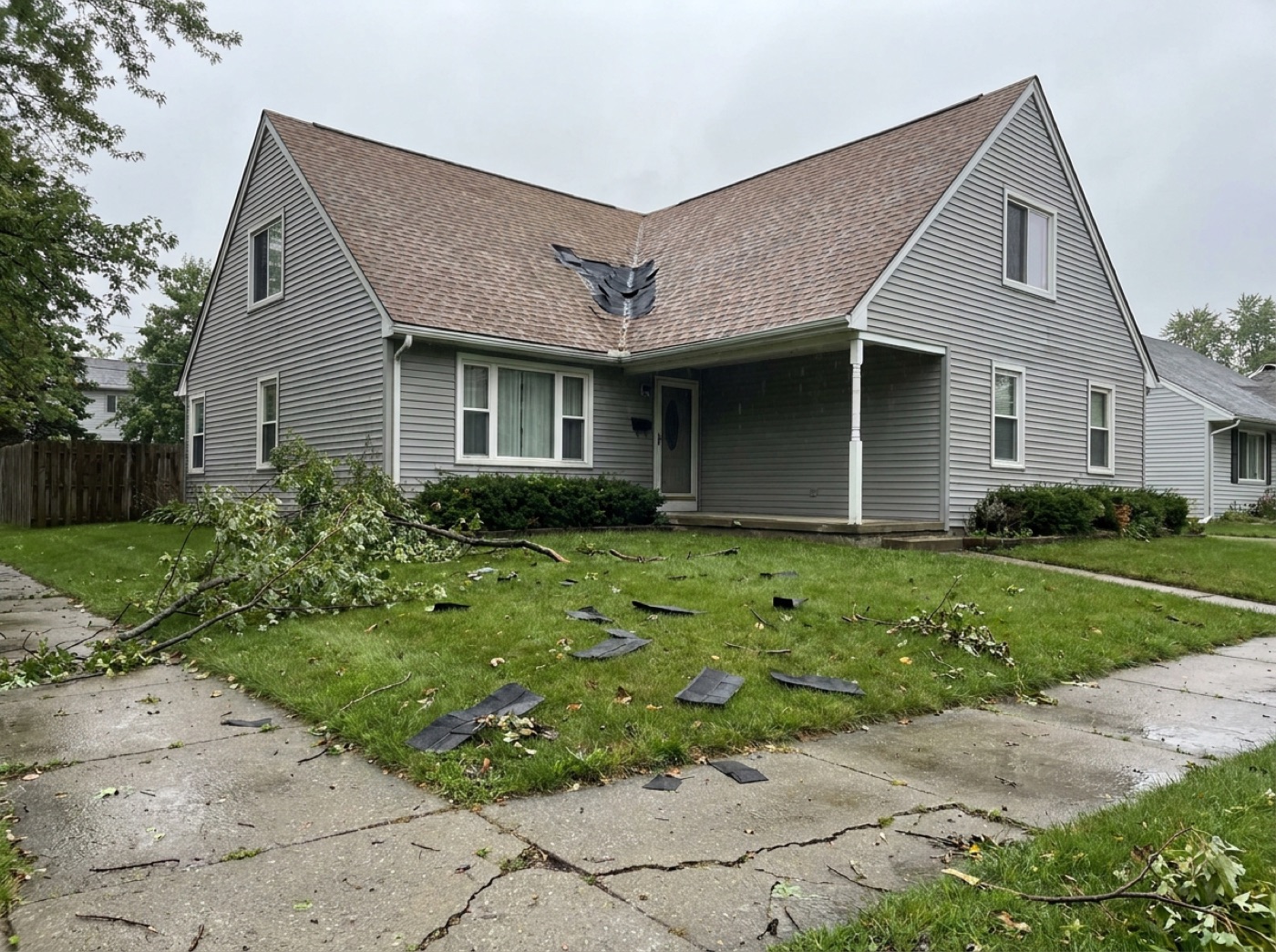
Storm damage is rarely symmetrical, which is why partial approvals are so common. Hail often arrives at an angle and hammers one or two exposures while barely touching the planes facing away. Straight-line wind loads one edge of the roof. After a real event like the August 2023 storms that brought a federal disaster declaration to Macomb County, it is completely normal for the west face of a subdivision to look shredded while the east faces look untouched. The adjuster who approves two slopes is often describing the storm accurately. The question the estimate does not answer is what it means to rebuild half of a roofing system that was installed, and has weathered, as one.
That question matters because a roof is a system, not a set of independent quadrants. The planes share ridge caps, valleys, flashing details, and a single ventilation path. Tearing off two slopes disturbs the ridge and the valleys the remaining slopes depend on, and the workmanship at the tie-in line, where new shingles weave into an aged field, is some of the most failure-prone detail work in roofing. Our storm and insurance claims hub covers the documentation side of all of this; the sections below cover the partial-scope problem specifically.
03 / READING THE PAPERHow a partial approval reads in the estimate
Carrier estimates itemize the roof by slope or by elevation, so a partial approval is visible in the line items if you know what to look for. You will typically see tear-off and installation quantities that add up to less than your total roof area, entries naming specific slopes or directions, a small repair allowance for the unapproved planes, and shared components like ridge cap, drip edge, or valley metal quantified only along the approved sections. If the policy pays replacement cost, the estimate will also show depreciation withheld until the work is complete, which our repair-versus-replacement claims guide explains in more depth.
The quickest tell on a thin partial scope is what happens at the boundaries. If the estimate replaces a slope but not the valley it drains into, or new shingles but not the ridge cap they die into, ask how the tie-in is supposed to be built. A roofer who reads carrier estimates every week can flag these gaps in minutes, and the inspection that produces that read is $0.
Quantities are the other thing to verify. Adjusters measure from aerial imagery and a ladder, and honest mistakes happen in both directions. Compare the square counts in the estimate against a contractor measurement of the same planes, and compare the scoped items against photographs of the actual damage. A partial approval that accurately captures two damaged slopes is a starting point you can work with. A partial approval that captures one and a half of the three damaged slopes is simply incomplete, and carriers can revise a scope when documentation supports it, a process called supplementing that happens on a large share of storm claims.
04 / THE MATCHING PROBLEMNew shingles against a decade-old field
Here is where partial approvals collide with physics. Asphalt shingles weather from the day they are installed: ultraviolet light fades the granule color, thermal cycling ages the asphalt, and the whole field slowly shifts tone. A brand-new shingle laid next to a ten-year-old one will not match it even if the product name is identical, and manufacturers also revise color blends over the years, so the same color name bought today may not be the same blend that is on your roof. Our shingle matching guide covers this in detail, and the short version is that a true match to an aged field is rarely achievable.
It gets harder when the original shingle is no longer made at all. Product lines retire constantly, and if your shingle is discontinued, the new slopes will be a different product, not just a different age of the same one. That fact can change the conversation with the carrier, because some policies and some carriers treat a reasonable match as part of restoring the property. What happens when no reasonable match exists is one of the most contested questions in roof claims, and our discontinued shingles claim guide walks through it, including how manufacturers formally document that a product is obsolete.
A partial approval prices the damaged slopes. It does not answer what the roof looks like, or how the seam performs, when new material meets a field that has been weathering for a decade.
Beyond looks, there is a workmanship question. The tie-in between new and old sections has to be woven or flashed so the seam sheds water for the life of both fields, and the old shingles at the boundary, brittle from age, often crack when they are lifted to weave the new courses in. A conscientious crew can build a sound tie-in on most roofs, but it is detail work, and it is fair to ask any contractor bidding a partial exactly how they will handle the seam, the valleys, and the ridge. If the answer is vague, keep looking.
05 / WHEN TO ACCEPTWhen a partial approval genuinely makes sense
Not every partial approval should be fought. If your roof is relatively young, the color is a current, available product, the damaged planes are cleanly separated from the rest by ridges or dormers, and the undamaged slopes genuinely have years of life left, a slope replacement can be a perfectly good outcome. You get new material where the storm hit, the seam sits along a natural break, and the mismatch, if any, is minor because the field has not had time to fade far from factory color.
Roof geometry does a lot of the deciding. On a simple gable where the replaced plane faces the back yard and the aged plane faces the street, nobody will ever see the two together, and the matching concern is mostly theoretical. On a hip roof where every plane is visible from the corner of the lot, a two-tone roof is obvious to anyone standing at the curb, and it can follow the house into an appraisal or a sale. The same partial scope can be sensible on one house and a real problem on the identical house rotated ninety degrees.
Age is the other axis. A roof under five years old takes a partial gracefully. A roof past fifteen usually does not, because the remaining slopes are close enough to end of life that you may be paying your deductible now and facing a full replacement at your own expense within a few seasons anyway. In that situation it is worth running the numbers both ways: a full asphalt replacement in Macomb County runs $9,000 to $18,000 installed, with most homes landing $12,000 to $16,000, and you can rough in your own figure with the 60-second cost calculator before you decide how hard to work the claim.
06 / EXTENDING SCOPEThe arguments that sometimes turn a partial into a full roof
There are recognized, legitimate arguments that can extend a partial approval, and there are fantasies. Start with the legitimate ones. The strongest is additional damage the first scope missed: if a contractor inspection documents qualifying storm damage on the unapproved slopes, with chalked photos and test squares, the carrier can reinspect and may revise the scope. This is the most common way partials grow, and it is pure documentation work, no doctrine required.
The second is repairability. A scope that replaces two slopes and spot-repairs the others assumes the others can actually be repaired. If the field shingles are brittle enough that they crack when lifted, individual shingle replacement may not be mechanically possible without breaking the surrounding courses, and a repair allowance that cannot be executed is an argument for replacing that slope too. Adjusters can test this on the roof, which is exactly the kind of thing a contractor who can meet your adjuster should demonstrate rather than assert.
The third is matching, and it needs careful handling. Some states have statutes, regulations, or published insurance-department positions on whether a carrier must address mismatch between new and existing materials, sometimes framed as line-of-sight or reasonable-match standards, and some policies add or exclude matching coverage by endorsement. Michigan's position rests on your specific policy language and on legal authority that we do not summarize from memory; the sources section below flags it for verification rather than pretending certainty. What we can say responsibly: read your policy for matching or pair-and-set language, ask the carrier in writing how it handles mismatch when a reasonable match is unavailable, and treat any contractor who promises that a matching argument will convert your partial into a full roof with suspicion. It may. It often does not. Nobody can promise your claim outcome, and the honest framing is that matching arguments sometimes extend scope and sometimes go nowhere.
If the gap between the carrier scope and reality stays wide after reinspection, the escalation ladder is the same one covered in our guide to repair-only approvals: a written supplement with documentation, the policy's appraisal clause if the dispute is about amount, a complaint to state insurance regulators, and, for large disputes, a licensed public adjuster or an attorney. Each rung costs time and sometimes money, which is why the decision in section 05, whether the partial is actually bad for your house, should come first.
07 / NEXT STEPSWorking a partial approval in Macomb County
The practical sequence is short. First, get an independent read on the whole roof, not just the approved slopes: our free inspection photographs every plane, measures the roof, and compares what is up there against the carrier estimate line by line. Second, decide with real numbers, using the published price ranges and the instant estimator to see what accepting the partial versus pursuing the full roof means for your out of pocket. Third, if the scope understates the damage, we document it properly and can meet your adjuster on the roof for the reinspection. And if the partial approval turns out to be fair, we will tell you that too, and simply build the approved slopes with a tie-in done right.
- Carriers scope roofs plane by plane and may approve replacing only the damaged slopes; that alone does not make the approval wrong.
- Read the estimate for slope-level quantities and shared components like valleys and ridge cap; thin scopes show up at the boundaries.
- New shingles will not truly match a decade-old field, and discontinued products make matching arguments stronger but never automatic.
- Partials make the most sense on young roofs with clean plane separation; on older or highly visible roofs, run the full-replacement math first.
- Scope extends through documentation: missed damage, demonstrated non-repairability, and carefully hedged matching arguments, never through promises.
- No contractor can guarantee your claim outcome. Anyone who promises a full roof before the reinspection is selling, not scoping.
Questions we hear most
Yes. Policies generally cover direct storm damage, and adjusters scope roofs slope by slope, so a carrier may approve replacing only the planes with qualifying damage. Whether that partial scope is adequate depends on what the inspection actually found, how the tie-in and shared components are handled, and what your policy says about matching. An independent inspection that photographs every plane is the fastest way to check the scope.
Not exactly, and often they cannot: shingles fade with weathering, manufacturers revise color blends, and some products are discontinued entirely. Whether the carrier must address a mismatch depends on your policy language and on state law that varies by state, so read your policy for matching language and ask the carrier in writing how it handles mismatch. Matching arguments sometimes extend a partial scope to more of the roof, but no one can promise that outcome.
Sometimes. On a younger roof with a current color and clean separation between planes, a slope replacement can be a good outcome. On an older roof, or one where every plane shows from the street, it is worth comparing the claim against full-replacement math first, since asphalt replacements in Macomb County run $9,000 to $18,000 with most homes at $12,000 to $16,000. If the scope missed damage, carriers can reinspect and revise it when documentation supports that.
- FEMA disaster declaration DR-4757, severe storms and flooding, August 2023, including Macomb County, Michigan. fema.gov/disaster/4757
- Michigan Compiled Laws, full statute text via the Michigan Legislature. legislature.mi.gov
- Insurance Information Institute, consumer explainers on homeowners policy coverage, deductibles, and the claims process. iii.org
- Manufacturer technical and warranty literature for the major asphalt shingle lines: GAF (gaf.com), Owens Corning (owenscorning.com), and CertainTeed (certainteed.com).
- Macomb Roofing Pros 2026 price canon, installed ranges: asphalt $9,000 to $18,000 (most homes $12,000 to $16,000), repairs $350 to $3,200 (larger or complex can run higher).