
JUMP TO A SECTION
Shingle lines die quietly. Manufacturers retire products, merge color blends, close plants, and rebrand entire series, and none of that shows up on your roof until the day a storm takes a patch of shingles off and a repair crew goes looking for replacements. Then the quiet fact becomes the loudest thing in the claim: the adjuster's estimate says replace forty damaged shingles, and the shingle it prices no longer exists at any distributor in Michigan. This situation comes up constantly on Macomb County roofs, because so much of our housing stock was shingled fifteen to twenty five years ago with products that have since left the market. This guide covers what discontinuation actually changes in a claim, how it gets verified so the carrier treats it as fact rather than a contractor's opinion, how it feeds the matching and full-slope conversation, and what needs to be in the file. One caution before any of it: a discontinued shingle strengthens a scope argument, but it does not automatically buy anyone a new roof, and any roofer who promises otherwise is selling, not scoping.
01 / THE SHORT ANSWERWhat a discontinued shingle changes, and what it does not
An insurance repair estimate assumes the damaged material can be replaced in kind: pull the broken shingles, install the same product, done. Discontinuation breaks that assumption. If the exact shingle cannot be bought, the repair as written cannot be performed as written, and the claim has to answer a new question: what is the closest reasonable substitute, and how visibly different will it be? Sometimes a successor product from the same manufacturer is close enough that a patch reads fine from the street. Sometimes nothing on the market comes close in profile, dimension, or color blend, and a spot repair would leave an obvious checkerboard on the slope. That second case is where discontinuation starts to matter, because many policies address, in one way or another, whether the repaired property has to reasonably match what surrounds it.
What discontinuation does not do is decide the claim by itself. Carriers respond to it differently depending on the policy language, any matching or line-of-sight provisions, and the specific facts on the roof. Some claims resolve as a repair with a near-match product. Some expand to the damaged slope. Some expand further. The outcome typically turns less on the bare fact of discontinuation and more on how well that fact is proven and how clearly the mismatch consequence is documented, which is exactly what the rest of this guide is about. For the broader matching framework this feeds into, our guide on shingle matching in Michigan roof claims is the companion read. Ahead of that framework sits the word on its own: what matching means on a roof claim, and why the argument is about how much roof gets replaced rather than about whether the loss is covered.
A verified discontinued shingle turns a simple repair scope into a substitution question, and a well-documented substitution question can support a larger scope, but the policy language and the carrier's review decide the outcome, not the discontinuation alone.
02 / THE PROOFHow discontinuation actually gets verified
The single biggest mistake homeowners and contractors make here is treating discontinuation as something you assert. A sentence in an estimate that says the shingle is no longer available is an opinion, and adjusters are trained to be skeptical of opinions that raise the scope. What moves a claim is verification, and it typically comes from three directions.
Distributor and supplier checks
The first pass is commercial: can any roofing distributor actually order the product? A contractor who works in this market weekly can query the regional suppliers that stock southeast Michigan, ask for the product by its full name, line, and color, and document the answer in writing. Emails or written confirmations from distributors stating the product is no longer available to order are simple, dated, and hard to argue with. One supplier saying no is thin; several of the major distributors for the region saying no starts to look like fact. Leftover bundles in a clearance rack do not defeat the point either, because a repair needs enough matching material to complete the scope, not a partial pallet of a dead product in one warehouse.
Independent laboratory match reports
The second direction is the one carriers themselves lean on. Independent testing services exist whose business is exactly this question: a physical sample of the damaged shingle is cut from the roof and mailed in, and the lab identifies the product, reports whether it is still manufactured, and lists the closest available alternatives with a similarity assessment. Adjusters order these reports routinely, and contractors and homeowners can request that one be ordered when availability is in dispute. A lab report carries weight precisely because it is independent: it is not the contractor angling for a bigger scope or the carrier angling for a smaller one. If the report comes back confirming the product is discontinued and the nearest match differs in size or appearance, that document usually becomes the spine of the whole conversation. If it comes back naming a solid available match, that is worth knowing early too, because it means the repair path is real and the fight is not worth having.
The manufacturer's own record
The third direction is the source itself. Manufacturers publish current product lineups, and their technical departments can often confirm in writing when a line or color was discontinued. A dated discontinuation confirmation from the company that made the shingle is about as clean as evidence gets. It is also worth pulling because it can surface a subtler problem: some products were technically continued but reformulated, so the current version of the same name no longer matches roofs shingled with the old version. The name survives; the match does not. That nuance only comes out when someone actually checks.
03 / THE CONSEQUENCEMatching, mismatch, and the full-slope conversation
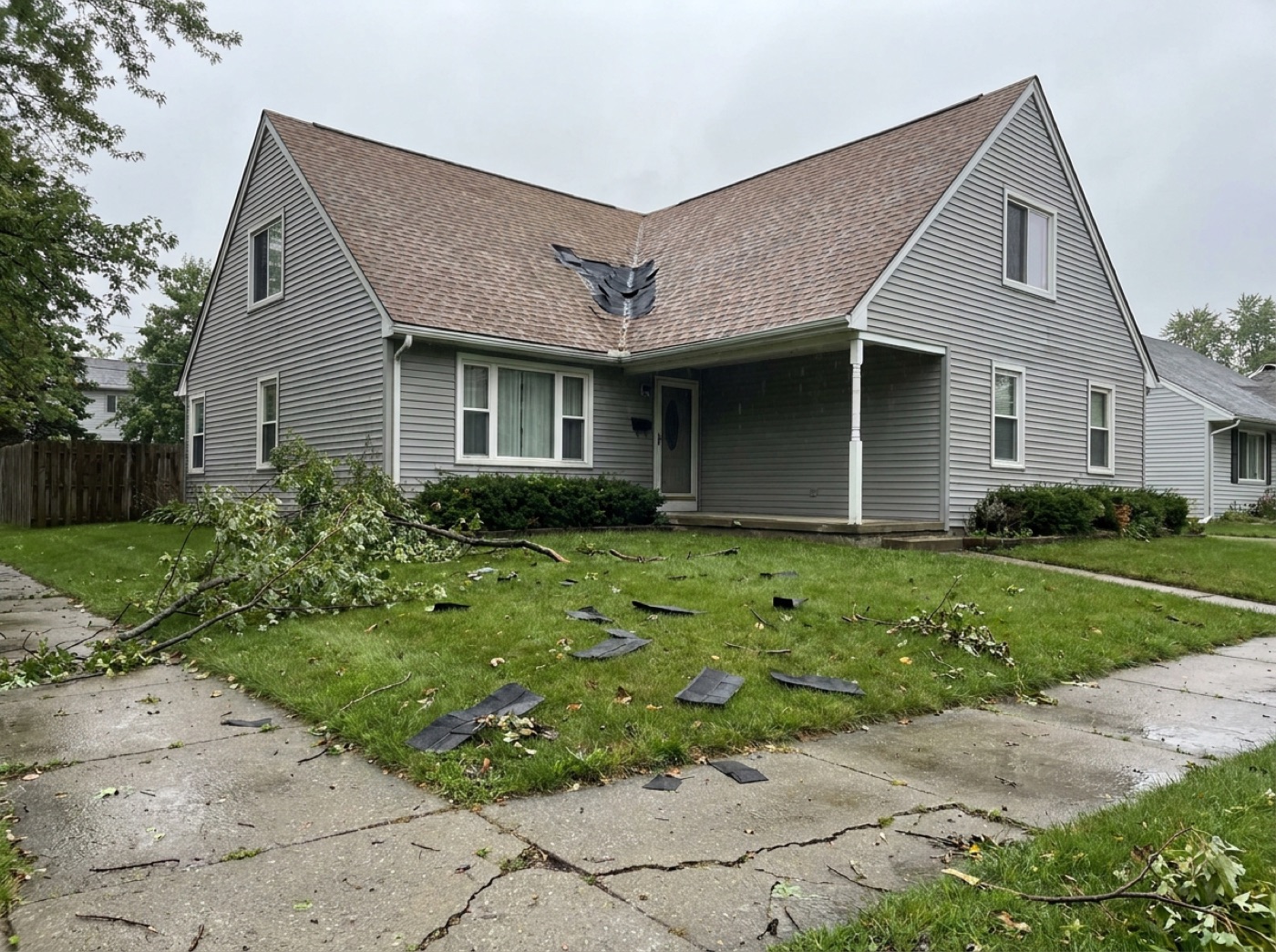
Verification answers whether the shingle exists. The next question is what follows from a no, and this is where the claim gets genuinely interesting. If the closest available substitute differs visibly from the surrounding roof, a spot repair produces a mismatch: a rectangle of different color, texture, or shadow line in the middle of an otherwise uniform slope. Whether the carrier owes anything for that mismatch depends on the policy. Some policies include language about matching or uniform appearance, some carriers apply line-of-sight guidelines that treat a visibly patched slope differently from a patch hidden on a rear elevation, and some policies expressly limit matching coverage or exclude it through an endorsement. Michigan does not hand you one universal rule here; the policy language and the carrier's own practice do most of the deciding, which is why reading the policy, not the brochure, is step one.
In practice, the conversation tends to escalate in stages. If a reasonable match exists, the claim usually stays a repair, priced within the ordinary $350 to $3,200 repair band that most Macomb County roof repairs fall into. If no reasonable match exists, the discussion often moves to replacing the damaged slope, so the mismatch lands at a roof plane boundary where the eye does not catch it. And when damage or mismatch consequences touch multiple slopes that are visible together, the discussion can reach full replacement, which for asphalt runs $9,000 to $18,000 in this market. Each step up requires more than the last: better documentation, clearer photos of the sightlines, and usually a written scope argument. Our guides on partial roof replacement in insurance claims and claim supplements cover the mechanics of pushing scope in both of those directions.
It is worth being honest about the ceiling on this argument, because plenty of people are not. A discontinued shingle is leverage, not a trump card. Carriers may offer a near-match repair and a small allowance for appearance. They may replace one slope and decline the rest. They may agree the whole roof has to go. All three outcomes happen, sometimes on facts that look similar from the driveway, and no contractor can promise which one your claim reaches. What a contractor can do is make sure the carrier is deciding on a complete file rather than a thin one, because the thin file almost always resolves to the cheapest reading.
Discontinuation is a fact you prove, not a phrase you say. The claim moves when the file shows the shingle is gone, shows what almost matches, and shows exactly what the mismatch would look like from the curb.
04 / THE FILEWhat the discontinuation file should contain
Everything in the previous two sections collapses into a checklist. When we work a claim where availability is in question, the goal is that the adjuster never has to take anyone's word for anything. The file does the talking, and it typically holds the following.
Two items on that list deserve emphasis. The physical sample matters because product identification from photographs is unreliable, and because the independent labs need the actual shingle to work from; a good crew cuts the sample from material that is already damaged, so the sampling itself costs the roof nothing. The sightline photos matter because the mismatch argument is ultimately visual. A photo taken from the street showing which slopes read as one surface does more work than a paragraph of prose, and it is the piece homeowners most often forget to capture before a tarp goes on. The rest of the storm paperwork, from first photos to adjuster meeting, follows the same playbook as any wind claim, which our storm and insurance claims guide walks end to end.
05 / THE OUTCOMESWhere discontinued-shingle claims tend to land
Because outcomes vary by carrier and policy, the useful thing to describe is the pattern, not a promise. The mildest resolution is a repair with the nearest available product, sometimes with a modest appearance allowance, and on roofs where the substitute is genuinely close, that is often a fair result. The homeowner should still get the nearest-match determination in writing, because if the substitute weathers differently over the next few seasons, the file establishes what was known when.
The middle resolution is slope replacement: the damaged plane is reshingled edge to edge in a current product, so no patch sits inside a field of old shingles. This is frequently where verified discontinuation plus strong sightline documentation lands, and it is also where scope disputes concentrate, because the boundary of which slopes read together is a judgment call. The furthest resolution is full replacement, which typically requires either damage across multiple slopes, policy language favorable on matching, or both. When a claim does reach that scale, the settlement conversation becomes a replacement conversation, and the numbers on our pricing page and in the 60-second cost calculator are the same canon we quote on claim work: most asphalt homes land $12,000 to $16,000.
Timing shapes these claims too. Availability checks, lab reports, and carrier re-reviews each add days or weeks, and an open roof cannot wait on paperwork. The standard sequence is to protect the roof immediately, with emergency tarping available 24/7, and let the scope question resolve underneath the tarp rather than in the rain. Slower is sometimes better here: a claim settled in a hurry, before anyone verified availability, is the classic way homeowners end up with a paid-out repair that no supplier can actually fulfill.
Discontinued shingles are a favorite pitch line for storm-chasing crews, who knock on doors promising that an old shingle means a free full roof. It may not. Treat anyone who guarantees a claim outcome on the doorstep the way you would treat any stranger asking you to sign paperwork on the first visit: get the verification done first, in writing, by someone local you can drive to.
06 / THE LOCAL ANGLEWhy this comes up so often in Macomb County
Macomb County is nearly a laboratory for this problem. Large tracts of Sterling Heights, Warren, Clinton Township, and Shelby Township were built out in waves, and whole streets were roofed in the same era with the same handful of products, many of which have since been discontinued or reformulated. When the August 2023 storms that produced federal disaster declaration DR-4757 tore through, they damaged exactly those roofs, and a large share of the resulting repair scopes collided with availability the moment a contractor tried to order material. If your roof was patched after that event and the patch never quite matched, the availability question may already have been answered on your street; it was just never written into your file.
Our role in these claims is the documentation and the craft, in that order. We identify the product, pull the sample, run the distributor checks, request the independent match report when availability is disputed, photograph the sightlines, and put the whole package in front of the adjuster, and we can meet your adjuster on the roof to walk it together. If the claim resolves as a repair, we do the repair with the nearest match and tell you honestly how it will read from the street. If it resolves larger, we build the slope or the roof to the approved scope. What we do not do is promise an outcome we do not control, and we would put that sentence in writing.
If you suspect your damaged shingles are no longer made, the first step costs nothing: a free inspection that identifies the product and starts the availability check, with photos of everything we find. You can start from the instant estimator and pick storm damage as the job type, or browse the rest of the claims series in our guides library while you wait for the appointment.
- A discontinued shingle turns a repair scope into a substitution question; it strengthens a matching argument but does not automatically buy a full roof.
- Verification beats assertion: written distributor confirmations, an independent lab match report, and a manufacturer statement carry the weight.
- Cut a physical sample from already-damaged material and photograph the sightlines before the tarp goes on.
- Outcomes range from a near-match repair ($350 to $3,200 territory) to slope or full replacement ($9,000 to $18,000 for asphalt), depending on policy language and the file.
- Tarp first, verify second, settle third. A claim closed before availability is checked is how homeowners get paid for a repair nobody can perform.
Questions we hear most
Not automatically. A verified discontinued product can support replacing more than the damaged patch, because a visibly mismatched repair may not be a reasonable fix, but the outcome depends on your policy language and the carrier's review. Claims resolve as near-match repairs, slope replacements, and sometimes full replacements, and no contractor can honestly promise which one yours will reach.
With documents, not statements. Written confirmations from regional roofing distributors that the product cannot be ordered, an independent laboratory match report based on a physical sample cut from the damaged area, and a discontinuation confirmation from the manufacturer are the three standard proofs. Adjusters often order the lab report themselves when availability is disputed.
Get the nearest-match determination and the mismatch documented in writing, including photos of how the substitute reads next to your existing shingles from the street. You can then ask the carrier to address the appearance issue, which some policies and carriers handle through larger scope and others through an allowance. Our free inspection documents exactly that comparison, and we can meet your adjuster on site to walk it.
- FEMA, disaster declaration DR-4757-MI, Michigan severe storms of August 2023 (Macomb County designated). fema.gov/disaster/4757
- Manufacturer technical and warranty literature for the major asphalt shingle lines: GAF (gaf.com), Owens Corning (owenscorning.com), and CertainTeed (certainteed.com).
- Insurance Information Institute, consumer explainers on homeowners policy coverage, deductibles, and the claims process. iii.org