
JUMP TO A SECTION
A denial letter is designed to sound conclusive, with policy citations and a firm final line. For most homeowners it lands like a door closing. It is better understood as a door with several more doors behind it. Insurance claims are decided on paper, and a denial is one carrier's read of the paper as it existed on the day the letter was written. That read can be wrong, incomplete, or simply arguable, and Michigan law gives policyholders a real, structured path to challenge it: internal appeal and reinspection first, the appraisal clause where the dispute is genuinely about amount rather than coverage, a complaint to the state regulator if the handling itself looks improper, and public adjusters or attorneys for the disputes too large or too tangled to fight alone. This guide climbs that ladder in order, with realistic, hedged expectations at every rung. Nothing here is legal advice, and nothing here can promise a reversed decision. What we can promise is a clear map of the moves that actually exist, and we document the roof itself and can meet your adjuster on site at any point along the way.
01 / FIRST MOVERead the denial letter like a work order
Before doing anything else, read the letter twice and pull three things out of it: the specific policy provision cited as the reason, the factual basis the carrier says supports that reason, and any deadline the letter states for a response or appeal. Carriers are required to state a reason, and that reason is your target. A denial for "wear and tear, not a covered peril" is a different fight than a denial for "damage predates the policy period," which is different again from "claim filed outside the reporting window." Vague frustration does not move a file. A rebuttal aimed at the exact clause and the exact factual claim does.
Highlight the policy section number cited, the stated reason in plain English, and the deadline (if any) for appeal or proof of loss. Those three lines are what every rung below responds to. If the letter cites a policy section without quoting the actual language, request the full text of that provision in writing before you respond to anything else.
It also matters what kind of denial you have. A full denial says nothing is covered. A partial denial, sometimes worded as a low payment rather than a formal denial, says something is covered but less than the roof actually needs. The two call for different next moves, and our guide to an underpaid roof insurance claim covers the partial-denial path in more depth than this page can. Everything below assumes a genuine, stated denial of the claim or a major, disputed part of it. One question runs alongside every rung below and deserves a straight answer rather than a rumor: whether a denied claim still affects your premiums separates what the shared claims database records from what a carrier does with it at renewal, and it is honest that nobody publishes the formula.
One more thing worth checking before you respond: whether the letter denies the entire claim or only a specific line item within it. Some letters deny coverage for the roof while still approving other storm-related repairs, such as gutters or siding, and treating the whole letter as a blanket denial can lead a homeowner to overlook approved work sitting in the same file. Read line by line, not just the summary paragraph at the top.
02 / THE PATTERNWhy Macomb County roof claims get denied
Denials cluster around a handful of recurring reasons, and knowing which category yours falls into narrows the response considerably. Our companion guide to reasons roof claims get denied covers the full list; the short version below is enough to orient a first response.
Wear and tear versus a covered peril
Homeowners policies generally cover sudden, accidental damage from named perils such as wind and hail, not the gradual aging of a roof. A carrier that reads granule loss and curling shingles as age, rather than storm damage, will deny on this basis, and the rebuttal has to be evidence that the damage pattern is sudden and storm-consistent, not simply that the roof looks bad.
Timing and the filing window
Every Michigan policy has a deadline for reporting a loss, and claims filed long after a storm event invite a denial on timeliness grounds even when the damage itself is real. Our guide to the Michigan roof claim filing deadline covers how that window is usually written and what documentation helps when a claim is filed later than ideal.
Pre-existing damage or a prior claim
If the carrier's inspection notes suggest the damage was already present before the policy period or before the storm date in question, that becomes the stated reason. This is where dated photos, prior inspection records, and a clear timeline matter most, because the dispute is entirely about when the damage happened.
Missing or late proof of loss
A sworn proof of loss is a formal document with its own deadline, separate from the initial claim report, and a missed or incomplete proof of loss can sink an otherwise valid claim on a technicality. If this is the stated reason, the fix is procedural: file the corrected document promptly and in writing, and ask whether the carrier will accept a late submission given the circumstances.
03 / THE PREPBuild the counter-evidence before you appeal
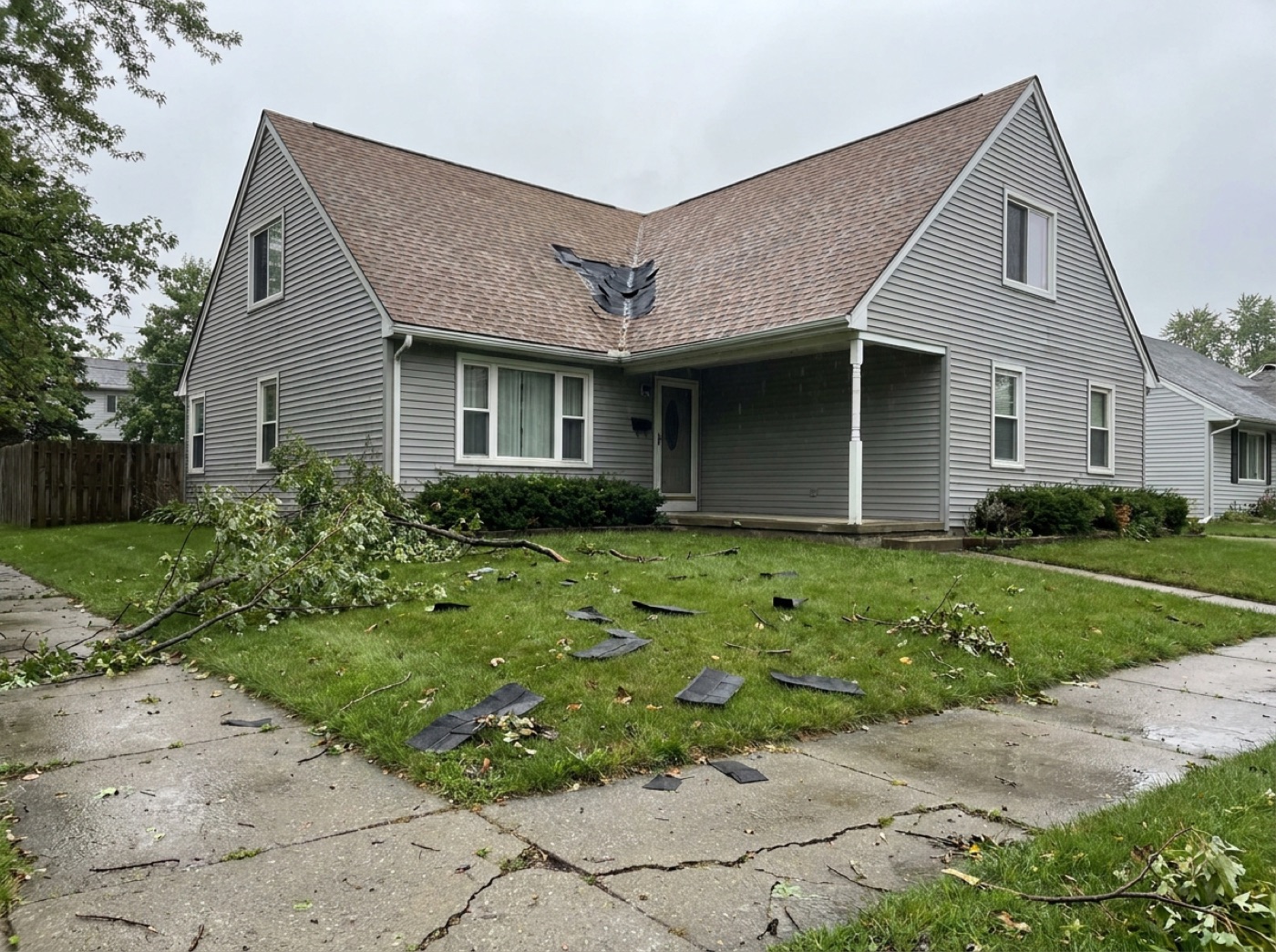
Every rung above the letter itself runs on the same fuel: documentation that speaks directly to the stated reason for denial. Before drafting an appeal, assemble what you actually have and what you are missing.
- Dated photos of the damage, ideally from before and after the storm event in question, including wide shots that establish context and close shots that show the damage itself.
- An itemized contractor estimate from someone who has been on the roof, written in the same line-item language the carrier's own estimate uses.
- A written timeline connecting the damage to a specific weather event, including the date and, where available, local weather service or news records of the storm.
- Your policy's actual language for the provision the carrier cited, not a summary of it, pulled from the declarations page or requested from the carrier directly.
- Any prior inspection records that show the roof's condition before the event, if you have them.
A free inspection is where most of this evidence gets built. We document the roof and, where relevant, the attic side of the deck with photos, and we write the scope in the same trade language an adjuster's estimate uses. That document does not argue with the denial; it gives the next rung something concrete to respond to. Start one through the instant estimator.
It is worth being organized about this rather than sending everything at once. Photos should be labeled by date and slope, the timeline should be a simple dated list rather than a narrative, and the itemized estimate should be attached as its own document, not summarized in an email. Reviewers on the other end are working through a stack of files, and a submission that is easy to scan gets read more carefully than one that buries the key point in three paragraphs of frustration. This is true whether the next stop is an internal appeal, a reinspection, or a DIFS complaint; the packet does not change, only the address it goes to.
A denial letter answers the file as it existed. The only way to change the answer is to change what is in the file, in writing, with evidence.
04 / RUNG ONEInternal appeal and reinspection
The first and lowest-friction rung is the carrier's own internal process. Most denial letters name a channel for requesting reconsideration, sometimes called an appeal, sometimes handled as a request for reinspection by a different adjuster or a senior reviewer. This rung works best when the request is specific and attached to new or corrected evidence rather than a repeat of the original claim: the missed slope, the corrected timeline, the itemized estimate that lists the code items the first inspection did not flag. A reinspection request that simply restates disagreement rarely produces a different outcome; one that hands the reviewer a specific, photographed gap can. Ideally your contractor is present for the reinspection to walk the roof alongside the adjuster, and we can meet your adjuster on site for exactly this purpose.
This rung is worth climbing even when you expect to need more, because it is fast, free, and sometimes sufficient on its own. It also creates a clean paper record for the rungs that follow: a documented, specific request that the carrier considered and responded to.
| RUNG | WHAT IT ADDRESSES | COST TO YOU |
|---|---|---|
| Internal appeal / reinspection | New or corrected evidence on an existing claim | Free |
| Appraisal clause | Genuine dispute over the dollar amount of a covered loss | Your appraiser's fee, split of umpire cost |
| DIFS complaint | Handling or process concerns, unreasonable delay | Free |
| Public adjuster | Full claim representation on a covered loss | Percentage of settlement |
| Attorney | Coverage disputes, denials, bad faith allegations | Varies by arrangement |
05 / RUNG TWOThe appraisal clause, where it applies
Most homeowners policies include an appraisal clause built for a specific kind of dispute: both sides agree the loss is covered but disagree about the dollar amount. Under a typical appraisal process, each side hires its own appraiser, the two appraisers select a neutral umpire, and the panel's finding sets the amount of the loss. It is a real, often faster alternative to litigation for amount disputes, but it is the wrong tool for a full coverage denial, where the carrier's position is that nothing is owed at all rather than that the number is too low. Read your policy's actual appraisal provision, note any deadlines or notice requirements it sets, and weigh the appraisal costs against the size of the disputed gap before invoking it. Our guide to the appraisal clause in roof claims covers the mechanics and the cost tradeoff in full.
06 / RUNG THREEFiling a complaint with DIFS
Michigan's Department of Insurance and Financial Services, DIFS, regulates how insurance companies operate in the state and accepts consumer complaints about claim handling. A DIFS complaint is the right rung when the dispute looks like a process problem rather than, or in addition to, a disagreement about the roof: unreasonable delay, a denial that does not match the policy's actual language, an adjuster who will not respond, or handling that appears to violate the state's claims-practices requirements. Filing is free and does not require an attorney. It is not, however, a mechanism for forcing a carrier to pay a specific dollar amount, and a complaint alone does not resolve a genuine coverage dispute the way an appeal, appraisal, or legal action can. Our guide to filing a DIFS complaint in Michigan walks the form and the documentation it expects.
A DIFS complaint typically prompts the department to contact the carrier for a written response explaining how the claim was handled, which can itself surface information that was not previously shared with you, such as the specific inspection notes or the internal reasoning behind the denial. That alone does not compel a payment. What it does is put the carrier's handling on the regulatory record and, in some cases, prompt a second look at a file that a reviewer knows is now being watched.
Proof of loss deadlines, appraisal demand windows, and the time limit to sue on a policy are all real clocks that keep running while you pursue an appeal or a complaint. Read the duties-after-loss section of your policy early and calendar every date, rather than assuming an appeal in progress pauses them.
07 / RUNG FOURPublic adjusters and attorneys
For claims large enough or contested enough that self-representation stops making sense, Michigan licenses public adjusters: independent professionals who represent the policyholder, document and value the loss, and negotiate with the carrier directly, typically for a fee taken as a percentage of the eventual settlement. Whether that fee is worth it depends on the size of the disputed amount and how much of the fight is left to do; our guide to public adjusters in Michigan roof claims walks that tradeoff. For a full denial the homeowner believes is wrong as a matter of policy interpretation, or for any allegation of bad faith handling, an attorney who handles insurance disputes is the appropriate rung, and that conversation is a legal one this page cannot substitute for.
Notice who does not appear on this ladder as a negotiator: your roofing contractor. Negotiating coverage on a policyholder's behalf is licensed activity in Michigan, reserved for public adjusters and attorneys, and a roofer who offers to fight your insurance company for you is offering something outside their license. What a contractor can honestly do is document the roof, write an itemized scope in trade language, and meet your adjuster on site. Every rung above depends on having that documentation ready, which is the role we play at any point on this ladder.
Expect this rung to take longer than the others. A public adjuster or attorney typically wants to review the full claim history, the policy itself, and any prior correspondence before taking a case, and a genuine coverage dispute can run weeks to months rather than days. That timeline is a reason to start the process early once a denial looks like it is going to stick, rather than waiting until a repair season or a policy deadline is closing in. It is also a reason the earlier rungs are worth exhausting first: an appeal or reinspection that resolves the issue in a few weeks is faster and cheaper than a dispute that ends up needing representation.
Macomb County has its own recent context here. The August 2023 wind storms placed the county inside federal disaster declaration DR-4757, and the claim volume that followed meant some first-round decisions, denials included, were made fast, on thin files, during a stretched season for adjusters. That does not make any given denial wrong, but it is a reason a documented second look is often worth the time it takes.
- Read the denial letter for the exact policy provision cited and the exact factual reason given; that combination is the target for everything that follows.
- Common denial reasons cluster into wear-and-tear findings, filing-window issues, pre-existing damage claims, and proof-of-loss technicalities, each calling for a different rebuttal.
- Build counter-evidence first: dated photos, an itemized contractor estimate, a documented timeline, and the policy's actual language, before appealing anything.
- Climb the ladder in order: internal appeal or reinspection, the appraisal clause for genuine amount disputes, a DIFS complaint for process problems, then a public adjuster or attorney for large or contested disputes.
- No rung, and no contractor, can promise a reversed decision or a claim outcome. We document the roof, write the scope, and can meet your adjuster on site at any point.
Questions we hear most
Read the denial letter closely for the specific policy provision cited and the specific factual reason given, since those two details are the target for any appeal. Then gather counter-evidence: dated photos, an itemized contractor estimate, and a documented timeline of the damage. Only after that is assembled does an internal appeal or reinspection request make sense.
Sometimes. A denial is one read of the file as it stood on a given day, and internal appeal, reinspection, the appraisal clause for amount disputes, a DIFS complaint for process problems, or a public adjuster or attorney for larger disputes are all real paths that can change the outcome. None of them guarantees a reversal, and no contractor can promise one.
It depends on the size of the claim and whether the dispute is about the dollar amount or about coverage itself. A public adjuster can document and negotiate the value of a covered loss for a fee; an attorney is the appropriate route for a full denial disputed on policy grounds or any allegation of bad faith. Either way, a Michigan roofing contractor cannot negotiate your coverage for you, but can document the roof and meet your adjuster on site.
- FEMA, disaster declaration DR-4757-MI, Michigan severe storms of August 2023 (Macomb County designated). fema.gov/disaster/4757
- Michigan Department of Insurance and Financial Services (DIFS), consumer insurance resources and complaint process. michigan.gov/difs
- Insurance Information Institute, consumer explainers on homeowners policy coverage, deductibles, and the claims process. iii.org
- Michigan Compiled Laws, full statute text via the Michigan Legislature. legislature.mi.gov