
JUMP TO A SECTION
Somewhere between the storm and the check, if there is one, sits a meeting between your adjuster and your roof. What that meeting concludes depends heavily on what evidence is sitting in front of it. A homeowner who calls a contractor the morning after high winds and books a documented inspection walks into that meeting with a dated, slope-by-slope photo record. A homeowner who waits, or who accepts a two-line summary with no pictures, walks in with a lot less. This guide covers the inspection itself: how a professional storm inspection is structured, what it is built to prove, and where the honest line sits between documenting damage and promising a claim outcome, which no contractor can do. Filing mechanics, deductibles, and the ACV versus RCV question belong to a different page, our storm and insurance claims guide, and this one stays on the roof.
01 / THE SHORT ANSWERWhat a storm inspection for insurance covers
A storm damage inspection built for an insurance conversation is a slope-by-slope walk of the roof that photographs every finding twice, a context shot showing where on the roof it sits and a close-up showing what it actually is, then separates what a wind or hail event likely caused from what is ordinary age and wear. It covers the shingle field, the flashing, the gutters, the roof penetrations, and usually the attic side of the deck, since water and impact damage both show up there too. The output is a dated report you keep, whether the news is good or bad, and it is $0 with no obligation through our free inspection.
If the report you receive cannot answer "where on the roof, and what does it look like" for every finding with a photo, it is an opinion, not documentation an adjuster meeting can run on.
02 / THE PURPOSEWhat this inspection is actually for
It helps to be precise about what this specific inspection is trying to accomplish, because the word "inspection" covers several different jobs on a roofing site. A pre-purchase inspection answers whether a house is safe to buy. A routine maintenance inspection answers whether anything needs attention this year. A storm inspection built for insurance purposes answers a narrower question: what changed on this roof, on or around a specific date, and can that change be shown rather than just described. Everything about how the walk is structured follows from that narrower goal.
That means the inspection is not trying to render a coverage verdict. Coverage is a policy question that belongs to your carrier and your declarations page, and nothing in an inspection report, however thorough, decides it. What the inspection can do is build the strongest possible factual record: dated photographs, slope-by-slope notes, and a clear separation between damage consistent with a storm event and conditions that were already there. A strong record does not guarantee an outcome. It gives the outcome something solid to be decided from.
This is also why timing matters more here than on a routine inspection. Wind and hail damage can be subtle the day after the storm and much harder to characterize months later, once additional weather has worked on the same weak points. Macomb County has a documented event on the calendar already: after the severe storms of August 2023, the county was included in federal disaster declaration DR-4757. Homeowners who had roofs inspected in the weeks after that event generally have a cleaner record than those relying on memory of what the roof looked like at the time.
Most homeowners book this inspection one of two ways. Some call a contractor the same week as the storm, before they have even reported the loss to their carrier, simply to know whether there is damage worth reporting at all. Others already have a claim number and an adjuster date on the calendar, and want their own record in hand before that visit happens. Both are reasonable entry points, and the inspection itself does not change based on which one brought you here. What changes is only the sequence: a pre-claim inspection can inform whether you report a loss in the first place, while a pre-adjuster inspection is purely about walking into that appointment prepared.
03 / THE WALKHow the inspection walk actually runs
A thorough storm inspection follows a structure, not a random tour of whatever is easiest to reach from the ladder. Knowing the structure also tells you what a rushed inspection skips.
Ground pass first
The walk usually starts at ground level, circling the house and noting collateral signs: dented gutters and downspouts, damaged screens, granules collected at the downspout outlets, and anything in the yard that corroborates a wind or hail event. These ground-level signs matter because they establish context before anyone gets on the roof, and they are often the first thing an adjuster looks for as well.
Slope by slope on the roof
Each roof plane, front, rear, and every side, gets its own pass. The inspector is looking for the specific signatures of wind and hail: creased or lifted tabs and torn shingle tabs from wind, and random, circular bruising with soft centers from hail, as opposed to the linear, directional wear patterns of ordinary aging. Every slope gets at least one wide context photo, and every finding on that slope gets its own close-up. A roof with damage concentrated on one or two slopes, matching the direction the storm came from, is a common and credible pattern; damage spread identically and uniformly everywhere is a pattern worth questioning.
Flashing, penetrations, and gutters
Flashing around chimneys, walls, and valleys, along with pipe boots, vents, and skylights, gets checked individually, because these details fail from wind stress even when the shingle field looks intact. Gutters get photographed for dents and granule buildup, both common wind and hail signatures that support the roof-level findings.
Attic side, when accessible
If the attic is accessible, the inspector checks the underside of the deck for fresh staining, wet insulation, or daylight coming through a nail hole or crack that was not there before. Attic evidence is some of the most persuasive documentation available, because it shows the water actually made it through, not just that the surface was disturbed.
Interior walk, if damage reached inside
When a storm has been severe enough to drive water through the roof assembly, the inspection should also cover any interior signs the homeowner has noticed: a new ceiling stain, a damp patch on an upstairs wall, or a musty smell in a closet that shares a wall with the affected slope. These interior signs get photographed and, where possible, tied back to the specific roof-level finding believed to be the source, since an isolated interior stain with no matching roof damage is a much weaker claim than one with a documented path from a specific flashing failure or lifted shingle down to the ceiling below.
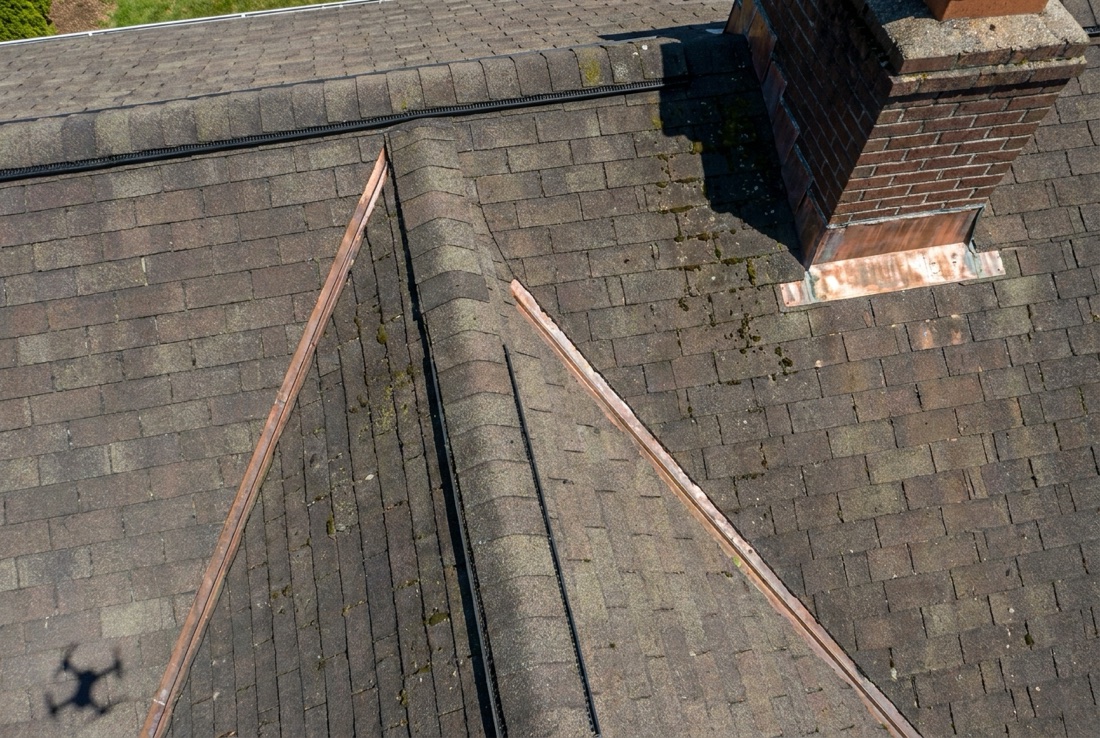
04 / THE SEPARATIONSeparating storm damage from ordinary wear
The hardest part of this inspection is not finding damage. It is telling storm damage apart from a roof that was simply getting old anyway, and doing that honestly matters, because insurance covers sudden events, not gradual wear, and a report that blurs the two helps nobody.
| SIGN | STORM PATTERN | ORDINARY WEAR PATTERN |
|---|---|---|
| Shape of the damage | Creased tabs, torn seals, circular bruising | Curling edges, uniform granule thinning |
| Distribution | Concentrated on storm-facing slopes | Even across all slopes and ages |
| Onset | Traceable to a specific date or event | Gradual, no single starting point |
| Companion evidence | Dented gutters, yard debris, siding marks | None, just the roof surface |
A shingle nearing the end of its rated life and a shingle damaged by a specific hail event can sit inches apart on the same roof, and only a trained, careful look, cross-referenced against the ground-level evidence and the direction of the storm, tells them apart honestly. A photo record that shows both, clearly labeled as what each one is, is more useful in an adjuster conversation than a report that claims everything is storm-related, because inflated claims tend to get scrutinized harder, not less.
Hail specifically gets its own verification method on a thorough inspection, marked test squares laid out on a representative section of each slope and counted for hits, rather than a single glance at the whole field. The takeaway that matters here: a granule count in the gutter, on its own, is ambiguous, since aging roofs shed granules too. What separates a storm claim is fresh, sharp-edged bruising on the mat beneath the granules, concentrated in a pattern that matches the storm, not just granules present.
The goal of this inspection is not to find the most damage possible. It is to find the real damage and show it clearly enough that nobody has to take your word for it.
05 / THE RECORDThe record the adjuster meeting runs on
By the end of the walk, a complete storm inspection produces a specific set of deliverables, and it is worth knowing what to expect and to ask for.
- A context photo for every roof slope, establishing the baseline condition of that plane.
- A labeled close-up for every finding, tied to a slope and a location on that slope.
- Attic photos when the attic was accessible, showing any staining or wet insulation.
- A written summary separating storm-consistent damage from ordinary wear, in plain language.
- A date stamp on the visit itself, tying the whole record to a specific point in time.
This is the same photo discipline covered in more depth in our roof inspection photos guide, applied specifically to a storm claim. The reason it matters here more than almost anywhere else: this record is very likely the first thing a homeowner hands an adjuster, and a record built before the adjuster ever arrives sets the tone for the whole conversation. It also gives you something independent to compare against the adjuster's own report once it comes back.
Keep the record even after the claim resolves. A dated photo set from the inspection is useful again if the carrier's estimate comes back missing a slope or a finding you know was documented, if a second opinion is ever needed, or if a question comes up years later about what condition the roof was in before a specific repair. None of that requires the photos to have been taken with a future dispute in mind. It only requires that they exist, that they carry a date, and that you keep a copy somewhere you can find again rather than leaving the only set on someone else's server.
06 / ON SITEMeeting your adjuster on site
Once your own inspection record exists, the natural next step for many homeowners is the adjuster's own visit. You are entitled to have your contractor present for that appointment, and we can meet your adjuster on site when that visit is scheduled. The role there is straightforward: walk the roof alongside the adjuster, point to what our own inspection already documented, and answer questions about what a finding is and how it would be repaired. That is a factual, technical role. It is not a negotiation, and it is not a substitute for the coverage decision your policy and your carrier control.
Being able to point an adjuster directly to a flagged finding, with a photo from days or weeks earlier showing the same spot, is a meaningfully different conversation than an adjuster discovering everything cold on the day of their own visit. It does not change what the policy covers. It changes how efficiently the appointment can confirm what is actually there.
Occasionally the two reports do not fully agree, our slope-by-slope findings and the adjuster's own file. That is not unusual, and it is not automatically a problem either. Roofs are large, weather is uneven, and two careful people can genuinely see a section differently on different days. What matters at that point is that both records exist, dated and photographed, so any gap between them can be discussed against evidence rather than memory. A homeowner with a documented pre-adjuster inspection is simply better positioned for that conversation than one without.
07 / THE BOUNDARYWhat this guide is not, and where the rest lives
Two things are deliberately out of scope here, and it is worth saying so plainly rather than gesturing at them incompletely. First, this guide does not cover how to file the claim itself, work with your carrier's timeline, or push back on a denial or a thin estimate; that entire sequence, along with the deductible and ACV versus RCV questions, lives on our storm and insurance claims page. Second, this guide does not promise, and no contractor honestly can promise, that documented damage results in an approved claim. Coverage decisions belong to your policy and your carrier.
What this page controls is the part a homeowner can actually control before any of that: getting a real, dated, photographed inspection of the roof as close to the storm as possible. If the roof only needs a repair once the claim resolves, most Macomb County repairs run $350 to $3,200, and larger or complex repairs can run higher. If it needs a full replacement, a typical asphalt replacement here runs $9,000 to $18,000, and most homes land $12,000 to $16,000, the same canon on our pricing page and worked through in detail in our replacement cost guide. For a ballpark before anyone visits, the 60-second cost calculator uses the same published ranges. If wind or hail damage is the specific question on your roof, our wind and hail damage inspection guide goes deeper on identifying those signatures, and our post-storm inspection guide covers the broader timing question of when to book after any storm, not only a claim-bound one. You can start the inspection itself from the instant estimator.
- A storm inspection for insurance purposes documents every finding with a context photo and a close-up, slope by slope.
- The honest work is separating storm-consistent damage from ordinary wear, not maximizing what gets flagged.
- Attic access, when available, often produces the most persuasive evidence of water intrusion.
- A dated record built before the adjuster's own visit makes that appointment more efficient, though the coverage decision stays with your carrier.
- We can meet your adjuster on site; filing mechanics, deductibles, and ACV versus RCV live on the storm and insurance claims page, not here.
Questions we hear most
As soon as reasonably possible. Damage signatures are clearest right after the event and can be harder to characterize once more weather has worked on the same weak points. A dated inspection close to the storm date, and to Macomb County's own DR-4757 event history, gives the strongest record.
No. An inspection can document what is actually on the roof with dated, labeled photos and separate storm damage from ordinary wear, but the coverage decision belongs to your policy and your carrier. No contractor can honestly promise a claim outcome.
Yes. We can meet your adjuster during their scheduled visit, walk the roof with them, and point to what our own inspection documented. That role is factual and technical, not a negotiation, and the coverage decision itself always stays between you and your carrier.
- FEMA, disaster declaration DR-4757-MI, Michigan severe storms of August 2023 (Macomb County designated). fema.gov/disaster/4757
- Insurance Information Institute, consumer explainers on homeowners policy coverage, deductibles, and the claims process. iii.org
- InterNACHI Standards of Practice for home inspections (scope of a generalist roof inspection). nachi.org/sop
- Michigan Department of Insurance and Financial Services (DIFS), consumer insurance resources and complaint process. michigan.gov/difs