
JUMP TO A SECTION
Ask ten roofing companies what an inspection includes and you will get ten different answers, but the gap that actually matters is simpler than any of them: did they hand you photos, or did they hand you an opinion? A verbal summary, even an honest one, is a claim you have to take on faith. A labeled photo set is evidence you can look at yourself, show a spouse, forward to an insurance adjuster, or pull up two years later when a warranty question comes up. This guide covers what that photo set should actually contain, how to judge the one you receive, and where drone imagery fits in. What happens after you have the photos, filing an insurance claim, is its own topic, covered in our storm damage documentation guide.
01 / THE SHORT ANSWERWhat a documented inspection looks like
A properly documented roof inspection produces a set of labeled photographs, organized by roof slope and location, showing every finding in two views: a wide context shot that establishes where on the roof the issue sits, and a close-up that shows what the issue actually is. No finding should exist as a sentence on a page with nothing to back it up. If an inspector tells you a valley is deteriorating, there should be a picture of that valley, not just the word "deteriorating."
If you cannot open the photo folder and independently confirm every claim on the written summary, the inspection was not documented. It was described. Those are different products, and only one of them holds up when it matters.
02 / THE ARGUMENTWhy photos, not just an opinion
An inspection is, at its core, one person's trained judgment about the condition of your roof. That judgment is valuable, but judgment alone is unverifiable. You cannot check the inspector's work, a second contractor cannot review it without climbing the roof again, and an insurance adjuster has no reason to take a stranger's word over their own eyes. Photos change the structure of the whole conversation. They convert "trust me" into "here, look."
There is also a quieter reason photos matter: they discipline the inspector. Someone who knows every finding has to be photographed and labeled is less likely to write "general wear noted throughout" and move on, because a vague claim with no supporting image is easy to spot as thin. An inspection built around documentation tends to be a more careful inspection, not just a better-recorded one.
This matters most in exactly the moments homeowners cannot predict in advance: a dispute with a buyer's agent months after a sale, a warranty claim on work someone else did years ago, or an adjuster who disagrees with your read of the damage. In every one of those situations, a photo taken on a specific date, showing a specific spot on the roof, outweighs a memory of what someone told you at the time.
03 / THE SETWhat a complete photo set covers
A thorough photo set is not a handful of random shots from the ladder. It follows a structure, slope by slope, so that anyone reviewing it later can tell exactly where each photo was taken without guessing.
Context shots, one per slope
Every roof plane, front, back, and each side, gets at least one wide shot that shows the whole slope in relation to the house. These establish the baseline: what did this section of roof look like overall, and where do the close-up findings below sit within it. Without a context shot, a close-up of a cracked shingle could be from anywhere on the house.
Close-ups of every finding
Each specific issue, a lifted tab, a cracked pipe boot, a rusted flashing seam, a bald patch of missing granules, gets its own close-up, sharp enough that the damage is unmistakable. A blurry, distant photo that could show almost anything is not documentation. It is a placeholder for documentation.
Labels by slope and location
Every photo should carry a label: which slope (front, rear, left, right), and where on that slope (ridge, mid-field, eave, valley, or near a named penetration like a chimney or vent). Photos with no location label are nearly useless six months later, when nobody, including the inspector, remembers which picture went with which spot on the roof.
Attic and interior shots when relevant
If the inspector finds a stain on the deck, rust on a nail tip, or damp insulation in the attic, that gets photographed too, not just described. The attic side of an inspection is where a lot of the real evidence lives, and it deserves the same photo standard as the shingle field. Our guide to reading an inspection report covers how attic findings usually get written up alongside the shingle findings.
Overview photos of gutters, flashing, and penetrations
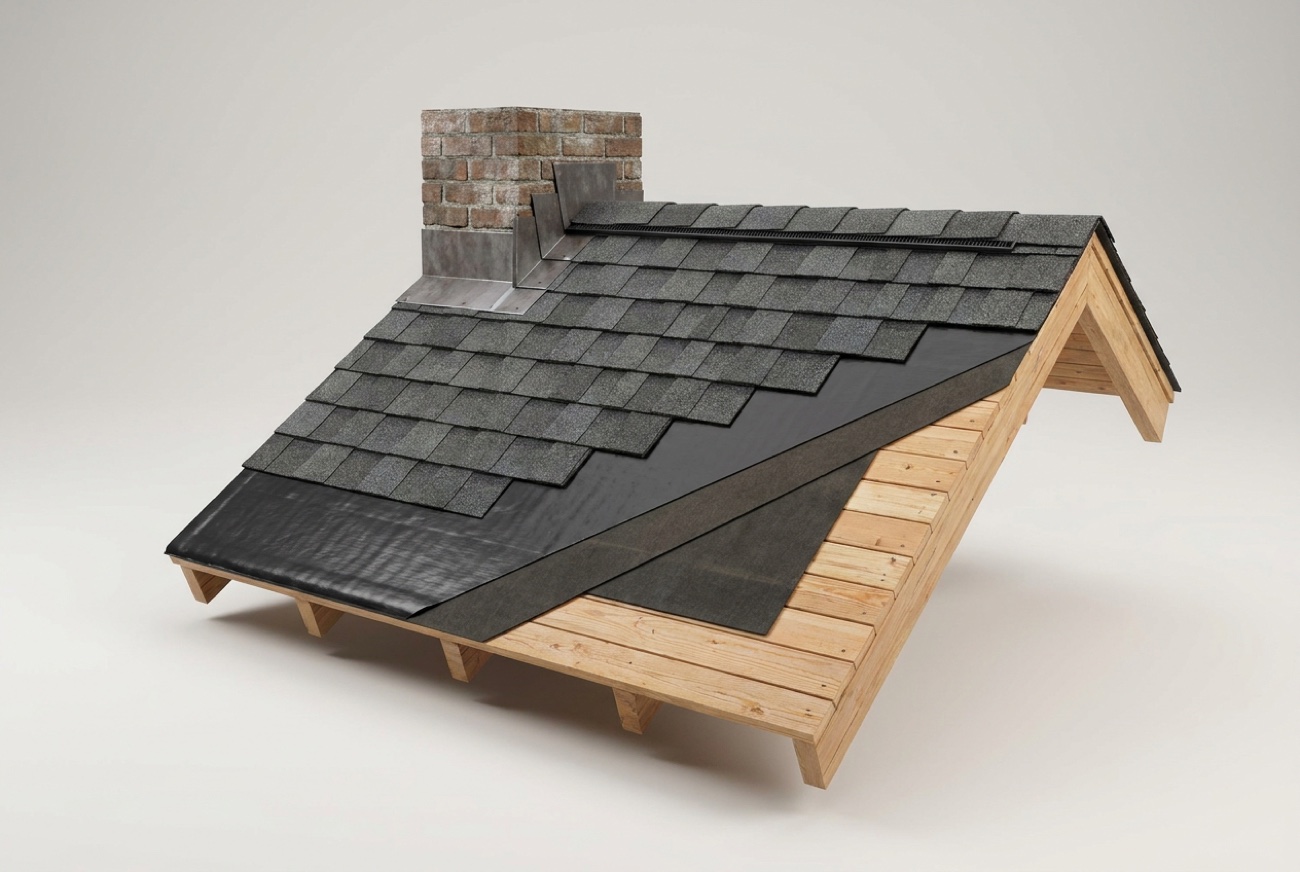
Beyond the individual findings, a complete set includes general-condition shots of the gutters, the flashing at chimneys and walls, and every roof penetration (vents, skylights, pipe boots), even when nothing is wrong. A clean bill of health deserves photo evidence too. "Everything looked fine" is a much stronger statement backed by a photo than left as an unsupported line in a summary.
04 / THE CHECKHow to evaluate the photo set you receive
When an inspector hands you a report, do not just skim the written summary. Open the photo folder and check it against a short list.
- Is there at least one context shot per roof slope, not just one photo for the whole house?
- Does every written finding have a matching photo you can find and identify?
- Are the close-ups sharp enough that you can see the actual damage, not a blur?
- Is each photo labeled with a slope and a location, or captioned in a way that ties it to the report?
- If the attic was checked, are there photos from inside it, not just a line saying it was checked?
- Are the photos date-stamped or otherwise tied to the date of the visit?
If you answer no to more than one or two of those, you did not receive a documented inspection. You received a verbal opinion with some pictures attached, and that is worth knowing before you make a repair or replacement decision based on it.
A finding without a photo is a claim. A finding with a labeled, date-stamped photo is a record. Only one of those survives a disagreement two years from now.
05 / WHY IT KEEPS PAYING OFFWhy the date stamp matters later
The value of a photo set rarely peaks the day you receive it. It peaks later, when you need to prove what condition the roof was in on a specific date. A homeowner leaning on a workmanship warranty a few years after a repair benefits from having the original photo record of what the roof looked like before that repair happened. A homeowner asked by a new insurer to document the roof's condition benefits from a dated set that predates any storm in question. A homeowner selling the house benefits from being able to hand a buyer's agent a photo-backed report instead of just a verbal assurance that "it was inspected once."
None of that requires the photos to have been taken for any particular future purpose. It only requires that they exist, that they are dated, and that you kept them somewhere you can find again. This is exactly why a documented inspection is worth more than a free estimate that skips the paperwork: the estimate answers today's question, while the photo record keeps answering questions for years.
One caution: photo documentation is a different deliverable from filing an insurance claim. Good inspection photos make a later claim conversation easier, and a professional can meet your adjuster on site to walk the roof together, but no contractor can promise how an insurer will rule on a claim. The mechanics of filing, working with an adjuster, and understanding your policy belong to our storm and insurance claims guide, not to this one.
06 / FROM THE AIRWhat drone photos add
A drone does not replace a walked inspection, but it adds a category of documentation a ladder and a walk-on cannot match: a full-slope overhead view of the entire roof plane in one frame, plus angles a person standing on the roof physically cannot get, like a straight-down look at a valley or the full run of a ridge from above. On a steep or fragile roof where walking every section safely is not practical, drone imagery can also cover ground a walk-on inspection has to approach more cautiously.
| WALK-ON INSPECTION | DRONE PHOTOS | |
|---|---|---|
| Close-up detail on a specific shingle or seam | Yes, hands-on | Limited, depends on camera resolution |
| Attic-side check from underneath | Yes | No, requires physical access |
| Full-slope overhead context in one frame | Difficult from the ground | Yes |
| Access on steep, fragile, or unsafe sections | Requires care and equipment | Often easier |
| Touch-test for soft decking or spongy spots | Yes | No |
The honest way to think about it is complementary, not competing. A thorough inspection often uses both: a walked, hands-on check for anything that has to be touched, seen up close, or checked from the attic, and drone photos to add the overhead context and hard-to-reach angles that round out the record. Our drone versus walk-on comparison goes deeper on when each method is the right call.
07 / OUR STANDARDWhat our free inspection includes
Every free Macomb Roofing Pros inspection is built around the standard this guide describes: context shots per slope, close-ups of anything worth flagging, labels tied to a location on the roof, attic photos when the attic is checked, and a dated record you keep, whether the news is good or bad. If the roof is fine, the photos back that up. If it needs a repair, most Macomb County repairs run $350 to $3,200 depending on scope, and you get a written price to match the photos before any work starts.
If you want a ballpark on repair or replacement cost before you book anything, the 60-second cost calculator uses the same published price ranges as the rest of this site. If you already have a photo set from another company and are not sure it holds up, the checklist in section 04 is a fair way to test it, and a second opinion is always an option. You can start either path from the instant estimator.
- A documented inspection produces labeled photos, not just a verbal or written opinion.
- A complete photo set includes a context shot per roof slope plus a close-up of every finding, each labeled by slope and location.
- Check any photo set you receive against a short list before trusting the report built on top of it.
- Dated photos keep paying off for years, in warranty questions, resale, and insurance conversations, though filing a claim is a separate topic.
- Drone photos add overhead context and hard-to-reach angles; they complement a walked, hands-on inspection rather than replacing it.
Questions we hear most
Yes. A finding without a photo is an unverifiable opinion. A thorough inspection photographs every issue up close, along with a wider context shot per roof slope, so you or anyone else reviewing the report later can confirm what was found and where.
There is no fixed number, since it depends on roof size and condition, but expect at least one context shot per slope plus a close-up for every finding, and attic photos if the attic was checked. A one or two photo report for an entire house is a sign of a rushed inspection.
They can. Dated, labeled photos showing the roof's condition are useful documentation in a claim conversation, and we can meet your adjuster on site to walk the roof together. No contractor can promise how an insurer will rule, and the filing process itself is covered in our storm and insurance claims guide.
- FEMA, disaster declaration DR-4757-MI, Michigan severe storms of August 2023 (Macomb County designated). fema.gov/disaster/4757
- InterNACHI Standards of Practice for home inspections (scope of a generalist roof inspection). nachi.org/sop
- Federal Aviation Administration, Part 107 rules for small unmanned aircraft (commercial drone roof surveys). faa.gov
- Insurance Information Institute, consumer explainers on homeowners policy coverage, deductibles, and the claims process. iii.org