
JUMP TO A SECTION
Call around for roof work in Macomb County and you will hear "estimate" and "inspection" used as if they mean the same visit. They do not, and the difference is not academic. One document tells you what a roof needs. The other tells you what a specific job costs. Confusing the two is how homeowners end up paying for a repair that never fixes the actual leak, or agreeing to a full replacement before anyone checked whether the roof only needed a $400 flashing fix. This guide lays out what each document actually contains, when you need which one, and why we run both from the same free visit.
01 / THE SHORT ANSWERTwo words, two different jobs
An inspection is diagnostic. Someone gets on the roof, into the attic, and around the exterior to document the actual condition of the shingles, flashing, decking, and ventilation, with photos of what they find. It answers one question: what is really going on up there? An estimate is a price. It assumes the diagnosis is already settled, either because an inspection just happened or because the homeowner already knows what they want done, and it puts a dollar figure on a defined scope of work. They are also billed differently, and in Michigan it is the pricing visit that comes free while the standalone condition report is the one with an invoice attached. Whether roofers charge for estimates in Michigan draws the same line without the comparison.
An inspection tells you what is wrong. An estimate tells you what it costs to fix it. You need the first answer before the second one means anything.
02 / THE ESTIMATEWhat an estimate actually prices
An estimate is a written price for a defined job: tear off this roof and install architectural asphalt shingles, or replace this valley and reseal these boots. It is built around a scope, a material tier, and a labor plan, and a legitimate one breaks those line items out instead of handing you a single lump number. On Macomb County homes, that is why a full asphalt replacement estimate typically lands somewhere in the $9,000 to $18,000 range, with most homes settling between $12,000 and $16,000, while a repair estimate for a defined problem generally runs $350 to $3,200, with larger or more complex repairs able to run higher.
Notice what an estimate does not do: it does not tell you whether you actually need the job priced. If a homeowner calls and says "I want a new roof," a roofer can absolutely hand back an estimate for that scope without ever confirming the roof needs full replacement instead of a repair. That is not dishonest by itself, but it puts the burden of diagnosis entirely on the homeowner, which is backwards. Our replacement cost guide breaks down the material-by-material ranges an estimate would draw from.
Why two estimates on the same roof can land thousands apart
This is the practical reason the order matters. If two roofers walk the same house and each assumes a different scope, one pricing a straightforward tear-off and the other quietly budgeting for two layers of old shingles and a few sheets of rotten decking, the estimates will not agree, even though both roofers did their arithmetic correctly. The gap is not dishonesty. It is two different guesses about what the inspection would have shown. An estimate is only as good as the diagnosis it is built on, which is exactly why a scope that was never actually inspected produces numbers that cannot be meaningfully compared.
03 / THE INSPECTIONWhat an inspection actually determines
An inspection produces findings, not a price for a predetermined job. A thorough one covers the shingle field, flashing at every valley, chimney, and sidewall, the pipe boots and vents, the gutters and edges, and the attic side of the deck, checking for daylight, staining, and soft spots a camera alone cannot always catch. What comes out the other end is a documented condition report, usually with photos, and a recommendation: healthy roof, targeted repair, or full replacement. Ours is $0, no obligation, because we would rather earn the job with an honest finding than guess at one over the phone.
The method matters as much as the checklist. A curbside look from the driveway can catch obvious problems, a sagging ridge or a bald patch of shingles, but it cannot tell you what the attic side of the deck looks like, or whether a valley that looks fine from the ground is quietly leaking behind the flashing. Getting on the roof and into the attic is what turns an impression into a finding, and it is the difference between a real inspection and a five-minute sales stop with a clipboard.
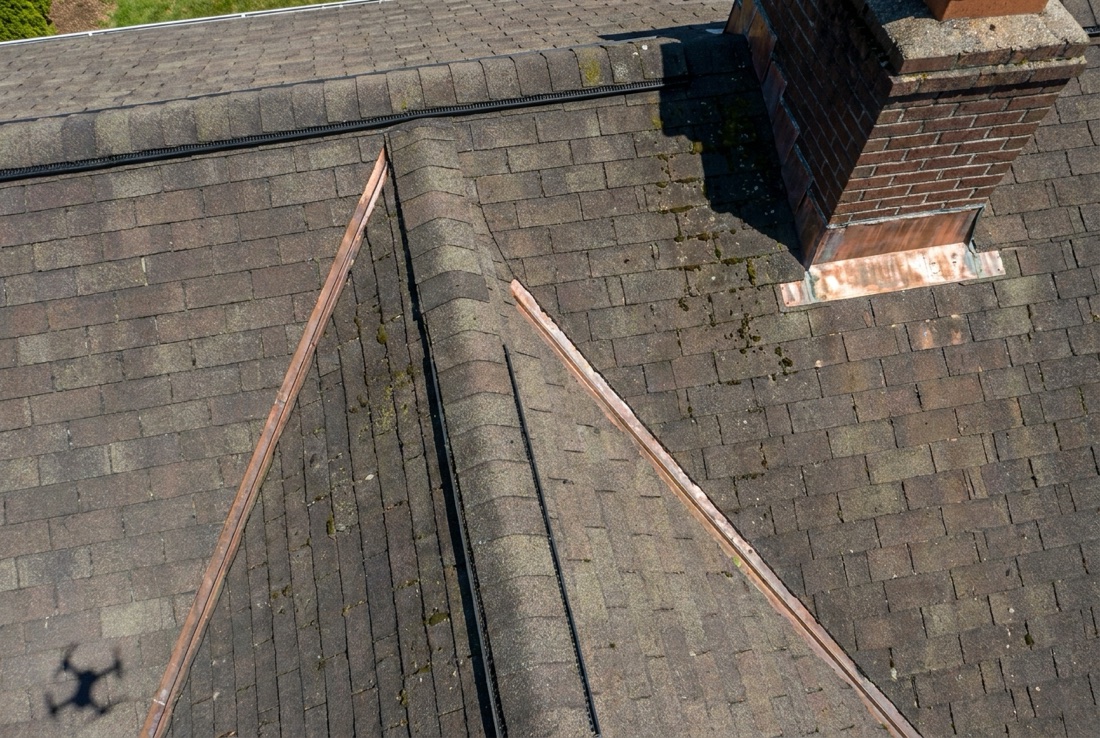
What a real inspection report contains
- Photos of the shingle field, flashing, and any damaged or worn areas
- The attic-side check: insulation, ventilation, deck staining, and daylight
- A plain-language finding: healthy, repair needed, or replacement warranted
- If work is recommended, the next step is a written estimate for that specific scope
If you have a report in hand already and are not sure what the notes mean, our guide to reading a roof inspection report walks through the terminology line by line. And if you are wondering what actually happens during the visit itself, how a free roof inspection works covers the whole appointment start to finish.
04 / THE ORDERWhy inspection-first protects the homeowner
Skipping straight to an estimate flips the normal order of operations. Instead of a professional telling you what the roof needs and then pricing it, you are telling the roofer what to price, based on a guess, a neighbor's opinion, or a sales visit that started with a knock on the door. That is exactly how homeowners end up buying a full replacement when a $600 flashing repair would have solved the actual leak, or how a decking problem gets discovered mid-tear-off instead of being priced up front.
A price without a diagnosis is not an estimate. It is a guess with a signature line, and the roof is the one paying for the mistake.
Inspection-first also protects you from the reverse problem: under-scoping. A roofer who only glances at the shingle field from the driveway and quotes a quick patch may miss a soft deck section or a chronically failed valley that will reopen the leak within a season. A real inspection, attic side included, catches both directions of error before any number gets written down. If you are further back in the process and simply trying to figure out how often to have a roof looked at at all, our guides library covers that groundwork too.
Consider a common Macomb County scenario: a homeowner notices a ceiling stain after a windy week and calls a roofer who, without climbing a ladder, quotes a full replacement on the spot. An inspection-first visit instead traces the stain to its source, often a single cracked pipe boot or a lifted run of shingles near a valley, and may resolve the whole problem for a fraction of a replacement estimate. The reverse happens too: a homeowner assumes a stain means "just patch it," and only an attic-side check reveals the decking underneath has been wet long enough to delaminate, which changes the right answer entirely. Neither outcome is knowable from a price alone.
05 / SIDE BY SIDEInspection and estimate, compared
| INSPECTION | ESTIMATE | |
|---|---|---|
| Answers | What is the roof's real condition? | What does this specific job cost? |
| Cost to you | $0no obligation, ours is free | No charge for a written quote |
| What you get | Photos and a plain-language finding | A itemized price for a defined scope |
| When it happens | First, before any work is priced | After the diagnosis is settled |
| Comes from | A licensed inspector on the roof and in the attic | The same visit, once the scope is known |
06 / OUR PROCESSHow both start from the same free visit
We do not make homeowners choose between the two or schedule them separately, and we do not schedule an "estimate appointment" as a separate visit weeks later either. The visit starts as an inspection: shingles, flashing, boots, gutters, and the attic side of the deck, documented with photos. If the roof is healthy, we tell you that and the visit ends there, no pitch. If it needs work, we write the estimate for that specific scope on the spot, with the same $9,000 to $18,000 replacement range or $350 to $3,200 repair range this page describes, priced against your actual roof instead of a guess. Nothing here is a substitute for that visit; it is the map of how the visit is structured.
Before any crew walks your roof, it is worth knowing what to ask. Our questions to ask a roof inspector guide gives you a short list that separates a thorough visit from a five-minute driveway glance. And if you want a rough number before anyone shows up at all, the cost calculator runs the same published ranges as this page and our honest pricing sheet against your roof's basics.
- An estimate prices a defined job; an inspection determines what the roof actually needs first.
- A legitimate estimate breaks out scope, material tier, and labor rather than one lump figure.
- A real inspection covers the shingle field, flashing, penetrations, and the attic side of the deck, with photos.
- Skipping the inspection puts the diagnosis burden on the homeowner and invites both over- and under-scoping.
- Our inspection is $0 with no obligation, and if repair or replacement is needed, the written estimate follows the same visit.
Questions we hear most
Not legally, but it is the honest order of operations. An estimate priced without an inspection is really a price for whatever scope you or the roofer assumed, not a diagnosis of what the roof actually needs. A free inspection first means the estimate that follows is priced against real findings instead of a guess.
No. An inspection documents condition with photos and a plain-language finding. A quote, sometimes called an estimate, is the dollar price for a specific scope of work, and it only makes sense once the inspection has established what that scope should be.
No. Both the inspection and the written estimate that follows, if work is recommended, are free with no obligation. You only pay if you decide to move forward with the repair or replacement.
- FEMA, disaster declaration DR-4757-MI, Michigan severe storms of August 2023 (Macomb County designated). fema.gov/disaster/4757
- National Roofing Contractors Association, technical guidance for steep-slope roof systems. nrca.net
- Michigan Attorney General, Consumer Protection resources (home repair and contractor complaints). michigan.gov/ag: consumer protection