
JUMP TO A SECTION
Plenty of Macomb County homeowners live under a roof that looks tired, patchy, or dated and has never once dripped onto a ceiling, and they treat the dry ceiling as the verdict: no leak, no problem. That logic feels reasonable, and it is also backwards. A roof's job is to keep water out for years after it stops looking good, and by the time it fails at that job, it has usually been in trouble for a while already. An ugly roof and a leaking roof are not the same question, and this guide is built around telling the two apart honestly, without a scare tactic or an invented statistic to do it. What follows is the same straight framework we use standing on a roof for a free inspection: what is only cosmetic, what is a functional warning sign even though it is still dry, and how to weigh age against symptoms so you are choosing your own timeline instead of letting the first ceiling stain choose it for you.
01 / THE SHORT ANSWERA dry roof is not the same as a sound roof
Whether an ugly, still-dry roof needs to be replaced now depends far less on whether it is currently leaking and far more on two other things: its age, and how many functional warning signs sit underneath the cosmetic ones. A roof can look rough and be perfectly fine to leave alone for a few more years. A roof can also look nearly identical from the curb and be genuinely near the end of its service life, with the only difference being what an inspector finds up close and in the attic. Leaking is the last chapter of that story, not the first page, which is exactly why waiting for a leak as your decision signal means you are always deciding late. That is the version of this question with no carrier in it. If a storm rather than age is what put the marks up there, whether a dry ceiling stops you from filing is answered separately in a roof claim without a visible leak.
Cosmetic wear, such as fading, staining, moss, or minor curling, tells you the roof has aged. Functional signs, such as granule loss down to the mat, brittle or cracking shingles, lifted or missing tabs, and compromised flashing, tell you the roof is running out of water-shedding capacity, whether or not it has leaked yet. Our companion guide on ten signs a roof needs replacing walks all ten visual and attic-side signs in depth; this page is about what to do once you have spotted a few of them and nothing has dripped.
02 / THE DISTINCTIONCosmetic aging versus functional end of life
Every roof ages in ways that are purely visual and do not, by themselves, threaten the water barrier. Shingle color fades unevenly where sun exposure is heaviest. Algae or moss streaking darkens north-facing slopes that dry slowly after rain. A little edge curl shows up on shingles well before it means anything structurally. None of that is attractive, and none of it, on its own, is an emergency. It is the roof looking its age, the same way a driveway develops hairline cracks long before it needs to be replaced.
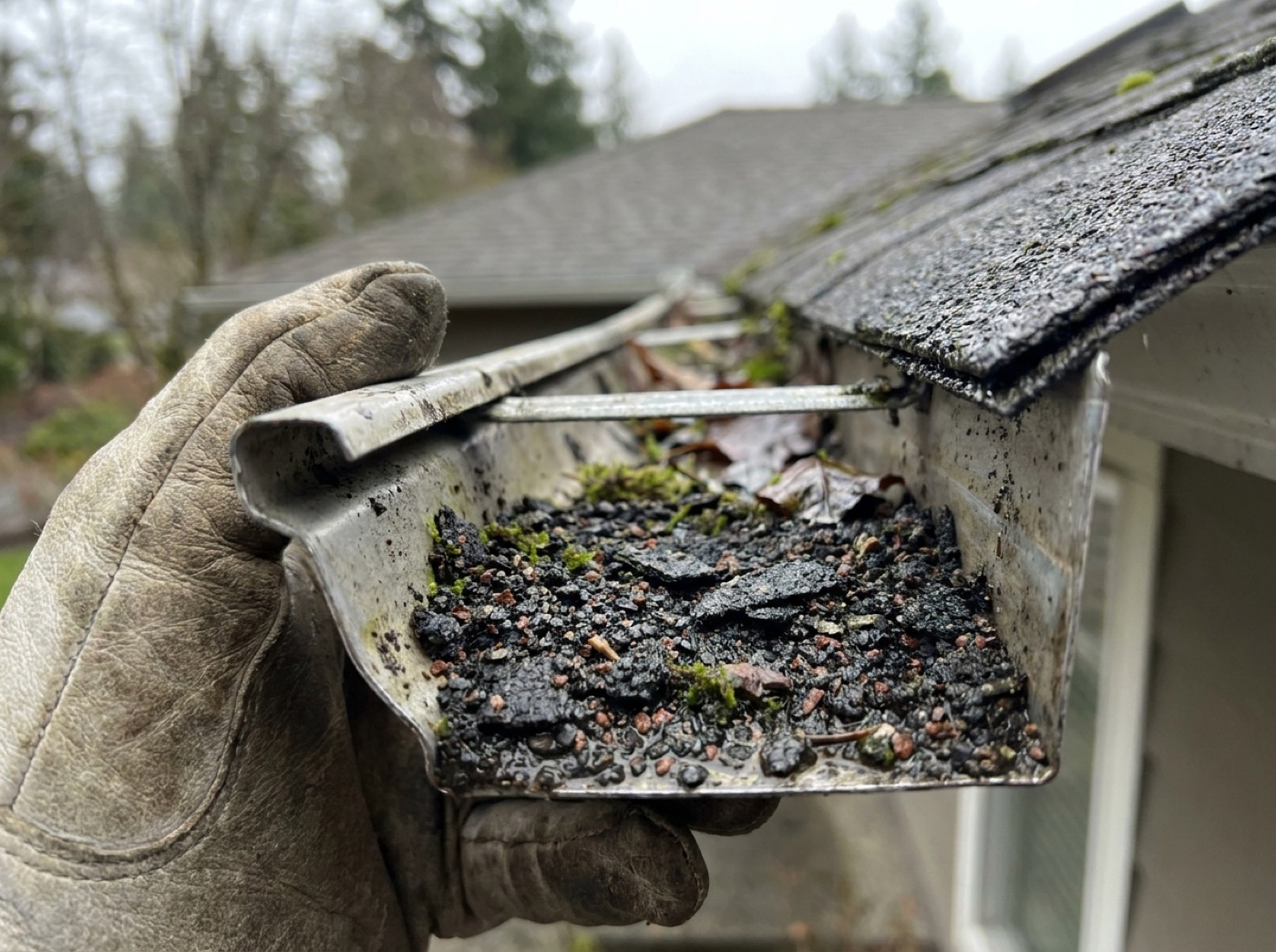
Functional wear is a different category, and it is the one worth taking seriously even with a dry ceiling. Granule loss that has worn down to the black asphalt mat, rather than just a light dusting in the gutters, means the shingle has lost the layer that shields it from UV breakdown. Shingles that crack or snap when lifted, instead of flexing, have gone brittle, which is a sign of age and heat cycling, not a passing phase. Tabs that are missing, lifted, or no longer sealed to the course below have lost their wind resistance even if the gap has not yet let water through on a calm day. Flashing around chimneys, valleys, and walls that is visibly pulled away, rusted, or cracked is a functional failure waiting for the right rain angle, not a cosmetic blemish. Any one of these can exist for a season or more without producing a visible leak, because a roof has some built-in redundancy: underlayment, ice barrier, and overlapping courses all buy time. That borrowed time is exactly what makes a dry ceiling a poor way to judge how much of it is left.
03 / THE MECHANISMWhy a leak is a late-stage symptom, not an early one
Water does not usually find its way to your ceiling drywall on the first try. It has to get past the shingle surface, then past the underlayment beneath it, then find a path through or around the wood deck, before it ever reaches a joist, insulation, and finally the drywall you can see from inside the house. Each of those layers is a line of defense, and a roof in decline fails them roughly in that order. That is the mechanical reason a ceiling stain is a late symptom: by the time water has tracked all the way down to drywall, it has typically already been getting past the shingle surface for some time, often soaking insulation and staining the attic side of the deck first, out of sight, before anyone downstairs notices anything.
This is also why two roofs that look similarly worn from the ground can be in very different real condition. One may still have intact underlayment and a sound deck behind aging shingles, buying real time. The other may already have a soft, water-stained deck section behind the same-looking shingles, with the only thing standing between the homeowner and a ceiling stain being a dry stretch of weather. From the driveway, both look like "the roof is getting old." From the attic, with a flashlight, they are two different projects. That gap is exactly what a physical inspection closes and a curb glance cannot.
04 / THE FRAMEWORKThe wait-or-act framework, by age and symptom mix
With no leak to anchor the decision, age and symptom count become the two honest inputs. Neither one alone tells the whole story, which is why the framework below weighs them together rather than picking a single cutoff. If you do not know your roof's age offhand, our guide on finding your roof's age walks through permits, disclosures, and physical cues a roofer reads on site.
A young roof with only cosmetic wear and no functional signs is genuinely fine to watch, and rechecking it once a year, especially after a hard winter, is a reasonable plan rather than nervousness. The same young roof carrying several functional signs, such as a lifted ridge, a cracked flashing detail, and heavy granule loss on one slope, is usually a repair case rather than a full replacement, since a sound deck under a mid-life roof still has years to give once the specific failures are fixed. Our roof replacement services page and its repair counterpart both start from that same honest triage. Once a roof crosses roughly the 20-year mark, the calculus changes regardless of how few signs are showing, because materials and fasteners are cumulatively fatigued from two decades of freeze-thaw cycling, and our reality check on whether a 20 year old roof is too old goes deeper on that specific threshold.
05 / THE COST LOGICReplacing on your schedule versus after the first stain
The financial argument for acting before a leak forces the issue is straightforward, and it has nothing to do with fear. A planned replacement lets you pick the season, compare contractors without a leak dripping into a bucket in the background, and finance the project on your terms if you choose to. Asphalt shingle replacement in Macomb County runs $9,000 to $18,000 installed, with most homes landing $12,000 to $16,000, and that number is the same whether you schedule the work in a calm spring week or in the middle of an emergency. What changes when you wait for the first stain is everything around that number: a rushed timeline, a scramble to get on a crew's schedule, and, if the deck has already taken on water, the possibility that some sheathing needs to be replaced as part of the job. A straightforward repair, by contrast, runs $350 to $3,200 when it is caught while the problem is still localized, which is the entire case for treating functional signs seriously before they graduate into a leak.
There is also an insurance angle worth being honest about. Homeowners policies generally cover sudden, storm-driven damage, not the gradual wear that produces most of the signs on this page, and every policy reads differently. A roof that finally fails from age rather than a discrete storm event is typically the homeowner's expense either way, which is one more reason the choice is really about when you pay, not whether the roof eventually gets replaced. If financing makes more sense than paying outright, a $13,500 roof financed over a 10 year term at 9.9% APR works out to about $178 a month as an illustration only; financing is subject to approval and your actual terms depend on the lender and your credit.
Waiting for a leak does not save you the cost of a new roof. It just moves the decision from a calm Tuesday to whatever week the ceiling happens to give out.
06 / THE REAL ANSWERGetting a straight answer, free, before anything drips
Everything above is a framework for triaging the question yourself, from the ground and from what you already know about your roof's age. It is not a substitute for someone actually getting on the roof and into the attic, because that is the only way to tell whether your specific mix of cosmetic and functional signs adds up to watch, repair, or replace. Our inspection is $0 with no obligation, and we tell you honestly which category your roof falls into, with photos of what we find. If it turns out to be nothing more than cosmetic aging, we will say so; we would rather build a reputation on that honesty than sell a replacement a roof does not need yet.
If you want a ballpark before anyone visits, the cost calculator runs the same published ranges against your roof's size, and the full ledger of what drives an installed price up or down is on our honest pricing sheet. Homeowners weighing this exact question across Sterling Heights, Warren, Clinton Township, and the rest of Macomb County can start either path, repair or replacement, from the instant estimator and get a number today rather than waiting for a stain to make the decision for them.
- A dry ceiling means no leak yet, not a sound roof; leaks are one of the last symptoms of a failing roof, not one of the first.
- Cosmetic wear (fading, moss, minor curl) is not urgent on its own; functional wear (granule loss to the mat, brittle shingles, failing flashing) is a warning sign even without a drip.
- Weigh age and symptom count together: young roofs with few signs can watch, older roofs or heavy symptom counts should plan or act.
- Asphalt replacement runs $9,000 to $18,000, most homes $12,000 to $16,000; targeted repairs run $350 to $3,200 when caught early.
- A free inspection is the only way to know which category your roof is actually in, before anything drips.
Questions we hear most
Not automatically, but it is worth checking. Leaks are a late-stage symptom of roof failure, not an early one, so a dry ceiling does not rule out real functional wear underneath. A free inspection looks at granule loss, shingle brittleness, flashing condition, and the attic side of the deck to tell you honestly whether it is cosmetic aging or something closer to the end of the roof's life.
Fading color, moss or algae streaking, and light edge curl are generally cosmetic. Granule loss worn down to the black mat, shingles that crack or snap when lifted, tabs that are lifted or missing, and flashing that is visibly pulled away or rusted are functional warning signs, even if nothing has leaked yet. Our guide on the ten signs a roof needs replacing covers the full checklist in detail.
Waiting does not lower the eventual replacement cost, which runs $9,000 to $18,000 for most asphalt roofs regardless of timing, and it can add expense if water reaches the deck or interior first. A planned replacement also lets you choose the season and compare quotes without pressure. A free inspection tells you whether your roof can safely wait or whether it is closer to the edge than it looks.
- FEMA, disaster declaration DR-4757-MI, Michigan severe storms of August 2023 (Macomb County designated). fema.gov/disaster/4757
- Manufacturer technical and warranty literature for the major asphalt shingle lines: GAF (gaf.com), Owens Corning (owenscorning.com), and CertainTeed (certainteed.com).
- InterNACHI Standards of Practice for home inspections (scope of a generalist roof inspection). nachi.org/sop
- Insurance Information Institute, consumer explainers on homeowners policy coverage, deductibles, and the claims process. iii.org