
JUMP TO A SECTION
Stand at the bottom of any roof with more than one plane and look for the line where two slopes meet at an angle. That line is a valley, and it is the single busiest piece of real estate on the roof. Every drop of rain that falls on either adjoining slope drains toward it, so a valley that handles water for one section of roof is really handling water for two. When something goes wrong with a valley, it rarely stays subtle. This guide covers the three ways Macomb County roofers build a valley, the specific way each one tends to fail, what a correct repair looks like from reflashing to a full rebuild with membrane underneath, and how valley work fits inside the published repair range.
01 / THE SHORT ANSWERWhy valleys go first
A valley is a concentration point. Two roof planes that might individually shed water without issue are, at their shared seam, moving twice the volume through a single narrow channel, often at a steeper effective pitch than either slope alone. That concentrated flow finds every weak point faster than a flat run of field shingles ever would: a nail driven too close to the channel, a seam in the metal, a shingle edge worn thin by years of moving water. Valleys also collect debris, leaves, grit, and granules washed down from above, and a partially dammed valley backs water up under the shingles on both sides at once.
covers most Macomb County roof repairs, and valley work sits across that range depending on scope. Reflashing a short run of open metal valley is toward the lower end; rebuilding a long valley with new membrane and decking work is toward the top, and larger or complex repairs can run higher. A free inspection tells you which end yours is on.
None of that means every valley needs work. A well-built valley in a well-maintained material can outlast the field shingles around it. The point of this guide is to help you recognize when a valley has actually failed versus when it is just doing its job loudly, and to explain why the fix depends heavily on which of the three common valley styles is on your roof.
Signs a valley is asking for attention
A handful of clues show up before a valley ever produces an obvious interior leak, and most of them are visible from the ground or the gutter line, no ladder required. Learning to spot them early is the difference between a modest reflash and a job that has grown to include soaked decking.
- A heavier-than-normal buildup of granules or grit in the gutters directly below the valley outlet, beyond the ordinary shedding every asphalt roof does as it weathers.
- A visible dip, dark streak, or moss and algae line running down the valley centerline that does not match the coloring of the surrounding field shingles.
- Standing debris, leaves, or small branches sitting in the valley channel after a rain instead of washing through to the gutter.
- A ceiling or wall stain anywhere below where two roof planes meet, even if the stain appears several feet from the valley itself, since water travels along the deck before it drips.
02 / THE THREE STYLESOpen metal, closed cut, and woven
Roofers build valleys three different ways, and the style on your roof changes both how it fails and how it gets repaired. Knowing which one you have is the first thing any estimator checks before quoting valley work.
| STYLE | HOW IT IS BUILT | HOW IT LOOKS |
|---|---|---|
| Open metal valley | A strip of metal, often 20 to 24 inches wide, runs down the valley center; shingles from both slopes are trimmed back and stop short of the metal, leaving it visible | A clean metal channel is visible down the full length of the valley |
| Closed-cut valley | Shingles from one slope run continuously across the valley and up onto the other plane; shingles from the second slope are cut along a line a few inches off the centerline | No metal visible; a cut line of shingle edges runs down one side of the valley |
| Woven valley | Shingles from both slopes alternate, overlapping each other across the valley in a woven pattern with no cut edges at all | No metal visible; the shingle courses interlace across the centerline with no straight cut line |
Open metal valleys are common on many Macomb County homes because the exposed metal channel handles heavy water volume and ice with the least ambiguity, and it is the style most inspectors and manufacturers favor for durability. Closed-cut valleys are widely used because they are faster to install and read as a cleaner, all-shingle look from the ground. Woven valleys have fallen out of favor with many roofers and are restricted or discouraged by some shingle manufacturers on the higher-profile architectural products common today, since the extra layer of overlapping shingles at the fold can crack more easily, especially in cold weather.
The style already on your roof is not always a choice you get to revisit cheaply. Whoever built or last reroofed the house picked a style, and unless a repair or a full reroof is already opening that section up, the existing style is usually what gets repaired in kind. Where a homeowner does have a real say is at that reroofing moment, or when a valley has failed badly enough that the repair already involves stripping it down to the deck anyway. In that situation, converting a worn woven or closed-cut valley to open metal is a common upgrade, since it trades a small amount of visible metal for a channel that is easier to inspect and generally more forgiving over the long run in a freeze-thaw climate like ours.
03 / THE FAILURE MODEHow each valley style actually fails
The three styles do not fail the same way, and a repair that fixes one would miss the point entirely on another.
Open metal valley failure
Exposed metal fails from the metal outward. Steel valley metal rusts through over enough years, especially where standing water or debris sits against it longer than it should. Nails driven too close to the channel, sometimes an installation mistake from years earlier, pierce the metal and give water a direct path to the deck. Ice and snow that dam in the channel during a Michigan winter can also work fasteners loose and lift the metal's edge away from the shingles it should be sealing against.
Closed-cut valley failure
A closed-cut valley's weak point is the cut line itself. The exposed edge of the trimmed shingle sits directly in the water's path, and that edge wears thin faster than the field shingles around it, since it takes the full brunt of the flow with no metal behind it but the underlayment. Once granules wear away along that line, water finds the seam and drives underneath the continuous run of shingles beneath it.
Woven valley failure
A woven valley's failure point is the fold itself. Every shingle bent over the valley centerline is under constant stress, and in cold weather that fold is exactly where a shingle is most likely to crack. Once one shingle in the weave cracks, the pattern that was supposed to shed water past that spot instead directs it straight through the break, and because the shingles interlock, a single failed course can be more involved to isolate and replace than a comparable failure in an open metal or closed-cut design.
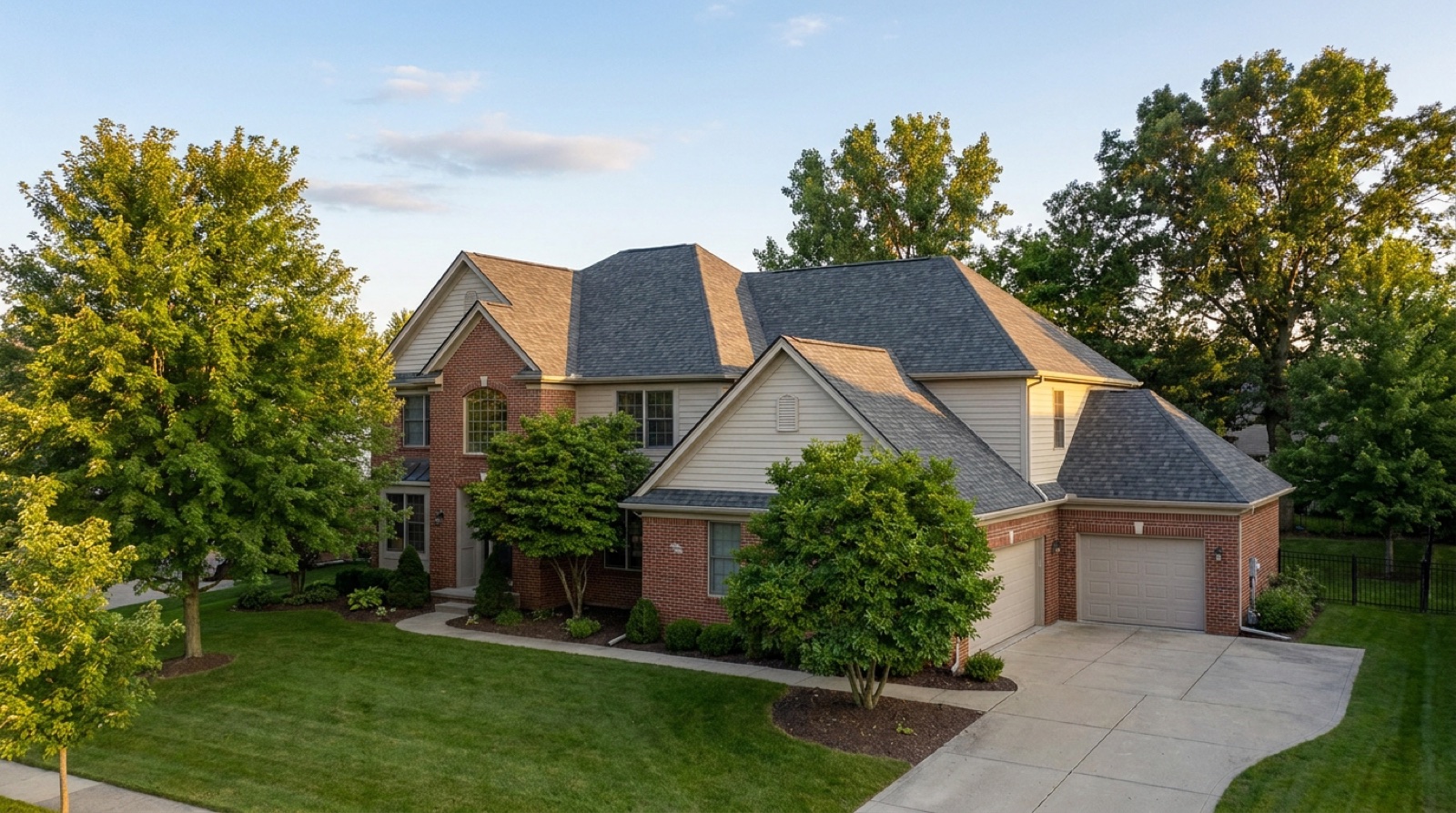
A valley does not fail because the roof around it aged badly. It fails because the valley itself has been doing double duty since the day it was installed, and eventually something in that specific detail gives out first.
04 / THE REPAIRWhat a proper valley repair involves
The repair scope follows directly from which style is failing and how far the damage has spread. A short section of rusted-through open metal, caught early, can sometimes be addressed by replacing that section of metal and the adjacent shingle courses, with the underlayment beneath checked and replaced if it shows any staining. A worn cut line on a closed-cut valley usually means pulling back the shingles on both slopes far enough to inspect the underlayment, then relaying with fresh shingles and, in many cases, converting the exposed area to open metal or adding an ice and water membrane strip underneath for a more durable result going forward.
Wider damage changes the job. If water has been finding its way under the valley for long enough that the deck itself has gone soft, spongy, or delaminated, the repair has to open further than the valley line alone: the affected decking gets replaced sheet by sheet, a self-adhering ice and water membrane goes down the full valley length before any shingles return, and only then does the valley get rebuilt to whichever style makes the most sense for that roof going forward. A woven valley with a cracked course generally cannot be spot-patched in place the way an open metal channel can, since the interlocking pattern means neighboring courses usually need to come up and be relaid together.
A valley is not a spot you can seal your way out of. Caulk or roofing cement smeared over a rusted seam or a worn cut line buys a season at most, because it does not address the volume of water moving through that channel or the fastener or fold that let water in to begin with. If the valley failed once, the same mechanism will keep failing until the actual detail is rebuilt correctly.
Wide or unusually complex valleys, where two steep slopes meet at a shallow angle, or where several rooflines converge near an addition or dormer, sometimes call for more than a like-for-like rebuild. In those cases a proper repair may add a cricket, a small built-up saddle that diverts water off a wide, slow-draining channel and onto a section of roof that can move it along faster. It is the same underlying idea as the dead valley problem discussed below, applied to a still-functioning valley that is simply overloaded for its width. A repair scope that includes a cricket is a sign the crew is fixing the actual water-management problem rather than just replacing what failed with an identical detail that will strain the same way again.
It is also worth checking what happens at the bottom of the valley, where it empties into a gutter. A valley that dumps a concentrated stream into an undersized or clogged gutter section can overflow at that exact spot even after the valley itself has been perfectly repaired, sending water behind the gutter and into the fascia. Our crews note this during a valley repair and will flag it if the gutter at that outlet point needs attention alongside the roof work, since fixing one without the other can leave the underlying water problem only partly solved.
This is also where our estimators pay close attention on every roof repair visit, storm-related or not, since a compromised valley on an otherwise sound roof is one of the most common single causes of a leak that seems to come from nowhere. If the valley in question has gone further and become a low-slope pocket that never fully drains, that is a related but distinct problem covered in our dead valley repair guide.
05 / THE PRICEWhat sets a valley repair's cost
Valley repairs live inside the published Macomb County repair range of $350 to $3,200, and larger or complex repairs can run higher. A few factors move a given valley job up or down that range, and they mirror the factors that set any repair's price, applied specifically to valley work.
The single biggest swing factor is whether the deck underneath is dry or damaged. Our roof leak repair cost guide covers how decking involvement moves any leak repair toward the top of the range, and valley leaks are one of the more common ways that happens, since a valley can run water for a long time before a stain shows up inside the house. A related detail worth knowing before your inspection: our types of roof flashing guide covers how valley metal relates to the step, apron, and chimney flashing elsewhere on the same roof, since a house with one aging flashing detail often has more than one.
Timing matters too, though it does not move the price canon itself. A valley caught early, granule buildup in the gutter, a hairline crack, a small area of surface rust, is almost always the cheaper end of the range, because the repair stays contained to the valley detail alone. A valley left to run for one or more Michigan winters after the first sign of trouble is the more common way a $500 fix turns into a $2,500 one, simply because the water had more freeze-thaw cycles to work on the decking underneath before anyone called for an inspection. Storm damage is the exception to this pattern: a valley that a recent wind or hail event damaged outright follows the timeline and documentation steps in our storm and insurance claims guide rather than the wear-and-tear path described here.
Only an on-site look answers the question for your specific valley. Our free inspection covers the valley from both the roof surface and the attic side of the deck below it, with photos of exactly what we find, and if the fix is a straightforward repair rather than anything bigger, that is precisely what we will quote. You can start that conversation from the instant estimator, choosing repair as the job type, or get a ballpark first with the 60-second cost calculator, which runs the same published ranges from our pricing page.
- Valleys carry water from two roof planes at once, which is why they fail first and leak biggest on a cut-up roof.
- The three valley styles, open metal, closed-cut, and woven, fail in different places: the metal itself, the exposed cut line, or the folded shingle course.
- Caulk over a failed valley is a one-season fix at best; the durable repair rebuilds the actual detail that let water in.
- Decking condition under the valley is the single biggest factor in where a valley repair lands inside the $350 to $3,200 range.
- A free inspection checks the valley from the roof and the attic side and tells you honestly whether it is a repair or something bigger.
Questions we hear most
Valley repairs fall inside the general Macomb County repair range of $350 to $3,200, with the exact price set by valley length, style, and whether the decking underneath is sound or needs replacement. Larger or complex repairs can run higher. A free inspection gives you a written price for your specific valley.
Open metal valleys are widely favored by roofers and shingle manufacturers for handling heavy water volume with the least ambiguity, and closed-cut valleys are a common, durable alternative. Woven valleys are restricted or discouraged by some manufacturers on modern architectural shingles because the folded shingle course is more prone to cracking, especially in cold weather.
In most cases, yes. A valley is a localized detail, and a competent repair addresses that section, the adjoining shingle courses, and the decking beneath it without touching the rest of the roof, as long as the surrounding shingles and deck are otherwise sound. A free inspection tells you whether your case fits that pattern or points toward a bigger job.
- Manufacturer technical and warranty literature for the major asphalt shingle lines: GAF (gaf.com), Owens Corning (owenscorning.com), and CertainTeed (certainteed.com).
- National Roofing Contractors Association, technical guidance for steep-slope roof systems. nrca.net
- Michigan Residential Code 2015, section R905.1.2 Ice Barriers: membrane required from the eave edge to not less than 24 inches inside the exterior wall line. up.codes: MRC chapter 9