
JUMP TO A SECTION
Every valley on a roof is a drainage channel, a place where two planes meet and shed water downhill. A dead valley is different. It is what happens when that channel runs out of slope before it runs out of roof, usually because it dead-ends into a wall, a dormer, or a second-story addition instead of flowing off the eave. Water arrives there the same way it does anywhere else on the roof. It just has nowhere left to go, and that is the whole problem in one sentence. This is one of the trouble spots our estimators check on every free inspection, because it fails quietly for years before it shows up as a stain on a ceiling.
01 / THE DEFINITIONWhat a dead valley actually is
A normal roof valley is a V-shaped trough where two sloped planes meet, and gravity does the work: water runs down the trough and off the eave. A dead valley, sometimes called a blind valley or closed valley, forms where that trough runs into something vertical, most often an exterior wall, a chimney, or a second-story wall above a lower roof, before it reaches an edge. The slope that is supposed to carry water away simply is not there for the last few feet, so instead of draining, the water pools, backs up, and sits against the wall flashing until it either evaporates or finds a way in.
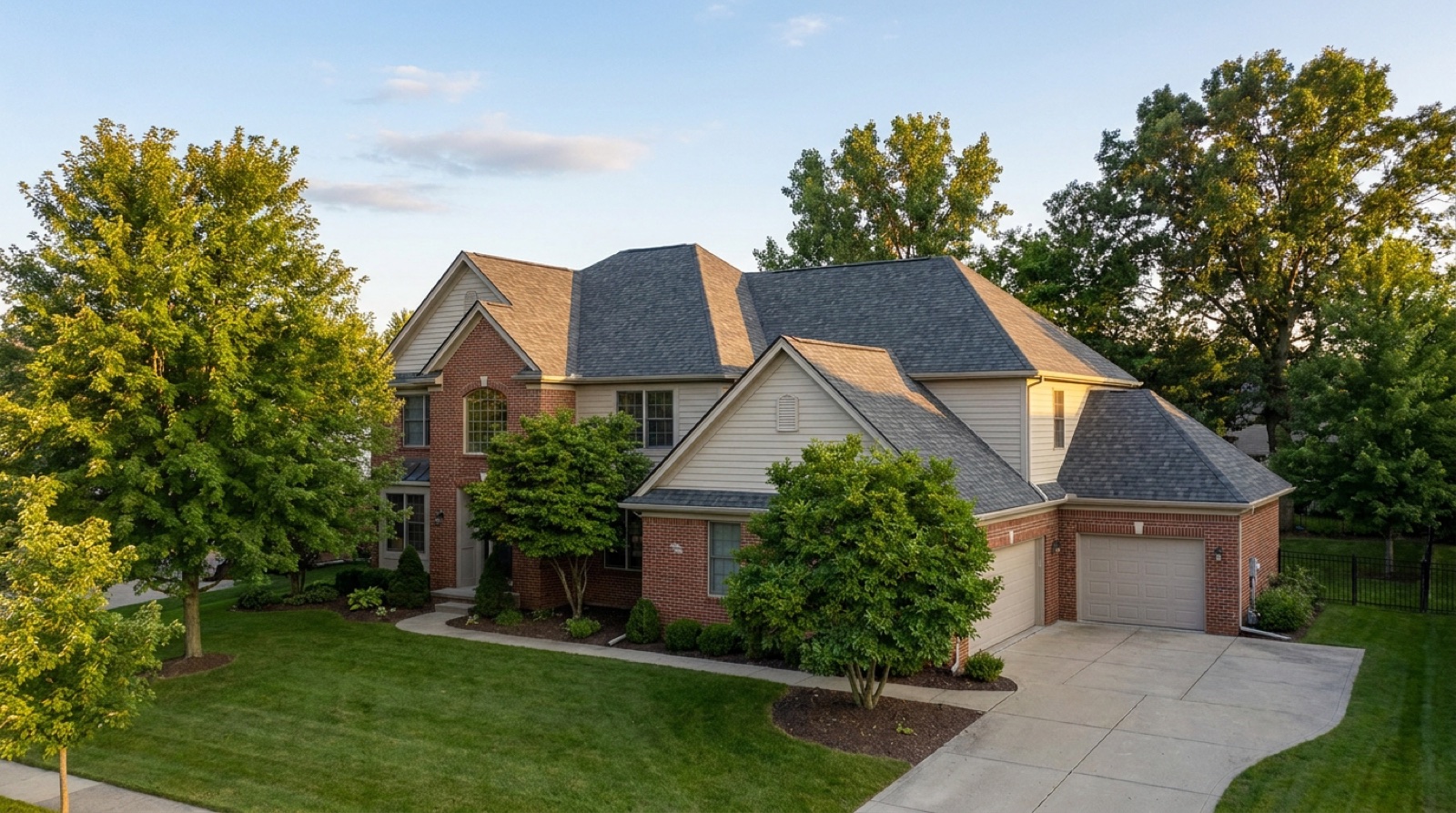
The giveaway from the ground is almost always a roofline that looks more complicated than it needs to be: a garage or family room addition tucked under a taller section of the house, a dormer that was added after the original roof was framed, or a ranch with an offset wing. Anywhere a lower roof plane meets a taller wall at anything less than a clean, steady slope, there is a good chance a dead valley is hiding at the junction.
02 / WHERE THEY HIDEWhere dead valleys show up on Macomb County rooflines
We see this detail constantly on the additions and dormers that are common across Macomb County ranch and split-level homes. A garage built a few feet lower than the main roof, a bump-out for a bathroom or laundry room, a dormer window cut into an attic for extra headroom: each of these creates a spot where a new, shallower roof plane has to tie into an existing wall, and the tie-in is exactly where a dead valley forms if it was not designed with enough pitch or a cricket to move water out.
Additions and bump-outs
When a single-story addition is built against a two-story wall, the addition's roof often has to run nearly flat where it meets the taller house to avoid blocking a window or a doorway below. That flat run is a dead valley waiting to happen, and it is one of the most common spots we find active leaks on additions that are otherwise in good shape.
Dormers
A dormer punches a small, steep-roofed box up out of a larger roof plane, and the two side valleys where the dormer meets the main roof frequently lose slope right where they meet the dormer's rear wall. Older dormers, especially ones added after the original build, are a frequent source of dead-valley leaks because the original framer was solving a headroom problem, not a drainage problem.
Complex ranch rooflines
Michigan ranch homes with an attached garage wing, a porch roof tucked under a taller gable, or a chimney set into a roof-to-wall corner all create the same geometry: two planes and a wall meeting at a shallow angle. The more corners a roofline has, the more chances there are for one of them to be a dead valley instead of a working one.
03 / THE PHYSICSWhy shingles alone always fail here
Asphalt shingles are designed to shed water, not hold it. They rely on overlap and gravity: each course laps over the one below it, and as long as water keeps moving downhill, it never has time to work backward under a shingle edge. A dead valley breaks that assumption. Water arriving from both roof planes stalls where the slope disappears, and standing or slow-moving water finds every seam, nail hole, and shingle edge that gravity-fed drainage was designed to ignore.
Michigan winters make it worse. Snow melts fastest near the warm wall, refreezes at the flatter, colder pocket of the dead valley, and builds an ice dam in exactly the spot with the least slope to push water past it. That ponded meltwater then has hours, not seconds, to find a way under the shingles and behind the wall flashing before it finally drains or refreezes again.
A stain on a ceiling or upper wall near where an addition or dormer meets the main house, especially one that only shows up after heavy rain or a thaw, is one of the more common signs of a dead valley problem, not a random roof leak. It is worth a look at the roofline outside before assuming the leak is somewhere else entirely.
This is also why a patch job over a dead valley rarely holds. Recaulking the seam or layering extra shingles over the trouble spot treats the symptom without fixing the geometry, and the same water that beat the original installation will beat the patch on the next hard rain or thaw cycle.
04 / THE REAL FIXWhat a durable fix actually looks like
A dead valley is a slope and drainage problem first and a shingle problem second, so the fix has to address both. There are three pieces we look at on every dead valley repair, and a complete job usually combines more than one of them.
A self-adhered membrane liner
Wherever water is going to be slow-moving or standing, the valley gets lined with a self-adhered rubberized membrane instead of relying on shingles and standard felt underlayment alone. The membrane seals around every nail penetration and gives the assembly a watertight layer underneath the shingles, so even water that does not drain promptly cannot reach the deck.
A cricket to restore slope
A cricket is a small built-up wooden saddle, framed and shingled or flashed in metal, installed at the high side of the dead spot to split incoming water and redirect it into a working drainage path instead of letting it dead-end against the wall. Where the geometry allows it, adding or enlarging a cricket is the single most effective fix, because it solves the actual problem: no slope. Our guide to what a chimney cricket is and when you need one covers the same principle applied to chimneys, and the logic carries straight over to a dead valley.
Rebuilding the slope or the wall flashing
In some cases the honest fix is to reframe a short section of decking to add pitch, or to rebuild the wall flashing higher and with a proper counterflashing reglet cut into the wall so water is shed further from the seam. This is more involved than a membrane-only repair, and it is usually reserved for valleys that have already failed once and reopened, or ones with visible rot at the wall line.
Standard roof valleys that simply need new shingles and flashing are a more straightforward job; our roof valley repair guide covers that version in detail. A dead valley is the harder cousin of that same detail, and it is worth knowing which one you actually have before anyone quotes the fix.
05 / THE NUMBERWhat a dead valley repair costs
Dead valley work falls inside our standard repair range of $350 to $3,200, the same ledger published on our honest pricing page, and larger or complex repairs can run higher. Where a specific job lands in that range depends almost entirely on which fix it needs. A membrane relining of an existing dead valley that has not yet damaged the deck sits toward the lower and middle part of that range. Adding or rebuilding a cricket, or reframing a section of decking and rebuilding the wall flashing, is more labor and material, and sits toward the top of the range or above it, especially if rotted decking is found once the old shingles come off.
covers most Macomb County roof repairs, dead valleys included, and larger or complex repairs can run higher. The only way to know your number is a free, no-obligation inspection where we look at the valley, the wall flashing, and the attic side of the deck. Get a ballpark first with the 60-second cost calculator.
A dead valley left alone rarely gets cheaper to fix. Repeated wetting and freeze-thaw cycles work on the deck underneath a little more each season, and what starts as a membrane-only fix can become a decking and flashing rebuild if it sits for a few more winters. If a wind or hail event may have contributed to the damage, our storm and insurance claims guide walks through documentation and what a claim can and cannot cover; we can photograph the detail and meet your adjuster on site, though no contractor can promise how a claim will be decided.
06 / THE NEXT STEPGetting a dead valley checked, free
A dead valley is exactly the kind of detail that is easy to miss from the ground and easy to spot from a ladder, which is why it is one of the specific trouble spots our estimators check on every inspection, not just an afterthought if a leak shows up. If your home has an addition, a dormer, or a roofline with more than one corner, it costs nothing to have that junction looked at before it becomes a ceiling stain.
The inspection is $0 with no obligation and covers the roof-to-wall junctions along with the rest of the roof, flashing, ventilation, and the attic side of the deck, with photos of anything we find. If the fix is a simple membrane reline, that is what we will quote. If the geometry needs a cricket or a rebuilt section, we will show you why before we recommend it. Start a repair estimate any time from the instant estimator and mention the addition, dormer, or wall junction you are worried about.
Porch roofs create a related low-slope problem worth knowing about too, since many porch roofs tie into a taller wall the same way a dead valley does; our porch roof leak repair guide covers that version of the same drainage problem. And if the leak you are chasing has already reached your ceiling, our roof repair page covers the full range of repairs we handle, dead valleys included.
- A dead valley is a roof valley that dead-ends into a wall or dormer before it runs out of roof, so water pools instead of draining.
- Common on Macomb County additions, dormers, and cut-up ranch rooflines where a shallow plane meets a taller wall.
- Shingles alone were built for gravity drainage and always eventually fail where water stalls or ices over.
- A durable fix uses a membrane liner, a cricket to restore slope, or rebuilt flashing, not just a caulk patch.
- Repairs run $350 to $3,200, and larger or complex repairs can run higher; the exact number needs a free inspection.
Questions we hear most
Look at the roofline from the ground where an addition, dormer, or garage meets the main house. If a lower roof plane runs into a taller wall with very little visible slope right at the seam, that junction is a likely dead valley. Ceiling stains that appear near that spot after rain or a thaw are a strong sign, and a free inspection can confirm it in minutes.
Recaulking treats the symptom, not the cause, and it typically fails again within a season or two because the underlying slope and drainage problem is still there. A membrane liner, a cricket, or rebuilt flashing addresses why the water is stalling in the first place, which is why we recommend one of those over a caulk-only patch.
Dead valley repairs fall within our general repair range of $350 to $3,200, and larger or complex repairs can run higher. A membrane reline on a valley with sound decking is toward the lower to middle of that range; adding a cricket or rebuilding decking and wall flashing runs higher. A free, no-obligation inspection gives you the exact number for your roof.
- FEMA, disaster declaration DR-4757-MI, Michigan severe storms of August 2023 (Macomb County designated). fema.gov/disaster/4757
- Michigan Residential Code 2015, section R905.2 Asphalt Shingles: fastening, slope, and underlayment application requirements. up.codes: MRC chapter 9
- InterNACHI Standards of Practice for home inspections (scope of a generalist roof inspection). nachi.org/sop
- Michigan Residential Code 2015, section R905.1.2 Ice Barriers: membrane required from the eave edge to not less than 24 inches inside the exterior wall line. up.codes: MRC chapter 9