
JUMP TO A SECTION
Every roof plane is built to shed water on its own, and it does that job well right up until two planes meet. A valley is the fold where two slopes come together, and it does not just add their runoff together, it concentrates it into a single channel that carries far more water than any square foot of the open field ever sees. Wind behaves differently there too, funneling down the crease instead of sliding across a flat surface, and storm debris finds the same low line and settles into it. That combination is why a valley is usually the first place we check after a storm, and often the last place a homeowner thinks to look from the ground.
01 / THE PHYSICSWhy valleys take the worst of every storm
Picture a rainstorm hitting a simple gable roof. Water falls on two slopes, and each slope sheds its share independently toward its own gutter line. Now picture the same storm hitting a roof with a valley where two sections meet at an angle. Instead of two independent sheets of water, the valley collects runoff from both slopes above it and channels the combined total down a single line. On a cut-up roof with several valleys, some of them are carrying multiples of what a flat run of shingles ever handles, and they are doing it during the exact hours when the roof is under the most stress.
Wind adds a second layer to the problem. Across an open field of shingles, wind tends to move across the surface, and a well-sealed shingle course resists it fine. A valley is a crease, and wind funnels down a crease the way it funnels down an alley between two buildings, picking up speed and pressure it would not have on a flat plane. That funneled wind is more likely to find a lifted edge, a loose seal, or a seam in the valley material and work it open, especially on the slope facing the storm.
A valley sees more water, more wind, and more debris than any other single line on the roof, which is why the same storm can leave the field shingles fine and the valley compromised. If a recent storm crossed your neighborhood, the valleys are the first thing worth having a professional look at, and a free storm inspection covers exactly that.
Then there is debris. Leaves, small branches, and hail itself all travel downhill and settle in the lowest line on the roof, which is the valley. A dam of debris does not just sit there looking untidy. It forces water sideways, up under the shingle edges on either side of the channel, instead of letting it run straight down and off the eave. Water that would have shed cleanly on a clear valley instead gets pushed exactly where a roof is weakest against it.
A simple gable roof has no valleys at all, and a cut-up roof with several dormers, a garage tie-in, and a couple of roof-line offsets can easily have four or five. Every one of those lines is another place carrying concentrated water, funneled wind, and settled debris at once, which is why a more complex roofline is not just harder to shingle, it is more exposed after every storm. It is also why a thorough inspection checks every valley on the roof rather than the one that happens to be visible from the driveway or the one a homeowner mentions on the phone.
02 / OPEN METAL VALLEYSReading damage in an open metal valley
An open metal valley leaves a strip of metal flashing exposed down the center, with shingles from each slope cut back and running parallel to it rather than overlapping across the middle. It sheds water fast and is a common, durable detail, but a storm leaves a specific signature on it.
Hail dents and scratches
Hail striking exposed metal leaves dents that are easy to see once you know to look, small round depressions catching the light differently than the surrounding surface. Scratches from wind-driven debris or hail can also strip the protective coating in a line, exposing bare metal underneath that will corrode faster than the rest of the flashing if it is left alone.
Lifted edges and loosened fasteners
Wind funneling down the valley can lift the cut edges of the shingles where they meet the metal, breaking the seal that keeps water from working sideways under them. On older installations, the same wind pressure can back out the fasteners holding the flashing down, opening a gap right along the line that is carrying the most water on the roof.
03 / WOVEN AND CUT VALLEYSReading damage in a woven or closed-cut valley
A woven valley interlaces shingles from both slopes across the centerline with no exposed metal, and a closed-cut valley runs one slope's shingles across and trims the other slope's shingles back to a straight line along that centerline. Both designs put shingle material, not metal, at the point taking the most water and wind, and storm damage there looks different from the metal case.
Cracking and granule loss along the centerline
The cut or woven line down the middle of the valley is the highest-stress bend point on the roof, and it is usually the first place a shingle mat cracks under hail impact or repeated flexing in wind. Granule loss often shows up as a stripe running down the centerline rather than scattered across the slope, because that line is where the shingle is folded or cut and the granules sit closest to the surface being hit.
Lifted seams and curling at the joint
Where two courses meet at the cut line, wind can work the seam open, and repeated freeze and thaw cycles curl the shingle edge upward at exactly that joint. Once the seam is open, it is a direct path for water to run under the course above it rather than over the course below, which is the opposite of how shingles are meant to shed water.
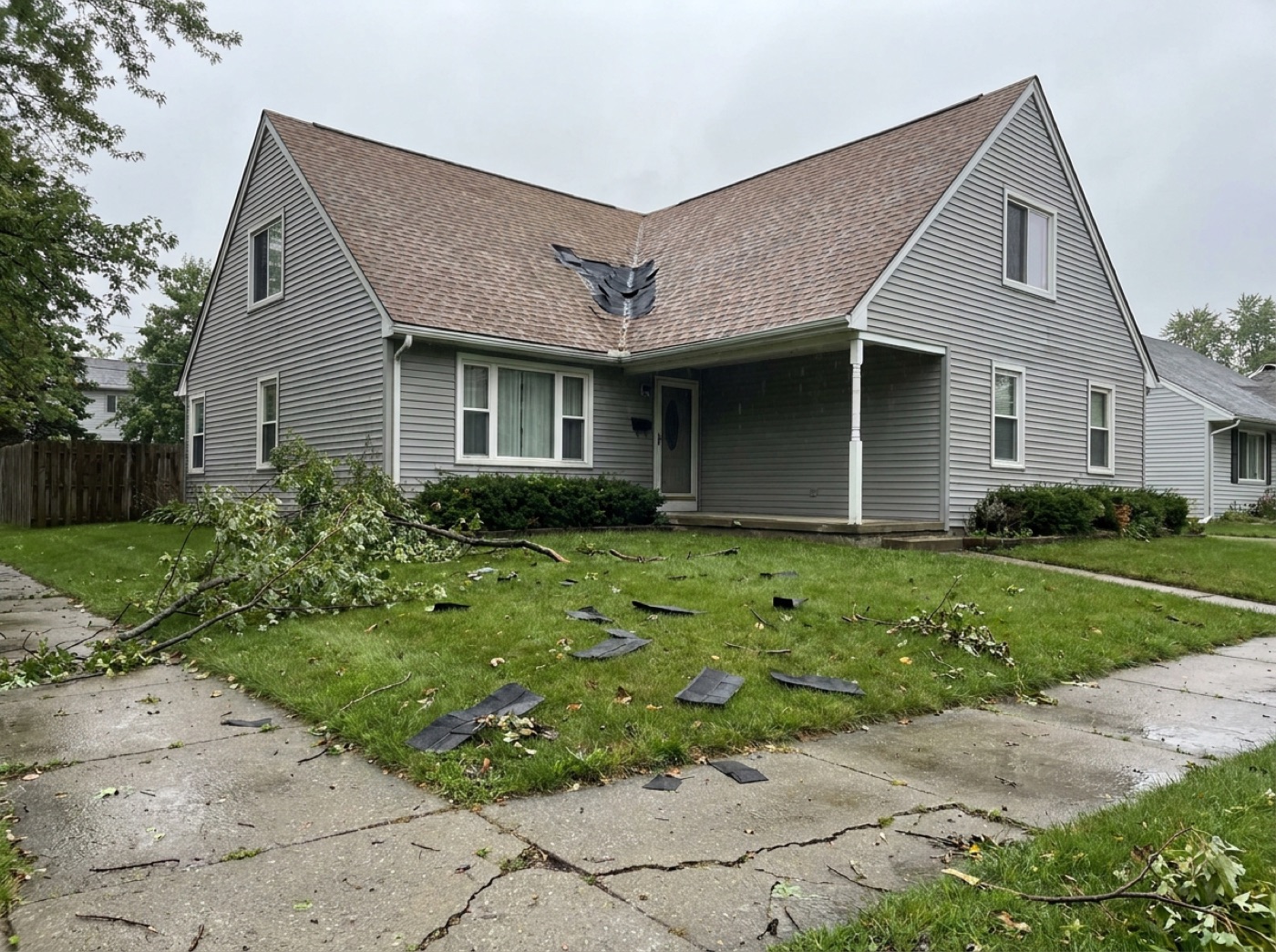
04 / DEBRISDebris, damming, and the clean-up mistake
After a storm, leaves and small branches end up in the same low line that the water does, and they do not just look messy. A dam of debris across a valley backs water up behind it, and that backed-up water finds the shingle edges on either side of the channel instead of running straight down and off the roof. A valley that would shed a heavy rain cleanly when clear can leak the same rain when it is dammed.
The mistake we see homeowners make with good intentions is clearing that debris themselves right after a storm. Shingle edges along a valley that has just taken wind and hail are already weakened, and a rake, a broom, or even a boot pulling debris loose can tear a shingle edge that was merely lifted into one that is now missing. Cold weather makes this worse, because asphalt shingles get brittle in low temperatures and can crack under foot traffic or a tool that would not have damaged them in summer. The safer move is to photograph what you can see from the ground and let a professional clear and inspect the valley at the same time.
Michigan winters add a second act to the debris problem. Leaves and small branches that settle into a valley in the fall do not just dam rain, they hold snow and meltwater in place longer than a clear channel would, and that trapped moisture can freeze and thaw against the valley material through the coldest months. The same freeze and thaw cycle that builds ice dams at the eaves works on a blocked valley too, prying at any seam or lifted edge a little further with every warm afternoon and cold night in a row.
05 / THE PATH OF WATERWhy the leak shows up somewhere else in the house
Water that gets under a valley shingle rarely drips straight down from where it entered. It runs along the underlayment or the deck surface, following the slope and the framing underneath rather than gravity in a straight line, and it can travel several feet along a rafter or a seam in the decking before it finds a nail hole, a joint, or a low point to drip through. That is why a stain can appear on a bedroom ceiling on the far side of the house from the valley that actually let the water in, and why tracing a leak back to a valley usually means checking the attic side of the deck, not just the shingles from the ground. Our guide to ceiling stains after a storm walks through how that tracing works room by room.
This is also why a heavy, sustained rain can expose a valley problem that a quick storm never revealed. Volume matters as much as intensity, because a dammed or compromised valley might shed a short burst fine and still fail under hours of steady runoff. Our guide to heavy rain and roof damage covers that volume effect in more detail, and it pairs well with this one if your storm was more rain than wind or hail.
06 / NEXT STEPSWhat to do about a valley after a storm
Start from the ground and from inside. Look for debris piled in the valley line, for shingle color or shape that looks different along the centerline compared to the rest of the slope, and for any staining on the fascia or gutter directly below a valley. Inside, check the attic for staining on the decking or rafters near where a valley lands, since that evidence often shows up before a ceiling stain ever does.
If a branch, a tool, or hail came down anywhere near a valley, it is also worth ruling out a direct puncture rather than assuming the valley alone is the source. Our guide to roof punctures from storm debris covers what a small impact wound looks like and how it differs from valley wear.
None of this replaces a set of eyes that can safely get onto the roof and into the attic. A storm damage inspection from us covers every valley, not just the one visible from your driveway, checks the attic side of the deck for water that has not reached the ceiling yet, and comes back with photos of exactly what we found. If the valley only needs a repair, that is what we tell you. You can see our published ranges any time on the pricing page, and the cost calculator gives you a ballpark before anyone visits.
Timing matters too. The window right after a storm, before the next round of wind or rain, is the cheapest time to catch a valley problem, because a lifted edge or a small crack is a repair while the same damage left through another season of freeze and thaw can spread into the deck underneath it. If a storm crossed Macomb County in the last few weeks and nobody has looked at your valleys since, that alone is reason enough to schedule the free inspection now rather than waiting for a stain to show up first.
- Valleys carry the combined runoff of two roof slopes, funnel wind harder than a flat plane, and collect debris fastest, so they take the worst of any storm.
- Open metal valleys show hail dents, scratched or exposed metal, and lifted shingle edges or loosened fasteners along the flashing.
- Woven and closed-cut valleys crack and shed granules along the centerline, and curl or open at the seam where the two slopes meet.
- Debris dams force water sideways under shingle edges instead of letting it run off, and clearing it yourself risks tearing already-weakened shingles.
- A valley leak often shows up as a stain somewhere else in the house entirely, because water travels along the deck before it drips through.
Questions we hear most
A valley collects the combined runoff of two roof slopes into one channel, so it carries far more water than the open field during any storm. Wind also funnels down the valley line instead of sliding across it, and storm debris settles in the same low channel and can dam the flow. Together those three factors make valleys the most storm-stressed line on most roofs.
In an open metal valley, look for hail dents, scratched or exposed metal, and shingle edges lifting off the flashing. In a woven or closed-cut valley, look for cracking or a stripe of missing granules along the centerline and curling at the seam where the two slopes meet. A free inspection is the reliable way to confirm what you are seeing from the ground.
We would rather you did not, especially in cold weather. Shingle edges along a valley that just took wind or hail are already weakened, and a rake, broom, or foot traffic can tear a lifted edge into a missing one, and cold asphalt shingles crack more easily under any pressure. Photograph what you can see from the ground and let a professional clear and inspect the valley together.
- FEMA, disaster declaration DR-4757-MI, Michigan severe storms of August 2023 (Macomb County designated). fema.gov/disaster/4757
- Manufacturer technical and warranty literature for the major asphalt shingle lines: GAF (gaf.com), Owens Corning (owenscorning.com), and CertainTeed (certainteed.com).
- Insurance Institute for Business & Home Safety, roof research and the FORTIFIED Roof standard. ibhs.org
- National Roofing Contractors Association, technical guidance for steep-slope roof systems. nrca.net