
JUMP TO A SECTION
Most roof problems are quiet. A missing shingle, a slow leak, granules piling up in the gutter. A sagging roofline is different, because it is visible from the street and it means the roof's structure, not just its surface, is under stress. Homeowners who notice a dip usually already suspect something is wrong. This guide explains what the sag actually tells a roofer, what causes it, and why the fix is rarely a simple reshingle job, sitting alongside our broader roof replacement service page as the structural edge case that page does not cover in depth.
01 / THE SHORT ANSWERWhat a sagging roofline actually means
A roofline that has developed a visible dip, wave, or dished section is showing you the effect of weight the framing or decking underneath was not built to carry, or wood that has weakened and can no longer carry the weight it once did. It is a structural symptom, not a shingle problem, and it is one of the few visual signs on this site that we treat as urgent rather than something to monitor for a season.
Curling shingles and granule loss describe a roof nearing the end of its service life on a normal schedule. A sag describes a roof where something underneath has already given way. The timeline for evaluating it is weeks, not seasons.
That does not mean panic. Most sagging rooflines we are called out for in Macomb County are stable, meaning the movement happened gradually over years and is not actively getting worse day to day. But stable and fine are not the same thing, and the only way to tell the difference is a look from both the roof and the attic side, which is exactly what a free inspection covers.
It is also worth separating this guide from the more common question homeowners ask first. If your roof looks aged but reads flat and even from the ground, curling shingles and bald patches of missing granules are the more likely story, and our signs your roof needs replacing guide covers that ground-level checklist in full. A dip or wave in the plane itself is a narrower, more specific signal, and it is the one this page is built around.
02 / THE TESTThe sightline test: reading your roof from the ground
Before anyone gets on a ladder, sag is usually visible from a driveway or the yard across the street, using two reference lines every roof should have.
The ridge line
Stand back from the house and sight along the top ridge of the roof, the highest horizontal line. On a sound roof it reads as straight, or very close to it. A ridge that dips in the middle, humps between supports, or reads visibly wavy from end to end is the first tell.
The slope plane
Next, look at the flat plane of each roof slope rather than just the ridge. A healthy slope is a single even plane from ridge to eave. A slope that looks dished, like a shallow bowl, or that shows a visible low spot between two high points, is telling you the deck or the framing underneath that spot has settled relative to what is around it.
A useful trick on a sunny day: low-angle morning or evening light rakes across a roof plane and makes small dips and humps show up as shadow lines that are invisible at midday. If you notice a dip this way and it also shows up on the sightline test, treat it as confirmed rather than a trick of the light.
03 / THE CAUSESWhat is actually happening under the shingles
Sag has a handful of common causes, and they are not mutually exclusive. Older Macomb County homes especially can have more than one at once.
Delaminated or rotted sheathing between rafters
The roof deck is plywood or oriented strand board spanning between rafters. When water gets into that wood repeatedly, whether from a slow-leaking flashing detail, ice damming at the eaves, or condensation from a poorly ventilated attic, the layers of the panel can delaminate or soften. A soft panel flexes and dips under its own weight and the weight of the shingles above it, showing up as a localized dish right over the weak spot.
Undersized or overspanned framing
Many older homes in this county were framed to the standards and lumber sizes common decades ago, and rafters that were adequate then can be marginal by today's expectations, especially if the span is long or the roof has been loaded with more than the original design intended. This shows up as a gentler, wider sag across an entire slope rather than one sharp low spot.
Long-term, slow leaks
A leak that has been quietly running for years, especially one nobody has traced or fixed, saturates the wood around it on a slow drip cycle. Wood that stays wet and dries repeatedly loses strength gradually and predictably, and by the time a sag is visible from the ground, the framing at that spot has usually been compromised for a while.
Added dead load from layered reroofs
A roof with two layers of shingles, sometimes called a roof over, is carrying real added weight the original framing may not have accounted for, and that weight is permanent, not seasonal. Combine an old second layer with a Michigan winter's snow load and marginal framing has to carry more than it was ever asked to.
Curious how many layers your roof is carrying, or whether it should even have a second one? That is one of the first things a free inspection identifies from the rake edge, and our roof decking replacement guide walks through what happens once the deck underneath any of these causes is exposed and evaluated.
| PATTERN | MOST LIKELY CAUSE | TYPICAL FIX SCOPE |
|---|---|---|
| Sharp, localized dip | Rotted or delaminated decking under one spot | Spot decking replacement during tear-off |
| Wide, gentle sag across a slope | Undersized or overspanned original framing | Rafter sistering or added support |
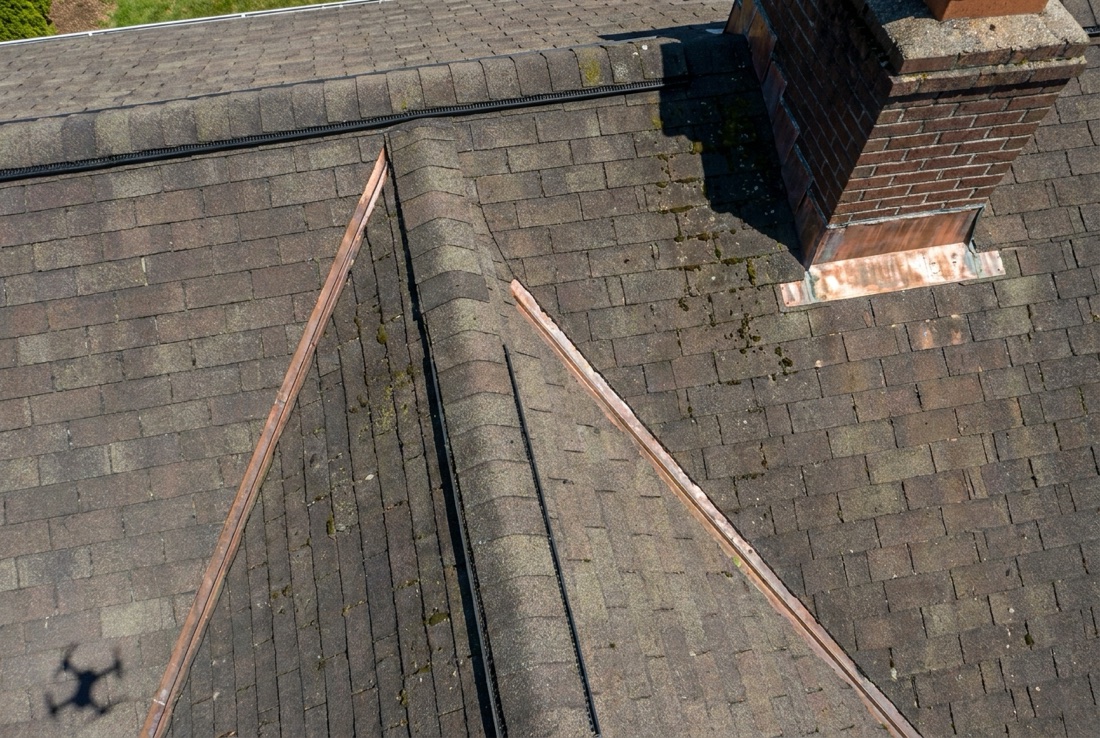
| Sag tracking a chimney or valley | Long-term slow leak at a flashing detail | Decking replacement plus flashing rebuild |
| Sag on a roof with two shingle layers | Added dead load from a prior overlay | Mandatory tear-off, deck and framing check |
These patterns are a starting point for what to expect, not a diagnosis. Two roofs can show the same dip and have different causes underneath, which is exactly why the next step is always a physical look rather than a guess from the sightline test alone.
04 / THE SCOPEWhy a sagging roof changes the job
A standard reroof assumes sound decking and sound framing underneath, with only ordinary per-sheet decking replacement expected during tear-off. A confirmed sag changes that assumption before anyone signs a contract.
Once the old shingles come off, a roof with a known sag typically needs the affected decking replaced outright, not patched, so the new roof surface sits flat and even. Depending on what the tear-off exposes, it can also mean sistering a weakened rafter with new lumber alongside it, or in more involved cases, bringing in additional framing support before the deck goes back on. That framing work is a different trade than roofing in the strict sense, which is why a contractor who finds structural sag should be telling you plainly what they found and what it will take to correct it, not quietly shingling over it.
A roof that is shingled over a known sag without addressing what caused it is a roof that will dip again, usually in the same spot, usually faster the second time.
This is also why a sagging roofline almost never fits neatly into the standard $9,000 to $18,000 asphalt replacement range on its own. The shingle work still falls in that range; the decking and any framing correction are additional line items priced once the deck is open and the extent is visible. Our published pricing covers the roofing side plainly; the honest answer on the structural side is that it depends on what tear-off finds, which is exactly why we photograph decking and framing conditions as we go rather than guessing up front.
There is a paperwork angle too. A standard reshingle needs the usual reroofing permit from your Macomb County municipality, but framing repair or added structural support can trigger its own review by the local building department, since it touches the load path of the house rather than just the weather surface. A contractor doing this correctly pulls the right permit for the scope actually performed, and asks you to sign off on nothing until that scope is written down in plain language.
05 / THE URGENCYWhy this is worth evaluating promptly, without the scare tactics
We want to be straightforward here rather than alarmist. Most sagging rooflines we inspect are not on the verge of collapse, and the homeowner has usually been living under that roof safely for a while already. The reason to act promptly is not imminent danger in most cases, it is that the underlying cause, whether rot, a slow leak, or added weight, does not resolve itself and generally gets slowly worse with each freeze-thaw cycle and each Michigan winter's snow load.
The practical reason to move on it sooner rather than later is scope creep. A localized soft spot caught early might mean replacing a handful of deck sheets. The same spot left through another winter or two of accumulated moisture and load can grow into a wider section of framing repair. Evaluating it does not commit you to any particular fix; it tells you which side of that line your roof is on right now.
If the sag is paired with other warning signs, such as daylight visible through the attic boards, water staining on the rafters, or a musty smell after a thaw, treat the combination as a stronger signal to schedule an inspection soon rather than later. Our attic warning signs guide walks through what those additional clues look like up close.
06 / THE NEXT STEPGetting a sagging roof evaluated the right way
A sag is confirmed, not guessed at, by looking from both sides: the shingle side, to map exactly where the dip sits relative to valleys, chimneys, and old repair patches, and the attic side, to see the rafters and the underside of the deck directly. That two-sided look is standard in every inspection we perform, and it is $0 with no obligation.
If the inspection finds a sag caused by isolated decking rot with sound framing around it, that is usually resolved within a standard tear-off and reroof, priced with the decking allowance stated up front. If it points to something more involved, framing that needs sistering or support, we tell you plainly and bring in what the job actually requires rather than shingling over a problem that will resurface. Either way, you get photos of what we found and a written scope before any work starts. You can also run a ballpark on the roofing side of the job with the cost calculator while you wait for someone to look at the structural side in person.
Not every dip you notice from the driveway turns out to be structural. Sometimes it is a trick of an old chimney cricket or a low spot in a valley that has always been there. That is one more reason not to guess: a fifteen-minute look answers the question either way, and if the news is good, that is what we will tell you.
Timing matters here in a practical, not urgent, sense. Roofing schedules in southeast Michigan fill up fastest in the warmer months, and a job that includes decking or framing correction needs more of that schedule than a straightforward reshingle. Homeowners who get a sagging roofline looked at in early spring generally have more choice over their install week than homeowners calling in September, when everyone with a summer storm story is also calling. The price canon on this page holds steady by season; your scheduling leverage does not.
- A sagging ridge or dished slope is a structural symptom, not a cosmetic one, and deserves evaluation within weeks, not seasons.
- Common causes are delaminated or rotted decking, undersized or overspanned framing, long-term slow leaks, and added dead load from a layered reroof.
- A confirmed sag usually adds decking replacement and possibly framing repair on top of a standard reshingle, priced once tear-off shows the extent.
- Most sagging roofs are stable rather than imminently dangerous, but the underlying cause tends to worsen with each winter left unaddressed.
- The only way to confirm what is happening is a two-sided look, roof and attic, and that inspection is $0 with no obligation.
Questions we hear most
Not usually. Most sagging rooflines we inspect developed gradually and are stable at the moment someone notices them, rather than at risk of sudden failure. That said, the underlying cause rarely improves on its own, so a prompt evaluation is the right move even when there is no immediate danger.
Sometimes. If the sag traces to an isolated area of rotted or delaminated decking with sound framing around it, replacing that decking during a normal reroof can resolve it. More extensive sag, especially from undersized framing or long-term structural moisture, can require sistering rafters or additional support, which is scoped after tear-off shows what is underneath.
Freeze-thaw cycling and heavy snow loads add stress that Michigan roofs carry every winter, which can accelerate problems that started with a slow leak, undersized original framing, or a second layer of shingles left on during a past reroof. None of those causes are unique to this climate, but the winter load tends to expose them faster.
It depends entirely on what tear-off finds. The shingle portion of the work falls within our standard $9,000 to $18,000 asphalt replacement range, and any decking or framing correction is priced as additional line items once the extent is visible and photographed. A free inspection is the only honest way to scope it before work begins.
- FEMA, disaster declaration DR-4757-MI, Michigan severe storms of August 2023 (Macomb County designated). fema.gov/disaster/4757
- Michigan Residential Code, 2015 edition, adopted with Michigan amendments by the LARA Bureau of Construction Codes, in effect since February 8, 2016. michigan.gov/lara: code books
- Your city or township building department: reroofing permit requirements and fee schedules are set locally in Macomb County; see the county directory of communities. macombgov.org