
JUMP TO A SECTION
Every roof replacement quote has a line for decking, and it is usually the vaguest line on the page. That is not because contractors are hiding something. It is because nobody, not even the most experienced roofer, can see the condition of every board until the shingles and underlayment are stripped away. Decking replacement is the most common legitimate reason a final invoice differs from the original estimate, and it deserves a plain explanation instead of a shrug.
Homeowners tend to hear the word 'decking' for the first time on tear-off day, when a crew member walks up with a photo of a soft board and a question about whether to proceed. That conversation goes a lot better when you already understand what decking is, why it fails where it fails, and what a fair contract says about it before anyone ever picked up a pry bar. That is what this guide covers, section by section, without inventing a price for something that genuinely cannot be priced until your specific roof is opened up.
01 / THE SHORT ANSWERWhat decking is and why it changes the job
The deck, sometimes called sheathing, is the solid wood surface fastened across your rafters or trusses. Everything else, underlayment, ice and water barrier, flashing, and shingles, is attached to it. If the deck is soft, delaminated, or gapped in a way that will not hold a nail, none of those layers can do their job for long. A new roof is only as good as the surface it is fastened to, which is why decking condition, not just the shingles on top, decides how long a reroof actually lasts.
Decking work is priced per sheet or per board and folded into the overall job. It does not push a typical Macomb County asphalt replacement outside the standard $9,000 to $18,000 range unless a home has widespread rot, and a written per-sheet price protects you either way. See the full breakdown in our roof replacement cost guide.
02 / TWO ERASPlank decking vs plywood and OSB
Macomb County's housing stock spans roughly a century, and the deck under your shingles usually tells you when the roof was last framed or fully reroofed.
Plank decking on older homes
Homes built before roughly 1970 were commonly framed with individual wood boards, usually one by six or one by eight, nailed side by side across the rafters. Done well, plank decking is solid and long lived. The catch is that boards shrink and swell with Michigan's humidity swings over decades, and gaps between planks widen. A little gap is normal and expected. A wide gap is a problem, because modern shingles are engineered to be fastened to a continuous nailing surface, not to bridge open air.
Plywood and OSB on newer builds and reroofs
Homes built from roughly the 1970s forward, and any older home that has already had a full reroof, typically carry plywood or oriented strand board, OSB, sheathing installed in four by eight foot sheets. Sheet goods give a continuous, gap-free nailing surface by design, which is one reason most manufacturers and codes now assume sheet decking as the baseline. Plywood and OSB can still fail: they delaminate from long-term moisture exposure, and OSB in particular can swell and lose strength if it stays wet for an extended period, most often from a slow leak that went unnoticed for years.
What you can tell before tear-off, and what you cannot
From the attic side, a flashlight and a walk along the ridge can reveal some things: daylight showing through at a seam, obvious staining or dark trails following a rafter, or a soft feel when you press a board by hand near a known trouble spot like a plumbing vent or a valley. What you generally cannot judge from the attic or the ground is the true extent of the problem, because rot travels sideways along the grain of a board and moisture damage often looks worse, or better, once the covering material is removed. This is also why a homeowner's own age-of-home knowledge is genuinely useful information to share with your contractor before the estimate: knowing whether your home has ever had a full tear-off and re-deck, versus only ever having new shingles laid over the original boards, tells an experienced eye a great deal about what to expect.
| DECKING TYPE | TYPICAL ERA | STRENGTH | WEAK POINT |
|---|---|---|---|
| Plank boards | Pre-1970s Macomb homes | Solid if gaps are tight | Gaps widen with age, and rot travels along a board |
| Plywood sheets | 1970s forward, most reroofs | Continuous nailing surface | Delaminates layer by layer under sustained moisture |
| OSB sheets | Common in newer construction | Continuous nailing surface, cost efficient | Swells and softens if it stays wet |
03 / THE REVEALWhat tear-off actually finds
Once the old shingles and underlayment are stripped, the deck is visible for the first time in years, sometimes decades. A few patterns show up again and again on Macomb County tear-offs.
- Soft or spongy sections around old pipe boot penetrations, where a failed rubber boot let water in slowly for seasons before anyone noticed a ceiling stain.
- Delamination near the eaves, where ice dams have backed meltwater under the shingles winter after winter, the single most common storm-adjacent decking issue in this climate.
- Rot along valleys, where two roof planes funnel water into a concentrated channel and any gap in the old flashing sent water straight into the boards below.
- Discolored, dark, or crumbling wood anywhere a chimney, skylight, or dormer wall meets the roof plane, the classic sign of a slow flashing leak.
- Wide plank gaps on older homes that were never sheeted over during an earlier reroof, which is a warranty issue even where the wood itself is sound.
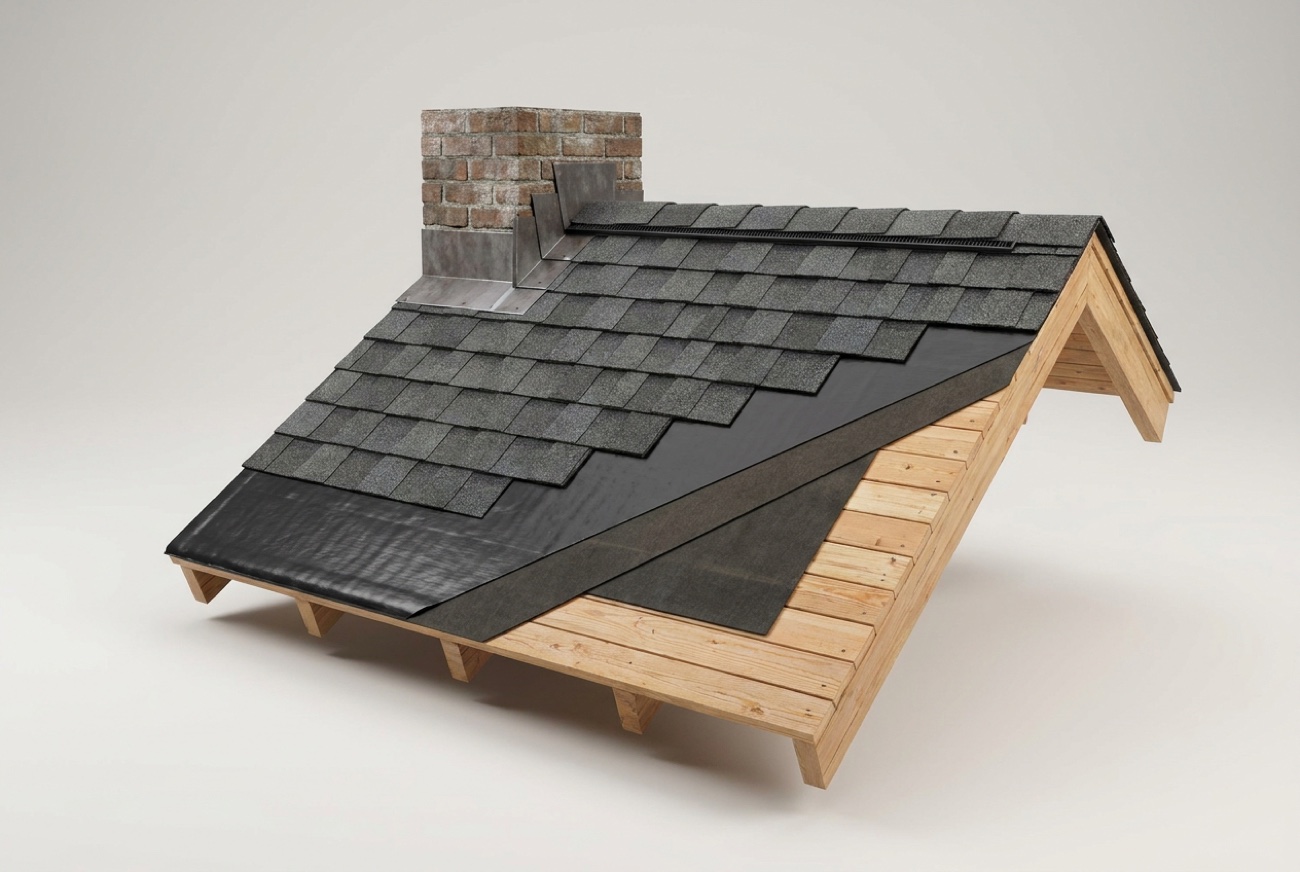
None of this is visible from the ground or even from inside the attic in every case. A good contractor documents what tear-off finds with photographs, board by board, so you are looking at evidence rather than taking a stranger's word for it. If you want the full sequence of what happens on demolition day, our tear-off process guide walks through it start to finish.
There is also a Michigan-specific pattern worth naming directly: ice dams. When attic heat escapes upward and melts the underside of the snowpack on the roof, meltwater runs down to the cold eaves, refreezes, and backs up under the shingles into the deck below. That cycle can repeat for years, one winter at a time, quietly softening the eave boards long before anyone sees a stain on a ceiling. Homes with marginal attic ventilation or thin insulation see this pattern most, which is one reason a decking conversation and a ventilation conversation often happen in the same visit.
04 / THE WARRANTY LINEWhy plank gaps matter for a modern warranty
This is the part homeowners on older plank-decked homes are most often surprised by. Shingle manufacturers publish installation requirements as a condition of their warranty coverage, and those requirements typically include a maximum acceptable gap between deck boards and, in many cases, a minimum sheathing thickness or a requirement that boards be resurfaced with sheet material before shingles go down. A gap that was perfectly fine for the wood shingles or three-tab asphalt your grandparents' generation installed can fall outside what today's architectural shingle warranty allows.
A plank deck can be structurally sound and still fail a manufacturer's installation spec if the gaps are too wide for the shingle line you are buying. That is not a sales tactic. It is the reason some older Macomb County homes need a layer of oriented strand board over the existing planks before new shingles go on, and it is worth asking your contractor to show you the manufacturer's written requirement, not just take their word for it.
The manufacturer's published installation and warranty specification is the kind of document a contractor should be able to produce on request. If a bidder cannot point to a manufacturer spec when they tell you re-sheeting is or is not required, ask a second bidder.
There is a second, less discussed reason gaps matter beyond the warranty paperwork: fastener holding power. Shingle nails are designed to bite into a solid nailing surface, and a nail that lands over a wide gap between planks instead of solid wood has meaningfully less holding strength against wind uplift. That is a real, physical difference in performance, not just a paperwork technicality, and it is part of why manufacturers wrote the gap limit into their installation instructions in the first place rather than leaving it to judgment on site.
05 / THE CONTRACTReading the per-sheet line before you sign
Because nobody can see every board before tear-off, an honest roof replacement contract handles decking as a stated allowance rather than a guess baked silently into the total. Here is what that should look like in writing, without a single dollar figure attached, since your contractor's actual per-sheet rate is a business decision that varies contractor to contractor and should be disclosed to you directly, not estimated on a guide page.
- A clear statement that decking replacement is priced per sheet or per board, separate from the base tear-off and install price.
- A commitment to photograph any section identified as needing replacement before it is covered up, so you have evidence, not just an invoice line.
- A stated per-sheet or per-board price agreed to in advance, so a change order is a known number applied to a known quantity, not a surprise negotiation mid-project.
- A verbal or written check-in before extensive replacement proceeds, if the scope grows well beyond what a normal tear-off typically reveals.
A decking allowance is not a loophole for a bigger bill. It is the honest acknowledgment that nobody can see through shingles, and it should come with a number and a photo, not just a number.
It is also fair to ask what happens if the scope turns out to be small, or unusually large. On the small end, a handful of sheets around one vent pipe or one valley is routine and should not require a pause in the work; the crew replaces the boards, photographs them, and keeps moving. On the large end, if tear-off reveals that most of the deck needs attention, most homeowners want a phone call before the crew proceeds rather than finding out only when the final bill arrives. Ask your contractor at what point they call you, and get that threshold in writing alongside the per-sheet rate.
This is also where the repair-versus-replace math connects back to the whole-job number. Widespread decking rot on an otherwise old roof is one of the signals that tips a homeowner from a targeted repair toward a full replacement, since replacing rotted boards piecemeal under aging shingles rarely makes sense. Our roof repair page and roof replacement page both cover that fork in more depth.
06 / RED FLAGSWhat a shortcut quote leaves out
The decking line is one of the easiest places for a lowball quote to hide a future surprise, because leaving it vague costs the bidder nothing on paper today.
- No mention of decking at all in the written estimate, as if every board on every roof is always fine.
- A verbal promise that 'we will not find anything' before anyone has been on the roof or in the attic.
- No stated per-sheet or per-board price, which means any decking found becomes a negotiation instead of a known number.
- No offer of photos of what was found and replaced, leaving you to trust an invoice line you cannot verify.
- A blanket claim that your specific deck type never needs attention, regardless of era or visible condition.
None of these red flags mean a contractor is dishonest, but each one removes a piece of the evidence you are entitled to before you approve a change to the price. The fix is simple: ask how decking is priced and documented before you sign anything, not after tear-off has already started.
A related pattern worth watching for is a bid that comes in noticeably lower than every other quote on the same roof with no obvious explanation. Decking allowances are one of the easier places for a lowball estimate to hide daylight, because a contractor who quietly plans to charge for every board later can present a smaller number up front. Comparing quotes line by line, including how each one handles decking, is one of the more useful things you can do before choosing a contractor, and it is exactly the kind of comparison our cost guide walks through for the job as a whole.
07 / THE REAL ANSWERGetting an honest answer before day one
A pre-construction estimate can flag likely risk areas from the attic side, soft spots felt underfoot on the existing roof, and the home's age and roofing history, but the only way to know exactly which boards need to come out is tear-off itself. What you can control ahead of time is the contract language: a stated per-sheet or per-board price, a photo commitment, and a contractor willing to explain both in plain terms before you sign.
Our free inspection includes a look at visible attic-side decking wherever it can be seen without demolition, and we always explain our per-sheet policy and photo commitment before any contract is signed, not after. If your home was built before the 1970s or has never had a full reroof, it is worth asking specifically about plank gaps and manufacturer warranty requirements during that conversation.
The broader lesson holds beyond decking: the parts of a roof you cannot see, the deck underneath, the underlayment, the ice barrier at the eaves, do more to determine how long a roof actually lasts than the shingle color anyone notices from the street. Our roof anatomy guide walks through every layer, decking included, so you know exactly what a thorough quote should account for before you compare a single number across bidders. If you are ready to see where your own roof stands, the cost calculator gives a ballpark in about a minute, and a free inspection gives you the real answer, photos included.
- Decking is the wood platform every other roofing layer is fastened to, and its condition is not fully visible until tear-off.
- Older Macomb County homes often carry plank decking; homes from the 1970s forward typically carry plywood or OSB sheets.
- Wide plank gaps can fail a modern shingle manufacturer's warranty requirement even when the wood itself is structurally sound.
- An honest contract prices decking per sheet or per board with a stated rate and a photo commitment, not a silent guess.
- Widespread rot is one signal that tips a decision toward full replacement rather than a targeted repair.
Questions we hear most
No. Many tear-offs find the deck in sound condition and only shingles, underlayment, and flashing are replaced. Decking replacement is common but not universal, and it depends on the home's age, roofing history, and whether there has been a slow leak. A written per-sheet allowance protects you either way, whether little or a lot of decking turns out to be needed.
You should be able to. Ask your contractor to photograph any section identified as needing replacement before it is covered by underlayment and shingles. A contractor who documents their work with photos is giving you the evidence behind a change order, not just an invoice line you have to take on faith.
Not always, but it is common enough to ask about directly. If the gaps between the original boards exceed what your chosen shingle manufacturer allows for warranty coverage, a layer of oriented strand board over the existing planks is typically the fix. Ask your contractor to show you the manufacturer specification rather than take a verbal answer on faith.
- FEMA, disaster declaration DR-4757-MI, Michigan severe storms of August 2023 (Macomb County designated). fema.gov/disaster/4757
- Manufacturer technical and warranty literature for the major asphalt shingle lines: GAF (gaf.com), Owens Corning (owenscorning.com), and CertainTeed (certainteed.com).
- APA, The Engineered Wood Association, technical guidance on plywood and OSB roof sheathing performance and moisture tolerance. apawood.org
- Your city or township building department: reroofing permit requirements and fee schedules are set locally in Macomb County; see the county directory of communities. macombgov.org