
JUMP TO A SECTION
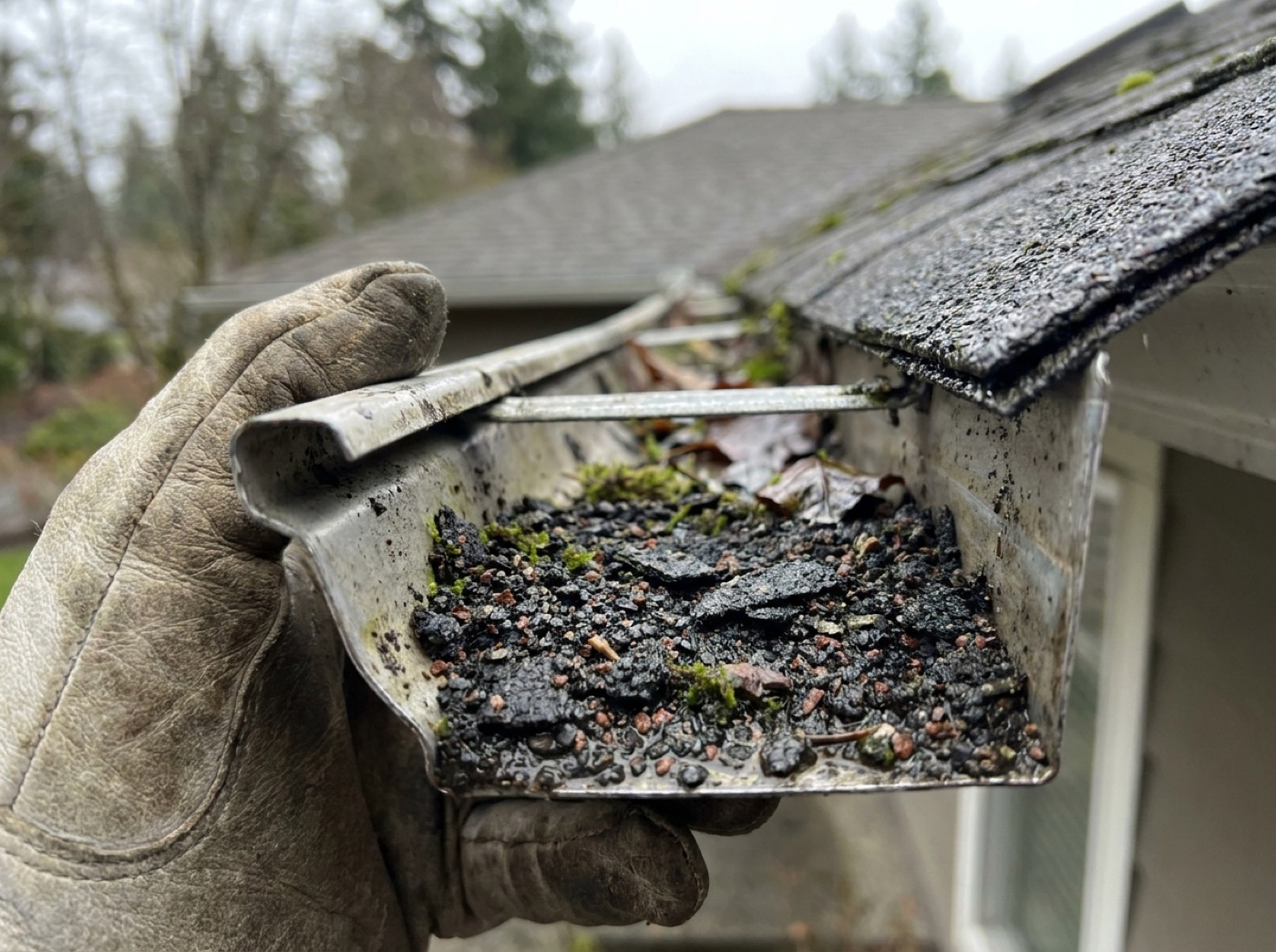
A gutter full of sandy black or gray grit is one of the most common reasons a Macomb County homeowner calls us, and the honest first answer is: it depends on where you are in the roof's life. Asphalt shingles are built with a layer of mineral granules pressed into the surface, and those granules do real work. They shield the asphalt mat underneath from ultraviolet light, they add fire resistance, and they give the shingle its color and its grip against wind uplift. Every shingle sheds some of that layer over its life. The question this guide answers is how to tell ordinary shedding from a roof that is telling you something more urgent.
01 / THE SIGNALWhat granules in the gutter actually mean
Granule loss is not one thing. It is a spectrum that runs from completely harmless to a genuine end-of-life indicator, and the same handful of black or gray specks can sit at either end depending on context. The manufacturing process embeds granules into hot asphalt and then presses them in, but adhesion is never perfect down to the last grain, so a percentage of loose granules ride along on every new roof and work themselves free during the first hard rains. That is different from a fifteen-year-old roof shedding at a rate that is climbing month over month, which is the asphalt mat itself starting to break down underneath a thinning granule layer.
The practical skill is reading three things together: the age of the roof, the rate of shedding, and whether the loss is spread evenly across every slope or concentrated in one area. A new roof shedding evenly is a shrug. An old roof shedding evenly is expected wear that deserves a look. Any roof shedding heavily in one concentrated spot, regardless of age, points to a local cause and usually a fixable one.
Nothing here replaces a physical look at your shingles. Granule loss is a strong clue, not a diagnosis on its own, which is why every inspection we do also checks for exposed asphalt, brittle or cracked tabs, and the attic side of the deck before we tell a homeowner what stage their roof is actually in.
It also helps to know where the granules actually go once they leave the shingle. Rain carries loose granules down the slope, into the gutter trough, and out through the downspout, which is why the clearest evidence usually sits in the gutter bottom or in a small pile at the downspout outlet rather than on the shingles themselves. A downspout that used to run mostly water and now runs visibly gritty water after every rain is telling you the same thing a full gutter is telling you, just earlier in the season.
02 / THE LIFECYCLENew shedding, midlife wear, and end-of-life exposure
Roofers think about granule loss in three stages, and knowing which one your roof is in changes the whole conversation.
Stage one: new roof shedding
In the first year or two after a shingle roof goes on, it is normal to see a noticeable amount of loose granules in the gutters and downspouts, especially after the first few storms. These are excess granules from manufacturing that never fully embedded, being washed free rather than pulled off an aging mat. This stage tapers off on its own and does not signal a problem.
Stage two: steady midlife wear
From roughly year three through the back half of a shingle's rated life, granule loss continues at a slow, steady, low-level rate as UV exposure and weather cycling gradually wear the surface. A light dusting of granules after a heavy rain at this stage is ordinary maintenance news, not an alarm. The roof is aging the way it is supposed to age.
Stage three: accelerating loss and exposed mat
The stage that matters is when the rate itself starts increasing, or when bare patches of black or gray asphalt mat become visible where granules used to be. Exposed mat has lost its UV shield and its fire layer, and it degrades far faster than granulated shingle, so a roof in this stage tends to fail faster than the calendar alone would suggest. This is the pattern most associated with a shingle nearing or past the end of its rated service life.
From the ground, exposed mat often reads as dull, dark, almost oily-looking patches on a slope that otherwise still shows its granulated color and texture. Up close it is bare asphalt with no grit at all. If you can see this pattern across a whole slope rather than one small spot, that is a replacement conversation, not a patch.
03 / THE LOCAL CAUSESWhen granule loss is localized, not systemic
Some of the heaviest granule loss we find has nothing to do with the shingles aging out. It comes from a handful of local mechanical causes, and each one is worth a repair call rather than a full replacement conversation.
Splash zones under a second roof plane
On homes with a two-story section or a dormer draining onto a lower roof, the water coming off the upper plane hits the lower shingles with real force, concentrated right where the drip line lands. That splash zone wears granules off years faster than the rest of the roof, and it is easy to spot because the worn patch has a clean, repeatable shape directly under the upper eave or valley.
Foot traffic paths
Anywhere someone has walked the roof repeatedly, whether for a satellite dish install, holiday lights, chimney work, or a prior repair, the shingles along that path show accelerated granule loss and sometimes cracking, because foot pressure grinds granules loose that weather alone would not have removed. These paths usually run in a straight line from an access point like a ladder spot or a low dormer roof.
Blister fields
Shingle blisters are small bubbles that form when trapped moisture or gas pushes up through the asphalt mat, and once a blister pops it leaves an open crater that sheds granules from that one spot far faster than the surrounding shingle. A cluster of blisters in one area of a roof can look, from the gutter evidence alone, like a bigger problem than it is. Our guide to blistering shingles covers how to tell a blister field from more serious wear.
Ice dam damage at the eaves
Macomb County winters build ice dams at the roof edge when attic heat melts the underside of the snowpack and the meltwater refreezes right at the cold eaves, backing up under the shingle courses above it. That freeze-thaw cycling is hard on the granule layer right at the eave line, and homeowners often notice a heavier band of grit at the downspouts closest to a roof section with a history of ice damming. If that pattern repeats every winter, the underlying fix is usually attic ventilation and eave protection rather than repeated shingle patching alone.
| PATTERN YOU SEE | LIKELY CAUSE | TYPICAL PATH |
|---|---|---|
| Even light dusting, roof under 2 years old | Manufacturing excess washing off | No action, monitor |
| Even light dusting, roof mid-life | Ordinary weathering | Monitor at next inspection |
| Heavy loss in one clean-edged patch below an upper roof | Splash zone from a second roof plane | Targeted repair or splash guard |
| Heavy loss in a straight line | Foot traffic path | Targeted repair, seal cracked tabs |
| Heavy loss clustered with round craters | Popped blister field | Targeted shingle replacement in that area |
| Heavier grit each winter near one eave | Repeat ice dam cycling | Repair plus ventilation and eave protection review |
| Bare asphalt mat visible across a whole slope | End-of-life shingle wear | Replacement conversation |
04 / THE CHECKA severity check before anyone sells you an answer
You do not need to get on a ladder to get a useful read before you call anyone. Four questions, answered honestly from the ground and the gutter line, tell you roughly which stage you are in.
- How old is the roof? Under 2 years, expect some shedding. Approaching or past its rated life, treat granule loss as a real signal.
- Is the gutter grit increasing over recent cleanings, or steady? An increasing rate matters more than the raw amount at any one visit.
- Is the wear spread evenly across every slope, or concentrated in one spot? Concentrated wear usually has a local, fixable cause.
- Can you see any bare, dark patches on the shingles themselves from the ground or a window upstairs? Visible bare mat, especially spread across a slope, is the strongest single signal.
If the honest answers point to even, low-level wear on a mid-life roof, that is not an emergency. If they point to an increasing rate, a concentrated patch, or visible bare mat, that is worth a free inspection before the next hard rain finds the weak spot for you. Our signs your roof needs repair guide walks through the other warning signs worth cross-checking alongside granule loss.
05 / THE FORKWhen a repair is enough, and when it is not
Granule loss almost never shows up alone as the only symptom worth acting on, and the right next step depends on what it is paired with. Localized loss from a splash zone, a foot traffic path, or a blister field is a textbook repair: the affected shingles get replaced or reset, and the rest of the roof is left alone because it is not the problem. Repairs in Macomb County run $350 to $3,200, and a targeted granule-loss repair generally lands toward the lower half of that range unless it is paired with deck work.
covers most granule-related repairs in Macomb County, from resealing a small blister field to replacing shingles along a worn splash zone. Larger or complex repairs, especially ones involving decking, can run higher. Get a written number from the repair estimator before you decide.
Uniform, accelerating granule loss across a roof nearing the end of its rated life is a different conversation. At that stage, granule loss is usually one of several symptoms showing up together with curling, cracking, or the start of leaks, and repair dollars start buying months instead of years. If a repair estimate is climbing toward a quarter of a full replacement, that is the signal to compare both numbers side by side rather than committing to another patch. A roofer who tells you plainly that granule loss alone is not automatically a replacement trigger is giving you the honest read; one who quotes a full tear-off from gutter grit alone, without getting on the roof, is not.
Granules in the gutter are a clue, not a verdict. The roof, the attic, and the pattern of the wear are what actually answer the question.
One practical note on targeted repairs: replacement shingles will rarely match a weathered roof exactly, because asphalt shingles fade and manufacturers periodically shift their color blends. A repair crew doing splash-zone or foot-traffic work will usually pull from a less visible slope or attic spares when they exist, and tell you honestly up front if a perfect match is not possible on the visible plane. That is a cosmetic tradeoff, not a reason to avoid a repair that is otherwise structurally sound.
If your roof does turn out to be past its useful life, our guide to repairing a twenty-year-old roof covers how we weigh one more repair against a full replacement on an aging system, and the cost calculator runs both a repair estimate and a replacement range against your actual roof size so you can see the numbers next to each other.
06 / THE REAL ANSWERHow to get a real answer instead of a guess
Everything above narrows the question. The only way to actually answer it is a look at the shingles up close and the deck from the attic side, which is exactly what our free inspection covers. We check for exposed mat, cracked or curling tabs, blister fields, and any staining on the attic side of the deck, and we photograph what we find so you can see it too. If the granule loss is localized and the roof is otherwise sound, we will tell you it is a repair. If the roof is genuinely near the end, we will show you why and let you compare a repair estimate against a full replacement using the same published ranges on our pricing page.
A word on timing: gutter grit tends to get noticed twice a year, during spring cleanout and during fall cleanout before the leaves come down for good. If you are cleaning gutters and finding a noticeably heavier load than the last time, that is worth a call before winter's freeze-thaw cycles get another season to work on whatever is already weakened. There is no cost to finding out where you actually stand.
- Some granule shedding is normal at every stage of a roof's life; the rate and the pattern matter more than the raw amount.
- Even, accelerating loss and visible bare asphalt mat across a slope point toward end-of-life shingle wear.
- Heavy loss concentrated in one clean patch usually traces to a splash zone, a foot traffic path, or a blister field, all of which are repairable.
- Targeted repairs run $350 to $3,200 in Macomb County; larger or complex repairs can run higher.
- A free inspection is the only way to know for certain, and it comes with photos either way.
Questions we hear most
Some granule loss is normal at every stage of an asphalt roof's life, especially in the first year or two after installation and at a slow, steady rate through midlife. It becomes a concern when the rate is increasing, when it is concentrated in one spot, or when you can see bare asphalt mat on the shingles themselves.
Not by itself. Localized granule loss from a splash zone, a foot traffic path, or a blister field is usually a straightforward repair. Widespread, accelerating granule loss with visible bare mat across a slope, especially on a roof nearing the end of its rated life, is a stronger signal that a replacement conversation makes sense, and a free inspection tells you which situation you are actually in.
Targeted repairs for splash zones, foot traffic wear, or blister fields typically run $350 to $3,200, toward the lower half of that range unless decking is also involved. Larger or complex repairs can run higher. We give you a written price after a free, no-obligation inspection.
- Manufacturer technical and warranty literature for the major asphalt shingle lines: GAF (gaf.com), Owens Corning (owenscorning.com), and CertainTeed (certainteed.com).
- Asphalt Roofing Manufacturers Association, industry technical bulletins. asphaltroofing.org
- National Roofing Contractors Association, technical guidance for steep-slope roof systems. nrca.net