
JUMP TO A SECTION
Most homeowners do not think about their roof until it makes them, and by the time it does, the problem has usually been building for a while. That is useful information, because it means a roof gives off checkable signals well before a leak lands on the ceiling: a stain that was not there last season, a gutter full of grit, a course of shingles that looks slightly off. None of the seven signs below require getting on the roof yourself. All seven are things you can spot from a ladder, the yard, or a flashlight tour of the attic, and each one points to a specific, addressable repair rather than a vague sense that something is wrong.
01 / THE SHORT ANSWERWhat your roof is trying to tell you
A roof in good condition looks almost boring: even courses, clean gutters, a dry attic. The seven signs below are the ways that boring picture changes, roughly grouped from the clearest interior evidence to the slower signs that build over a season or more. Seeing one of them does not automatically mean a full replacement. Most of the time it means a specific, targeted repair, and knowing which sign you have tells you a lot about which fix you need before anyone ever quotes you a price.
A 10 year old roof with three of these signs needs attention sooner than a 20 year old roof with none of them. The signs describe the actual condition of your specific roof, not just how many winters it has weathered.
02 / THE INTERIOR EVIDENCESigns 1 to 3: what the ceiling and gutter show
1. A stain on the ceiling or an attic wall
A brown or yellow ring on drywall, especially one that grows after a rain, means water has already made it through the roof assembly and into the living space. The stain rarely sits directly under the actual hole, because water runs along the underside of the deck and down a rafter before it drips. That is exactly why a repair crew traces the leak from the attic side rather than guessing from where the stain shows up. Our guide to finding a roof leak walks through how that tracing actually works.
Before anyone comes out, it helps to note a few details: whether the stain shows up during a specific kind of storm (wind-driven rain versus a straight downpour), whether it has grown or stayed the same size since you first noticed it, and roughly where it sits relative to the nearest exterior wall or chimney. None of that is required, but it can shorten how long the attic side of the inspection takes, since it gives the crew a starting point instead of an entire deck to search cold.
2. Granules collecting in the gutter
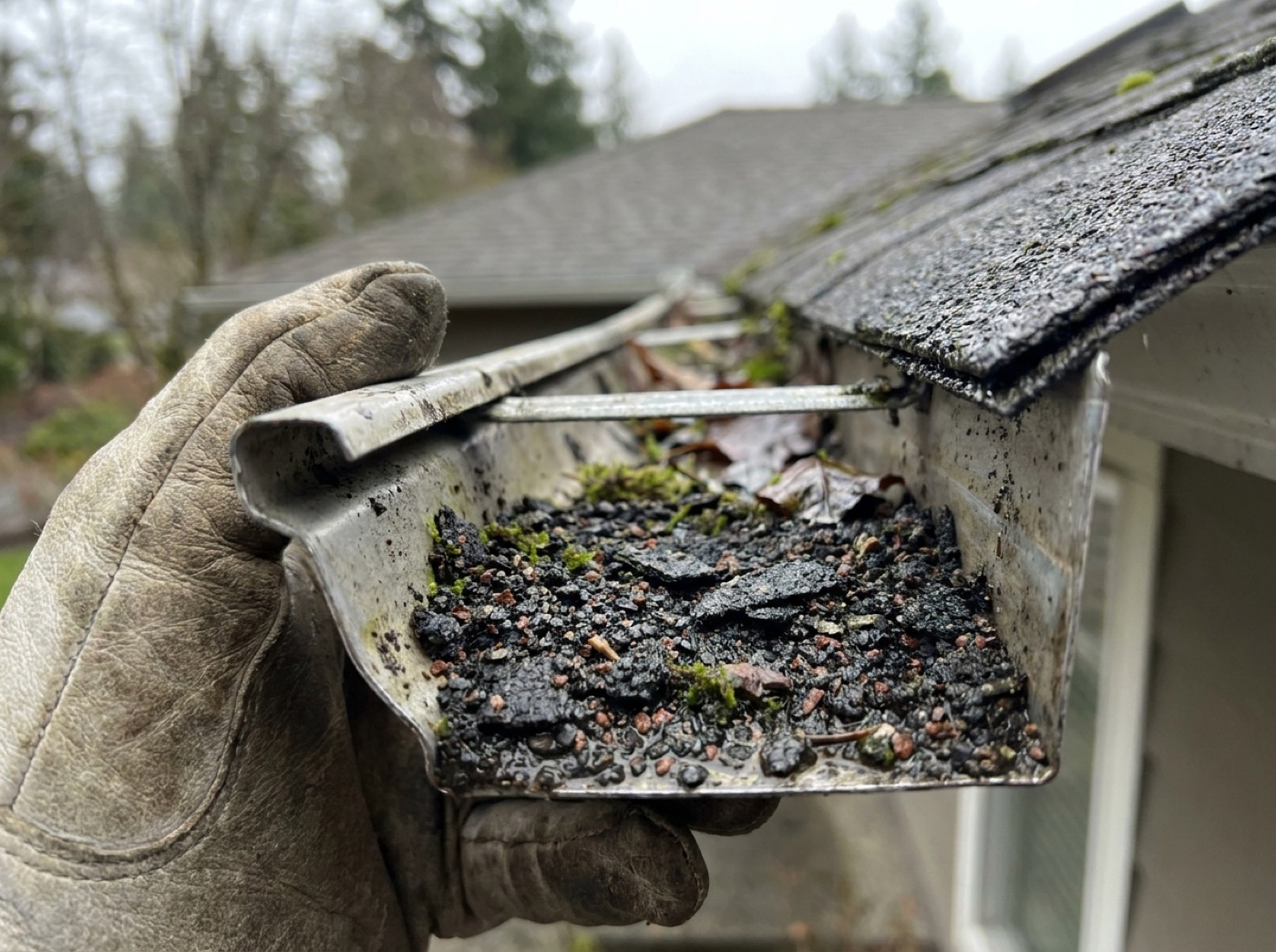
Asphalt shingles shed some granules over their life, which is normal in small amounts. A gutter that is visibly gritty, or granules that show up after every rain rather than just once or twice a year, means the shingle surface is wearing faster than it should, and the asphalt underneath is being exposed to UV and moisture it was designed to be protected from. Isolated granule loss on one section can be a targeted repair. Granule loss spread evenly across the whole roof is a sign the shingles themselves are aging out, which our granule loss guide covers in more depth.
Where the granules collect matters too. Heavy grit below one valley or one slope, and clean gutters everywhere else, points to a localized problem: a section catching more runoff than it should, or shingles that were damaged in one spot by a fallen branch or foot traffic. Even, roof-wide grit in every downspout is a different story, and it is the kind of finding that gets weighed against the shingles' expected service life rather than treated as a single repair line item.
3. Lifted, curling, or missing shingles
Wind works at the tab edges of a shingle first, and once the seal strip lets go, the tab can lift, curl upward at the corners, or tear off completely. A handful of lifted or missing shingles after a windstorm is one of the most common repair calls we get, and it is usually a same-visit fix: replace the damaged shingles, reseal the surrounding field, and check the courses above for wind damage that is not obvious from the ground. Left alone, a lifted shingle is an open invitation for the next rain to get under the course beside it.
Curling is a slightly different signal than a clean wind tear. Shingles that curl upward at the corners across a wide area, without an obvious storm event to blame, are usually reacting to age, heat cycling, or a ventilation problem underneath rather than a single gust. A few curled shingles in one spot can often be replaced individually. Curling spread across most of a slope is a sign the shingles are nearing the end of their service life, and a repair there is a stopgap rather than a lasting fix.
03 / FROM THE GROUNDSigns 4 and 5: what you can see without a ladder
4. Gaps or cracks around flashing and boots
Binoculars or a zoomed phone photo from the yard can often show the flashing around a chimney, a wall intersection, or a plumbing vent pipe. Rust streaks below a flashing joint, a visible gap where metal has pulled away from a wall, or a rubber pipe boot that looks cracked or shrunken are all signs that detail is no longer sealing the way it should. Flashing failures are one of the most common sources of leaks precisely because they are easy to miss from the ground and easy to underestimate once found, and a proper fix is more involved than a bead of caulk.
Different flashing details fail in different ways. Step flashing along a wall intersection tends to pull loose one piece at a time, so a gap in the middle of a run is a sign to check the whole run, not just the visible spot. Chimney flashing more often fails at the counter flashing where it meets the masonry, showing up as a rust streak down the brick. Pipe boots almost always fail the same way regardless of brand: the rubber collar dries and splits with age, usually within ten to fifteen years, well before the shingles around it are due for anything.
5. A visibly sagging roofline or dip between rafters
Stand across the street and sight down the roof plane. A ridge that is straight and a slope that reads as one flat surface is normal. A dip, wave, or sag anywhere along the plane usually means the decking underneath has softened or a rafter has weakened from sustained moisture, and that is a structural sign rather than a surface one. A localized dip over a small area can sometimes be a decking-only repair. A widespread sag, especially paired with other signs on this list, points toward a broader condition problem worth a full inspection, which our sagging roof guide covers in detail.
A sag is also the one sign on this list worth photographing rather than climbing up to inspect yourself. The safest way to confirm it is from the ground, ideally in low, angled light in the early morning or evening, when shadows make a subtle dip much easier to see than they are at midday. If the dip is new, or clearly larger than it was a season ago, treat it as a priority call rather than something to watch for another year.
04 / THE SLOWER SIGNSSigns 6 and 7: what builds over a season
6. Daylight or staining in the attic
A flashlight tour of the attic on a dry day can catch problems the outside of the roof will not show for months. A pinpoint of daylight through the deck marks an active gap. Brown or gray staining on the sheathing or rafters marks a path water has already traveled at least once, even if it is not actively dripping today. Rusty nail tips scattered across the attic point to moisture sitting somewhere nearby, repeatedly, rather than a single dramatic event. None of these require special tools to spot, just a working flashlight and a day after rain.
Walk only on the framed, stable parts of the attic, never across insulation that may be hiding open joists, and stop if access is limited or footing is unclear. A first-pass attic check is worth doing in early spring, after a Michigan winter's freeze-thaw cycles have had the most time to work on any weak points, since a stain or a patch of rust found then can be repaired before another full season adds to it.
7. Moss or heavy biological growth holding moisture
A thin layer of algae streaking is mostly cosmetic, but thick moss growth, especially on north-facing slopes that stay shaded and damp longer, holds water against the shingle surface well after the rest of the roof has dried. That sustained moisture speeds up granule loss underneath the growth and can work into seams and nail lines over a season or two. Moss is rarely an emergency by itself, but it is a sign worth addressing before it graduates into the granule loss and shingle damage described above.
Moss removal on an older, brittle roof is its own small hazard: scraping it off carelessly can crack shingles that were otherwise sound, so this is one sign where the fix matters as much as the diagnosis. A repair crew that has seen the growth pattern before will typically clear it gently, check what condition the shingles underneath are actually in once it is gone, and recommend whether the surface needs anything beyond cleaning.
05 / THE PATTERNOne sign versus several signs together
Any single sign on this list is worth a call. A handful of missing shingles after a windstorm, on their own, is a straightforward, inexpensive repair. The read changes when signs stack: granule loss plus attic staining plus a sagging section is not three small problems, it is one roof telling you it has been absorbing water for a while, and that combination is exactly when the honest conversation shifts from repair to replacement. Our repair versus replacement guide walks through that decision in more depth, with both canon price ranges side by side.
Roof age is worth weighing alongside the signs, not instead of them. A roof well inside its rated life that shows one isolated sign is almost always a repair, full stop. A roof approaching or past the upper end of its expected service life, even with what looks like a single sign today, is more likely to be showing the first of several, simply because the whole system is aging at once. That is the practical reason an inspector looks at the roof as a whole rather than only the spot you called about; the sign that prompted the call is rarely the only thing worth noting once someone is actually up there.
The signs are not there to scare you into a bigger job. They are there so you can catch the small, cheap fix before it becomes the expensive one.
06 / THE PRICE PICTUREWhat each sign should cost to fix
Roof repairs in Macomb County run $350 to $3,200, and larger or complex repairs can run higher. A single lifted shingle patch or one pipe boot replacement sits at the low end of that range. A full valley rebuild or extensive flashing work sits toward the high end. Granule loss and attic staining, on their own, are diagnostic signs rather than a repair line item; the price depends on what the tracing turns up once someone gets on the roof and into the attic.
covers most Macomb County roof repairs, from a single pipe boot to a rebuilt valley. Larger or complex repairs can run higher. The only way to price your specific signs is a free inspection, and if the roof only needs a repair, that is exactly what we will tell you. Get your repair estimate in about 60 seconds.
A sagging deck section is the one sign on this list most likely to change scope, since soft or delaminated decking has to be replaced, priced per sheet, before any new material goes down. That is still very often a repair rather than a full reroof, but it is the kind of finding that needs eyes on it rather than a phone estimate. If you are weighing your own numbers before anyone visits, the cost calculator and our published pricing sheet use the same canon ranges as this page.
07 / THE FREE PATHGetting your signs confirmed, free
A free Macomb Roofing Pros inspection checks the shingles, flashing, boots, gutters, and the attic side of the deck, with photos of anything we find. If you spotted one or more of the seven signs above, that inspection is what turns a suspicion into a written answer: which repair fixes it, roughly what it costs, and whether anything else nearby needs attention while a crew is already up there. We are on the schedule Mon-Sat 7am to 7pm, with 24/7 emergency tarping available if a sign has turned into an active leak. Start the conversation from the instant estimator and pick repair as the job type.
Timing matters a little here too. Southeast Michigan's roofing season runs hardest from late spring through fall, and schedules fill fastest right after a windstorm moves through the county, when everyone who noticed a sign that week calls at once. A homeowner who books an inspection as soon as a sign shows up, rather than waiting to see if it gets worse, usually has more say over the week the work actually happens. None of that changes the price canon on this page; it just changes how much choice you have about scheduling.
- A ceiling stain, gritty gutters, and lifted or missing shingles are the clearest signs a repair is due, and the earliest to act on.
- Flashing gaps, cracked boots, and a sagging roofline can be spotted from the ground or a ladder without climbing onto the roof.
- Daylight or staining in the attic and heavy moss growth are the slower signs that build over a season rather than a single storm.
- One isolated sign is usually an inexpensive, targeted repair; several signs together point toward a bigger condition conversation.
- Repairs run $350 to $3,200, and the only way to price your specific signs is a free inspection with photos, no obligation.
Questions we hear most
A handful of lifted or missing shingles after a windstorm is the most common repair call we get, and it is usually a same-visit fix once we replace the damaged shingles and reseal the surrounding field. It is a clear sign of a repair, not a reason to consider replacement, unless it is showing up alongside several other signs.
Yes, for most of the signs. A ceiling or attic stain, granules in the gutter, flashing gaps visible with binoculars from the yard, a sagging roofline, and heavy moss growth can all be spotted from the ground, a ladder, or a flashlight tour of the attic. A free inspection is still the honest way to confirm what a sign actually means and price the fix.
There is no fixed number, but signs that stack, especially attic staining, granule loss, and a sagging section appearing together, usually mean the roof has been absorbing water longer than a single event would explain. That combination is when the honest conversation shifts toward replacement, and a free inspection is the way to get a straight answer rather than a guess.
- FEMA, disaster declaration DR-4757-MI, Michigan severe storms of August 2023 (Macomb County designated). fema.gov/disaster/4757
- National Roofing Contractors Association, technical guidance for steep-slope roof systems. nrca.net
- Manufacturer technical and warranty literature for the major asphalt shingle lines: GAF (gaf.com), Owens Corning (owenscorning.com), and CertainTeed (certainteed.com).
- Building Science Corporation, published research and information sheets on moisture movement, air leakage, and roof assemblies in cold climates. buildingscience.com