
JUMP TO A SECTION
Every Michigan homeowner has been given a different reason for the ridge of ice sitting at the edge of a roof: too much snow, clogged gutters, an old roof, a hard winter. Almost none of that is the actual cause. An ice dam forms because part of a roof deck is warmer than it should be while another part of the same deck sits right at outdoor air temperature, and meltwater keeps traveling from the warm zone toward the cold one until it runs out of room to stay liquid. Understand that one mechanism and every other ice dam question, from why heat cables only help a little to why raking never ends the cycle for good, starts to make sense.
01 / THE SHORT ANSWERIce dams are a heat problem, not a snow problem
Snow sitting on a roof does not, by itself, create an ice dam. Snow is simply the raw material the meltwater comes from. The actual cause is a roof deck that is not one uniform temperature underneath that snow. On most Michigan houses, part of the deck sits a few degrees above freezing because heat is escaping from the living space below it. Another part, usually the unheated overhang beyond the exterior wall, sits right at outdoor air temperature. Meltwater is produced in the first zone and freezes solid the moment it reaches the second, and it keeps doing that, thin layer after thin layer, until the ice has enough thickness to back water up under the shingle courses above it.
is the only number in this guide that actually matters. Above it, snow touching the roof deck turns to liquid water. Below it, that same water turns back to ice. An ice dam is the visible record of exactly where that line sat on a given roof, night after night, all winter long.
02 / THE RECIPEThree things have to be true at the same time
An ice dam needs three conditions present in the same place at the same time. Remove any one of them and a dam cannot form, no matter how much it snows that season.
A snow blanket to insulate the deck
Dry snow traps an enormous amount of still air between its crystals, and still air is one of the best insulators there is. That trapped air is what allows a roof deck to hold a different temperature than the air sitting just above the snow surface. A bare, snow-free deck settles close to whatever temperature the outdoor air is, because it radiates and convects heat away freely into the sky. Add a few inches of snow and the deck is now wrapped in insulation, so any heat arriving from below has nowhere to go except into melting the underside of that snow layer.
Heat escaping into the attic
This is the ingredient that varies most from house to house. Warm, moist air from the living space finds its way into the attic through gaps most homeowners never see, and once it is there it warms the underside of the roof deck above the insulated part of the attic floor. The more of this warm air arrives, and the longer it lingers before it is flushed back outside, the warmer that section of deck runs, and the more meltwater it produces.
An eave that stays cold no matter what
Roof framing extends past the exterior wall to form the overhang, and there is usually no attic space, and often no insulation at all, underneath that stretch of deck. It is thermally connected straight to outdoor air with almost nothing between them. Whatever happens further up the slope, the eave overhang stays close to the outdoor air temperature all winter, which is exactly why our guide to roof overhangs and ice dams treats that strip of roof as its own separate problem.
03 / THE HEAT PATHHow warmth actually reaches the shingles
Heat gets from a living room to a roof deck two different ways, and they matter very differently. The first is plain conduction: warmth passing through drywall, insulation fibers, and framing, a slow trickle that attic insulation is specifically built to slow down further. The second is moving air, warm house air escaping through gaps around light fixtures, the attic hatch, plumbing chases, and top plates, then convecting directly against the underside of the deck. Moving air carries far more heat per minute than conduction through a solid material ever does, which is why two attics with identical insulation depth can produce very different amounts of ice damming depending on how airtight the floor beneath that insulation is.
Part of why that warm air keeps arriving is a phenomenon called the stack effect: warm air inside a house is less dense than cold air, so it rises and constantly seeks an exit near the top of the building, pulling replacement air in low down to take its place. An attic sits right at the top of that column. Any bypass in the attic floor becomes an exhaust port for house heat, and the taller the house and the colder the outdoor air, the harder that column pushes. Our stack effect guide works through the pressure math in more detail.
Framing itself adds a second, quieter path. Wood rafters and trusses conduct heat faster than the insulation batts sitting between them, so a roof deck often runs a degree or two warmer directly over each framing member than it does over the insulated bays beside it. That creates faint parallel warm stripes on the deck that you can sometimes read from the ground as stripes in the snowmelt pattern, a phenomenon our thermal bridging guide covers on its own.
None of these paths act alone. A house with poor air sealing but generous insulation can still run a warm deck, because moving air simply carries the heat around the insulation rather than through it. A house with excellent air sealing but thin, settled insulation can run cooler overall but still show localized warm stripes from thermal bridging. Reading an ice dam pattern correctly means asking which of these paths is doing the damage on that particular roof, not assuming the answer is the same one every time.
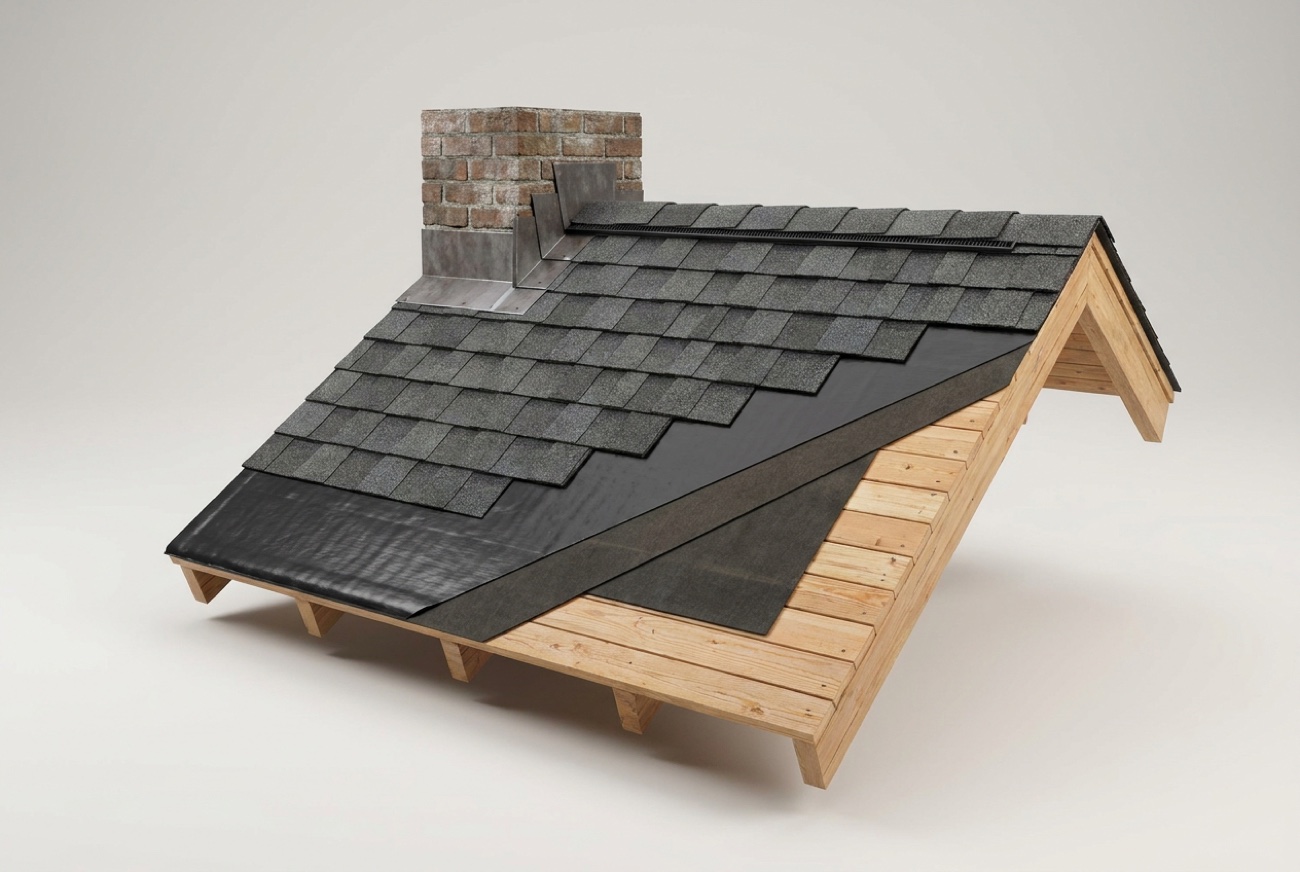
04 / THE WALKTHROUGHA 20 degree day, traced step by step
The clearest way to see the mechanism is to walk one cold day across a roof, from ridge to gutter, the way heat and meltwater actually move. The numbers below are an illustration of a typical poorly air sealed attic on a cold day, not a measurement of any specific house.
Snow blankets the whole roof at the start of the day, so from the ground every square foot looks identical. Underneath that blanket, the deck over the main body of the house sits above freezing because warm attic air is reaching it, so the bottom of the snowpack there is quietly turning to water. That water does not evaporate and it does not simply vanish into the shingles below; it runs downhill through the channels inside the snow, following the roof slope toward the eave, the way water always moves toward the lowest available path.
Somewhere on the way down, the water crosses an invisible line where the deck temperature drops back below freezing. On most homes that line sits close to where the attic floor insulation ends and the unheated overhang begins, because that is where the heat source underneath the deck effectively disappears. The moment meltwater reaches that colder section, it refreezes on contact. The next day's melt cycle deposits another thin layer on top of the ice from the day before, and over a multi-week cold snap those layers build into a visible ridge thick enough to pond water above the shingle laps upslope of it, which is the point water starts finding its way under the roofing rather than off the edge of it.
05 / WHY THE EAVE, SPECIFICALLYWhy the transition happens near the wall line, winter after winter
The boundary between the warm zone and the cold zone is set by the framing of the house, not by that particular winter's weather, which is why the same stretch of eave tends to ice up on the same houses year after year. Attic floor insulation generally stops at or near the top of the exterior wall. Past that point the rafters keep going to form the overhang, and there is nothing but roof deck and outdoor air on the underside of it. Move the insulation, air sealing, or ventilation around inside the attic and you can change how warm the deck runs above the living space. You cannot change the physics of the overhang itself, short of adding a heat source to it, which is exactly why stopgap measures aimed at the eave, rather than the attic above it, tend to need repeating every season.
Roof geometry can move that boundary around, too. Valleys collect meltwater from two roof planes at once instead of one, and dormers create short, awkwardly shaped eaves with airflow that is hard to ventilate from below, which is why those areas often ice up first and worst on a complex roofline. The underlying cause is the same three ingredients described above; the geometry just concentrates them in a smaller footprint. Our full ice dam guide walks through the complete picture, including the fixes, in the order that actually addresses the cause rather than the symptom.
Pitch plays a role as well. A steep roof sheds meltwater quickly, giving it less time sitting against any one section of deck before it reaches the eave, while a shallow roof lets water linger longer over the warm zone, which can produce a wider, slower-forming dam even with a similar attic underneath. None of that changes which three ingredients are responsible; it only changes how visible and how fast the pattern shows up from the ground.
06 / WHY THIS MATTERSThe physics tells you which fixes actually work
Because the cause sits in three specific places, a fix that actually ends the cycle has to target one of them: reduce the heat reaching the attic, keep the deck over the living space closer to outdoor temperature, or remove one of the other ingredients entirely. Stopgap measures like roof raking or heat cables manage the current storm without touching any of the three; they are not wrong to use, they just are not solving the underlying imbalance. That is worth knowing before you spend money on any remedy, because a homeowner who understands the mechanism can ask a much better question than "how do I get rid of this ice," namely "why is my attic warmer than it should be."
If a dam has already been forming on your house for more than one winter, or if you are seeing stains on a ceiling after a thaw, the question has moved from physics to damage, and that calls for eyes on the actual roof and attic rather than another article. A free inspection checks the shingles, the ice barrier at the eaves, and the attic side of the deck, and tells you plainly whether you are looking at a ventilation fix, a repair, or nothing at all. If the roof is old enough that the conversation shifts toward a full roof replacement, our published price sheet on the pricing page and the 60-second cost calculator both use the same ranges, so you can see where your house likely lands before anyone knocks on the door.
- An ice dam needs three things present at once: an insulating snow blanket, heat escaping into the attic, and a cold overhang beyond the exterior wall.
- 32°F is the line that matters. Above it on the deck, snow turns to water. Below it, that water turns back to ice.
- The transition from warm deck to cold deck usually sits right where attic floor insulation ends and the unheated overhang begins, which is why the same eave ices up every year.
- Moving air through attic bypasses carries far more heat than conduction through solid insulation, which is why sealing those bypasses does more than adding insulation alone.
- Working fixes follow the physics: air sealing and ventilation address the cause. Raking and heat cables only manage the symptom for the current storm.
Questions we hear most
An ice dam forms when three things happen at once: a layer of snow insulates the roof deck, heat escaping from the house warms the deck above the insulated attic floor above freezing, and the unheated overhang beyond the exterior wall stays close to outdoor air temperature. Meltwater produced in the warm zone runs downslope and refreezes the moment it reaches that cold overhang, building up in layers until it forms a visible ridge of ice.
The eave overhang sits past the exterior wall line, where there is typically no attic space and little or no insulation underneath the deck. That section is thermally connected almost directly to outdoor air, so it stays cold even while the deck above the heated part of the attic runs a few degrees above freezing. Meltwater simply freezes where it first reaches a section of deck that is back below 32°F, which is usually right at that boundary.
Snow amount matters less than most people assume. A thick, dry snowpack actually needs a genuine heat source underneath it to melt at all, since snow itself is an insulator, not a heat source. Two identical snowfalls can produce very different amounts of damming depending on how much heat is escaping into each attic. The house with the more air-sealed, better-ventilated attic will generally see a smaller dam from the same storm.
- FEMA, disaster declaration DR-4757-MI, Michigan severe storms of August 2023 (Macomb County designated). fema.gov/disaster/4757
- Asphalt Roofing Manufacturers Association, industry technical bulletins. asphaltroofing.org
- ENERGY STAR (U.S. EPA/DOE), recommended home insulation R-values: R-49 to R-60 for attics in climate zone 5, which covers southeast Michigan. energystar.gov: insulation R-values
- Michigan Residential Code 2015, section R905.1.2 Ice Barriers: membrane required from the eave edge to not less than 24 inches inside the exterior wall line. up.codes: MRC chapter 9