
JUMP TO A SECTION
A homeowner calls after a storm convinced the roof is covered in hail damage, and half the time they are right. The other half, what they are looking at is a blister that has nothing to do with the weather, a scuff from a satellite install years ago, or granule loss that is just the shingle getting old. None of that is a knock on the homeowner. Shingles are not designed to be read from the ground, and several completely unrelated problems leave marks that look enough alike to fool anyone who has not spent years on roofs. This guide catalogs the common impostors, teaches the one test that separates real storm damage from everything else, and explains why we would rather tell you the truth than talk you into a claim that will not hold up.
Some roofers get paid more when they find more hail damage, so they find more hail damage. We would rather be the company that tells you honestly when a mark is a blister and not a bruise, even if that means a smaller job today. That honesty is also what protects a real claim later: an inspector who cannot tell the difference hurts a legitimate claim by mixing it in with marks that will not survive an adjuster's second look.
01 / THE SHORT ANSWERSeveral everyday problems mimic hail
Hail is not the only thing that leaves a dimple, a bald patch, or a dented vent cap. Heat and trapped moisture can blister a shingle from underneath. Foot traffic from a satellite install, a chimney repair, or an old antenna job scuffs granules loose in a path. Manufacturing leaves the occasional granule void straight from the factory. Animals, tree contact, and plain age all wear a roof unevenly over time. Every one of these can produce a mark that, in an isolated photo, looks a lot like a hail hit. The difference almost never comes down to the mark itself. It comes down to the pattern the marks make across the whole roof.
None of this means a homeowner should assume the roof is fine just because a mark could be explained away. It means the marks alone are not the whole answer, on a roof that has been hit by hail or on one that has not. The next section walks through the single test that does the most work in sorting real storm damage from its lookalikes.
02 / THE TESTThe randomness test: how real hail actually falls
Hail falls the way rain falls: driven by wind, scattered across a slope, with no regard for where a person's boots have walked or where a satellite dish is mounted. That randomness is the single most useful diagnostic tool a homeowner or an inspector has. Real hail damage is randomly distributed across a roof face and directional in the sense that the slope facing the storm typically takes more hits than a sheltered slope, but within that slope the individual impacts have no pattern to them. They are not lined up, not clustered around a single fixture, and not confined to a walking path.
Impostor damage almost always fails that test by following something other than the storm. A line of scuffed granules that tracks in a straight or slightly curved path across a slope is a footpath, not hail, because hailstones do not walk. A cluster of marks ringing a satellite mount, a vent, or a chimney base is mechanical damage from whoever installed or serviced that fixture, because hail does not aim. A blister that shows up in the same general zone as a poorly ventilated attic bay, or on the sun-facing slope specifically, points to heat and trapped moisture, because that is where both of those conditions concentrate.
Directional but not random is still a clue, just a different one
It is worth being precise here, because hail damage is directional at the slope level (one face of the roof can take far more than another) while still being random within that slope. An inspector reading a roof holds both ideas at once: which slope faced the storm, and whether the marks within that slope scatter freely or line up with something a person or a tool actually touched. A pattern that is directional at the individual-mark level, every hit running the same line, angling the same way, spaced with any regularity, is telling you something other than weather.
Why the test works even for an untrained eye
You do not need to know how to identify a hail bruise by feel to apply this test usefully. Standing back and asking whether the marks on a slope look scattered at random, or whether they trace a path, a circle around a fixture, or a repeating spot on every shingle in a course, is something anyone can do from a photo or a zoomed-in phone shot. It will not settle every case, some genuinely need a hands-on check, but it will correctly rule out a large share of false alarms and correctly flag a large share of real ones before anyone climbs a ladder.
03 / THE IMPOSTORSFive things that get mistaken for hail
1. Blisters
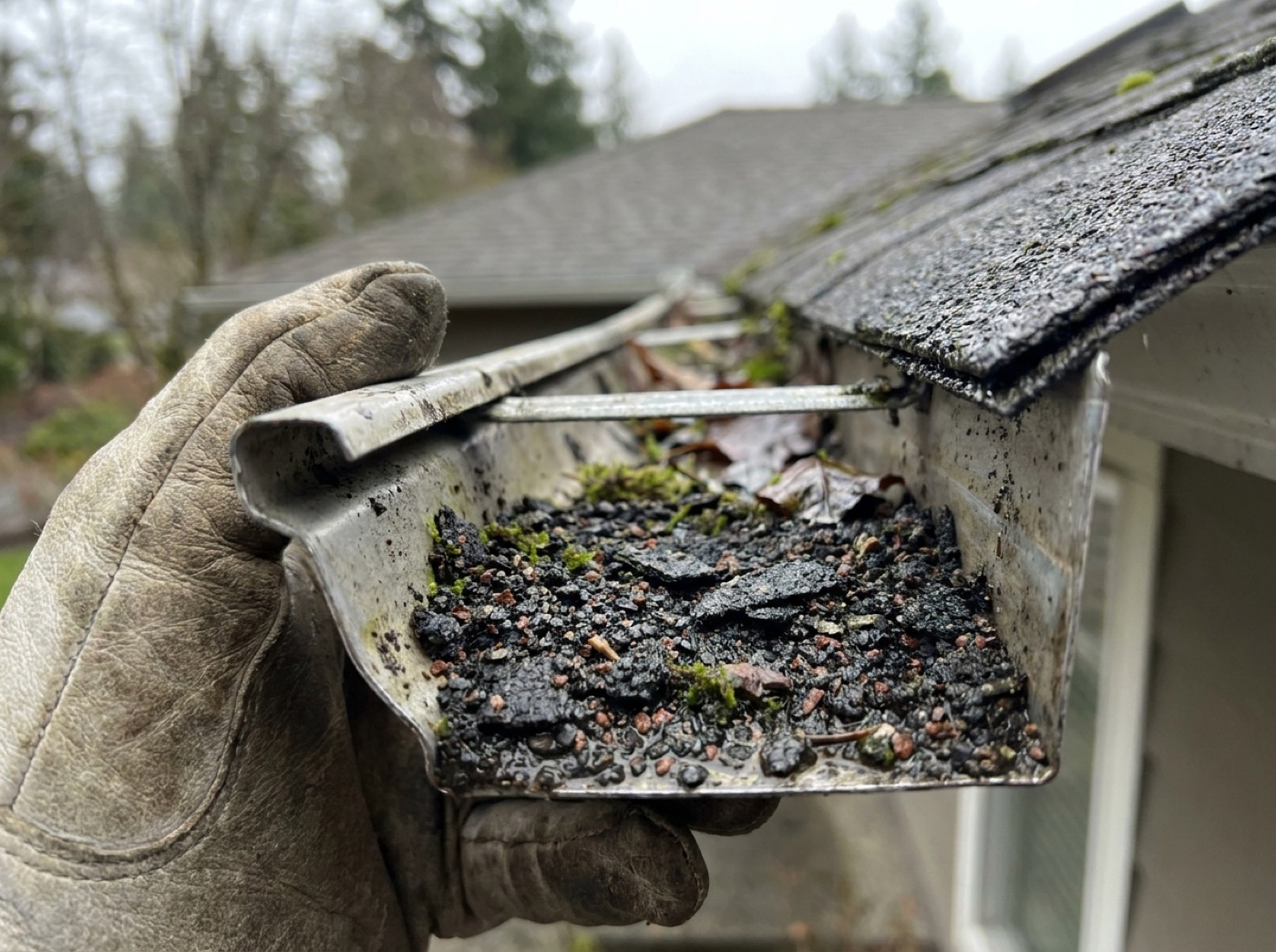
A blister forms when trapped moisture or manufacturing gas pockets inside the shingle expand under heat, pushing up a small dome that eventually pops. What is left is a crater, often with a slightly raised rim, and granules around the crater usually stay intact and undisturbed rather than displaced inward the way a hail bruise fractures the mat beneath the surface. Blisters have nothing to do with a storm; they are a heat and ventilation issue that would show up on a sunny July afternoon just as easily as after a hailstorm, and they tend to cluster on the same sun-exposed slope rather than scatter across the whole roof. Our companion piece on hail damage versus blistering goes deeper on telling the two apart at the shingle level.
2. Foot traffic and mechanical scuffs
Anyone who has walked a roof, an installer running a satellite line, a chimney sweep, a solar estimator, an old antenna crew, leaves granules scuffed loose along the path their boots took. That wear follows a route: it runs toward whatever fixture the work was for and tends to concentrate at turning points and footholds, not scatter evenly across the field. It is also usually confined to one area rather than spread across an entire slope, since nobody needed to walk the whole roof to service one vent stack.
3. Satellite and antenna mount damage
Beyond the footpath, the mount itself often leaves a ring of disturbed granules or small punctures where lag bolts or a mounting bracket penetrated the shingle. These marks sit in a tight circle around the fixture, at a height and spacing no hailstone would produce, and they usually predate any storm the homeowner is asking about by years. If a roof has ever had a satellite dish, even one removed long ago, expect a small zone like this near the old mounting location.
4. Manufacturing granule voids
Shingle manufacturing is not perfect, and it is normal for a small percentage of shingles to leave the factory with a light patch where the granule coating did not fully bond. These voids tend to repeat: the same relative position on multiple shingles from the same production run, which often means the same course or a course near it, rather than scattered at random across the whole roof. A single course with a faint, repeating bald spot in roughly the same place on each shingle is a manufacturing signature, not a storm signature.
5. Animal wear and plain old age
Squirrels, raccoons, and birds all leave claw marks, and squirrels in particular will chew at shingle edges and ridge caps, leaving torn, frayed damage concentrated near roof edges, tree-adjacent sections, and ridgelines rather than scattered across open field. Age does its own version of the same thing: granule loss that thins gradually and evenly across the whole roof, curling tab edges, and a generally worn, flattened look are simply a shingle nearing the end of its rated life, not evidence of a specific event. Uniform, roof-wide wear is the opposite of the scattered, slope-specific pattern real hail leaves.
Tree contact deserves its own mention, because it produces some of the most convincing false positives of the whole list. A branch that sways against a slope in every strong wind wears a track of scuffed granules and even small punctures over months or years, and that track sits directly under whatever limb caused it, not scattered across the field. Trim the branch and the wear stops; a fresh storm does not change the pattern, it only adds to a track that was already there. An inspector checking a claim will always look up at the overhanging canopy before deciding what a mark under a tree actually means.
04 / BOTH DIRECTIONSWhy the honest read protects homeowners either way
Storm-chaser crews that roll through a neighborhood after a big weather event have an incentive to call everything hail, because more damage found means more work sold and, if a claim gets filed, more money on the table. That overdiagnosis is not free. An insurance claim that mixes real bruises with blisters and foot traffic gets weaker, not stronger, because an adjuster who catches even one misidentified mark starts questioning the whole report. Our guide to storm-chaser red flags covers the sales tactics to watch for on top of the diagnosis itself.
The opposite mistake carries its own cost. A roof with genuine hail bruising can look almost normal at a glance, especially next to obvious impostors like a blister or a boot scuff that draw the eye. An inspector who dismisses everything as ordinary wear because a few marks turned out to be blisters can walk right past a real bruise a few feet away. Getting the call right in both directions, ruling out the impostors without ruling out real damage along with them, is the actual job, not a simplified yes-or-no answer.
It also matters for homeowners who are not thinking about insurance at all, just trying to decide whether the roof needs attention. A retiree comparing quotes after a hailstorm does not benefit from a contractor who calls every blister and boot scuff hail damage any more than they benefit from one who waves off a genuine bruise as harmless age. Either way, the decision that follows, filing a claim, paying for a repair out of pocket, or doing nothing, only makes sense if the diagnosis underneath it is accurate. That is the whole reason this guide exists as a standalone piece rather than a footnote on a claims page.
An honest inspection has to be willing to say no. If every mark on every roof gets called hail, the word stops meaning anything, on your roof and on the next one.
05 / THE REAL ANSWERHow a real inspection sorts it out
The randomness test in section two gets a homeowner most of the way there from a photo or a ground-level look, but confirming what is actually happening on the shingle mat still takes a trained hand and, often, a formal count. Inspectors frequently use a marked test square on each slope to count qualifying hits consistently rather than eyeballing the whole roof; our guide to hail test squares explains how that count works and what it does and does not prove on its own. Combined with the pattern read described above, a test square turns a subjective impression into a documented, repeatable finding.
Our free inspection walks every slope with both questions in mind: does this pattern scatter the way real hail scatters, and does the shingle itself show the fractured mat a bruise leaves behind. If what we find is blistering, foot traffic, or age, we say so, plainly, even when that means the honest answer is a repair instead of a storm claim, or no work at all. If it is real hail, we document it with photos and can meet your adjuster on site to walk the roof together. What we will not do is promise a claim outcome, no roofer honestly can, and every policy is different. Macomb County has recent history worth knowing about here: the severe weather of August 2023 was significant enough that the county was included in federal disaster declaration DR-4757, so plenty of roofs in the area do have a real event to check against. Our storm and insurance claims guide covers what happens after the inspection, from documentation to what an adjuster actually looks for.
If the inspection turns up a repair rather than a full claim, most hail-adjacent shingle work falls inside the general repair range of $350 to $3,200, with larger or more complex work running higher, the same published range on our honest pricing sheet. You can start either path, storm assessment or a straightforward repair, from the free inspection request, and the cost calculator is there if you want a ballpark before anyone visits.
- Blisters, foot traffic, satellite mounts, manufacturing voids, and age all leave marks that can look like hail at a glance.
- Real hail is randomly scattered within a slope, though one slope can take more hits than another depending on storm direction.
- Impostor damage usually follows something other than weather: a footpath, a fixture, a production course, a roof edge.
- Overcalling hail damage weakens real claims; undercalling it misses genuine damage. Both mistakes matter.
- A trained inspection combines the pattern read with a hands-on, often test-square, check of the shingle mat, and ours is free.
Questions we hear most
Start with the pattern. Real hail scatters at random across a slope with no regard for fixtures or footpaths. Marks that line up in a path, ring a satellite mount, or repeat in the same spot on every shingle in a course usually point to foot traffic, mechanical damage, or a manufacturing quirk instead. A trained inspection confirms it at the shingle level.
A blister is a crater from trapped heat or moisture, usually with a raised rim and the surrounding granules undisturbed. A hail bruise fractures the fiberglass mat beneath the surface and can displace granules inward around the impact. Blisters also tend to cluster on sun-exposed slopes rather than scatter across the whole roof.
No, and you should be wary of anyone who does. An honest inspection sometimes concludes that what looks like storm damage is actually blistering, foot traffic, or ordinary age, and we will tell you that plainly. If it is real hail damage, we document it and can meet your adjuster on site, but no contractor can promise a claim outcome.
- FEMA, disaster declaration DR-4757-MI, Michigan severe storms of August 2023 (Macomb County designated). fema.gov/disaster/4757
- Manufacturer technical and warranty literature for the major asphalt shingle lines: GAF (gaf.com), Owens Corning (owenscorning.com), and CertainTeed (certainteed.com).
- Insurance Institute for Business & Home Safety, roof research and the FORTIFIED Roof standard. ibhs.org
- National Roofing Contractors Association, technical guidance for steep-slope roof systems. nrca.net