
The March 2017 Windstorm: What It Taught Macomb Roofs
No lightning, little rain, just wind that started before breakfast and did not quit until after dark. The March 8, 2017 windstorm is still the event we reach for when a homeowner asks why late-winter wind scares roofers more than a summer thunderstorm. This is the field record.
Some storms announce themselves. The one that crossed southeast Michigan on March 8, 2017 barely qualified as a storm at all in the way most people use the word. There was no thunder and almost no rain. There was only wind, hour after hour of it, strong enough that by evening it had become one of the most talked-about weather events the region had seen in years. For roofers it became a teaching day, and nine years later we still cite it on inspections. This note is the retrospective: what the event actually was, why its timing in early March made it far harder on roofs than the same wind in July would have been, and what it should change about how you treat a late-winter forecast.
01 /What happened on March 8, 2017
The windstorm was a gradient wind event, which is weather shorthand for wind driven by the pressure difference between large systems rather than by a passing thunderstorm. A deep area of low pressure tracked near the Great Lakes, and the tight pressure gradient behind it dragged sustained wind and repeated strong gusts across lower Michigan for the better part of a day. The National Weather Service logged the peak gusts county by county, and those station observations, not anyone's memory of the day, should carry the numbers. The NWS Detroit event summary logs peak gusts near 68 mph at Detroit Metro.
The power grid told the other half of the story. Outage reporting from that week described tree and line damage across an enormous portion of the southeast Michigan utility map, on a scale newsrooms treated as historic: roughly one million utility customers lost power statewide, the largest combined outage event in Michigan history at the time. What matters for this record is not the exact count. It is that a single dry, sunny, thunderstorm-free day produced that much damage, because of when it happened as much as how hard it blew.
02 /Why late-winter wind is the cruelest wind
An asphalt shingle is a different material in March than it is in August. Cold asphalt is stiff and brittle, so a gust that a warm, pliable summer shingle would flex through can crease or fracture a cold one along the lift line. Worse, the factory sealant strip that bonds each shingle course to the one below is heat activated. It bonds in warm sun and it stays dormant in cold. Any tab that lost its seal during the winter, whether to an earlier wind event or simply to age, had no way to rebond before March 8. The storm did not have to break those bonds. Winter had already broken them, and the wind only had to finish the job.
Then there is duration. A severe thunderstorm gust front hits a roof for minutes. A gradient windstorm works it for hours, flexing every unsealed tab through thousands of load cycles in a single day. That is fatigue loading, the same mechanism that snaps a paperclip you bend back and forth, concentrated at the nail line of every compromised shingle. Roofs that rode out the morning were still being worked at dinnertime. We cover how rated wind speeds compare to what our gusts actually do in the shingle wind threshold record, but March 2017 is the local proof that the label on the bundle is only half the story.
03 /What it taught Macomb roofs
- Duration beats peak speed. The roofs that suffered most were not always under the highest gusts. They were the ones with unsealed tabs that got flexed all day long.
- Edges and rakes are the front line. Wind pressure concentrates at eaves, rakes, and ridges, so that is where cold, brittle shingles crease first and where we look first on every post-wind inspection.
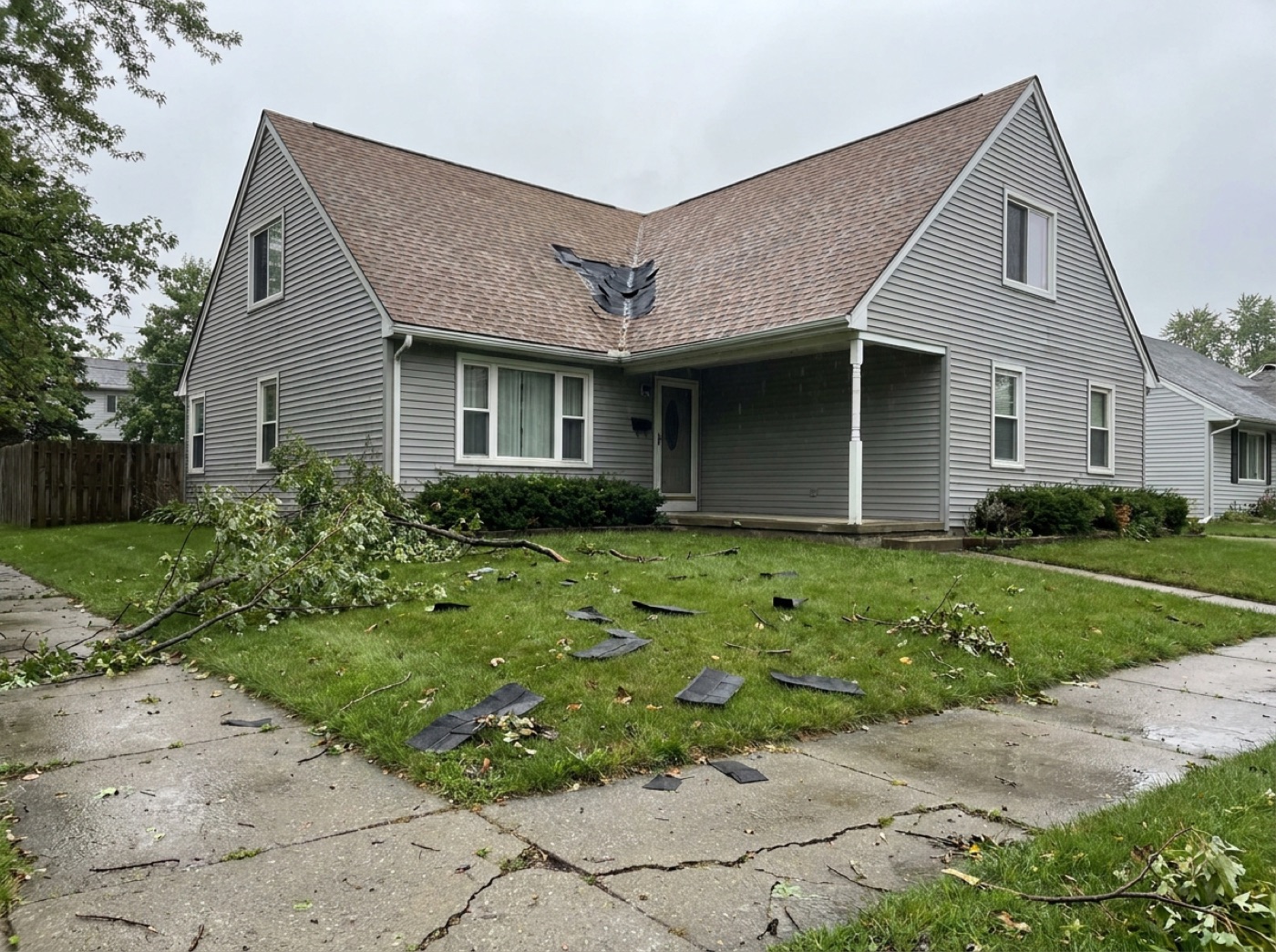
- The yard is not the evidence. Plenty of homes had no shingles on the lawn and still had creased tabs and broken seals overhead. From the driveway, a creased shingle looks like a fine shingle.
- A calm forecast is not a safe roof. The damage a March windstorm starts, the following winters finish. A roof that shrugged off 2017 with a few broken seals could be leaking several freeze-thaw seasons later.
Long-duration wind damage often surfaces weeks or months after the event, as creased tabs finish breaking and unsealed courses let wind-driven water past. If a wind event may have damaged your roof, a documented inspection can support an insurance claim, and we can meet your adjuster on site to walk what we found. No contractor can promise what a carrier will approve, and this note is general information, not legal or insurance advice.
The practical takeaway has not changed since 2017. After any serious wind event, get eyes on the roof, even if the yard is clean. We inspect roofs across Macomb County for free, at no cost or obligation, and we photograph what we find either way. Most wind-event fixes are repairs, not replacements, and repairs run $350 to $3,200, with larger or complex repairs able to run higher. You can put a rough number on your own roof in a minute with the cost calculator, read the deeper storm playbook on the storm damage service page, or study up first in the guides library. And if wind ever opens your roof while it is still blowing, we answer 24/7 for emergency tarping. The claims process itself lives in our storm damage and insurance claims guide.
- National Weather Service Detroit/Pontiac, March 8, 2017 high wind event summary: peak gusts near 68 mph at Detroit Metro, roughly one million Michigan utility customers without power. weather.gov/dtx: March 8, 2017 event