
What Wind Speed Lifts Shingles? Ratings vs Real Gusts
Every bundle of shingles ships with a wind rating, and every homeowner who calls us after a storm wants to know what that number really means. Here is the honest translation: what the rating classes actually promise, what southeast Michigan wind actually does, and why a shingle can fail well below the speed printed on its wrapper.
There is a number on the wrapper of every shingle sold in Macomb County, and most homeowners never see it until the wind makes it relevant. It is a laboratory rating, and it is true under laboratory conditions: a new shingle, nailed exactly to spec, with its factory sealant strip fully bonded to the course below. The wind over Sterling Heights and Shelby Township has never once agreed to laboratory conditions. This note translates the rating classes into plain English and sets them beside the gusts this region actually records, because the gap between the two is where roof damage lives.
01 /The rating classes, translated
Two test standards govern asphalt shingle wind resistance. ASTM D3161 is the older, blunter one: shingles go in front of a fan and are graded on whether their tabs lift at a given speed. ASTM D7158 is the newer standard used for most modern architectural shingles; it measures the strength of the sealant bond and calculates the wind speed the shingle should resist when properly installed. Both express their results as letter classes, and the letters, not the marketing copy, are the actual promise. See ASTM D3161 and D7158, the shingle wind-resistance test standards.
In plain English: an older three tab roof typically carries the lowest ratings on this ledger, often in the 60 to 70 mph neighborhood, while a modern architectural shingle sold today is usually rated Class G or Class H, meaning 120 to 150 mph on paper. Read the fine print, though, and every class carries the same two conditions. The shingle must be installed correctly, with the right nails in the right zone, and the sealant strip must be fully bonded. Miss either condition and the letter on the wrapper stops applying to the roof on your house.
02 /What southeast Michigan wind actually does
Now set those classes against the local record. The National Weather Service calls a thunderstorm severe when it produces a gust of 58 mph or more, because that is roughly where structural damage begins. Southeast Michigan logs those warnings every year. The stronger events go further: the March 2017 gradient windstorm raked the region for hours, the August 2023 storms damaged enough of Macomb County to earn federal disaster declaration FEMA DR-4757, and derecho type events have crossed lower Michigan more than once, a pattern we cover in our note on what derechos do to Michigan roofs. Specific peak gust figures belong to the station record, not to us. See the National Weather Service Detroit/Pontiac office records.
The uncomfortable arithmetic is on the last line. A single ordinary severe warned thunderstorm, 58 mph by definition, lands inside the rated range of a typical aging three tab roof. The area's worst events have run well past that, as the full ledger in our companion note on the strongest winds ever recorded around Macomb County shows. A Class H architectural roof holds a wide margin over almost everything in the local record. An old three tab roof holds almost none. A good share of those gusts arrive late in the summer, out of short downbursts rather than long frontal systems. The late summer severe season takes up what that back half of the year does to a roof here.
03 /Why shingles fail below the number on the label
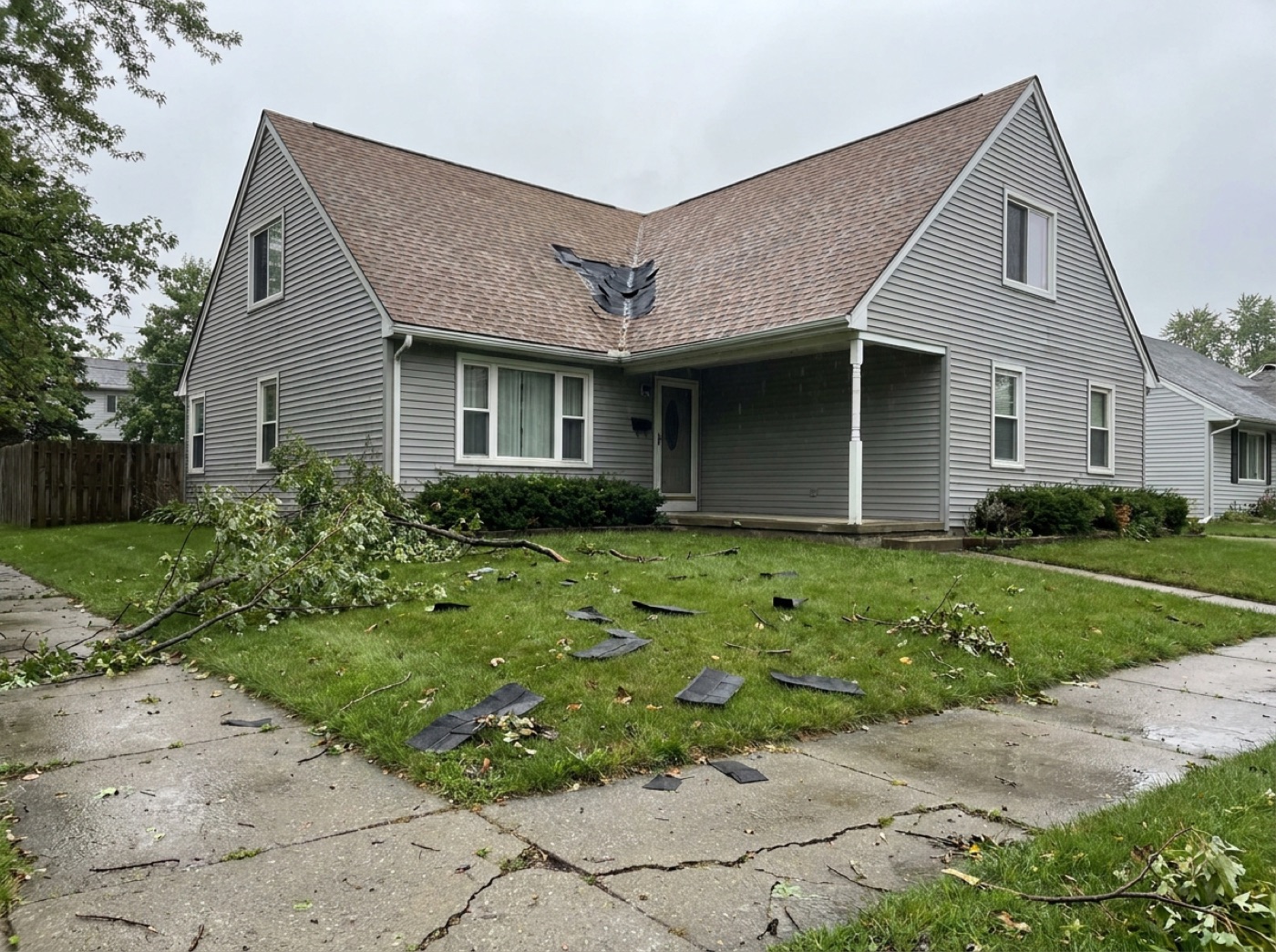
This is the part the wrapper does not say out loud. The rating describes a sealed system: wind resistance in an asphalt roof comes less from the nails than from the continuous adhesive bond gluing every course to the one beneath it. Anything that weakens that bond lowers the real failure speed, and Michigan supplies plenty. Age is the big one: fifteen summers of heat and fifteen winters of freeze and thaw leave the sealant brittle, so a roof rated to 90 mph when new may start surrendering tabs in a 50 mph gust. Cold is the second. Sealant bonds with heat, so shingles installed in late fall may not fully seal until spring, and a cold snap makes even bonded shingles brittle enough to crease where a warm shingle would flex.
Installation is the third. Nails driven too high, too few, or overdriven through the mat quietly void the rated class before the first storm arrives. The honest wind rating of any roof is not the letter it shipped with; it is the condition it is in today, and knowing that condition takes a trained eye on the sealant bonds and nail lines. It is also why building codes set a required design wind speed for the region rather than trusting wrapper ratings, a subject we unpack in our note on what wind speed Michigan roofs are actually built for.
A tab does not need to blow off to be wind damaged. If a gust folds it back and it settles into place, the fiberglass mat can be creased and the sealant bond broken, invisible from the driveway. That shingle will fail in a later, weaker wind, and by then the storm that actually caused the damage is harder to establish. If a documented wind event may have hit your roof, an insurance claim can be on the table, and the date of loss matters to your carrier. This is general information, not legal or insurance advice.
04 /What to do with these numbers
Use them as a screening test, not a verdict. If your roof is architectural shingle less than a decade old, the ratings say most Michigan wind should not trouble it. If it is a three tab roof past its first decade, the arithmetic above says the local wind record has probably already met or passed its real world rating, possibly several times. Either way, our inspections are free, no cost and no obligation, and you get photos of what we find. Most wind findings are repairs, not full replacements, and repairs run $350 to $3,200, with larger or complex repairs running higher. If you want the replacement math first, the 60 second cost calculator uses the same published ranges.
If a specific storm broke the seal, our storm damage and insurance claims guide walks the documentation process, and we can meet your adjuster on site to make sure what we photographed gets seen. We never promise what a carrier may approve; no honest contractor can. Start at the storm damage service page, browse the guides library if you want to study up first, and if water is coming in right now, we answer 24/7 for emergency tarping.
- ASTM D3161 and ASTM D7158, standard test methods and classifications for wind resistance of asphalt shingles.
- National Weather Service, severe thunderstorm criteria: damaging wind threshold of 58 mph
- National Weather Service, Detroit/Pontiac forecast office: southeast Michigan forecasts, warnings, and event records. weather.gov/dtx
- FEMA, Disaster DR-4757-MI, Michigan severe storms (August 2023)