
Tear Off vs Overlay Roofing in Michigan: How to Decide
One skips the dumpster and the tear off crew. The other tells you exactly what is holding your house together before it becomes your problem. Here is the honest ledger on overlaying versus tearing off an asphalt roof in Macomb County, including where Michigan simply takes the choice away from you.
Overlay only makes sense on a single existing layer of sound asphalt shingles, over a deck you have actually verified, when speed or budget genuinely matters. Tear off is the right call everywhere else, and it is the only legal call on any Macomb County roof that already carries two layers. A free inspection tells you which category your roof falls into before you sign anything.
Roof over it, or tear it off? The question comes up on almost every estimate for an asphalt roof that still has one intact layer underneath, because overlaying looks like the cheaper, faster answer. Sometimes it is. It can also bury deck rot under a second layer of shingles, load your rafters with extra weight through a full Michigan winter, and leave you with a roof that telegraphs every ridge and valley of the layer hiding beneath it. Michigan also has a hard limit on how many times you are legally allowed to do this, and a lot of older Macomb County ranches already hit that limit without the homeowner knowing it. This page runs the comparison straight, with an honest case for overlay instead of a strawman, so you can see exactly what it buys you and what it costs.
01 /What tear off and overlay actually are
A tear off removes every existing layer of roofing down to bare decking, then rebuilds from scratch: new underlayment, new ice and water shield at the eaves and valleys, new drip edge, and a fresh layer of shingles fastened directly to the deck. It is the industry default and the only method that lets a roofer actually see the plywood or plank decking your house depends on.
An overlay, sometimes called a roof over or a recover, leaves the existing shingle layer in place and installs a new layer of shingles directly on top of it, usually with a layer of new underlayment or a starter course to smooth the transition. No dumpster, no tear off labor, no exposed deck. It is faster and it is one of the few line items on a roof replacement quote that can genuinely come in below the full tear off price for the same house.
Neither term describes a single fixed product. A tear off can be a same-day job on a simple ranch or a multi-day project on a steep, cut-up roof with several valleys and penetrations. An overlay can be a straightforward single layer add-on, or, on a roof that already has an overlay from a previous owner, it can turn out to be illegal the moment a crew counts layers and finds two already there. That is one more reason the two options are not really interchangeable line items on a quote; they depend entirely on the roof already sitting under your shingles, not on preference alone.
02 /The cost comparison, honestly
In Macomb County, a typical asphalt shingle project, tear off or overlay, runs $9,000 to $18,000, and most homes land between $12,000 and $16,000. There is not a separate published price tier for overlay, because the job uses the same shingles, the same crew day rate, and often the same underlayment. What changes is what gets skipped: no dumpster rental, no disposal fee, and typically a full day or more of labor removing old material. That is why an overlay on a given house tends to price toward the lower end of the same range, not into a cheaper category of its own. The full breakdown for your specific roof lives on our pricing sheet.
Skipped disposal fees and a shorter labor day, both real, both modest against a $9,000 to $18,000 project. It is a discount within the same price range, not a different price range. Weigh that saving against everything the next three sections cover before you let it decide the job. Coming at that same discount from the other side, what a tear-off adds to a quote explains why removal is quoted inside one range rather than as a line you could strike.
| System | Typical Installed Range |
|---|---|
| Asphalt shingle replacement (most homes $12,000 to $16,000) | $9,000 to $18,000 |
| Metal replacement (standing seam, stone-coated steel) | $18,000 to $30,000 |
| Tile and slate replacement | $20,000 to $36,000 |
| Flat and commercial (TPO, EPDM, modified bitumen) | $9,000 to $16,000 |
| Roof repairs (larger or complex repairs can run higher) | $350 to $3,200 |
03 /Michigan's two layer limit
This is the part an estimate over the phone will never mention: Michigan follows Michigan Residential Code 2015, section R908.3.1 (roof re-cover limits), which caps how many layers of asphalt shingles a roof is allowed to carry at once. Once a roof already has two layers on it, overlay stops being a legal option and a tear off is required, full stop, regardless of what it costs.
This matters more in Macomb County than in newer subdivisions because so much of the housing stock is older. A ranch built in the 1960s or 1970s that had one overlay done decades ago, common practice at the time, is already sitting at the two layer limit. Its next roof has to be a tear off no matter what a homeowner would prefer to pay. Part of a free inspection is simply counting layers and checking your address against what code allows before we ever talk price.
04 /What overlay hides: deck rot, weight, and old contours
An overlay's biggest limitation is not legal, it is physical: it does not let anyone see the deck. Plywood or plank decking can be soft, delaminated, or rotted from a slow leak that never made it to your ceiling, and none of that is visible once a second layer of shingles goes down on top of it. A tear off exposes every inch of decking to the crew, so soft spots get replaced before new shingles ever touch them. An overlay simply covers whatever is under there, good or bad.
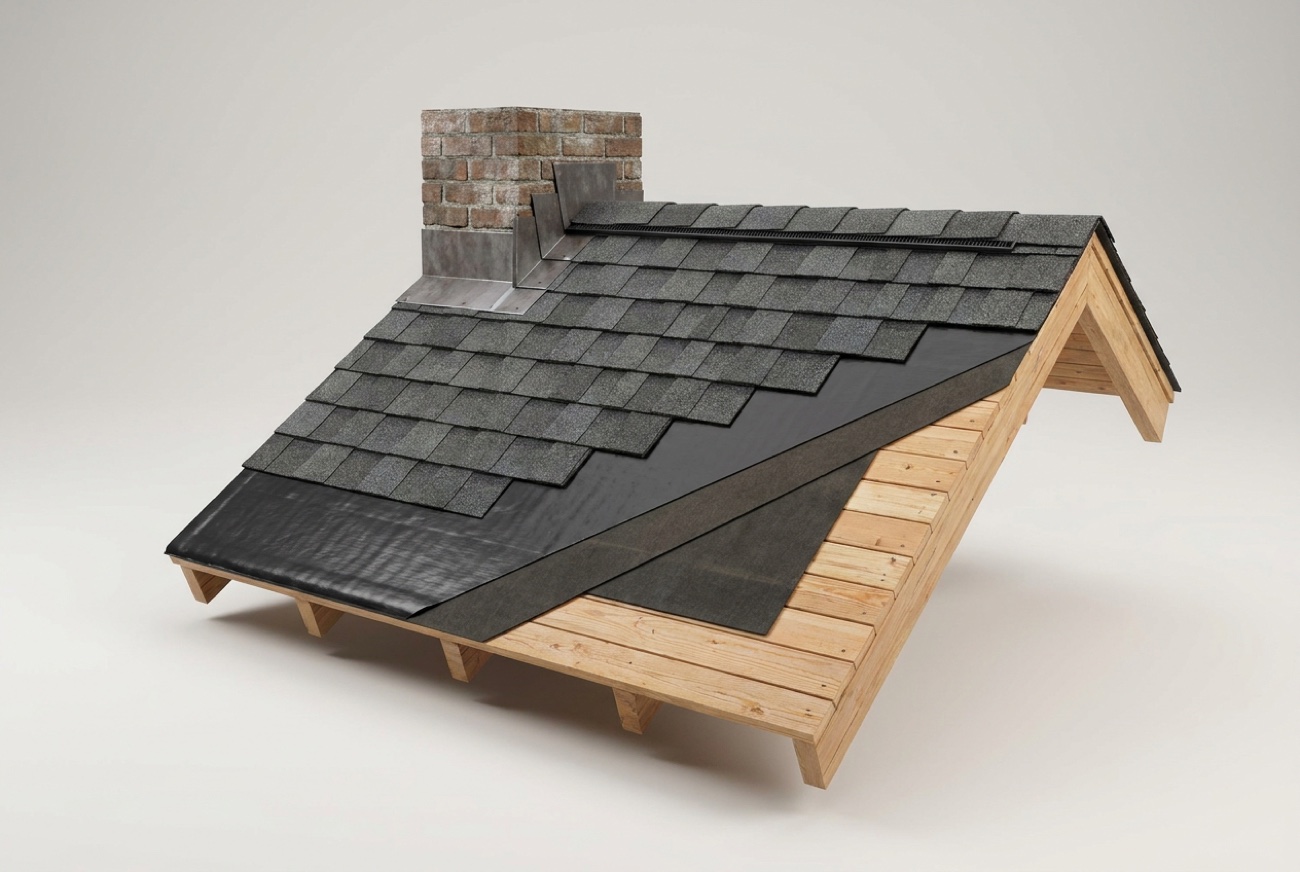
Weight is the second issue. Every layer of shingles adds roughly two to three pounds per square foot to a roof that was designed around a specific load, and Michigan roofs already carry real snow load most winters. Two layers of shingles is manageable on a structurally sound roof; it is one more variable working against an already stressed frame on an older or marginal one. And cosmetically, an overlay telegraphs: the ridges, valleys, and any curling or cupping in the old shingle layer show through the new one, especially as both layers age together, which is part of why overlaid roofs tend to look tired sooner than a fresh tear off.
05 /Michigan winters: how each performs
Both systems have to survive the same Macomb County winter, but they do not start from the same position. A tear off gets fresh ice and water shield installed at the eaves and in the valleys, the exact spots where ice dams form and force water backward under shingles. An overlay depends on whatever ice and water shield protection, if any, was installed under the original layer, which on an older roof may predate current practice or may not exist at all.
Ice dams form when attic heat escapes, melts snow, and that meltwater refreezes at the cold eaves, working backward under whatever roofing is there. A tear off is the only time that eave detail gets fully rebuilt to current standards. On an overlay, we check what protection already exists during a free inspection, but we cannot add ice and water shield without removing the layer on top of it.
Wind is the other factor. Macomb County was part of federal disaster DR-4757 after the August 2023 wind event, and wind driven shingle loss is one of the most common things we document on storm and insurance calls. An overlay's nailing pattern drives fasteners through an extra layer of material into the deck, which some manufacturers rate differently for wind resistance than a single layer installed straight to bare wood. Check the specific shingle's published wind rating for overlay applications before assuming it matches a tear off installation.
06 /Warranty, insurance, and resale
Shingle manufacturers write their strongest warranties around a single layer installed to spec on bare decking. Many warranties reduce coverage, add exclusions, or void entirely on an overlay installation, because the manufacturer cannot verify deck condition or the performance of whatever is underneath their product. Read the specific warranty language for any shingle you are quoted before treating overlay as a cost-free shortcut; the sticker price and the real cost of ownership are not always the same number.
On insurance, an overlay complicates a future storm claim. An adjuster evaluating hail or wind damage on a roof with two layers has to account for both when assessing what is storm damage versus pre-existing wear, and depreciation calculations can get more complicated with a layer of unknown age underneath. We photograph and document roof condition on every free inspection and can meet your adjuster on site to walk the same evidence, but a single, known layer is simply a cleaner file than two.
On resale, a home inspector will note an overlay, and some buyers or their lenders treat it as a flag worth asking about, particularly once a house is already at the two layer limit and its next roof is necessarily a full tear off. That is a cost the next owner inherits, priced into their offer or not.
None of that means an overlay is a defect to hide. Plenty of Macomb County homes carry a well documented single overlay with no issues, sold and resold without incident. The problem is not the overlay itself, it is an undocumented one: no record of how many layers exist, no record of deck condition before the new layer went down, and no way for a future buyer, adjuster, or roofer to know what they are actually working with until they open it up.
07 /When overlay is actually the right call
None of this makes overlay a bad choice everywhere. It is a reasonable option on a specific, narrow set of roofs, and pretending otherwise would be its own kind of dishonesty.
If every line on that ledger fits your house, an overlay can be a legitimate, code-compliant way to buy time and stay near the bottom of the $9,000 to $18,000 range. If even one line does not fit, especially the deck history line, a tear off is the safer spend even though nothing about the sticker price makes that obvious upfront.
08 /How to decide
Strip the decision down to three questions before any estimate gets signed. How many layers are already on your roof? A tear off is required past two, full stop. How long do you plan to stay in the house, and does the deck have any known history of leaks? A short horizon and a clean deck history favor overlay; a forever home or any leak history favors tear off every time.
- A tear off and an overlay share the same $9,000 to $18,000 asphalt price range; overlay tends to land toward the lower end.
- Michigan caps asphalt roofs at two layers; past that limit, tear off is the only legal option.
- An overlay hides deck condition completely. A tear off is the only way to actually see and repair what is underneath.
- Manufacturer warranties and future insurance claims are both cleaner on a single, known layer.
- A free inspection counts your existing layers and checks your deck before you decide anything: $0, no obligation.
If you want the fuller picture on what a full asphalt replacement covers line by line, our roof replacement service page walks through the process, and the cost calculator gives you a size-adjusted number for your own home in under a minute. Or skip the reading: the inspection is free either way, and we will tell you honestly whether your roof even qualifies for overlay before we ever discuss overlay pricing.
Questions we hear most
They share the same $9,000 to $18,000 asphalt price range, and an overlay tends to land toward the lower end because it skips disposal fees and tear off labor. It is a discount within that range, not a separate cheaper category, and Michigan law only allows it on a single existing layer over a sound deck.
Michigan follows a residential code provision that limits asphalt shingle roofs to two layers; past that, a tear off is required. Many older Macomb County homes already carry one prior overlay, which means their next roof has to be a full tear off regardless of preference. A free inspection confirms your exact layer count.
Yes. An overlay installs new shingles directly over the existing layer, so the decking underneath is never exposed or inspected. A tear off is the only method that lets a roofer see and repair soft spots, rot, or leak damage before new shingles go down. If your roof has any history of leaks, that difference alone usually favors tear off.