
JUMP TO A SECTION
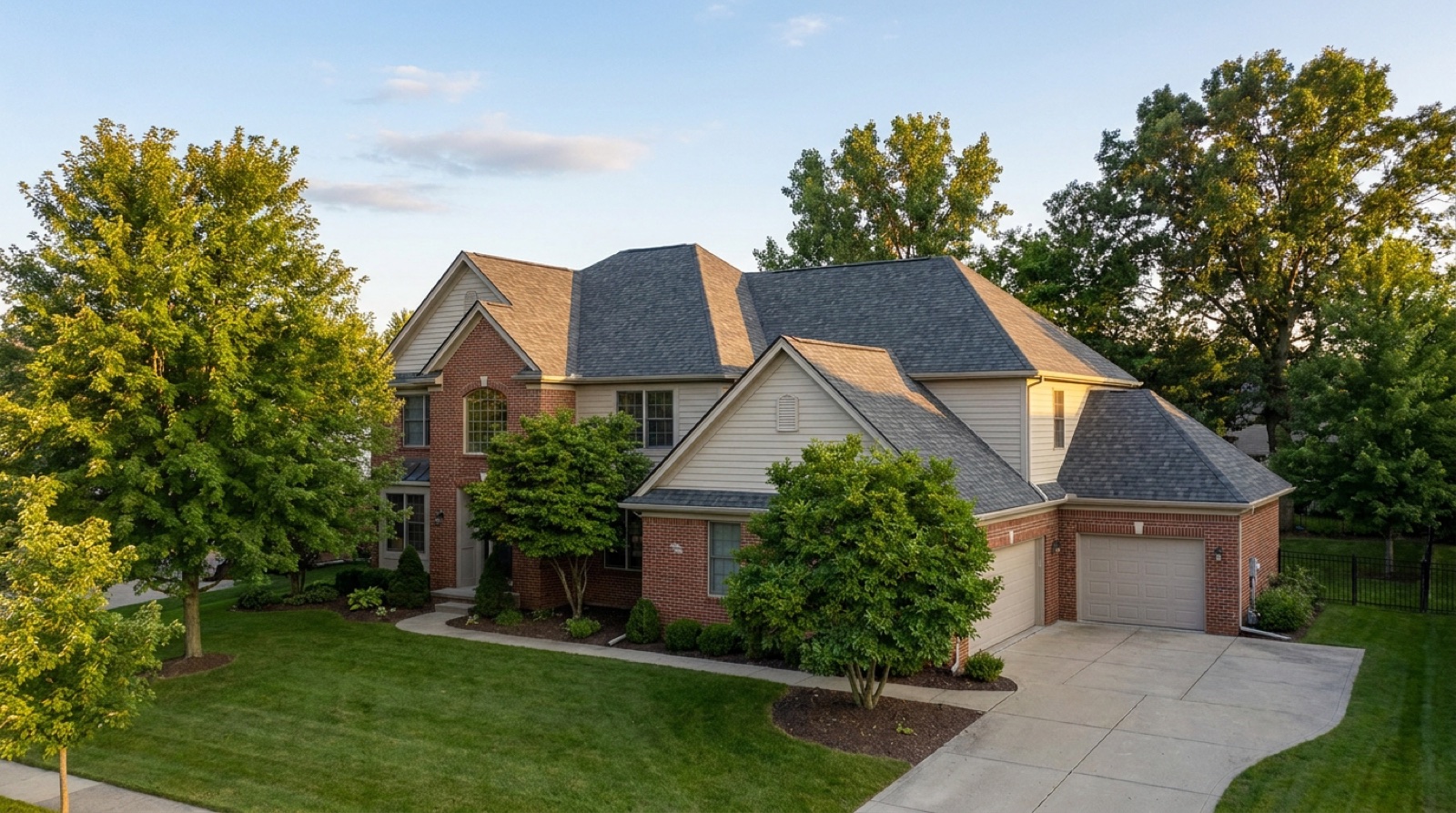
Drive any grid street in Sterling Heights, Warren, Roseville, or Clinton Township and the house you will see the most is a brick ranch built somewhere between the 1950s and the 1980s: one story, a long low roofline, and a hip or gable profile that sits close to the ground. That shape changes the roofing conversation. On a two-story colonial the roof is one element among several. On a ranch it is often the single largest visible surface on the house, which means the material you choose reads from the street more than it does on almost any other home style. This guide compares the four systems that make sense on a ranch, designer asphalt, metal shingles, standing seam, and stone coated steel, against Michigan weather and against the brick underneath them, using only the published price canon.
01 / THE SHORT ANSWERThere is no single best roof, only a best fit
For most brick ranch owners, a designer or luxury tier asphalt shingle is the practical answer: it delivers the deepest shadow lines and the closest look to shake or slate while staying inside the familiar asphalt range of $9,000 to $18,000 installed, usually toward the upper end. For owners planning to stay long term, or who want the ranch's low roofline to read as a true statement rather than a good shingle job, metal shingles or standing seam in the $18,000 to $30,000 range buy decades of service life and a cleaner, more architectural line. Stone coated steel sits in between on look and mostly at the metal price point, and it earns its keep on ranches with complex hip and valley geometry where lightweight, interlocking panels install cleanly.
spans the realistic range for a brick ranch roof, from a designer asphalt shingle at the low end to standing seam metal at the high end. Get a ballpark for your own roof in about 60 seconds with the instant estimator, or run it against your square footage in the cost calculator.
02 / THE SHAPEWhy the ranch roof is a different problem
Three things about the classic brick ranch change the roofing math compared to a taller, steeper house. First, the roofline is long and low, which means a shallow pitch is common and a much larger share of the visible house is roof rather than wall or window. A shingle color, profile, or shadow line that would disappear on a steep colonial gable reads clearly on a ranch from the sidewalk. Second, many ranches carry a hip roof, four sloped sides meeting at a ridge rather than two gable ends, which adds hip and valley length relative to the footprint and gives the roof more surface for the same square footage of house below it. Third, ranch attics are often shallow, sometimes barely walkable, which raises the stakes on ventilation. A starved, low-clearance attic traps heat against the deck in summer and lets warm air melt the underside of the snowpack in winter, which is exactly the recipe for an ice dam at the eaves.
None of that changes which material is legal or installable, every system in this guide can go on a ranch, but it does change which upgrades actually pay off. On a hip roof with more linear feet of ridge and hip flashing, the labor to detail a premium material scales up along with the material cost, so the gap between a basic and a premium roof narrows a little. And because a shallow attic makes ventilation harder to get right, the intake and exhaust plan deserves as much attention on a ranch as the shingle or panel choice sitting on top of it.
The August 2023 wind storms that led to federal disaster declaration DR-4757 across Macomb County are a useful real-world data point here. Hip roofs generally shed high wind better than gable roofs, because there is no flat gable end for wind to catch broadside, and homeowners who called us after that event with hip-roofed ranches were disproportionately dealing with granule loss and lifted tabs rather than structural damage. That is not a guarantee for any individual roof, wind damage depends on age, fastening, and exposure too, but it is one more reason the hip ranch is a forgiving shape to invest a premium material into.
The shallow attic and why ventilation is not optional
Ranch attics built in the 1950s through 1980s were rarely designed with today's ventilation standards in mind, and the low roof pitch that gives the ranch its profile also gives the attic very little vertical clearance to work with near the eaves, right where intake ventilation needs to happen. When intake is starved, exhaust at the ridge cannot pull air through the space properly, and the deck runs warmer than it should in both directions: hotter in summer, which shortens shingle life from underneath, and warm enough in winter to melt the base of the snowpack and start an ice dam at the cold eaves. Whichever material you choose for the surface, ask your contractor to walk the attic and describe the actual intake and exhaust plan for your specific roof, not a generic answer. On a ranch, that conversation matters as much as the shingle brand.
03 / DESIGNER ASPHALTDesigner and luxury asphalt on a ranch
Above the architectural shingle that most Macomb County homes wear sits a designer or luxury tier: heavier laminates with deeper, more irregular shadow lines built to mimic hand-split cedar shake or natural slate. On a ranch, that extra dimension is doing real work. A flat, uniform shingle on a long low roofline can read as a plain gray lid over the brick. A designer profile with real shadow depth breaks that flatness up and gives the roof texture from the street, which is often the single cheapest upgrade available for curb appeal on this house style. Our full luxury asphalt shingles guide covers the profiles and manufacturers in more depth.
The price stays inside the familiar asphalt canon of $9,000 to $18,000 installed, though a designer shingle typically lands toward the upper half of that band rather than the middle, and a hip roof's extra ridge and hip length adds a little more premium capping material than a simple gable. The installation crew, fasteners, tear-off, and underlayment are the same trade most Michigan roofers already run every week, which keeps labor familiar and scheduling straightforward compared to a specialty metal crew. For an owner who wants the biggest visual step up for the smallest jump in complexity, designer asphalt is usually the answer.
Which designer profile actually suits a ranch
Not every designer line reads well on a long, low roofline. A shake-profile designer shingle, with its irregular, chunky shadow line, tends to suit the horizontal, ground-hugging feel of a ranch better than a slate-profile shingle, which was originally designed to mimic the tight, uniform coursing of a steep, formal roof shape. That is a generalization rather than a rule, and it is worth seeing both in person on a similar home before deciding, but if you are choosing blind between two designer catalogs, the shake profile is usually the safer starting point on this house style.
Where designer asphalt falls short on a ranch
It is still asphalt. Service life, while longer than a basic shingle, is still shorter than metal, and granule loss, algae staining, and wind-lifted tabs remain the long-term maintenance items every asphalt roof eventually deals with. On a roof that is a huge share of the house's visible surface, some owners decide those long-term maintenance realities are worth paying to avoid altogether, which is where metal enters the conversation.
04 / METALMetal shingles and standing seam on a ranch
Metal roofing on a brick ranch splits into two distinct looks. Metal shingle or shake panels are stamped to mimic the same shake and slate profiles as designer asphalt, but in steel or aluminum, so from the sidewalk a metal shingle roof can look similar to its asphalt counterpart while behind the scenes it is a fundamentally more durable system. Standing seam is the other look entirely: long, clean vertical panels with raised seams and no shingle pattern at all, a more overtly modern, architectural statement that reads as a deliberate design choice rather than a shingle upgrade. Both sit in the canon metal range of $18,000 to $30,000 installed, roughly double the asphalt band, because the panels, fasteners, and specialized labor all cost more per square.
On a ranch specifically, metal has two practical advantages worth naming. The low, long roofline means a passerby sees a large, unbroken expanse of whatever material is up there, and standing seam's clean lines can make that expanse look intentional and high end rather than simply large. And metal's typical service life runs well beyond two or three asphalt roofs, which matters more on a house where the roof is such a dominant visual and financial share of the exterior. Whether that math clears for you depends heavily on how long you plan to stay in the house, which our metal vs asphalt comparison and the deeper metal shingle roofs in Michigan guide both walk through in detail.
A ranch roof is not a small piece of the house you can quietly upgrade later. It is most of what the street sees, which is exactly why the material decision deserves more time than the paint color does.
The tradeoff is upfront cost and, for standing seam in particular, a more modern look that some owners feel clashes with a traditional brick ranch rather than complementing it. That is a taste call, not a performance one, and it is worth looking at photos of standing seam on similar homes in your neighborhood before committing, since the look reads very differently in person than in a brochure.
05 / STONE COATED STEELStone coated steel: the middle path
Stone coated steel panels are steel roofing with a granule-coated stone finish bonded to the surface, built to mimic shingle, shake, or tile profiles while carrying steel's strength and weight underneath. It prices inside the same canon metal range of $18,000 to $30,000 as shingle-profile and standing seam metal, generally toward the lower to middle part of that band, and it installs as large interlocking panels rather than individual shingles, which can move faster on a roof with the hip and valley geometry common to ranches.
The stone coating is what makes it a genuine middle path visually: from the sidewalk a stone coated shake or shingle profile can look closer to a textured shingle roof than to bare metal, while the panel underneath brings metal's wind resistance and long service life. For a ranch owner who wants metal's durability but is not sold on the more overtly modern standing seam look, stone coated steel is usually the profile worth getting quoted alongside a designer asphalt bid, so the two are compared on the same roof rather than in the abstract.
There is a practical installation upside on a hip roof too. Because stone coated panels interlock in larger units than individual shingles, a crew can move across a cut-up hip and valley roofline with fewer individual pieces to fasten and flash at each transition. That does not necessarily make the job cheaper, the panel and labor rates already reflect that efficiency, but it does mean fewer field seams overall on a roof shape that has more hips and valleys than a simple gable to begin with, which some owners view as fewer long-term places for a leak to start.
06 / THE PALETTEMatching the roof to the brick
Because the roof and the brick are the two dominant materials on a ranch's exterior, with less siding, trim, or upper-story wall to visually separate them, color coordination matters more here than on most house styles. A few general principles hold across the material choices above, whether you land on asphalt, metal shingle, standing seam, or stone coated steel.
- Warm red and orange-toned brick common on 1950s to 1970s Macomb County ranches generally reads best against charcoal, weathered wood, or deep brown roof tones rather than cool blacks or blues, which can fight the brick's warmth.
- Lighter tan, buff, or painted brick gives more flexibility and can carry a wider range of roof tones, including cooler grays, without clashing.
- Standing seam and stone coated steel both come in a narrower factory color range than asphalt, so if a specific shade matters to you, check the manufacturer's actual color chart before you fall in love with a photo of someone else's house.
- Whatever material you choose, ask to see a full-size sample against your own brick in daylight rather than judging from a small chip or a screen. Undertones that look neutral indoors can shift noticeably outside.
07 / THE VERDICTChoosing by homeowner type, not by one winner
Rather than naming a single best roof, it is more honest to sort by what kind of owner you are, because each material above is the right answer for a real, common situation.
| IF YOU ARE... | CONSIDER | WHY |
|---|---|---|
| Planning to sell within 5 to 10 years | Designer asphalt$9,000 to $18,000 | Biggest visible upgrade per dollar spent, familiar to appraisers and buyers |
| Staying long term in the house | Metal shingle or standing seam$18,000 to $30,000 | Longest service life spreads the cost over the most years of protection |
| Working with a complex hip and valley roof | Stone coated steel$18,000 to $30,000 | Large interlocking panels suit cut-up geometry, metal durability included |
| Wanting a bold, modern statement | Standing seam$18,000 to $30,000 | Clean vertical lines make the most of a long, unbroken roofline |
Every one of those paths still narrows to the same next step: someone needs to actually measure your roof, count its hips and valleys, and check the attic ventilation before any number stops being a range and becomes a quote. Our inspection covers all of that at $0 with no obligation, and it is the same visit whether you are leaning asphalt or metal when you call.
Most homeowners do not pay for a roof from savings. As an illustration only, a $13,500 project financed over a 10 year term at 9.9% APR works out to about $178 per month. That example is not an offer of credit; financing is subject to approval, and your actual rate, term, and payment depend on the lender and your credit profile.
If you want to see the material tradeoffs from the buyer's side rather than the builder's side, our metal roof colors for a brick ranch guide goes deeper on the palette question, and the roofing services hub lists every system we install with its own price detail.
- There is no single best roof for a brick ranch, only a best fit: designer asphalt for value and curb appeal, metal for longevity, stone coated steel for complex hip roofs, standing seam for a modern statement.
- The ranch's long, low roofline makes it a larger share of the house's visible exterior than on most home styles, which raises the stakes on both shadow line and color.
- Designer and luxury asphalt stay inside the canon $9,000 to $18,000 range, usually toward the upper end; metal systems run $18,000 to $30,000.
- Shallow ranch attics raise the stakes on ventilation regardless of material choice, since a starved attic drives ice dams and early wear from underneath.
- The exact number for your roof needs an inspection, and ours is $0 with no obligation.
Questions we hear most
There is no single best answer. Designer or luxury asphalt shingles, running $9,000 to $18,000 installed, give the biggest curb appeal upgrade for the money and suit owners who may sell within a decade. Metal shingles, standing seam, or stone coated steel, running $18,000 to $30,000, suit owners staying long term or dealing with a complex hip roof, since the material lasts well beyond two or three asphalt roofs.
Usually somewhat more, because a hip roof has more linear feet of ridge and hip flashing to detail relative to its footprint than a simple gable roof. The difference is one of several factors, alongside total square footage, pitch, layers, and decking condition, that a free inspection prices exactly rather than estimating from the street.
It should coordinate rather than match exactly. Warm-toned red or orange brick generally pairs well with charcoal, weathered wood, or deep brown roof tones, while lighter tan or painted brick allows a wider range including cooler grays. Always check a full-size sample against your actual brick in daylight before deciding, since small chips and photos can be misleading.
- FEMA, disaster declaration DR-4757-MI, Michigan severe storms of August 2023 (Macomb County designated). fema.gov/disaster/4757
- Manufacturer technical and warranty literature for the major asphalt shingle lines: GAF (gaf.com), Owens Corning (owenscorning.com), and CertainTeed (certainteed.com).