
JUMP TO A SECTION
A two-story colonial hides most of its roof behind a steep pitch and a tall facade. A low-slung Macomb County ranch does the opposite: the roof plane sits close to the ground, spans nearly the full width of the house, and is often the single largest surface a passerby actually sees. Pair that with the red, orange, and blond brick that went up on thousands of postwar ranches across Sterling Heights, Warren, and Roseville, and the roof color stops being a minor finish decision and becomes one of the two or three biggest visual choices on the house. This guide walks through which metal panel colors actually work with that brick, why a black roof is not automatically a mistake or automatically a win, and how heat and fade behave differently by color and finish.
01 / THE RANCH FACTORWhy a ranch roof reads differently than a two-story roof
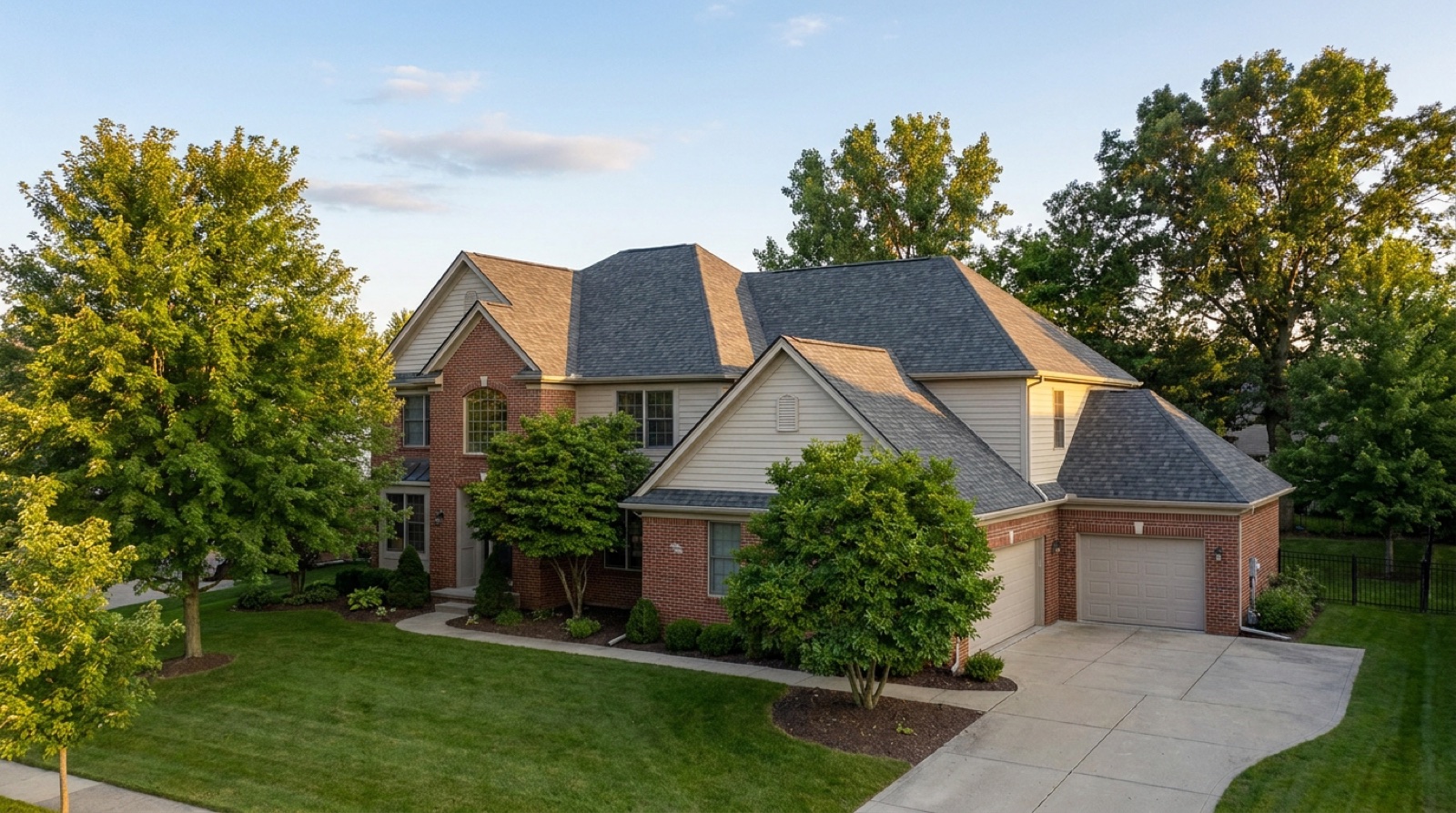
On a ranch, the roof and the brick are doing a duet, not a solo. A steep gable roof on a colonial or a Cape Cod can carry a color that clashes slightly with the brick below and still read fine, because your eye takes in the brick, the shutters, the door, and the roof as separate notes in a longer composition. A ranch compresses that composition. The eaves sit low, the roof pitch is shallow enough that you see the plane of it rather than just its edge, and the brick band below it runs the full length of the facade with almost nothing else competing for attention. Whatever color goes on that roof is going to sit next to that brick in nearly every photograph, every drive-by, and every listing photo for as long as the roof is up there.
That is not a reason to play it safe with beige and call it done. It is a reason to actually look at your brick before you look at a swatch book. Postwar Macomb County brick runs in a real range: warm red-orange common brick, a more muted brick-red, and the blond or tan brick that shows up on a lot of 1950s and 1960s ranches in the county. Each of those undertones pulls a different metal color toward looking sharp or looking off, which is the whole subject of the next section.
There is also a scale question specific to ranches that a lot of color guides skip. A steep roof on a two-story home is seen mostly at an angle, foreshortened by perspective as you walk or drive past. A ranch roof's shallow pitch means you often see it closer to its true, full plane, especially from across the street or from a neighbor's yard. That means small color and finish differences that would disappear on a steep roof stay visible on a ranch: a slightly glossier finish catches more direct reflection, a slightly warmer charcoal reads more brown than gray in afternoon light, and panel seam lines and rib spacing become part of the visual texture rather than a detail you only notice up close. None of this is a reason for anxiety over the decision. It is a reason to look at samples outdoors, in real light, rather than trusting a printed color chip alone.
installed for a typical Macomb County home, against $9,000 to $18,000 for asphalt. Color choice does not change the price tier; panel profile, finish system, and roof size do. Get a ballpark on your own roof with the instant estimator.
02 / THE PAIRINGSColors that actually work with brick ranch facades
There is no single correct roof color for a brick house, but there are combinations that consistently photograph well and combinations that fight each other. The reliable performers fall into a few families.
Charcoal and dark bronze
A dark charcoal or bronze panel is close to a universal answer against Macomb County brick, whether the brick leans red-orange or blond. Charcoal reads as neutral rather than colored, so it does not compete with the brick's undertone the way a strongly colored panel can. Bronze goes a step further and pulls warmth out of red and orange brick, echoing the brick's tone instead of contrasting with it. Both colors are common enough in residential metal lines that finding a good match rarely requires special ordering.
Forest and hunter green
A deep green reads as a classic, almost traditional choice against red and orange brick specifically, the same pairing that has shown up on brick homes for generations in other trim materials. Against blond or tan brick, green can work as well but tends to look more deliberate and less automatic, so it is worth sampling before committing. Steer away from brighter or more saturated greens, which read as more of a statement than most ranch facades are asking for.
Matte black
Matte black is its own category and gets a full section below, because it behaves differently from the other dark options and deserves an honest pros-and-cons treatment rather than a quick recommendation.
Colors that tend to fight the brick
Bright or true red panels next to red-orange brick usually create a color clash rather than a match, because the two reds rarely sit on the same undertone and the eye reads the mismatch instantly. Very light or white panels can also struggle on a ranch specifically, since a pale roof over a dark brick base can make the roof look disconnected from the house rather than integrated with it, though this depends heavily on trim and gutter color and is worth sampling rather than ruling out outright.
| BRICK TONE | COLORS THAT TEND TO WORK | COLORS WORTH SAMPLING CAREFULLY |
|---|---|---|
| Red-orange common brick | Charcoal, dark bronze, forest or hunter green | Bright red, true white |
| Muted brick-red | Charcoal, bronze, matte black | Light gray, very saturated colors |
| Blond or tan ranch brick | Matte black, charcoal, dark bronze | Green, light or white panels |
Treat that table as a starting shortlist, not a final answer. Brick color varies within each of those categories from house to house, and the mortar color, weathering, and any painted trim already on the home all shift how a given panel color reads against your specific facade.
03 / THE BLACK QUESTIONIs a black metal roof right for a brick ranch
Black is the color homeowners ask about most, and it deserves a straight answer instead of a sales pitch either direction.
The case for black
A matte black panel is dramatic in a way that flatters a lot of brick colors, especially blond and tan brick, where the contrast makes both the roof and the brick look more deliberate rather than washed out. Black also pairs cleanly with black or dark bronze gutters, downspouts, and window trim, so if you are already committed to a dark trim package, black metal tends to complete rather than complicate that look. It photographs well and tends to be the color homeowners describe as giving the house a more modern, upgraded feel.
The case against black, or at least the tradeoffs
Black absorbs more solar heat than a lighter or reflective panel, which the next section covers in more detail, and on a low-slope ranch that heat gain is closer to the living space than it would be on a steep two-story roof with more attic volume to buffer it. Black also shows dust, pollen, and water spotting more visibly than a mid-tone gray or bronze, simply because contrast makes any surface debris more obvious. Neither of these is a reason to avoid black outright; they are reasons to ask about reflective pigment technology and finish quality, covered in the next section, before you commit to it.
The honest summary: black is a legitimate, popular choice on brick ranches and not a mistake by default, but it is a choice with real tradeoffs rather than a universally safe one the way charcoal or bronze tends to be. If you are drawn to it, ask to see it on a sample panel in daylight against your actual brick before you sign anything.
Black vs charcoal: a closer look
Homeowners often use "black" and "charcoal" almost interchangeably when they are actually describing two different decisions. True matte black is a high-contrast, near-zero-undertone color that reads as a bold statement against any brick. Charcoal sits a step lighter and usually carries a faint warm or cool undertone depending on the manufacturer's formulation, which lets it blend rather than contrast with brick, trim, and shingled neighbors on the same street. If you like the idea of black but want something slightly less dramatic, ask to see a dark charcoal sample next to a true black sample on the same day. The difference is more visible outdoors than it looks on two adjacent paint chips.
04 / HEAT AND FADELight vs dark: heat and fade in real terms
Color is not only an appearance decision on a metal roof. It changes how the panel behaves in the sun over the decades you will own it.
Heat behavior
Darker colors absorb more solar radiation than lighter colors, which is basic physics that applies to any roofing material, metal included. Many metal panel lines now use reflective, cool-roof pigment technology specifically to reduce how much of that absorbed heat radiates into the attic below, even in darker colors, though the effect varies by manufacturer and pigment formulation and should be confirmed with the specific product you are considering rather than assumed. What does not change with pigment technology is that a well-insulated, properly ventilated attic assembly is doing most of the real work of keeping that heat out of your living space, regardless of the panel color sitting on top of it.
Fade expectations by finish type
How well a color holds up over time depends more on the paint finish system than on the color itself. Premium resin-based finishes are formulated to resist chalking and fading far longer than value-tier finishes, and darker, more saturated colors tend to show fade more visibly than mid-tone grays simply because any shift is more noticeable against a strong original color. If long-term color retention matters to you, especially on a bold color choice, ask about the specific finish system on the panel you are considering, not just the color name. Our PVDF vs SMP finish guide walks through the two dominant finish systems and how that choice interacts with color longevity in more depth.
The color you pick off a small swatch and the color that ends up on your roof are related but not identical. Panel finish, gloss level, and sunlight all shift how a color reads at full scale.
One more honest point on maintenance: color does not change how a metal roof is cared for, but it does change how visible dirt, pollen, and streaking are between cleanings. Our metal roof maintenance checklist covers the seasonal routine that keeps any color looking its best.
Gloss level matters as much as hue
Two panels in the exact same color name can look noticeably different depending on gloss level. A higher-gloss finish reflects more direct sunlight and can wash out a color's depth at certain times of day, while a low-gloss or matte finish tends to hold a color's true tone more consistently across changing light. Matte finishes have also become the more common choice on residential metal specifically because they read as less reflective and less commercial against a brick facade, though a higher-gloss option is not wrong if that is the look you actually want. Ask what gloss level a sample panel is before you judge the color from it, since a matte and gloss version of the same named color can look like two different colors side by side.
05 / BEFORE YOU COMMITAlways sample the color on-site
Every recommendation above is a starting point, not a substitute for standing in your own driveway with an actual panel sample. Metal roofing colors shift noticeably depending on the light: a charcoal that looks nearly black under a showroom light can read distinctly gray at 4pm against your specific brick, and a bronze that looks warm on a small chip can look muddier or brighter at full roof scale. Michigan's overcast winter light and bright summer light also show the same color differently, so if you have a strong preference, it is worth looking at the sample on more than one type of day if your timeline allows it.
The other variable worth checking on-site is how the roof color interacts with everything else already on the house: brick tone, trim color, gutter color, garage door, and shutters. A color that is technically a good brick pairing can still clash with a trim color you are not planning to change, so bring the whole house into the decision, not just the brick sample. This is exactly the kind of detail a free inspection conversation is built for, alongside the structural and pricing side of the project.
If you are also weighing whether metal is the right system at all before you get to color, our metal vs asphalt comparison covers the broader tradeoff, and our metal shingle roofing guide covers a profile option that reads more traditional than standing seam if that fits your ranch's style better. And if brick pairing questions extend beyond metal to which roofing system suits a ranch shape best overall, our best roof for a brick ranch guide covers that broader decision. Whichever direction you lean, the instant estimator and the cost calculator both run on the same published price ranges as this page, and a free inspection is the place to actually hold a sample panel against your own brick.
- A ranch puts more roof in view than a two-story house, so the color decision carries more visual weight against the brick below it.
- Charcoal and dark bronze are the most reliably safe pairings against red-orange and blond Macomb County brick; forest green is a classic pairing against red-orange brick specifically.
- Black is a legitimate, popular choice with real tradeoffs: more visible heat gain and surface debris, not a mistake by default.
- Finish system (PVDF vs SMP) affects long-term fade and chalk resistance at least as much as the color itself.
- Always sample the actual panel against your actual brick in more than one light before committing; small swatches and full roof scale read differently.
- Metal runs $18,000 to $30,000 installed in Macomb County regardless of color; a free inspection is where you hold a sample against your house.
Questions we hear most
There is no single best color, but charcoal and dark bronze are the most reliably safe pairings against both red-orange and blond Macomb County brick, because they read as neutral rather than competing with the brick's undertone. Forest green is a classic pairing specifically against red-orange brick. The right choice still depends on your specific brick tone and trim, which is why sampling a panel on-site matters more than picking from a small swatch.
It can be. Black tends to look dramatic and deliberate against blond or tan brick and pairs cleanly with dark trim and gutters, but it absorbs more heat than lighter colors and shows dust and pollen more visibly. It is a legitimate choice with real tradeoffs rather than a universally safe one, so ask about reflective pigment technology and finish quality before committing.
Generally no. Metal roofing in Macomb County runs $18,000 to $30,000 installed, and that range is driven mainly by panel profile, finish system, and roof size, not by which standard color you choose. Custom or specialty colors outside a manufacturer's standard line can occasionally carry a premium, which is worth confirming with your specific system during a free inspection.
- FEMA, disaster declaration DR-4757-MI, Michigan severe storms of August 2023 (Macomb County designated). fema.gov/disaster/4757
- Manufacturer technical and warranty literature for the major asphalt shingle lines: GAF (gaf.com), Owens Corning (owenscorning.com), and CertainTeed (certainteed.com).
- Metal Construction Association, technical resources for metal roof systems. metalconstruction.org