
JUMP TO A SECTION
Ask ten homeowners to picture a metal roof and most of them will describe long vertical panels running from ridge to eave. That is one branch of the metal family, but it is not the only one, and for a lot of Macomb County houses it is not the right branch. Metal shingles are stamped steel or aluminum panels formed and painted to read as cedar shake, slate, or clay tile from the curb, then locked together on all four sides so the roof behaves like a single interlocked skin rather than a field of individual pieces. This guide walks through how that system is put together, which homes and neighborhoods it suits, how it holds up against Michigan wind and snow, and where it lands in the metal price canon we publish on our honest pricing sheet.
01 / THE SHORT ANSWERWhat a metal shingle roof costs and who it is for
Metal shingle roofs sit inside the same canon range as every other metal system in Macomb County: $18,000 to $30,000 installed for a typical single family home. The finished job includes tear-off of the old roof, disposal, underlayment and ice barrier, flashing, ventilation, the interlocking shingle panels themselves, and labor. Metal shingles are usually the right call for an owner who wants the durability and longevity of the metal category but wants a roofline that reads as a traditional shingle or shake roof rather than a bold row of vertical panels.
is the full metal canon in Macomb County, and metal shingle systems price within it the same as standing seam and stone coated steel. Your exact number depends on roof size, complexity, and panel finish. Run a quick ballpark with the instant estimator.
If you have not settled on metal at all yet, our guide to the four residential metal families is the right place to start, since it compares metal shingles against standing seam, exposed fastener panels, and stone coated steel side by side. This page goes deep on the shingle branch specifically.
02 / THE CONSTRUCTIONHow a metal shingle roof is built
A metal shingle is a stamped panel, usually steel or aluminum, formed under pressure into a texture and shape that mimics a natural material and finished with a painted or granule-coated surface. Unlike a standing seam panel that runs the full length of a roof slope, a metal shingle is a discrete unit, closer in size to a section of shake or a course of tile, that ships as part of a system meant to be assembled course by course across the deck.
Interlocking on all four sides
The detail that separates a metal shingle system from an exposed fastener panel is how the pieces attach to the deck and to each other. Each shingle locks into its neighbors on all four edges, so the fasteners that hold it down are concealed under the course above rather than driven through the painted face. That interlock does two jobs at once: it hides every fastener from weather and UV exposure, and it means wind has to overcome the combined grip of an entire interlocked field rather than lifting one exposed screw at a time. Our guide to exposed fastener failures covers what happens when a system relies on face-driven screws instead.
Weight and substrate
Stamped steel and aluminum shingles are light compared to natural slate or clay tile, which means most homes can carry the system on standard framing without the structural reinforcement that heavier tile roofs sometimes require. Installation typically goes down over synthetic underlayment and ice barrier at the eaves, the same code-driven layer every roof in a Michigan ice dam climate needs, whether or not it also carries battens depending on the specific product line.
The look, up close and from the street
From the sidewalk a good metal shingle roof reads convincingly as shake, slate, or tile, with the shadow lines and staggered coursing that make asphalt look flat by comparison. Up close it is obviously a manufactured metal product, and the finish, whether painted steel or a granule-coated stone texture, is part of what a homeowner is buying along with the panel itself.
03 / THE FITWhere the look fits best
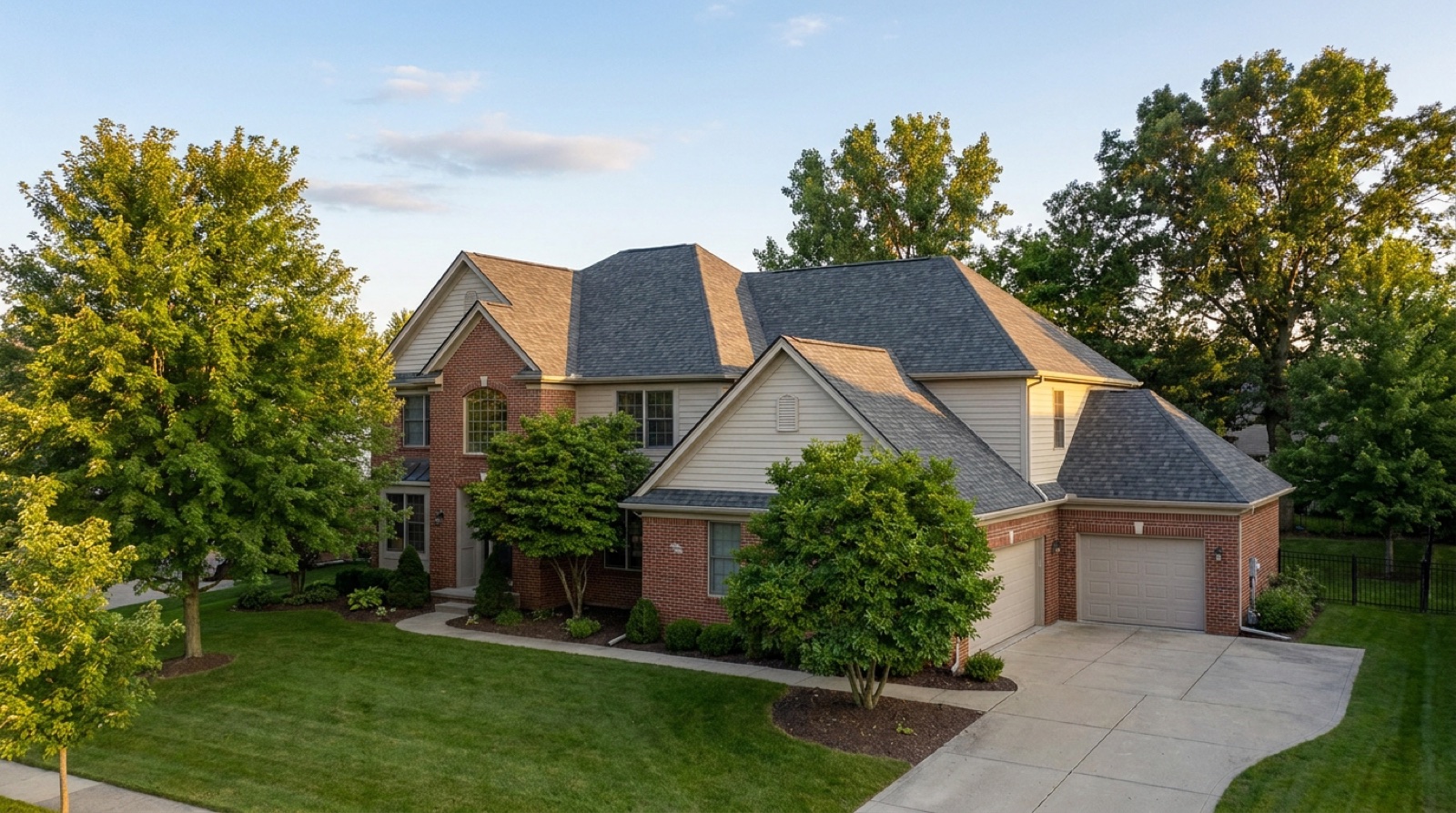
Material choice is partly engineering and partly neighborhood context, and metal shingles solve a fit problem that vertical panels and exposed fastener systems do not. In a lot of Macomb County subdivisions, a house wearing crisp vertical standing seam lines can read as too modern or too much of a departure from the colonials, ranches, and craftsman-style homes on either side of it. A metal shingle roof avoids that mismatch because it presents the same silhouette homeowners already expect: a shake or dimensional shingle profile, just built out of a longer-lived material.
That makes metal shingles a natural fit for subdivision streets where curb appeal and resale consistency matter, for homes with traditional architectural styling that would look out of place under vertical panels, and for owners who want the durability upgrade over asphalt without the visual statement that standing seam makes. Exposed fastener panels, by contrast, tend to suit outbuildings, pole barns, and rural properties rather than a subdivision colonial, which is exactly the gap metal shingles are built to fill.
Standing seam says metal roof. A good metal shingle roof just says roof, and lets the material do its job quietly for the next several decades.
Color and profile selection matters as much as the material decision itself once you have settled on shingles. A dark, deeply textured shingle profile can read almost identically to weathered cedar shake from the street, while a lighter, flatter profile leans closer to a dimensional asphalt look with more shine. If you are also weighing colors against a specific exterior, brick tone, or trim scheme, our guide to metal roof colors on a brick ranch works through that pairing in more detail.
04 / THE CLIMATE TESTWind, snow, and freeze-thaw in Macomb County
Any roofing system sold in Michigan eventually has to answer to the same three stresses: sustained wind, heavy snow load and shedding, and the freeze-thaw cycle that runs from November through March. Metal shingles are built to handle all three, with behavior that differs in useful ways from both asphalt and vertical panel metal.
Wind resistance from the interlock, not just the fastener
Because every shingle locks to the courses around it, wind uplift has to work against a connected field rather than a single tab or a single exposed screw. That interlock behavior is a meaningful part of why metal systems broadly outperform asphalt in sustained wind events, including the kind of straight-line wind that struck Macomb County in August 2023 and led to the county's inclusion in federal disaster declaration DR-4757. No manufacturer or contractor can promise a specific wind speed rating without pointing to the tested product line, so ask for the manufacturer's documentation on any system you are considering.
Snow behavior is different from standing seam
Smooth vertical panels shed snow in sudden sheets once the surface warms slightly. A textured, interlocked metal shingle surface, especially a granule-coated one, has more surface friction and tends to hold snow longer and release it more gradually. For a lot of homeowners that is a feature, not a drawback, because it reduces the avalanche-style shedding that can pile snow at doors, walkways, and gutters. Our guide to snow behavior on metal roofs covers the shedding question across the whole metal family in more depth.
Freeze-thaw and finish durability
Michigan's freeze-thaw cycle is hard on any roof, because trapped moisture that repeatedly freezes and expands is what eventually opens up seams, sealants, and fastener holes. An interlocked metal shingle system has fewer exposed penetration points than an exposed fastener panel, which limits one of the more common failure paths in that climate. The painted or granule-coated finish is still subject to normal weathering over time, chalking and gradual color fade among them, and the pace of that weathering depends on the specific coating system the manufacturer uses.
05 / COST AND LIFESPANWhat you are buying at $18,000 to $30,000
Metal shingles price inside the same $18,000 to $30,000 canon as the rest of the residential metal category in Macomb County, roughly double the $9,000 to $18,000 asphalt range on a comparable house. The premium buys the stamped panel material itself, the interlocking trim and starter details at every edge, and labor from crews trained on a fastening system that is more involved than nailing down a shingle bundle. Our roof replacement cost guide walks the seven factors, size, pitch, layers, decking, material tier, complexity, and permits, that move any roof price within its band, metal shingles included.
| SYSTEM | INSTALLED RANGE | NOTES |
|---|---|---|
| Metal shingle | $18,000 to $30,000 | Interlocked panels, concealed fasteners |
| Standing seam | $18,000 to $30,000 | Vertical panels, concealed clips |
| Stone coated steel | $18,000 to $30,000 | Granular texture bonded to a steel panel |
| Asphalt shingle, for context | $9,000 to $18,000 | Most homes land $12,000 to $16,000 |
Lifespan claims across the metal roofing industry are generally quoted in broad, multi-decade ranges rather than a single number, and the honest answer is that a metal shingle roof is built to substantially outlast an asphalt roof under normal Michigan conditions, with the specific figure depending on the gauge, coating, and manufacturer warranty behind the product you choose. Ask to see the manufacturer's written warranty terms for any system quoted to you rather than relying on a verbal estimate of years. Financing is available on metal projects, subject to approval, and we can run your real monthly figures once you have a firm project price from an inspection.
06 / THE COMPARISONMetal shingles vs the rest of the metal family
Metal shingles are one of four residential metal roofing branches, and it is worth knowing where they sit relative to the others before you commit. Standing seam delivers the crisp vertical look and sheds snow the fastest, but on a traditional home it can read as a stronger visual statement than some owners want. Exposed fastener panels are the least expensive metal option but rely on gasketed screws through the panel face that require periodic retightening, which is why they suit outbuildings and pole barns more than a primary residence. Stone coated steel shares metal shingles' shake-and-tile ambitions but uses a bonded granule surface rather than a painted stamped panel, which changes the sound, the walkability, and the snow-holding behavior slightly.
Metal shingles land in a specific niche within that family: the durability and concealed-fastener security of premium metal, delivered in a silhouette that a subdivision full of colonials and ranches will not read as out of place. If stone coated steel's granular look and heavier feel appeals to you as well, our stone coated steel guide lays out that specific system's construction and where it earns its premium.
None of this replaces seeing the actual panel on your own roof. Color, sheen, and texture all read differently under real daylight than they do in a brochure photo or a small sample, and the only way to judge the fit against your specific brick, siding, and trim is to look at a physical sample or a completed installation nearby.
07 / THE REAL NUMBERHow to get an exact price, free
Everything above narrows a range. The only thing that produces your actual number is someone measuring your roof, counting its valleys, hips, and penetrations, and checking the deck underneath. Our inspection is $0 with no obligation, and it covers the roof surface, the flashing, the ventilation, and the attic side of the deck, with photos of everything we find. Tell us you are considering metal shingles specifically and we will price that system against asphalt and against the other metal families so you are comparing real numbers, not ranges off a page.
Metal installers in southeast Michigan book up fastest in the late spring through fall stretch, so getting an inspection early in the season gives you the widest choice of install dates. The price canon on this page does not move with the season, but your scheduling leverage does. Want a ballpark before anyone sets foot on your roof? The instant estimator uses the same published ranges as this page, and the cost calculator runs those ranges against your specific roof size. You can also browse the rest of our metal and premium coverage in the guides library or start from the roof replacement service page for the full process.
- Metal shingles are stamped steel or aluminum panels that interlock on all four sides, concealing every fastener under the course above.
- They mimic shake, slate, or tile while behaving like a connected metal skin, which suits subdivisions where vertical standing seam panels can look out of place.
- The interlock resists wind uplift as a connected field, and a textured surface tends to hold and release snow more gradually than smooth vertical panels.
- Price lands in the same $18,000 to $30,000 metal canon as standing seam and stone coated steel in Macomb County.
- Ask for manufacturer warranty documentation on lifespan and coating rather than a verbal estimate before you choose a product line.
- The exact number for your roof comes from a free inspection, and ours is $0 with no obligation.
Questions we hear most
Metal shingle roofs run $18,000 to $30,000 installed, the same canon range as standing seam and stone coated steel, roughly double the $9,000 to $18,000 asphalt range on a comparable home. Your exact price depends on roof size, complexity, and the specific panel finish, and the only way to get it is a free on-site inspection.
It depends on the look you want. Standing seam gives a crisp vertical line that can read as a bold statement on a traditional colonial or ranch, while metal shingles mimic shake, slate, or tile in a silhouette that blends into a subdivision street without looking out of place. Both price within the same metal canon and both interlock to conceal fasteners.
Metal shingle systems are built to substantially outlast an asphalt roof under normal Michigan conditions, with the specific figure depending on the gauge, coating, and manufacturer warranty behind the product. Ask to see the written warranty terms for any system you are quoted rather than relying on a verbal estimate, and a free inspection can help you compare products against your budget.
- FEMA, disaster declaration DR-4757-MI, Michigan severe storms of August 2023 (Macomb County designated). fema.gov/disaster/4757
- Manufacturer technical and warranty literature for the major asphalt shingle lines: GAF (gaf.com), Owens Corning (owenscorning.com), and CertainTeed (certainteed.com).
- UL, product safety listings for outdoor electrical and de-icing products. ul.com
- Michigan Residential Code 2015, section R905.1.2 Ice Barriers: membrane required from the eave edge to not less than 24 inches inside the exterior wall line. up.codes: MRC chapter 9