
JUMP TO A SECTION
A stain on the ceiling in the middle of winter is one of the most alarming things a Macomb County homeowner can spot, and it is also one of the most commonly misdiagnosed. The instinct is to assume the roof is leaking, and sometimes it is. But a large share of the winter stain calls we run turn out to be attic condensation, moisture that formed inside the house and never came through the shingles at all. The two causes look similar at a glance and very different once you know the two tests that tell them apart: when the stain showed up, and where on the ceiling it sits.
This guide is a diagnostic tool, not a repair manual. It will tell you which category your stain most likely falls into and what to do next. It will not talk you through fixing a flashing detail or resealing a vent boot yourself, because guessing wrong on a wet ceiling wastes time a real leak does not have. Whichever way the tests point, the next step is the same: get eyes on the roof and the attic before the stain gets bigger.
01 / THE SHORT ANSWERTwo causes, two very different fixes
A roof leak means water is entering from outside, through failed shingles, a cracked flashing detail, or a backed-up ice dam, and traveling down to the spot where you see it. Attic condensation means humid air from inside the house rose into a cold attic and turned back into liquid water on the underside of the roof deck or ductwork, which then drips or seeps down onto the ceiling below, without a single shingle having failed. Our attic condensation guide covers that physics in full if you want the deeper explanation; this page focuses on telling the two apart from the stain itself.
Ask when the stain first appeared relative to weather, and where it sits on the ceiling. A stain that follows a specific storm and sits under a valley, chimney, or exterior wall usually points to a leak. A stain that grows slowly, blooms during a thaw, and sits under a closet, a bath fan, or a run of ductwork usually points to condensation. Neither test is a substitute for an inspection, but both narrow the odds fast.
Either way, the honest next step is the same: a free inspection that checks the roof, the flashing, and the attic side of the deck in one visit. If it is a leak, you get a repair price. If it is condensation, that is what we will tell you, and we will not sell you roofing work the roof does not need.
02 / THE LEAK PATTERNWhat a roof leak stain actually looks like
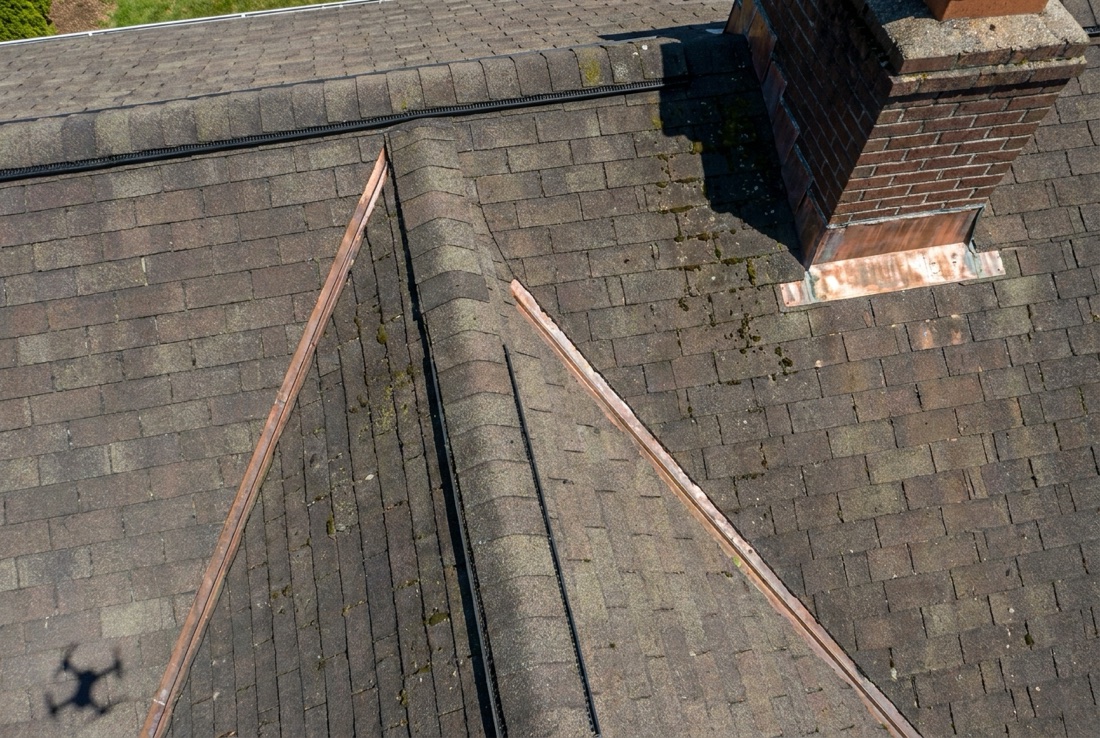
Water entering from outside travels along the shortest path gravity and the framing allow, which is rarely a straight line down from the hole it came through. It runs along the underside of the sheathing, down a rafter or a truss chord, and announces itself wherever it finally pools against drywall. That means a leak stain is usually narrow, roughly circular or oval, with a defined edge, and it sits below or near one of the roof's known weak points: a valley where two roof planes meet, a chimney, a skylight curb, a plumbing vent boot, or an exterior wall where flashing meets siding.
Leak stains also track weather events. A stain that appeared, or visibly grew, the day after or during a heavy rain, a wind storm, or a thaw that released water trapped behind an ice dam is behaving like a leak. It may darken during and right after the event and then stay roughly the same size until the next one. If you can point to the specific storm that caused it, or the specific week an ice dam was visibly hanging off your eaves, that timeline is doing a lot of the diagnostic work for you already.
One Michigan-specific leak source deserves its own mention: ice dams. Ridges of ice at the eaves back up meltwater under the shingles, and that water can travel well inside the wall line before it finds a gap in the deck. Our ice dam damage guide walks through why the stain from a dam often shows up several feet from the actual eave, which confuses homeowners who expect leak damage to sit right at the edge of the roof.
03 / THE CONDENSATION PATTERNWhat a condensation stain looks like instead
Condensation stains form differently because the water is not entering the house, it is forming inside the attic and working its way back down through the ceiling drywall or insulation. That gives condensation stains a broader, softer-edged shape than a leak, sometimes a diffuse yellowish or brownish blotch rather than a sharp ring, and it tends to sit above rooms and features that generate or trap moisture rather than above roof features.
The classic locations are closets and corners on an exterior wall, ceilings below or beside a bathroom that vents poorly, and ceilings that run under a duct run or a bath fan housing in the attic above. A stain that sits below a run of attic ductwork, especially where the duct crosses an unheated section of attic, often points to condensation dripping off cold metal or a poorly sealed duct joint rather than a roof failure. Corners and closets condensate first because they are the coldest, least ventilated points on an exterior wall, the same reason a corner of a cold window fogs before the rest of the glass does.
Condensation stains also tend to be paired with other signs that a leak would not produce: frost visible in the attic on a cold morning, a faint musty smell, or peeling paint on a bathroom ceiling that has nothing to do with the roof at all. If your household runs a whole-house humidifier through the winter, that is worth noting too, since an aggressively high setting is one of the most common ways a condensation problem gets manufactured that was not there the winter before, a topic our indoor humidity guide covers with a temperature-indexed target.
| SIGN | LEAK PATTERN | CONDENSATION PATTERN |
|---|---|---|
| Shape | Narrow, defined ring or oval | Broad, soft-edged blotch |
| Location | Below a valley, chimney, vent, or exterior wall flashing | Below a closet, corner, bath fan, or duct run |
| Timing | Appears or grows with a specific storm or ice dam event | Grows slowly, blooms during thaws and cold snaps |
| Companions | Attic staining traced to one entry point | Attic frost, musty smell, high indoor humidity |
04 / THE TIMELINE TESTMatching the stain to the weather
The single most useful question to ask yourself is when the stain first appeared, or when it last visibly grew, and lining that date up against recent weather. A stain that shows up the same day as a heavy rain or wind event, or within a day or two of a thaw that released water from a visible ice dam, is behaving like a leak. Our January thaw guide covers why leak calls cluster hard during midwinter warm spells, when frozen water that had been dammed at the eaves all winter finally has somewhere to go, usually into the house.
A stain that grows gradually over weeks with no single triggering storm, or that gets noticeably worse during a stretch of very cold weather followed by a thaw rather than during the storm itself, is behaving more like condensation. Condensation follows the indoor-outdoor temperature gap and the humidity in the house, not a single rain event, so it tends to track the calendar of cold snaps rather than the radar.
Keep a simple note on your phone: the date you first saw the stain, the date it changed size, and what the weather was doing both days. That timeline, brought to an inspection, saves real time, because it tells us where to look first instead of starting a search of the entire roof and attic from scratch.
05 / THE LOCATION TESTReading the map of your ceiling
Go stand under the stain and look straight up through the house, floor by floor if you can, to the roof above it. Is there a valley, a chimney, a skylight, or a dormer wall directly above that spot on the roof? If so, that is a real leak suspect, since every one of those features is a place where flashing has to be hand-formed and can eventually fail. Is the stain instead under a bathroom, a closet on an exterior wall, or a run of ductwork you know passes through the attic above it? That points toward condensation instead.
It also helps to check whether the stain sits near the perimeter of the house, close to the eaves, or further in toward the center of the roof. Ice dam leaks tend to show up near exterior walls, where the dam itself sits, while condensation from a poorly sealed ceiling penetration can show up almost anywhere the warm, moist air found a path upward, including well away from any exterior wall. Neither location rule is absolute, which is exactly why the timeline test in the prior section and the location test here work best used together, not alone.
A stain never lies about where the water came from. It just takes two questions, not one, to read what it is saying.
06 / THE STAKESWhy getting the diagnosis right matters
Treating a condensation stain like a leak wastes money and does not fix anything: resealing a flashing detail or replacing shingles that were never the problem leaves the real cause, an air leak and a humidity source inside the house, working all winter long. Treating a real leak like condensation is worse, because it leaves an active entry point open through more freeze-thaw cycles, and a leak that is ignored tends to get more expensive, not less, the longer it runs.
The cost difference between the two paths is real. A leak traced to a single failed flashing detail or a cracked pipe boot is typically a straightforward repair within the standard $350 to $3,200 range that covers most Macomb County repairs, and larger or more complex repairs can run higher. Condensation, on the other hand, is rarely a roofing repair at all in its early stages; it is attic-side work, sealing and ventilation, priced separately and usually well below a repair line. In either case, if the roof turns out to be near the end of its life for unrelated reasons, that conversation moves into full replacement territory, where most Macomb County asphalt jobs land $12,000 to $16,000 within a full range of $9,000 to $18,000, a topic covered fully in our roof replacement cost guide.
There is also a storm and insurance dimension worth flagging honestly. If your stain lines up with a specific severe weather event, including the kind of wind and hail damage that led to federal disaster declaration DR-4757 for Macomb County after the August 2023 storms, it may be worth documenting for a potential claim. Insurance generally covers sudden storm damage rather than gradual wear, and every policy reads differently, so nothing here is a promise about coverage. Our storm and insurance claims guide walks through documentation and what a contractor can and cannot promise about the outcome.
07 / THE REAL ANSWERGetting a real answer, not a guess
The timeline and location tests above narrow the odds, but only an inspection that puts eyes on both the roof and the attic side of the deck actually confirms which cause you have. Our inspection is $0 with no obligation, and it checks the shingles, the flashing at every valley and penetration, the ventilation, and the attic side of the sheathing above your stain in the same visit. If it is a leak, you get a written repair price. If it is condensation, we will tell you that directly and point you to the attic-side fix instead of selling you roofing work you do not need.
If the stain is actively growing or dripping right now, call first rather than waiting for a scheduled visit. We offer 24/7 emergency tarping to stop active water intrusion from a confirmed leak while a permanent repair gets scheduled. For a ballpark on any roofing work that turns out to be needed, the instant estimator runs the same published ranges as our honest pricing page, and the cost calculator applies those ranges to your own roof size in about a minute.
- A ceiling stain in winter is either a roof leak, water entering from outside, or attic condensation, moisture that formed inside the house and never crossed the shingles.
- Leak stains are narrow, track specific storms or ice dam thaws, and sit below roof features like valleys, chimneys, and vents.
- Condensation stains are broader, grow gradually or bloom during thaws, and sit below closets, corners, bath fans, or duct runs.
- Use the timeline test and the location test together; neither one alone is conclusive, and both point toward the same next step.
- A free inspection checking the roof and the attic side of the deck is the only way to confirm the cause and price the right fix, not a guess.
Questions we hear most
Check when it appeared and where it sits. A stain that showed up during or right after a storm or an ice dam thaw, and that sits below a valley, chimney, or vent, usually points to a leak. A stain that grew slowly, blooms during cold snaps and thaws, and sits below a closet, corner, bath fan, or duct run usually points to condensation. A free inspection that checks both the roof and the attic confirms which one you actually have.
Yes. Humid air from inside the house rises into a cold winter attic, condenses on the underside of the roof deck or on ductwork, and that moisture can work its way down through insulation and drywall to appear as a ceiling stain, without any shingle ever failing. It is one of the most commonly misdiagnosed causes of a winter stain.
Note the date it appeared and what the weather was doing, and note exactly where it sits under your roof. If it is actively growing or dripping, call for emergency tarping if a leak seems likely. Otherwise, schedule a free inspection, which checks the roof, the flashing, and the attic side of the deck to confirm the cause before anyone recommends a repair.
- FEMA, disaster declaration DR-4757-MI, Michigan severe storms of August 2023 (Macomb County designated). fema.gov/disaster/4757
- U.S. Environmental Protection Agency, moisture control guidance for building design, construction, and maintenance. epa.gov/indoor-air-quality-iaq/moisture-control-guidance
- Building Science Corporation, published research and information sheets on moisture movement, air leakage, and roof assemblies in cold climates. buildingscience.com
- InterNACHI Standards of Practice for home inspections (scope of a generalist roof inspection). nachi.org/sop