
JUMP TO A SECTION
After a wind or hail event, most Macomb County homeowners want an answer before they want a contractor: is the roof actually damaged, or did it just make a lot of noise? A careful walk around the outside of the house, using nothing more than your eyes, a phone camera, and maybe a pair of binoculars, can answer that question more often than people expect. It cannot answer it completely, and knowing exactly where the ground check stops is as useful as knowing where it starts.
01 / THE SHORT ANSWERWhat a ground check can and cannot confirm
A ground-level check is a screening tool, not a diagnosis. It is good at catching the damage that is large, high-contrast, or already shedding evidence into your yard and gutters: missing shingles, dented soft metal, a sagging gutter line. It is not good at catching the damage that lives inside the shingle mat or under an intact-looking course, which is exactly the kind that shortens a roof's life the most. Both things can be true at once. You can find nothing from the ground and still have real damage, and you can find something from the ground and still need a closer look to know how serious it is.
Think of the ground check as the first pass, not the final word. It tells you whether a professional look is worth scheduling right now, or whether things look fine enough that you can keep an eye on it. Either way, the walk is free, it takes less time than the coffee gets cold, and it puts you in a much better position than guessing from the driveway.
Timing helps too. Do the walk once it is safe to be outside, meaning the wind has actually died down and there is no lightning nearby, rather than waiting until the following weekend. Fresh damage is easier to read: a newly lifted shingle still sits at an odd angle before wind and sun settle it back down, and granules sitting on top of standing water in a gutter are easier to spot than granules that have since washed through the downspout. None of this is a deadline; it is simply that the earlier you look, the clearer the picture.
02 / THE ROUTEThe walkaround route: four elevations, one loop
Walk the property line, not the driveway. Most people glance at the roof from wherever they happen to be standing, usually straight in front of the house, which shows you one slope from one angle in one kind of light. A proper check is a loop: front, both sides, and the back, standing far enough away that you can see the full slope from eave to ridge rather than a foreshortened sliver of it.
Light and distance matter more than most people think
Shingle damage shows up as a change in texture and shadow, not usually a change in color you can spot from twenty feet away. Low, angled light, early morning or late afternoon, throws long shadows across lifted tabs and creased courses that disappear under flat midday sun. If you can, do the walk when the sun is behind you rather than behind the roof; glare off the shingles or a hazy sky washes out exactly the detail you are looking for. Standing across the street, or even from a neighbor's driveway with their permission, often gives a better angle on a slope than standing directly below it.
Cover every elevation, not just the one you see from the street
Wind and hail rarely hit a house evenly. A wind-driven storm loads up one or two slopes depending on which way it was blowing, and a hail cell can hammer one side of a roof while leaving the other nearly untouched. Checking only the front slope because it is the one visible from the sidewalk is the single most common gap in a homeowner's own inspection. Walk the side yards, and if a fence or a locked gate blocks the backyard, at minimum look at the back slope from an upstairs window or from as far into the yard as you can safely get.
| ELEVATION | WHERE TO STAND | WHAT'S DIFFERENT THERE |
|---|---|---|
| Front (street side) | Across the street or from the far edge of the driveway | The angle most people already check, but rarely from far enough back |
| Side yards | Property line, both sides | Often skipped; catches wind-facing slope damage the street view misses |
| Back slope | Yard, deck, or an upstairs window | The slope facing away from the street and easiest to overlook entirely |
| Garage or addition roofs | Driveway or side yard | Lower-pitch sections that show granule loss and ponding evidence differently |
03 / THE DETAIL PASSWhat binoculars or a phone zoom actually reveal
Once you have the full slope in view from a safe distance, the second pass is about detail. A phone camera zoomed all the way in, or a basic pair of binoculars, turns a vague impression into specific evidence you can point to and photograph. Here is what that detail pass is actually looking for.
Missing tabs and lifted lines
A missing shingle or tab leaves a dark, exposed rectangle where the felt or deck underneath shows through, and it is usually visible even without a zoom. Lifted lines are subtler: a course of shingles that has popped its seal will sit slightly proud of the courses around it, and in low light that shows up as a faint shadow line running across the slope instead of the clean, tight lines of an undamaged roof.
Ridge gaps and flashing shine
The ridge is one of the first places wind gets a grip, so scan the roofline itself for cap shingles that look uneven, gapped, or lifted at the seam compared to the rest of the ridge. Flashing, the metal strips sealing valleys, chimneys, and wall intersections, normally has a dull, weathered surface. A bright, shiny patch of exposed metal usually means a sealant bead cracked or a piece bent, exposing metal that has not weathered yet.
Dented vents, caps, and pipe boots
Metal vent caps, turbine vents, and pipe boot collars are soft enough to dent from hail that barely marks a shingle, which makes them a useful proxy: dents on the metal accessories are a reason to look harder at the shingles around them, even if the shingles themselves look fine at a glance. A zoom lens catches these dents far more reliably than the naked eye at ground level.
Granule shadows in valleys and low-slope sections
Valleys and low-pitch sections such as a garage roof or a porch roof collect runoff from everywhere else, so they are also where dislodged granules tend to concentrate before they wash all the way to the gutter. From a distance this can look like a faint dark stain running down the valley centerline or pooling near a low edge; it is worth a second look through the zoom before assuming it is just old age or shade from a nearby tree, since both explanations can look similar from far away and only a closer inspection tells them apart.
- Dark rectangles where a tab or shingle is missing entirely
- Shadow lines where a course sits slightly proud of the ones around it
- Uneven or gapped ridge cap shingles along the roofline
- Bright, unweathered metal shine on flashing, valleys, or chimney flashing
- Dents on vent caps, turbine vents, pipe boot collars, or gutter guards
- Bald or discolored patches where granules appear to be thinning, especially in valleys
04 / ON THE GROUNDGutters, downspouts, and the yard tell their own story
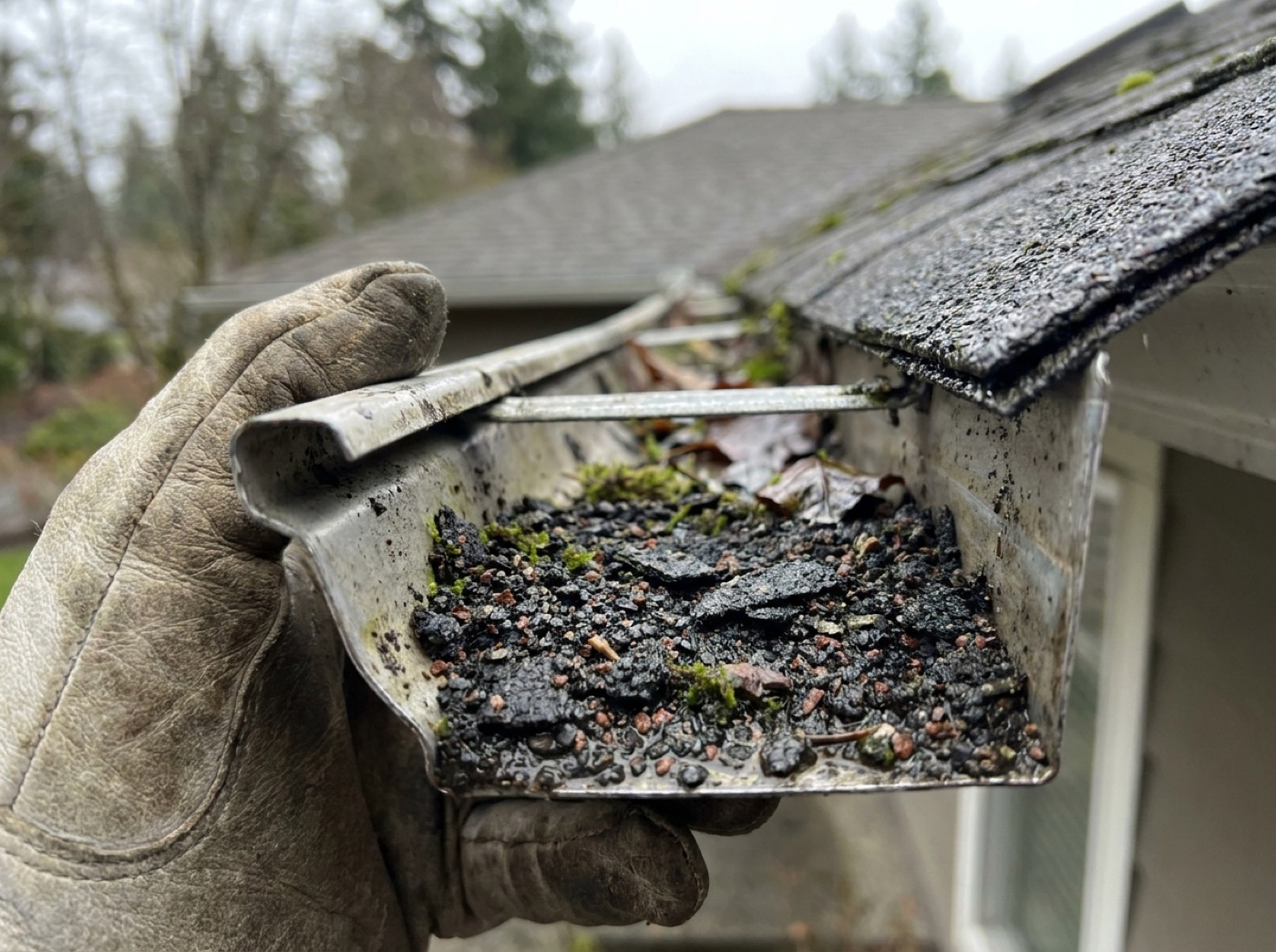
Some of the most reliable storm evidence never requires looking up at all. Gutters catch granules washed off the shingle surface, and a handful of dark, sand-like granules pooled at the downspout outlet or streaked down the gutter face is a strong sign that something on the roof lost its coating in the storm, not just from ordinary age. Dented gutters and downspouts are also a fair proxy for hail size, since aluminum gutter stock dents at roughly the same impact energy as a bruised shingle mat, which our collateral hail damage guide covers in more detail.
Walk the yard itself while you are out there. Torn or punched window screens, dented air conditioner fins, a dinged mailbox or grill lid, and shredded leaves or stripped bark on the side of trees that faced the storm are all collateral clues that corroborate what you may be seeing on the roof. Debris matters too: a fallen branch or a chunk of shingle in the yard means something landed there, and it is worth checking the roof directly above where it fell rather than assuming the debris explains itself.
Downspout outlets and splash blocks are worth a specific look after heavy rain paired with hail or wind. A sudden patch of eroded mulch or soil right where a downspout empties, or an unusual amount of grit and granules in a splash block, both suggest more material came off the roof in that storm than the gutter alone tells you. It is a small detail, but it is one more point of evidence you can photograph and compare the next time you check, especially if you are tracking whether things are getting better or worse after a series of storms.
Dented gutters, damaged screens, and yard debris are corroborating evidence, not a substitute for a roof inspection. They tell you a storm with real force reached your property. They do not tell you what the shingles themselves did, which is a separate question a trained eye answers better than a ledger of yard damage ever will.
05 / THE SAFETY RULEWhy you stay off the roof, especially right after a storm
Everything above is designed to be done with both feet on the ground, and that is not a suggestion, it is the point. Ladders and rooftops are already a leading source of serious home injuries in ordinary conditions, which is why organizations like OSHA publish standing guidance on ladder use around the home. After a storm, the roof itself is a worse place to be than usual: loose granules act like ball bearings underfoot, a wet or frost-glazed surface loses traction fast, and shingles or decking weakened by the same event you are trying to assess may not hold weight the way they normally would. None of that is visible from a photo, which is exactly why a homeowner walking the roof to get a better look at damage is a common way to add a second, worse problem to the first one.
The instinct to get up there and see for yourself is understandable, but the ground route above genuinely captures most of what matters for deciding your next step. If you have an active leak or exposed decking that needs to be covered before the next rain, that is what 24/7 emergency tarping is for, and it is done by someone equipped and trained to be on a roof safely, not by a homeowner with a stepladder.
Storm events also bring door-to-door crews from out of state offering to "take a look" for free. Do not let anyone, including us, pressure you onto your own roof to point things out, and be careful with any crew that wants to climb up and start work the same day, before you have had a chance to get a second opinion or talk to your insurer. A legitimate inspection starts with a conversation, not a ladder against your house within the hour.
The same caution applies to hazards you may not think of as roof-related. Downed or sagging power lines near the house, a leaning tree, or a detached section of gutter hanging at head height are all reasons to keep the ground walk to a safe distance and call the utility company or the fire department first, rather than pushing closer for a better photo. A roof can wait a few hours for a safe look; a live wire cannot wait for anyone's curiosity.
06 / THE HANDOFFWhen the ground check means it's time to call
A few findings from the ground check are worth acting on the same day: an active drip inside the house, daylight or sky visible through the roof deck from the attic, a tarp or debris actively sitting on the roof, or shingles you can see are missing entirely over a living space. Everything else, dents, shadow lines, granules in the gutter, gapped ridge caps, is worth a call but rarely an emergency.
The honest reason to schedule an inspection even when the ground check turns up little is that some of the most consequential storm damage is invisible from anywhere but the roof surface and the attic side of the deck. Broken shingle seals, hairline mat fractures, and torn underlayment under a course that looks perfectly normal are the subject of our hidden roof storm damage guide, and none of it shows up in a photo taken from the yard. Pairing your ground check with a look at the attic, covered in our attic check after a storm guide, closes some of that gap yourself, but it does not close all of it.
If you found anything worth documenting on your walk, photograph it properly before you call anyone; our guide to photographing storm damage covers the technique. From there, a free professional inspection is the only way to turn a ground-level impression into an actual answer, and it costs nothing to find out. You can start one from the estimator, check our published pricing so there are no surprises about what a repair might run, or use the cost calculator to get a ballpark before anyone steps foot on your property.
- A ground check is a screening tool: it catches missing shingles, dented metal, and gutter granules, but not seal failure or mat bruises hidden inside the shingle.
- Walk all four elevations, not just the street-facing slope, and use low-angle light and a zoom for detail.
- Gutters, downspouts, and yard damage (screens, AC fins, debris) corroborate a storm's force without proving what the shingles did.
- Stay off the roof yourself, especially right after a storm, when loose granules and possible deck damage make footing worse than usual.
- When in doubt, a free inspection turns your ground-level findings into an actual answer, including the damage that never shows from the yard.
Questions we hear most
You can catch a lot from the ground: missing or lifted shingles, dented vents and gutters, granules washed into the downspout, and yard debris are all visible without a ladder. What a ground check cannot confirm is damage hidden inside the shingle mat or under the deck, which is why it is a first pass rather than a final answer.
A phone camera zoomed all the way in or a basic pair of binoculars is enough. Stand far enough back to see the full slope, walk the property line to cover every side of the house, and check in low-angle morning or afternoon light rather than flat midday sun. No ladder and no special equipment is needed for this pass.
The ground-level walk is safe and worth doing. Getting on the roof yourself is not something we recommend, especially right after a storm, when loose granules, wet or frost-glazed surfaces, and possibly weakened decking make footing worse than normal. If you have an active leak, 24/7 emergency tarping covers that without you needing to go up there; a free inspection handles the rest.
- OSHA, general guidance on ladder safety and fall prevention around the home. osha.gov/ladders
- FEMA, disaster declaration DR-4757-MI, Michigan severe storms of August 2023 (Macomb County designated). fema.gov/disaster/4757
- National Roofing Contractors Association, technical guidance for steep-slope roof systems. nrca.net
- Manufacturer technical and warranty literature for the major asphalt shingle lines: GAF (gaf.com), Owens Corning (owenscorning.com), and CertainTeed (certainteed.com).