
JUMP TO A SECTION
Every homeowner does the same thing after a storm: stand in the driveway, look up, and check whether anything looks wrong. Most of the time, nothing does. Shingles are still in their courses, nothing is in the yard, and the gutters are not full of granules. That glance is a reasonable first check, but it is not the same thing as an inspection, because the failures that actually cost a roof its remaining life rarely announce themselves from ground level. They happen underneath the visible surface, in the layer of adhesive, mat fiber, felt, or fasteners that nobody can see without getting close and, in some cases, without lifting a shingle to look under it.
01 / THE PROBLEM WITH A CLEAN LOOKWhy a roof that looks fine can still be damaged
A shingle roof is a system of overlapping layers doing several jobs at once: shedding water, resisting wind uplift, and protecting the wood deck underneath from the weather entirely. A storm can degrade any one of those jobs without disturbing the layer a homeowner actually sees, which is the top face of the shingle. Wind can break an adhesive bond two shingles deep and leave the surface looking flat. Hail can fracture the fiberglass mat inside a shingle without dislodging a single granule. None of that shows up as debris in the yard or a hole in the roofline, and none of it heals on its own.
That gap between what a storm can do and what a driveway glance can detect is exactly why we inspect for a living, and it is worth walking through the five specific failures that hide best, in roughly the order our inspectors check for them. None of the five requires a dramatic storm to occur. An ordinary summer wind gust, a stray tree branch, or a single hard hailstone can produce any one of them on a roof that otherwise looks brand new from the street.
02 / THE FIRST HIDDEN FAILUREBroken seal bonds under shingles that never moved
Every shingle ships with a factory adhesive strip that bonds it to the course above once sun heat cures it, and that bond is what actually resists wind uplift, more than the nails do. Wind strong enough to get a finger under a tab edge can break that seal without tearing or dislodging the shingle at all. The tab settles back down and looks exactly like it did before the storm. Underneath, the bond is gone, and it almost never reforms reliably once grit works into the gap. Our guide to lifted shingles after a storm walks through why that seal rarely reseals on its own, but the short version matters here too: a shingle can pass every visual check and still be structurally unsealed, waiting on the next ordinary gust rather than another named storm to finish what this one started.
This is the single most common hidden failure we find during a post-storm inspection, because it requires no visible evidence at all. A trained inspector checks it by hand, working along the eaves, rakes, and ridge where uplift pressure concentrates, gently testing whether a tab lifts with light pressure that a properly bonded shingle would resist.
03 / THE SECOND HIDDEN FAILUREHairline fractures in the shingle mat
An asphalt shingle is built around a fiberglass mat, and that mat is what gives the shingle its strength and its ability to shed water evenly for decades. Hail impact and hard debris strikes can bruise or fracture that mat without breaking the surface granules loose or leaving a visible dent, especially on a warmer shingle that flexes rather than cracks on impact. The result is a shingle that looks completely intact from above but has lost structural integrity in a spot smaller than a coin. Our guide to hail bruising covers how that specific fracture pattern forms and why it is different from the granule scuffing that mimics it.
A hairline fracture does not leak the day it happens. It leaks months or years later, once the compromised spot sheds granules faster than the surrounding shingle and UV light reaches asphalt that was never meant to be exposed. That delay is exactly why hail damage assessments rely on the test square method and a hands-on check rather than a look from the ground; a fracture is often felt as a slight give under thumb pressure before it is ever visible to the eye.
A hairline mat fracture and simple granule loss can look nearly identical from a few feet away. The difference is whether the mat underneath is intact, and that is a hands-on determination, not a visual one. See our signs of hail damage guide for the fuller list of what a trained eye is actually checking for.
04 / THE THIRD HIDDEN FAILUREShingles that lifted, then settled back into place
This one is closely related to a broken seal but deserves its own line, because the visual evidence is even weaker. A gust can lift a shingle edge high enough to flex the tab, then drop it, and the shingle can settle back close enough to its original position that the shadow line an inspector would normally look for in low-angle light is faint or gone entirely by the time anyone checks. Repeated flexing during that lift-and-drop cycle can crease the shingle at the fold line even when the tab ends up looking flat again, and a crease is a weak point the same way a fold in a sheet of paper is, regardless of whether the paper springs back flat.
The practical effect is a shingle that has already been mechanically stressed once and is more likely to fail the same way again in a smaller wind event, precisely because nothing about its appearance flags it for a closer look. This is one of several reasons a full post-storm inspection checks every course by hand along the perimeter rather than relying on a walk-by scan of the roofline.
05 / THE FOURTH HIDDEN FAILURETorn underlayment beneath courses that look untouched
Underlayment, whether felt or synthetic, is the roof's second line of defense, installed under the shingles and designed to shed water that gets past the shingle surface. Wind-driven debris, a branch strike, or even foot traffic from a prior repair can tear that layer without disturbing the shingles laid over it, since the shingles are the outer layer and the underlayment sits beneath the deck-facing side. From above, the course in question looks completely normal, because the shingles themselves were never touched.
A tear at this layer does not leak immediately in most cases; water still has to find its way past the shingle course above the tear first. But once it does, the water has no second barrier left to stop it, and it tracks along the deck until it finds a seam, a nail hole, or a low point to drip through, often far from the actual tear. That is part of why interior stains rarely line up directly under the point of entry, a pattern our wind-driven rain guide covers from the water's side of the story. Finding a torn underlayment before it leaks generally requires either an attic-side check for daylight or moisture, or lifting a section of shingle during a hands-on inspection, neither of which happens from the driveway.
Underlayment age matters here too. A newer synthetic underlayment tolerates far more incidental exposure and mechanical stress than an older felt underlayment that has already gone through several Michigan freeze-thaw cycles and dried out in the process. On an older roof, the same debris strike that a newer underlayment would shrug off can be the one that actually tears through, which is one more reason roof age belongs in the conversation whenever a homeowner is deciding how closely to look after a storm.
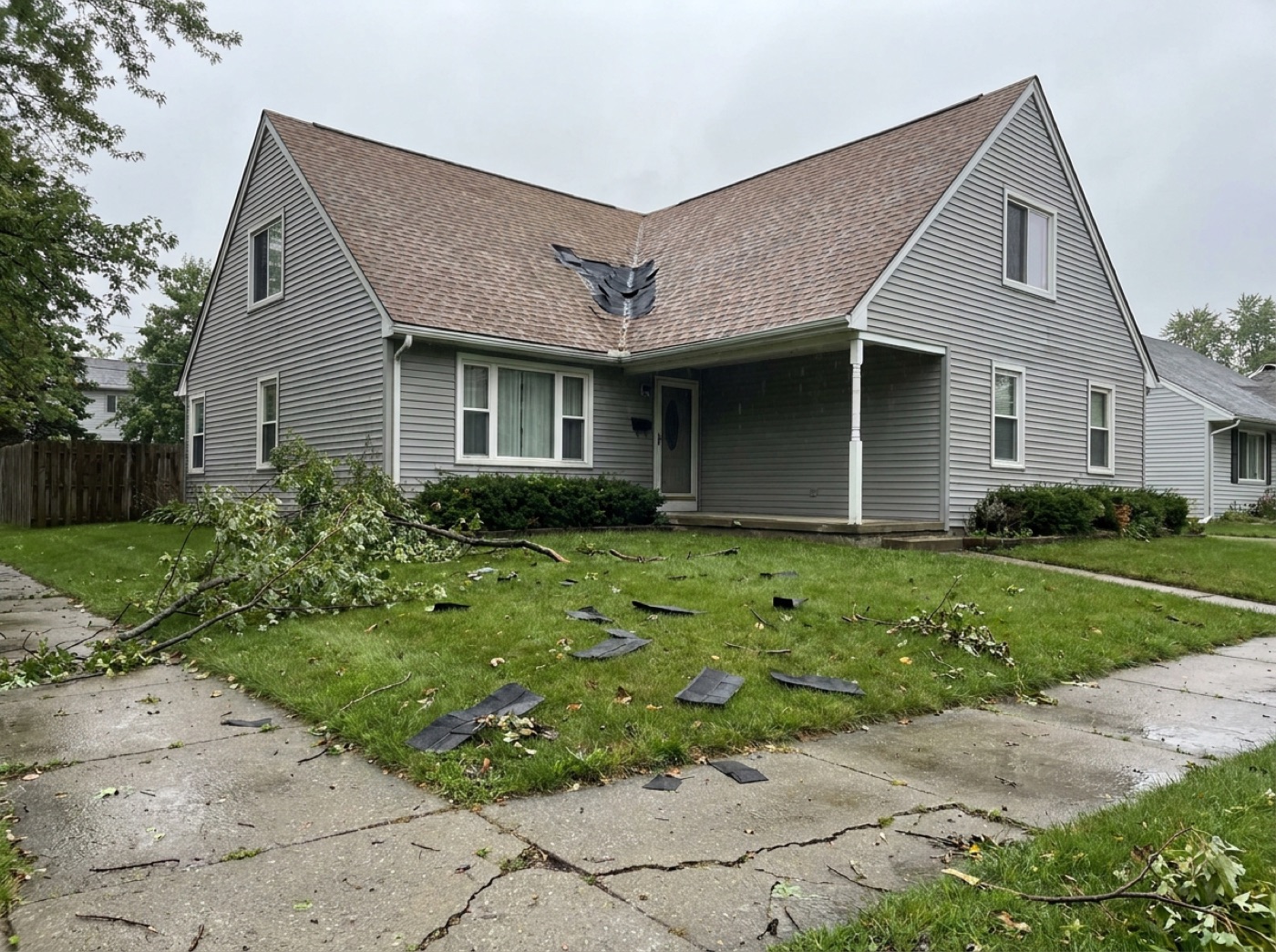
06 / THE FIFTH HIDDEN FAILUREFastener back-out
Nails hold a shingle's position even though the adhesive seal does most of the wind-resistance work, and a strong enough gust can work a nail partway out of the deck without tearing the shingle or leaving any visible sign on the surface, especially on a roof where fasteners were driven a little high or at a slight angle to begin with. A backed-out nail head sits proud under the shingle above it, which can eventually work a pinhole through that overlying shingle from beneath, or simply leave that section of roof with less holding power than it had before the storm, ready to lift further in the next event.
This is one of the few hidden failures that can sometimes be felt rather than seen: a slightly raised bump under a shingle where a flush nail head should be. It is not something most homeowners would think to check for, which is exactly why it belongs on a professional inspection checklist rather than a homeowner's own walkaround.
07 / THE PATTERNWhat five hidden failures add up to on the same roof
None of these five failures is dramatic on its own, and that is precisely the point. A roof rarely fails all at once. It accumulates a handful of small, invisible weak points after a storm, and each one shortens the roof's remaining service life or opens a slower path for water, even on a roof that would pass a homeowner's own visual check with no notes. Our guide on how storm damage gets worse over time walks through the timeline each of these failures tends to follow once it is left unaddressed.
It is also worth being honest about what an inspection cannot do: it cannot tell you a roof will never leak again, and no legitimate inspector should promise that. What it can do is find the specific weak points that exist right now, document them with photos, and give you an accurate picture of where the roof actually stands instead of a guess based on how it looks from forty feet away. That documentation matters on its own, and it matters even more if a claim ever gets filed, since our guide to documenting storm damage covers how a photographed record from right after a storm holds up better than a reconstruction weeks later. Homeowners often assume none of that record is worth keeping until a ceiling stains, and a roof claim with no visible leak is its own question: what a dry roof can and cannot be filed on.
The roofs that worry us most after a storm are not the ones missing shingles. Those are obvious and they get fixed. It is the roof that looks completely fine that needs the closer look.
This is also the honest argument for a free inspection rather than a sales pitch dressed up as one. If a roof genuinely came through a storm clean, a thorough inspector tells you that, in writing, with photos. What a free inspection actually protects against is the roof that looks clean and is not, because every failure on this page is one that a trained eye, working by hand along the eaves and courses and checking the attic side of the deck, catches long before it becomes a ceiling stain. That distinction, checking rather than guessing, is the entire reason our storm damage inspection service exists.
- Broken seal bonds under tabs that never visibly moved, most common at eaves, rakes, and corners.
- Hairline mat fractures from hail or debris impact, felt more easily than seen.
- Shingles that lifted and settled back close to flat, sometimes creased at the fold.
- Torn underlayment beneath shingle courses that look completely untouched from above.
- Fastener back-out, a raised bump under a shingle where a flush nail head should sit.
If your roof went through a recent wind or hail event and passed your own driveway check with flying colors, that is good news, but it is not the same evidence as a hands-on inspection, and it is worth the fifteen minutes to be sure before the next storm finds the weak point for you. Start from the free storm damage estimate tool, or if the damage traces to a covered event, our storm and insurance claims guide covers documentation and what we can and cannot promise about any claim.
- A roof that looks untouched after a storm can still carry real, un-healing damage underneath the surface.
- Broken seal bonds, hairline mat fractures, settled shingles, torn underlayment, and fastener back-out are the five most common hidden failures.
- Most of them are found by hand, not by eye, which is the entire case for a professional inspection over a driveway glance.
- None of these failures heals itself; each one shortens the roof's remaining life or opens a slower leak path.
- The inspection that checks for all five is $0, with no obligation.
Questions we hear most
Yes. Broken seal bonds, hairline mat fractures, and torn underlayment can all occur without any visible sign from the driveway or even from a ladder at the eave. That is why a hands-on inspection checks by touch along the courses and the attic side of the deck, not just by looking at the roofline.
By working the roof by hand rather than scanning it visually: testing whether tabs lift under light pressure, feeling for hairline give in the shingle mat, checking the attic side of the deck for daylight or moisture, and in some cases lifting a shingle course to check the underlayment beneath it.
Generally yes. A broken seal, a fractured mat, or a backed-out fastener does not typically cause an immediate leak, but each one degrades the roof's ability to shed water or resist wind, and the failure tends to progress rather than heal. Addressing it early is usually far less costly than waiting for the leak it eventually causes.
That is exactly the situation a free inspection is built for. If the roof genuinely came through clean, we tell you that in writing with photos and there is no obligation. If it did not, you get an honest, documented look at what we found before it becomes an interior problem.
- FEMA, disaster declaration DR-4757-MI, Michigan severe storms of August 2023 (Macomb County designated). fema.gov/disaster/4757
- Manufacturer technical and warranty literature for the major asphalt shingle lines: GAF (gaf.com), Owens Corning (owenscorning.com), and CertainTeed (certainteed.com).
- Haag, engineering-based damage assessment methodology for hail and wind effects on roofing. haagglobal.com