
JUMP TO A SECTION
Most homeowners assume masonry damage means something hit the chimney, or that decades of weather simply wore the brick down from the outside, the way paint fades or wood grays. Chimney spalling works differently. The brick and mortar are failing from a fight happening inside their own pores, where water that soaked in during a thaw expands into ice during the next hard freeze and physically pries the material apart. The chimney is also the most exposed masonry structure on the house, standing above the roofline on all four sides with no attic or insulation behind most of it, which is why it is often the first place a freeze thaw winter leaves visible damage.
This guide is the masonry chapter of a larger story we cover across our winter science library: the same freeze thaw cycling that fatigues shingles and flexes flashing also attacks brick, mortar, and concrete, just through a different mechanism. Understanding spalling matters beyond the chimney itself, because a chimney that is failing above the roofline is also a chimney that is very likely leaking water into the roof-to-chimney flashing joint below it.
01 / THE SHORT ANSWERWhat chimney spalling actually is
Spalling is the term for brick, mortar, or concrete that cracks, flakes, or pops off in chips and slabs, exposing rougher, more porous material underneath. It is not caused by impact or ordinary sun and rain exposure. It is caused by water that has already soaked into the masonry freezing in place, expanding, and breaking the material from within. A spalled chimney did not get hit by anything. It got wet, then it got cold, over and over, until something gave.
Brick and mortar are porous and drink in rain and snowmelt. When that trapped water freezes, it expands and pushes outward against the pore walls from the inside. Repeat that cycle enough winters in a row and the surface has nowhere left to go but off.
That single mechanism explains almost everything a homeowner sees on a spalling chimney: the timing (it shows up worst after hard winters, not hot summers), the location (north and shaded faces, and the top courses nearest the crown, usually go first), and why patching the surface with paint or a sealant that traps moisture inside can make the next freeze cycle worse instead of better.
02 / THE MECHANISMHow trapped water becomes a wedge
Water expands when it freezes, and it does so with real force, which is exactly why a full water bottle left in the freezer splits its own plastic wall. Brick and mortar are not solid, impermeable blocks. Both are full of microscopic pores that absorb liquid water the way a sponge does, just far more slowly and far less visibly. Older or softer brick, and mortar that has started to weather or was mixed too soft for the masonry it holds together, absorb more water and hold it longer, which makes them more vulnerable to this cycle than newer, harder material.
Southeast Michigan gives that cycle plenty of chances to run. Every stretch of above-freezing days that lets rain or snowmelt soak into the chimney, followed by a hard overnight freeze, is one repetition of absorb, freeze, expand. Our companion guide on the freeze thaw cycle covers how often that crossing happens over a typical winter here, and the same count that fatigues a shingle mat is doing this work to your chimney at the same time, just through a different failure path.
The crown, the poured or precast cap on top of the chimney, deserves its own mention because it takes the brunt of the exposure. A crown is meant to shed water off the top of the stack the way a roof sheds water off a house. Once it develops even a hairline crack, water gets straight into the masonry below it and into the flue liner space, and every freeze afterward works that crack wider. A cracked crown is one of the single most common starting points for a chimney that spalls badly within a few winters.
03 / THE SIGNSRecognizing spalling before it spreads
The most obvious sign is also the most literal one: pieces of brick face, sometimes thin flakes and sometimes chunks the size of a coin or larger, showing up on the roof, in the gutters, or on the ground near the chimney base. If you have ever swept brick fragments off a roof section near the chimney and assumed a storm knocked them loose, freeze thaw spalling is worth considering as the real cause, especially if it keeps happening in the same spot every winter.
- Brick faces that look rougher, pitted, or flaked compared to the rest of the stack, usually worst on the shaded or north-facing side
- Mortar joints that are receding, crumbling, or soft enough to scrape out with a fingernail
- Visible cracks in the concrete or masonry crown on top of the chimney
- White, chalky mineral staining (efflorescence) on the brick, a sign water has been moving through it
- A chimney that looks noticeably more weathered than the brick on the rest of the house, even though both were built at the same time
None of these signs are visible from inside the house, and most homeowners only look up at the chimney when something falls off it. That is one reason we check the chimney as a standard part of every roof inspection, not just the shingles and flashing around its base.
04 / THE EXPOSUREWhy the chimney takes the worst of it
Every other exterior wall on a Macomb County house gets some benefit from the building behind it. Heat leaking out through the wall assembly, however small, keeps interior-facing brick a few degrees warmer than it would be on its own, and most walls are shielded on at least one or two sides by roof overhangs, other structures, or simple orientation. A chimney gets almost none of that help. It rises above the roofline, exposed on all four sides to sun, wind, rain, and snow, usually with an open flue running straight up its center that provides no meaningful warmth to the masonry around it once the fireplace or furnace below is not actively running.
That means a chimney experiences more total freeze thaw cycles per winter than almost any other masonry on the property, because it has less thermal protection and more direct weather exposure at every hour of every day. It is also usually the tallest point on the roof, which means it takes wind-driven rain and snow that lower sections of the house never see at the same intensity. Put those factors together and it becomes clear why a chimney is so often the first masonry element on a house to show real freeze thaw damage, sometimes years before the rest of the exterior shows anything comparable.
05 / THE ROOF CONNECTIONHow a failing chimney undermines the roof below it
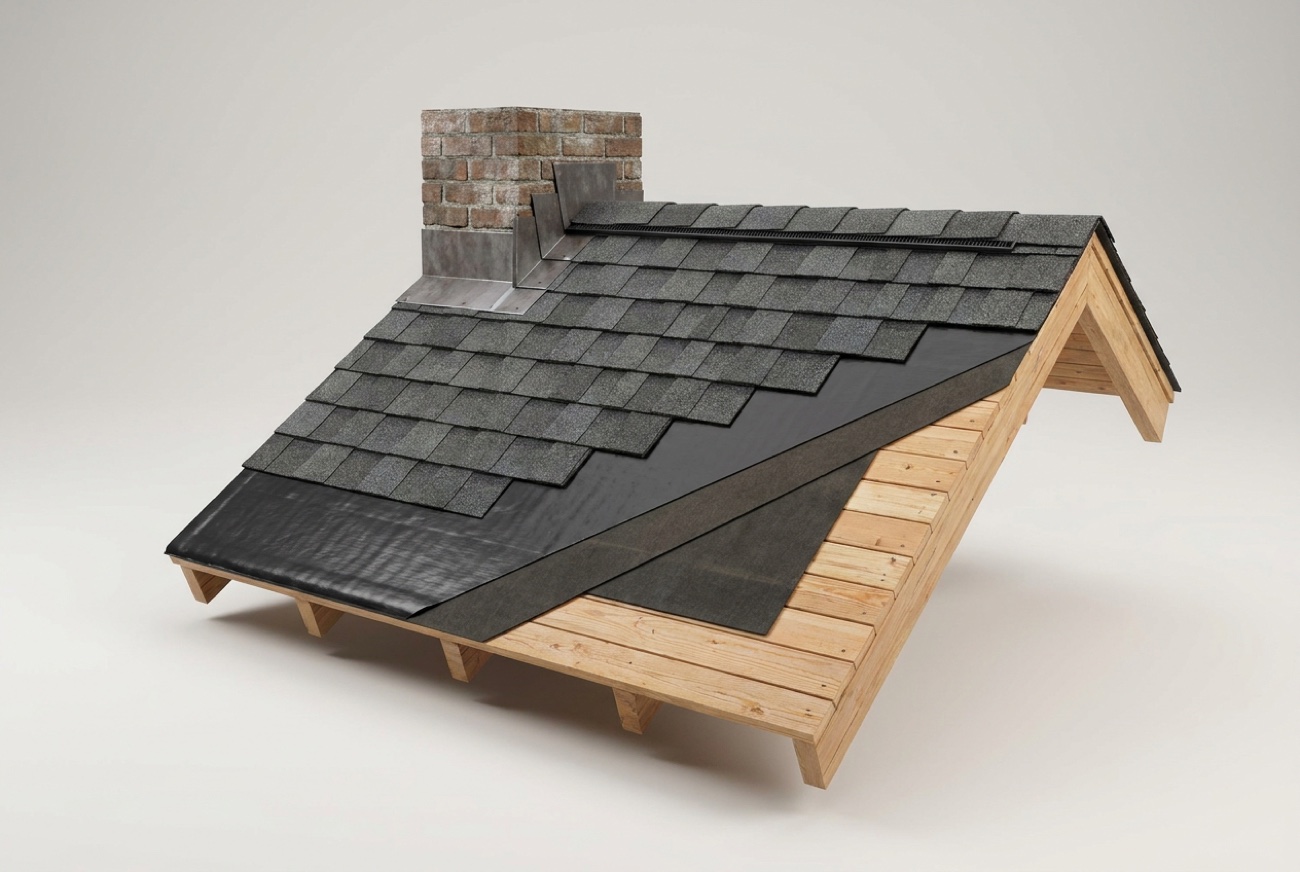
A chimney is not just a masonry problem sitting next to the roof. It is a penetration through the roof, and the flashing that seals that penetration depends on the masonry around it staying sound. Step flashing and counter flashing are typically set into a reglet cut or mortar joint in the brick, and that joint is exactly the kind of surface that spalling and eroding mortar attack first. Once the masonry around the flashing starts to crumble, the seal that flashing depends on weakens with it, even if the metal itself is in good shape.
A cracked crown compounds the problem from above. Water that gets into the top of the chimney does not necessarily stay at the top. It can travel down inside the flue liner cavity and the wall of the chimney itself, appearing later as staining on an interior chimney chase, a damp smell near a fireplace, or moisture at the attic penetration where the chimney passes through the roof deck. By the time water shows up inside the house, the masonry has usually been absorbing and freezing for more than one winter.
A roof inspection that skips the chimney is only checking part of the penetration. The flashing and the masonry around it fail together, not separately.
This is also why we treat chimney condition as a roofing question, not a separate masonry trade issue, even though rebuilding a chimney crown or repointing mortar is different work from replacing shingles. If your roof needs attention and the chimney beside it shows any of the signs above, that flashing detail deserves a close look during the same visit, and the guide on signs of winter roof damage covers the rest of the penetration and flashing symptoms worth watching for at the same time.
06 / PREVENTIONWhat protects a chimney, and when to call
The fixes for chimney spalling are mostly about keeping water out in the first place, since the masonry itself cannot be un-frozen once it has already broken. A sound, uncracked crown is the single most protective feature a chimney can have, since it is the surface most directly exposed to standing water and the coldest point on the stack. A properly fitted rain cap over the flue opening keeps snow and rain from getting straight down into the flue liner and the top of the masonry. Breathable masonry water repellents, applied correctly, can reduce how much water the brick face absorbs without trapping existing moisture inside, which is the opposite of what a film-forming sealant or paint coating does.
Once spalling has started, the damaged material generally needs to be addressed rather than left to spread, because each additional winter works on the newly exposed, rougher surface even faster than it worked on the original brick face. Depending on how far it has progressed, that can mean repointing mortar joints, replacing individual damaged brick, rebuilding a cracked crown, or in more advanced cases a partial rebuild of the top courses. None of that is a job to estimate from the ground with binoculars, and it is exactly the kind of finding a thorough roof inspection turns up along with the flashing and shingle condition around it.
Macomb County was included in federal disaster declaration DR-4757 following the severe wind storms of August 2023, and wind events like that can crack a chimney crown or loosen flashing in ways that are easy to miss from the ground. If your chimney and roof were never checked after a storm like that, a free inspection is a low-cost way to find out where you actually stand before another winter runs the freeze thaw cycle on whatever damage is already there.
A free inspection is the practical starting point either way. We check the chimney, the crown, the flashing at its base, and the surrounding shingles and deck in the same visit, so you get one honest picture of the whole penetration rather than a masonry quote and a roofing quote that were never looked at together. If your roof is also due for attention, our replacement cost guide and the cost calculator use the same published price canon to give you a ballpark before anyone sets foot on the property.
- Chimney spalling is caused by water already inside the brick and mortar freezing and expanding, not by outside weathering or impact.
- A cracked crown is the most common starting point, because it is the most directly exposed surface on the whole chimney.
- The chimney takes more freeze thaw cycles than the rest of the house because it gets no warmth from below and is exposed on all four sides.
- Spalling and eroding mortar around the roof-to-chimney flashing joint compromise the flashing seal even when the metal itself looks fine.
- Prevention (a sound crown, a rain cap, breathable water repellent) is cheaper than repair, and a free inspection tells you which stage yours is at.
Questions we hear most
Spalling happens when water that has soaked into brick, mortar, or a concrete chimney crown freezes and expands, breaking the surface apart from the inside. Southeast Michigan's frequent freeze and thaw cycles through the winter give that process many chances to repeat, which is why chimneys here often show spalling years before the rest of a home's exterior masonry does.
It starts as a durability problem and can become a bigger one. Beyond the appearance, spalling and eroding mortar around the base of the chimney can undermine the flashing seal where the chimney meets the roof, and a cracked crown can let water travel down inside the chimney toward the attic and living space. A roof inspection that includes the chimney is the way to know which stage a given chimney is at.
Film-forming paints and sealants can trap existing moisture inside the masonry, which often makes the next freeze cycle worse rather than better. Breathable masonry water repellents applied correctly can help going forward, but existing spalled brick or a cracked crown generally needs to be repaired or rebuilt rather than covered over. A free inspection can tell you which approach fits your chimney's actual condition.
- FEMA, disaster declaration DR-4757-MI, Michigan severe storms of August 2023 (Macomb County designated). fema.gov/disaster/4757
- NOAA National Centers for Environmental Information, U.S. Climate Normals (Detroit-area stations). ncei.noaa.gov
- Chimney Safety Institute of America, guidance on chimney crowns, moisture prevention, and post-storm inspection. csia.org
- Manufacturer technical and warranty literature for the major asphalt shingle lines: GAF (gaf.com), Owens Corning (owenscorning.com), and CertainTeed (certainteed.com).