
JUMP TO A SECTION
- 01 The short answer
- 02 The physics: why ice pries things apart
- 03 How often it happens in a Michigan winter
- 04 Where it attacks first: shingles and seals
- 05 Flashing, gutters, and masonry
- 06 Why Michigan roofs work harder than the rating assumes
- 07 What years of cycling adds up to
- 08 Questions we hear most
A roof does not usually fail on the day of the storm that finally finds its weak point. It fails a little at a time, all winter, in a process most homeowners never see and few roofers explain well: the freeze thaw cycle. Water finds its way into a crack, a lap, a pore in a material never designed to hold it, and then the temperature drops below freezing. What happens next is physics, not weather, and it repeats with almost mechanical regularity across a Macomb County winter, whether the forecast calls for a blizzard or a quiet, gray Tuesday in January. This guide is the material-science pillar behind almost everything on this site about winter roof damage: what the cycle actually does, how often it happens here, and why it is the reason Michigan roofs live harder lives than the same shingles installed somewhere that never sees a hard frost.
The short version: water is one of the only common substances that expands when it freezes, gaining roughly 9 percent in volume as it turns from liquid to solid ice. Every crack, seam, or pore holding a trace of water when a Michigan front pushes through becomes a small hydraulic wedge the moment the temperature drops. Do that once and nothing happens. Do it dozens of times a winter, for the fifteen, twenty, or thirty winters a roof is expected to survive, and the wedge does real, cumulative damage, well before that roof reaches the age its rated service life implies it should still be sound.
01 / THE SHORT ANSWERWhy a freeze thaw cycle matters to a roof
A freeze thaw cycle, in the plain sense this guide uses it, is any stretch of weather where a surface crosses from above freezing to below freezing and back again, whether the swing happens over a single afternoon or over several days. Southeast Michigan does not get a handful of these crossings each winter. It gets dozens, and every one of them is a small mechanical test applied to every crack, seam, and joint on a roof that is already holding a trace of moisture. No single cycle breaks anything on its own. The damage is cumulative, invisible for years, and it is the single biggest reason a roof's rated service life reads differently on the shingle wrapper than it plays out on an actual Macomb County house, a gap our companion guide on why Michigan roofs age faster covers directly.
is roughly how much water expands when it freezes solid. That expansion, repeated every time a Macomb County winter swings back across the freezing line, is the mechanical engine behind cracked shingles, failed sealant, and spalling masonry described below.
The rest of this page walks that mechanism in order: the physics of why freezing water pries materials apart, roughly how many times a typical Macomb County winter runs the cycle, the specific roof components that take the worst of it, and what years of repeated cycling adds up to on a house. If you already suspect this cycle has been working on your roof for a decade or two and want an honest read on where things stand, our inspection is $0 with no obligation and covers the shingles, flashing, gutters, and the attic side of the deck in a single visit.
02 / THE MECHANISMThe physics: why ice pries things apart
Almost every other common liquid contracts as it cools and keeps contracting as it solidifies. Water does the opposite below about 39 degrees Fahrenheit, and the effect is dramatic right at the freezing point: as liquid water turns to ice, its molecules lock into a rigid crystal lattice that takes up more space than the same molecules did as a liquid, an expansion of roughly 9 percent by volume. That is not a rounding error. It is why a sealed glass bottle of water cracks in a freezer, why a full radiator can split a metal engine block, and why a pothole in a road grows wider every winter instead of healing itself.
A roof gives that expanding ice plenty of places to work. Asphalt shingles have overlapping laps, nail penetrations, and a granule-embedded surface with countless microscopic pores. Sealant beads, flashing joints, and mortar all have some porosity or some seam where a trace of water can sit. None of these gaps need to be visible to a homeowner standing in the yard. A hairline crack invisible from the ground is more than enough room for water to enter during a thaw, then freeze that same night, expand by roughly a tenth of its volume, and press outward against whatever surrounds it. Repeat that same event through a full winter and each cycle can wedge the crack a fraction wider than the one before, letting slightly more water in next time, which is why freeze-thaw damage tends to accelerate rather than plateau as a roof ages.
The damage is rarely dramatic in the moment. It looks like nothing happened, because ice does not shatter a shingle on contact the way a hammer would. It works the way metal fatigue works on an airplane wing: a small stress, applied over and over, that a single application would never reveal. Engineers call this kind of failure fatigue damage, and it is the correct mental model for almost every winter roof problem on this site, from cracked shingles to spalling brick. The freeze-thaw cycle is the loading event; the roof material is the part being fatigued.
03 / THE COUNTHow often it happens in a Michigan winter
The reason this matters so much more here than it does in a warmer state is simple: Macomb County crosses the freezing line far more often than the calendar suggests. A single stretch of subzero weather might sound like the harshest part of winter, but from a fatigue standpoint a hard, unbroken freeze that never thaws is almost gentle, because nothing is expanding and contracting while it stays frozen solid. The damaging weather is the in-between kind: a daytime high that climbs just above 32 degrees, enough to melt a surface film of ice or let a trapped pocket of water go briefly liquid, followed by a nighttime low that drops it straight back below freezing. Southeast Michigan runs that exact pattern on a large share of winter days, not just during the coldest week of January.
That pattern repeats across late fall, the core winter months, and the early spring thaw, and it is what separates a Macomb County roof from the same shingle installed in a climate that either stays reliably cold all winter or barely freezes at all. Both of those climates spare a roof most of the fatigue loading described above. Southeast Michigan, sitting almost exactly on the seasonal freeze line for months at a stretch, delivers close to the worst-case pattern of freeze-thaw cycling a roof can experience in a single year.
The January thaw is the clearest single example: a multi-day warm spell in the dead of winter that melts snowpack and frost, followed by a hard refreeze once the warm air moves out. That one event alone can represent several freeze-thaw crossings in the space of a week, on top of the routine day-to-day swings the rest of the season provides. Our broader seasonal overview of Michigan winter roof problems maps out where events like that fall across a typical year, month by month.
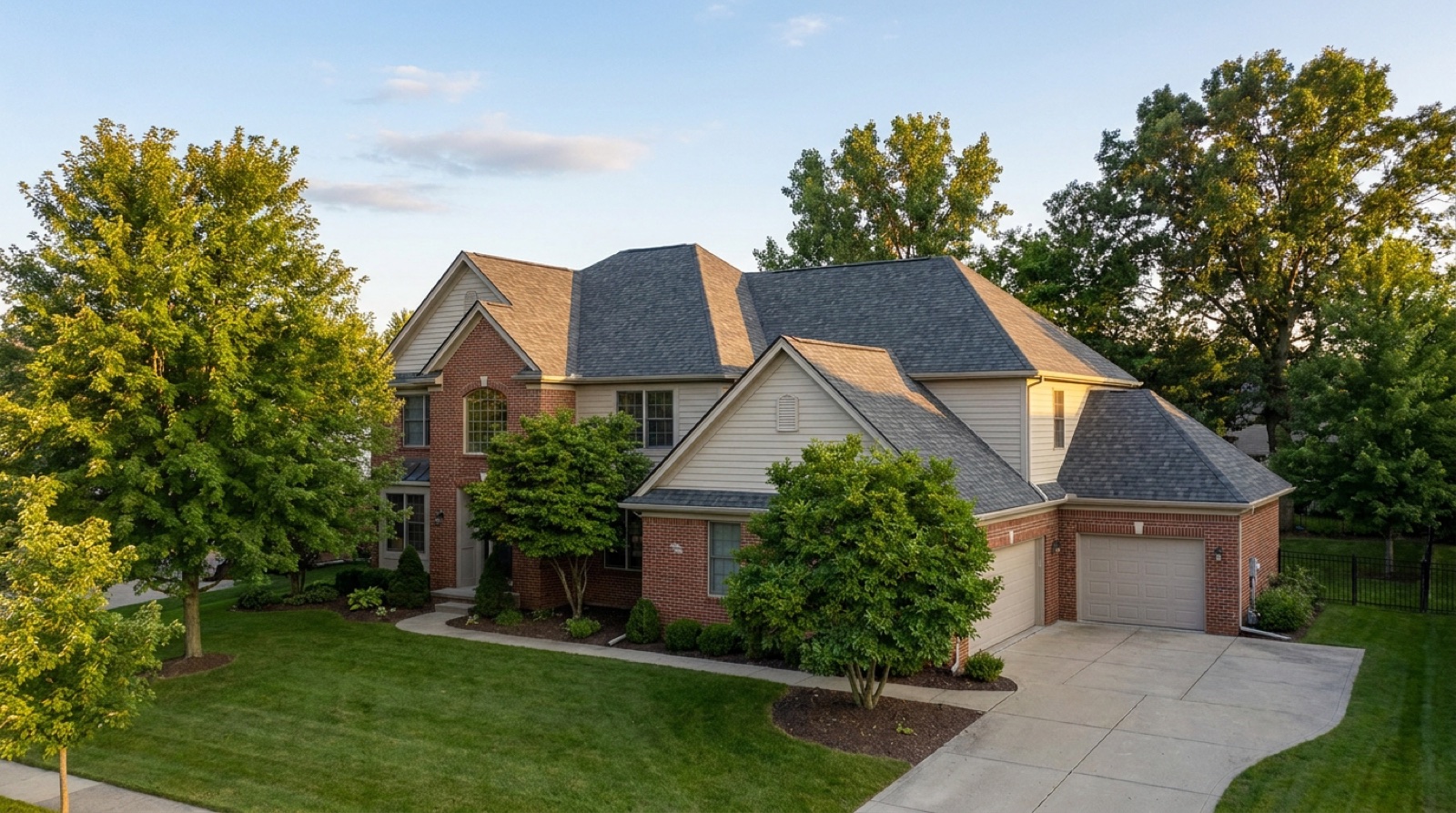
04 / THE FIRST TARGETSWhere it attacks first: shingle edges and seals
Asphalt shingles take the most direct and visible hit from freeze-thaw cycling, because they are the roof's largest exposed surface and they are full of the small seams and pores the cycle exploits. The self-sealing strip that bonds one course of shingles to the one below it is a common early casualty: a bond that trapped a trace of moisture before it fully cured, or one that has simply aged and lost some elasticity, is a candidate for a wedge of ice to work loose over repeated cycles, especially at shingle tabs near the eave where meltwater lingers longest. Our companion guide on how freeze thaw damages asphalt shingles layer by layer goes deep on the shingle mat itself, granule bond fatigue, and why granules collecting in the gutter each spring are a direct readout of this process.
Shingle edges and exposed tabs are the other predictable target, because edges are where a shingle is most likely to hold a sliver of standing water against a raised lip or a slightly lifted corner. Combine that with the fact that asphalt itself grows measurably more brittle as temperatures drop, covered in full in our shingles cracking in cold weather guide, and an edge that is both holding moisture and losing flexibility is exactly where a freeze-thaw cycle does its most visible work: a hairline crack that was not there in October and is unmistakable by March.
None of this shows up as an obvious hole to a homeowner scanning the roofline from the driveway. It shows up as granule loss, as a slightly raised tab that used to lie flat, or eventually as a leak that seems to come from nowhere during a thaw, which our winter ceiling stain guide walks through as a diagnostic. The pattern to remember: freeze-thaw damage on shingles rarely announces itself with a single event. It accumulates quietly for years before it becomes a leak.
05 / BEYOND THE SHINGLESFlashing, gutters, and masonry take the same beating
Shingles are not the only roof component running this fatigue test every winter. Flashing, the metal that seals a roof where it meets a chimney, a wall, a valley, or a vent pipe, relies on sealant and metal-to-metal laps that can trap the same trace moisture the shingles do. Sealant is porous at a microscopic level and ages by drying and shrinking, and a bead that has already lost some elasticity is exactly the kind of material a repeated freeze-thaw load pries open fastest. Once a flashing seal opens even slightly, it stops being a freeze-thaw problem and becomes a straightforward water-entry problem, one of the most common repair calls we get, covered fully on our roof repair page.
Gutters take a related but distinct version of the same abuse. Standing water left in a gutter section with poor pitch or a partial clog freezes solid, expands, and can bow or split a metal gutter seam over a season or two, especially at end caps and corner miters where the metal is already under stress from the joint itself. A gutter that ices up repeatedly at the same low spot every winter is showing you exactly where its pitch or drainage is wrong, and it is worth fixing before the ice itself finishes the job of splitting the seam.
Masonry above the roofline runs the same physics on a slower, more destructive timeline. Brick and mortar are both somewhat porous, which means both absorb a small amount of water from rain and snowmelt. When that absorbed water freezes inside the material rather than on its surface, the expansion happens from the inside out, and clay brick and aging mortar are far less able to flex around that internal pressure than a shingle or a sealant bead is. The result is a face of brick popping off in flakes, or a mortar joint crumbling and widening year over year, a failure mode with its own name: spalling. Our dedicated guide on chimney spalling and freeze-thaw damage above the roofline covers that mechanism and why a spalling chimney is a roof problem too, since it sits directly above the flashing detail that seals the chimney into the roof.
06 / THE COMPARISONWhy Michigan roofs work harder than the rated life assumes
Shingle manufacturers rate a product's service life against laboratory testing and broad national averages, not against any specific climate. A roof in a climate that rarely freezes skips almost this entire guide; there is no expanding ice to wedge open a seam that never sees a hard frost. A roof in a climate that freezes once in November and stays frozen solid until March, without much of a midwinter thaw, actually escapes a surprising amount of the damage too, because a frozen system sitting still is not the same as one cycling repeatedly through the phase change that does the mechanical work.
Southeast Michigan sits in the worst position on that spectrum: a climate that spends months hovering right around the freezing line, thawing and refreezing on a near-weekly, sometimes near-daily basis rather than settling into one long, stable freeze. That is the specific reason a shingle rated for a national average service life tends to show its age here sooner than the rating implies, and it is the core argument of our companion piece on why Michigan roofs age faster than their warranty suggests. Freeze-thaw cycling is not the only stress a Macomb County roof carries; ice dams, heavy wet snow, and wide seasonal temperature swings all add their own load, all covered in the wider winter roof problems overview. But freeze-thaw cycling is the most constant of them, running quietly in the background on ordinary days that never make the local news.
Ice does not break a roof the way a falling branch does. It works like metal fatigue: the same small stress, applied hundreds of times, until a material that looked fine on the last inspection is not fine anymore.
07 / THE ACCUMULATIONWhat years of cycling adds up to on a real roof
A single winter of freeze-thaw cycling rarely produces a leak anyone notices. A decade of it is a different story, and this is exactly why so many Macomb County homes on their second or third covering over the same deck show damage patterns that line up neatly with age: granule loss concentrated at the eaves and in valleys where water lingers longest, sealant strips that no longer hold a shingle tab flat, flashing that has quietly opened at a chimney or a wall, and gutters that have bowed at the same low corner year after year. None of those are storm damage in the usual sense. They are the visible endpoint of thousands of small hydraulic wedges, each one doing a little more than the last.
| COMPONENT | TYPICAL FREEZE-THAW SIGN | WHAT IT USUALLY MEANS |
|---|---|---|
| Shingle seal strips | Tabs that lift or flap in wind that used to lie flat | Bond fatigue, often near the end of the shingle's service life |
| Shingle mat and granules | Granules collecting in gutters each spring | Surface wear accelerated by repeated freeze-thaw exposure |
| Flashing and sealant | A joint that used to be watertight now seeps during a thaw | Sealant has lost elasticity; a repair is usually due |
| Gutters | The same corner or end cap ices and bows every winter | Standing water freezing repeatedly at a poor-pitch low point |
| Chimney masonry | Flaking brick faces or widening mortar joints | Spalling from water absorbed into the masonry, then frozen |
None of this means every Macomb County roof is in trouble. A well-built roof with sound flashing, tight seal strips, and a properly maintained deck can absorb decades of freeze-thaw cycling without a serious problem, which is exactly why routine seasonal maintenance and an occasional inspection matter more here than in a milder climate. What it does mean is that age alone is not the whole story when a roof is evaluated. A twelve-year-old roof that has spent every one of those winters cycling through dozens of freeze-thaw events has absorbed meaningfully more fatigue loading than the same shingle would have on a house in a climate that barely freezes, and an honest inspection accounts for that rather than judging a roof strictly by the calendar.
If a roof is showing the signs in the table above, the right next step is not guessing at the cause from the ground. It is getting someone on the roof and in the attic who can tell the difference between ordinary wear, freeze-thaw fatigue that is still years from a problem, and damage advanced enough that a repair or a replacement is the honest recommendation. Localized freeze-thaw damage, a lifted section of shingles, a seeping flashing joint, a split gutter corner, is squarely repair territory, and most repairs in Macomb County run $350 to $3,200, with larger or more complex repairs able to run higher. When the cycling has caught up with a roof broadly, across multiple systems and multiple seasons, a full replacement is the more honest recommendation, and most asphalt replacements here run $9,000 to $18,000, with most homes landing $12,000 to $16,000.
Either way, the only way to know which category a specific roof is actually in is a real inspection, not a guess based on age or a look from the ground. Ours is $0 with no obligation and covers the shingles, the flashing, the gutters, and the attic side of the deck in a single visit, with honest photos of anything we find. If the roof only needs a targeted repair, that is exactly what we recommend. For a ballpark before anyone visits, the instant estimator runs the same published ranges as our honest pricing page in about a minute, and the cost calculator applies those ranges to your own roof's size. If a section is already leaking during a thaw, we offer 24/7 emergency tarping to stop the water while the permanent repair gets scheduled, and a full replacement conversation, if the cycling has caught up with the whole roof, starts on our roof replacement page.
- Water expands roughly 9 percent in volume when it freezes, turning any trapped moisture in a crack, seam, or pore into a small hydraulic wedge every time the temperature drops below freezing.
- Southeast Michigan crosses the freezing line far more often than a hard, stable winter would, which is exactly the pattern that causes the most freeze-thaw fatigue on a roof.
- Shingle edges and seal strips, flashing sealant, gutters, and chimney masonry are the components that show freeze-thaw wear first and most visibly.
- The damage accumulates like metal fatigue, invisible for years, which is why a roof's real condition can differ meaningfully from what its age alone would suggest.
- Localized freeze-thaw damage is usually a $350 to $3,200 repair; broader damage across multiple systems is when a $9,000 to $18,000 replacement becomes the honest call, and a free inspection tells you which one applies.
Questions we hear most
A freeze thaw cycle is any stretch of weather where a surface crosses from above freezing to below freezing and back again. It matters because water expands roughly 9 percent in volume as it freezes, so any trace of water trapped in a crack, seam, or pore becomes a small hydraulic wedge every time that crossing happens. Southeast Michigan sees this crossing dozens of times a winter, which is far more mechanical stress than a roof in a climate that stays reliably frozen or rarely freezes at all ever experiences.
Shingle service life ratings are based on national averages and lab testing, not on any one climate. Southeast Michigan spends months hovering right around the freezing line, thawing and refreezing repeatedly rather than settling into one long, stable freeze, which is close to the worst-case pattern for freeze-thaw fatigue. That extra cycling, on top of ice dams and wide seasonal swings, is why local roofs often show wear sooner than the rated service life would imply.
No. Localized freeze-thaw damage, like a lifted section of shingles, a seeping flashing joint, or a split gutter corner, is usually a repair, and most Macomb County repairs run $350 to $3,200, with larger or more complex repairs able to run higher. Replacement becomes the honest recommendation when the cycling has caught up with the roof broadly, across shingles, flashing, and the deck at once. A free inspection is the only reliable way to tell which category a specific roof is in.
- FEMA, disaster declaration DR-4757-MI, Michigan severe storms of August 2023 (Macomb County designated). fema.gov/disaster/4757
- Manufacturer technical and warranty literature for the major asphalt shingle lines: GAF (gaf.com), Owens Corning (owenscorning.com), and CertainTeed (certainteed.com).
- NOAA National Centers for Environmental Information, U.S. Climate Normals (Detroit-area stations). ncei.noaa.gov