
JUMP TO A SECTION
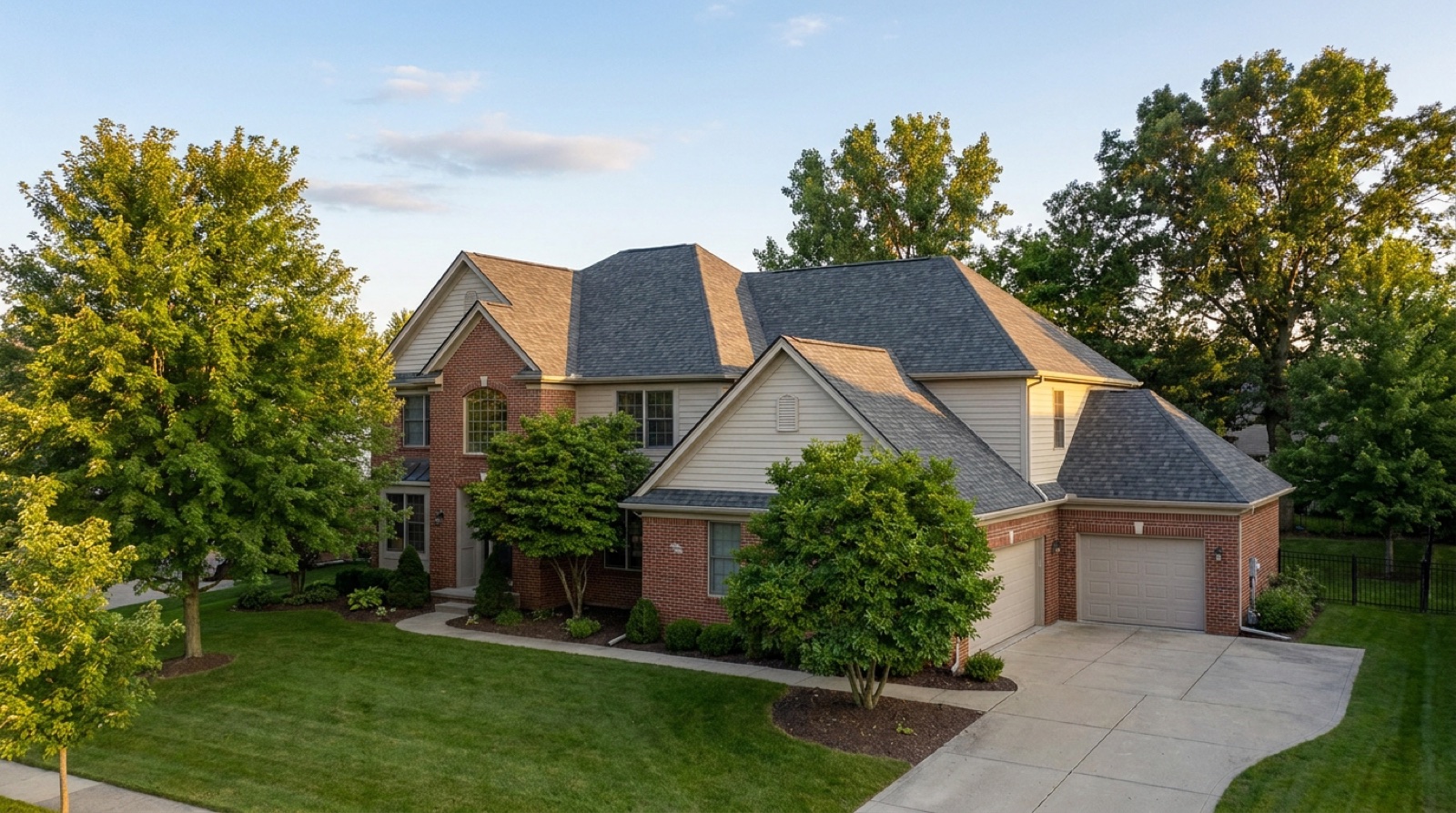
The simplest roof shape to build and to shingle is a plain gable: two slopes, one ridge, water leaves at the eaves and nowhere else. Almost nobody lives under one of those anymore. Colonials with a bump-out over the garage, capes with three dormers punched into the front slope, additions tacked onto the back of a ranch: every one of those design choices adds a place where two roof planes meet, and every one of those meeting points is a spot where water has to be told, with metal and membrane, exactly where to go. This guide walks the trouble spots that Macomb County's newer colonials and custom builds carry more of than older, simpler homes: dead valleys, dormer clusters, and roof-to-wall intersections. It covers why they fail first, what a correct replacement does differently there, and how to count that complexity yourself before a bidder ever shows up.
01 / THE SHORT ANSWERShape drives failure location as much as age does
A roof rarely fails evenly across its whole surface. It fails first at the places where two slopes, a wall, and gravity are all arguing with each other at once, and where the standard field shingle detail does not apply. A dead valley is the sharpest version of that problem: a spot where two roof planes drain toward each other and dump their combined water against a wall or a lower roof section with no ridge or outlet to carry it away. Dormer clusters and roof-to-wall intersections are the same problem in smaller, more numerous doses, since every dormer adds two miniature valleys and a run of sidewall flashing where a plain slope used to be.
None of this is optional detail work you can skip to save money. It is the part of the job most likely to determine whether the new roof you are paying for leaks in its first few winters or holds for decades, and it is largely invisible once the shingles go down.
The good news is that none of it requires exotic materials. It requires a bidder who walks the roof, counts every one of these spots, and prices the membrane and flashing work honestly instead of quoting a per-square number that assumes a simple gable. The sections below give you the vocabulary and the eye test to hold any quote to that standard.
02 / FROM THE YARDCounting your own roof's complexity before anyone bids
You do not need to get on a ladder to do this. Stand in the driveway and across the street and look at the roof the way an estimator should. Count four things.
- Roof planes. Every distinct sloped surface, including the garage, any dormers, and additions. A plain ranch might have four; a colonial with a front-facing dormer bank and a rear addition can easily run past ten.
- Valleys. Every inward angle where two planes meet, visible as a diagonal seam running down toward an eave, or in the worst case, toward a wall instead.
- Wall intersections. Anywhere a roof plane's high edge dies into a taller wall, most often where a single-story garage or addition meets a two-story section.
- Penetrations. Chimneys, skylights, and plumbing vents, since each one interrupts the shingle field and needs its own flashing.
Add those counts up and you have a rough complexity score. A simple gable ranch might score four or five total. A cut-up colonial with dormers, a bump-out, and a chimney can easily score fifteen or twenty. That gap is exactly why two houses of similar square footage can land on different sides of our published $9,000 to $18,000 asphalt replacement range, and it is worth doing this walk-around before you ever call for a quote, so a bidder's number makes sense against what you already counted.
The spot most homeowners miss: where two roof lines aim at a wall
Most valleys are easy to spot because they run down to a gutter and you can watch water leave. The ones worth flagging are the rare valleys that do not reach an eave at all: two slopes converge and the water they carry runs straight into a vertical wall, a chimney, or a lower roof section instead of off the house. That is a dead valley, and it deserves its own section below because it is the single highest-consequence detail on a complex roofline.
03 / THE FAILURE POINTDead valleys: two slopes with nowhere to send the water
A dead valley, sometimes called a blind valley, forms wherever two roof slopes drain toward each other and the combined flow runs into an obstruction rather than an open eave. It shows up most on 1990s-and-newer colonials and custom builds with a second-story addition set back from a lower roof, a dormer bank that empties against the main roof plane instead of past it, or a chimney and a valley positioned close enough together that water from both has to funnel through the same narrow channel.
Three things make dead valleys fail before the rest of the roof does. First, they carry more water than a normal valley, since they are collecting runoff from two full slopes with no relief point. Second, debris collects there: leaves, pine needles, and grit wash down both slopes and settle exactly where the water is trying to squeeze through, and a partially blocked dead valley backs water up under the shingles above it. Third, they sit low on sightlines from the ground, tucked behind a dormer or against a rear wall, so a slow leak there can run for a season or two before anyone notices a stain inside.
If you see a water stain on a rafter or the underside of the deck near where an interior wall lines up with an exterior wall below a roof-to-wall junction, a dead valley or a similar blind spot is the first place to suspect, even before you assume a simple shingle failure.
Michigan winters add a second failure mode on top of the water-volume problem. Snow melts unevenly across a cut-up roofline, and a dead valley is exactly the kind of low, shaded, debris-prone spot where meltwater refreezes overnight, building a small ice dam in miniature. That ice backs water up under the shingles the same way a dam at the eaves does, except it is happening in a spot that was already the hardest place on the roof to keep dry even without ice involved.
04 / DORMERS AND WALLSDormer clusters and roof-to-wall intersections
A single dormer looks like a small, simple feature from the curb, but it adds a disproportionate amount of flashing work relative to the square footage it covers. Every dormer contributes two small valleys where its own roof meets the main slope, a run of step flashing up both sidewalls, and headwall flashing where its low roof edge meets the main roof if it is set into the slope rather than sitting on top of it. A front elevation with three dormers can carry more linear feet of flashing than the rest of the roof combined, even though the dormers themselves cover a small fraction of the total area.
Roof-to-wall intersections show the same pattern without the miniature roof attached: anywhere a lower roof plane, most often a garage, porch, or single-story addition, meets a taller wall section, that top edge needs continuous apron or headwall flashing tucked correctly behind the siding or into the brick. Where that intersection is wide enough to matter, a small cricket, a peaked mini-roof built into the corner, is sometimes the right detail to split the water flow and keep it moving toward the gutter instead of pooling against the wall.
Why these spots get worse the longer they are ignored
Unlike a field of shingles that wears down evenly and gives you gradual warning through granule loss, dormer and wall-intersection flashing tends to fail suddenly once sealant dries out or a seam finally opens, and the water that gets in runs down inside a wall cavity rather than showing up on a visible ceiling right away. That is part of why these spots deserve their own line of attention on a replacement rather than an assumption that the standard shingle detail covers them.
05 / THE FIXThe membrane and flashing package a quality replacement uses
None of the failure points above are unsolvable. They are solved the same way on every quality replacement: more membrane, correctly detailed metal, and a crew willing to spend the extra hour a simple gable roof never needed.
The membrane detail matters most at dead valleys specifically. Code requires an ice and water barrier at the eaves everywhere in our climate, but a dead valley is exactly the kind of spot where a quality installer extends that self-adhered membrane well beyond the minimum, running it up both contributing slopes rather than stopping at a standard valley width, because the water volume and the ice-damming risk are both higher there than in a normal valley. Our open versus closed valley guide covers the two standard valley styles and how each sheds water, and the same underlying membrane logic scales up for a dead valley: more coverage, not less, in the spot doing the most work.
The flashing detail matters most at dormers and wall intersections, and the rule is the same one that governs every flashing decision on a full reroof: new metal, correctly seated, not old metal pried up and reused. Our flashing details guide walks through step flashing, counter-flashing, and apron flashing piece by piece, and every one of those details shows up again here, just concentrated into a smaller footprint with more of them packed close together.
One more detail worth naming: not every low-slope section on a complex roofline can simply be shingled. Porch roofs, bump-outs, and some dormer tops fall under the minimum pitch threshold for asphalt shingles, and those sections need a membrane system instead of a shingle match. Our minimum pitch guide explains where that line sits and what a correct replacement does on the shallow section of an otherwise-shingled roof.
06 / THE BID GAPWhy two quotes on the same house split apart here
Detail work like this is slow, and slow work is expensive to price honestly. A crew quoting by the square, without walking the roof and counting valleys, dormers, and wall junctions individually, will price your complex roofline the same way it would price a plain gable of the same total area. That quote can look attractively low right up until the crew shows up and discovers how much extra membrane and flashing time the roof actually needs, and one of two things happens from there: the price changes mid-job, or the crew rushes the detail work to hold the number they quoted.
A low bid on a complex roofline is not a better price. It is a bet that the crew will either cut the detail work or come back to you for more money once tear-off reveals what the roof actually needed.
This is also why complexity, not just square footage, is one of the seven factors that sets a replacement price, alongside size, pitch, layers, decking, material tier, and permits. A quote that accounts for every dead valley, dormer, and wall junction on your specific roof will usually run higher than a generic per-square number, and that gap is not padding. It is the membrane and flashing labor this guide has walked through, priced honestly instead of assumed away.
For the full breakdown of what drives a replacement price across all seven factors, our roof replacement cost guide is the companion piece to this one: that page covers the ledger of ranges and factors, and this page covers the specific detail work behind the complexity factor on a cut-up roofline.
07 / BEFORE YOU SIGNWhat to ask a bidder about your specific roofline
Once you have your own complexity count from section 02, use it. Walk any quote through the same list and ask the bidder to speak to each item by name rather than accepting a single lump-sum number.
- Does the price separately account for every valley on the roof, including any that drain against a wall instead of an eave?
- How is membrane coverage handled at valleys and dead-valley sections specifically, and does it extend past the code minimum where it needs to?
- Is flashing at every dormer sidewall and roof-to-wall junction new, or is any of it planned to be reused?
- Does the crew plan to build a cricket at any wide wall junction, and if not, why not?
- Has anyone from the crew actually walked the roof and attic, or is the quote based on a satellite measurement alone?
A bidder who can answer each of those specifically, ideally with photos from a walk of your own roof, is pricing the job you actually have. One who answers with a single per-square number and no detail is pricing the job they assume you have, and on a complex roofline those are rarely the same job.
The only way to get a number built around your actual roofline is a free inspection, and ours includes a walk of every plane, valley, and wall junction with photos of what we find, priced against the same published ranges on this page rather than a generic estimate.
- Dead valleys drain two slopes into a wall or lower roof with no outlet, and they fail first, especially on 1990s-and-newer colonials and custom builds.
- Count your own roof's planes, valleys, wall junctions, and penetrations from the yard before any bidder arrives.
- A quality replacement uses extended membrane at dead valleys, new step and headwall flashing at every dormer, and a cricket where wide wall junctions call for one.
- Complexity is one of the seven factors that sets a replacement price, alongside size, pitch, layers, decking, material tier, and permits.
- A quote that does not name these details by item is pricing a simpler roof than the one you have.
Questions we hear most
A dead valley, also called a blind valley, is a spot where two roof slopes drain toward each other and the combined water runs into a wall, chimney, or lower roof section instead of reaching an open eave. It is common on colonials and custom builds with additions or dormer clusters, and it carries more water with less relief than a standard valley, which is why it tends to fail first.
Usually, yes. Complexity, alongside size, pitch, layers, decking condition, material tier, and permits, is one of the factors that sets a replacement price, and a roof with several dead valleys, dormers, and wall junctions needs more membrane and flashing labor than a simple gable of the same square footage. Our published range for asphalt replacement is $9,000 to $18,000, with most homes landing $12,000 to $16,000; a highly cut-up roofline tends to sit toward the higher end of that range.
Stand across the street and look for a diagonal seam where two roof planes meet. If that seam runs down and empties at an open eave, it is a standard valley. If it instead runs into a vertical wall, a chimney, or a lower roof section with no visible exit, that is a dead valley, and it is worth pointing out to any bidder who quotes your roof.
- Michigan Residential Code 2015, section R905.1.2 Ice Barriers: membrane required from the eave edge to not less than 24 inches inside the exterior wall line. up.codes: MRC chapter 9
- National Roofing Contractors Association, technical guidance for steep-slope roof systems. nrca.net
- Manufacturer technical and warranty literature for the major asphalt shingle lines: GAF (gaf.com), Owens Corning (owenscorning.com), and CertainTeed (certainteed.com).