
JUMP TO A SECTION
Almost every guide in our winter science library eventually points back to the same three-letter idea: dew point. It explains why a bathroom mirror fogs, why a cold soda can sweats on a summer porch, and why a Macomb County roof deck can rot from underneath without a single shingle failing. Most homeowners have heard the term on the weather report and never really needed it to mean anything. In a winter attic, it means everything, because dew point is the exact temperature where the air around your roof deck stops being able to hold its moisture as invisible vapor and starts giving it up as liquid water or frost.
This guide is written to stand on its own as the plain-language physics primer behind the whole moisture cluster on this site. If you came here from our attic condensation guide, our frost in the attic guide, or our indoor humidity guide, this is the concept those pages assume you already understand. Read it once and the rest of the series gets a lot easier to follow.
01 / THE SHORT ANSWERDew point is the temperature where air gives up its water
Dew point is the temperature at which a given parcel of air, holding a given amount of water vapor, becomes fully saturated and can no longer hold all of that moisture as an invisible gas. Cool that air any further and the extra water has to go somewhere. Above freezing, it condenses as liquid droplets. Below freezing, it deposits directly as frost, skipping the liquid stage entirely, which is exactly what shows up on roofing nail tips in a hard cold snap.
Every parcel of air can hold only so much water vapor at a given temperature. Cool it past its dew point and the surplus comes out as liquid water or frost on whatever surface is cold enough to trigger it. In a winter attic, that surface is almost always the underside of the roof deck.
Dew point is not a fixed number. It rises and falls with how much moisture is actually in the air. Dry winter air might have a dew point well below zero, meaning it would have to get extremely cold before it gave up any water at all. The same air after a hot shower, a pot of pasta boiling, or a whole-house humidifier running hard can carry a dew point in the 40s, which is a completely ordinary indoor temperature range for a Michigan attic in January. That gap between a humid house and a cold roof is where every condensation problem on this site begins.
02 / THE ANALOGYThe glass of iced tea explains the whole attic
Set a glass of iced tea on a table on a humid summer afternoon and beads of water form on the outside of the glass within minutes. That water did not leak through the glass. It condensed directly out of the surrounding air, because the glass chilled a thin layer of air right at its surface below that air's dew point, and the moisture the air could no longer hold appeared as droplets on the coldest surface available.
A winter attic runs the identical experiment at the scale of an entire roof. The roof deck, chilled by outdoor air on one side, plays the role of the cold glass. Warm, humid air escaping upward from the living space below plays the role of the humid summer afternoon. When that air reaches the sheathing and cools past its dew point, water appears on the wood the same way it appears on the glass, except in an attic nobody is standing there to wipe it away, and it happens on the underside of your roof, out of sight, night after night, all winter.
The comparison also explains why the fix is never about the glass, or the roof deck, itself. Drying the outside of the glass does nothing if the tea inside stays cold and the air stays humid. In the same way, no amount of scraping frost off a nail tip solves anything if warm, moist house air keeps arriving at that same cold surface every night. The lasting fix works on the humidity and the air path, a sequence our attic condensation guide walks in full.
03 / THE CAPACITYWhy warm air holds more water than cold air
The reason dew point matters at all comes down to a simple physical fact: warm air can hold far more water vapor than cold air can, even when both feel equally dry or humid to a person standing in them. Air is not really "holding" water the way a sponge holds liquid, but the metaphor is close enough to be useful. As air warms, its molecules move faster and further apart, opening more room for water molecules to stay mixed in as invisible vapor. Cool that same air down, and the space for vapor shrinks, whether or not you add a single drop of extra moisture.
This is why relative humidity, the percentage figure on a thermostat display, can be misleading on its own. A house reading 40 percent relative humidity at 68 degrees is carrying a real quantity of water vapor in its air, even though 40 percent sounds comfortably dry. Move that exact same parcel of air into a cold attic and let it cool toward outdoor temperatures, and its relative humidity climbs automatically, with no humidifier and no new moisture added, purely because cold air has less room for the water that was already there. Push the cooling far enough and relative humidity reaches 100 percent: the dew point. Cool it one degree further and the surplus water has nowhere left to go but out, onto the coldest surface it can find.
04 / THE WORKED EXAMPLEWhat happens when 68 degree house air meets 15 degree sheathing
Put real numbers to it. A typical Macomb County living space in winter runs around 68 degrees at roughly 30 to 40 percent relative humidity, a comfortable, unremarkable range for an occupied house. Air in that range has a dew point in roughly the mid-30s to lower-40s, meaning it does not need to get anywhere near freezing before it starts giving up water. On a cold winter night, roof sheathing with outdoor air on one side and an under-ventilated attic on the other can easily sit in the teens, sometimes colder still under a clear night sky that lets the roof radiate its heat straight out. That sheathing is dozens of degrees below the dew point of the air arriving from the house.
| INDOOR AIR | APPROX DEW POINT | 15 DEGREE SHEATHING |
|---|---|---|
| 68 deg F, 30% RH | lowAPPROX MID-30s | Well above dew point, condenses readily |
| 68 deg F, 40% RH | moderateAPPROX LOW-40s | Well above dew point, condenses readily |
| 68 deg F, 50% RH | highAPPROX UPPER-40s | Far above dew point, heaviest condensation risk |
| Dry winter air, low indoor RH | lowestWELL BELOW FREEZING | Sheathing may stay above dew point |
Read the table as a simple rule: the higher the indoor humidity, the higher the dew point, and the more likely ordinary attic sheathing is to sit below it on any given winter night. That is the entire mechanism behind frost on nail tips, damp insulation, and the stained decking we cover in our roof deck moisture guide. Nothing about it requires a leak in the roofing. It only requires humid house air, a path upward, and a cold enough surface to finish the job, which a Michigan winter provides for months at a time.
This is also why the fix so often points at the thermostat on the humidifier rather than the roof itself. Push indoor relative humidity from 30 percent up to 50 percent at the same 68 degrees and the dew point climbs roughly ten degrees, meaning sheathing that stayed just above the threshold at the lower setting can drop below it at the higher one, with no other change in the house or the weather. Our indoor humidity guide gives a temperature-indexed setpoint table built on exactly this relationship.
05 / THE ATTICWhy the attic is the worst possible place for this to happen
Every part of a house has some risk of hitting a local dew point somewhere, but the attic combines the worst possible conditions for it. It sits directly beneath the coldest surface exposed to a Michigan winter, which is a roof deck losing heat to outdoor air and, on clear nights, to the sky itself. It sits directly above a heated living space that is constantly producing water vapor from showers, cooking, laundry, and simple breathing. And it is connected to that living space by dozens of small gaps, called bypasses, around light fixtures, the attic hatch, and plumbing chases, that let warm, humid air ride upward on the pressure differences a heated house naturally builds in cold weather.
Put those three conditions together, a strong moisture source below, a strong cold sink above, and an open path between them, and an attic becomes close to the best possible machine for manufacturing condensation. It is also why the same physics plays out differently depending on where you look. A north-facing roof slope, warmed less by the sun during the day, runs colder for more hours and crosses its dew point more often than a south-facing slope with identical attic conditions below it. The ridge, often the highest and coldest point the rising air actually reaches before venting out, tends to collect the heaviest frost and staining for the same reason.
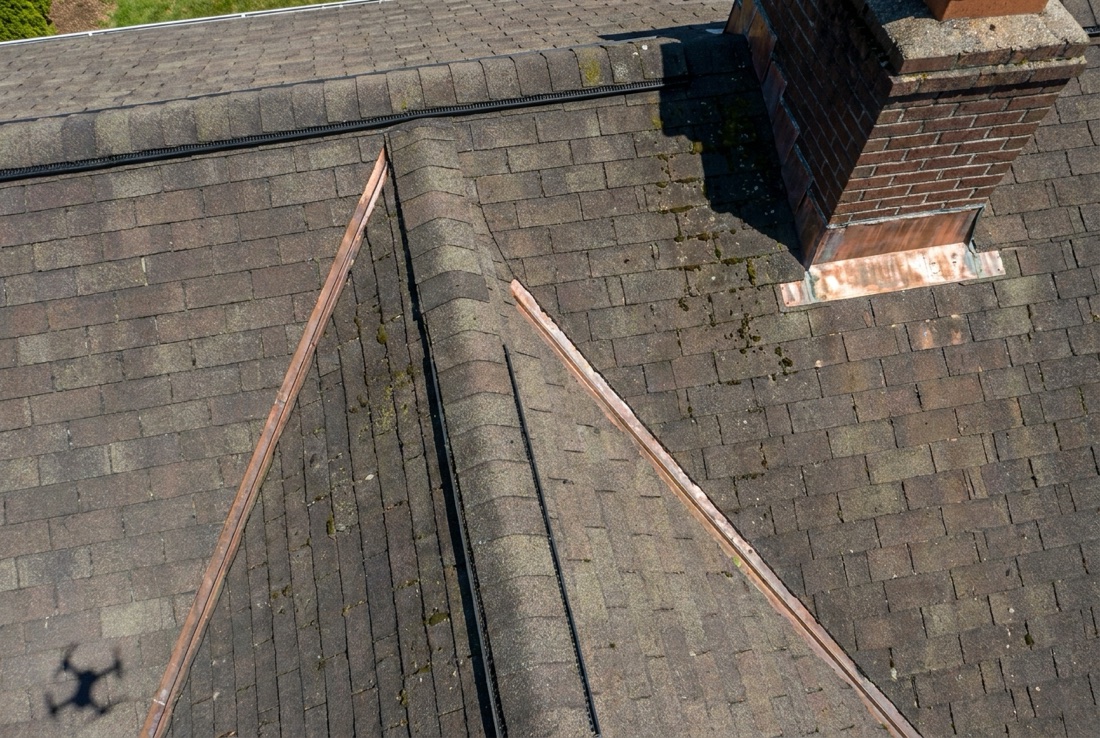
None of this means every attic in Macomb County is condensing every night. A well-sealed ceiling plane keeps humid air from reaching the attic in the first place, and balanced soffit-to-ridge ventilation flushes out whatever moisture does get through before it has time to accumulate. Dew point is the physics that makes condensation possible. Whether it actually happens in your attic, and how badly, comes down to the source, the path, and the ventilation, which is the full sequence our attic condensation guide covers end to end.
06 / THE TAKEAWAYWhat this means for your roof, and what it does not
Understanding dew point does not tell you whether your specific attic has a problem. What it does is reframe how you look for one. Frost on nail tips, damp insulation spread broadly under the deck, and staining that shows up near the ridge or on the colder north slope are not signs of a leaking roof. They are signs that warm, humid air crossed its dew point against your sheathing, exactly as the physics predicts it will wherever the conditions line up. A narrow stain tracing back to one flashing detail or shingle failure is a different problem entirely, and the two are worth telling apart before anyone reaches for a repair estimate.
Left unaddressed across a full Michigan winter, repeated dew point crossings on the same sheathing can soften and stain wood decking over several seasons, mat the insulation directly beneath it, and set up the conditions for the mold growth our attic mold guide covers separately. If that damage has already reached the decking, the repair falls in the standard $350 to $3,200 range that covers most Macomb County roof repairs, and larger or more involved repairs can run higher. If a reroof is already due on its own timeline, correcting the underlying ventilation and sealing issue at the same time is the most cost-efficient point to do it, since the deck is already exposed, and it folds into the standard $9,000 to $18,000 asphalt replacement range most Macomb County homes fall within, typically $12,000 to $16,000.
The reassuring part is that dew point itself is not something you fight directly. You do not need to change the weather or refrigerate your attic. You address the two things that are actually within your control: how much moisture the house is sending upward, and how easily that air can reach the cold sheathing in the first place. Reduce either one and the frequency and severity of dew point crossings against your roof deck drop with it, which is the whole logic behind our air sealing versus insulation guide.
If you want to see where your own attic stands rather than reason it out from a chart, a professional inspection reads the sheathing, the insulation, and the ventilation path together and tells you honestly whether what you are seeing is ordinary winter physics or something that needs correcting. Ours is $0 with no obligation. If roofing work turns out to be part of the answer, the instant estimator runs the published price canon from our honest pricing page in about a minute, and the cost calculator applies those ranges to your own roof size.
You cannot see dew point. You can only see what happens after air crosses it: frost on a nail, a bead of water on a glass, a stain on a ceiling that showed up with no rain in the forecast.
- Dew point is the temperature at which air holding a given amount of moisture becomes saturated and starts releasing that moisture as liquid water or frost.
- Warm air holds more water vapor than cold air, so ordinary house air at 68 degrees carries real moisture that a cold attic has far less capacity to hold.
- A Michigan roof deck in the teens sits well below the dew point of typical 68 degree indoor air, which is the entire mechanism behind attic condensation, no leak required.
- The north slope and the ridge condense hardest because they run coldest for the most hours, exactly where the physics predicts dew point crossings will happen most.
- The fix targets the moisture source and the air path into the attic, not the cold surface itself, since the sheathing cannot be prevented from being the coldest thing up there.
Questions we hear most
Dew point is the temperature at which air holding a certain amount of water vapor becomes fully saturated and starts releasing that extra moisture as liquid water, or as frost when the surface is below freezing. It rises when the air is more humid and falls when the air is drier, and it explains everything from a foggy mirror to condensation on a cold roof deck.
Warm indoor air can hold more water vapor than cold air can. When that humid air rides up into a winter attic and reaches the cold roof sheathing, it cools past its dew point and gives up its extra moisture as liquid water or frost on the wood, the same way humid air condenses on a cold glass. No leak in the roofing is required for this to happen.
Not by itself, but it explains where to look. Dew point tells you condensation happens when humid air meets a cold enough surface; fixing it means reducing the moisture reaching the attic and sealing the air path that carries it there, which is covered in our attic condensation and air sealing guides. A free inspection checks all three factors together and tells you honestly what your attic needs.
- National Weather Service, dew point and humidity explainer. weather.gov/arx/why_dewpoint_vs_humidity
- U.S. Department of Energy, Energy Saver program, guidance on attic air sealing and moisture. energy.gov/energysaver/air-sealing-your-home
- U.S. Environmental Protection Agency, moisture control guidance for building design, construction, and maintenance. epa.gov/indoor-air-quality-iaq/moisture-control-guidance
- ASHRAE, ventilation and building-envelope standards referenced by residential attic design guidance. ashrae.org